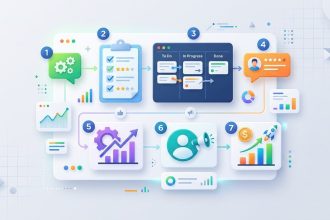
Building and scaling a SaaS product as an indie developer or small startup founder can be a rewarding challenge. The right open-source tools can accelerate development, reduce costs, and help you maintain control over your product. Instead of relying solely on costly SaaS subscriptions, leveraging open-source solutions empowers you to customize, optimize, and grow your SaaS with confidence. Here’s a curated list of the top open-source tools every indie SaaS creator should consider integrating into their workflow.
Using open-source tools allows indie SaaS developers to build scalable, cost-effective products with full control. Focus on essential solutions for hosting, authentication, analytics, and deployment to maximize efficiency and growth potential.
Why open-source tools matter for indie SaaS development
Indie SaaS developers often face constraints like limited budgets, small teams, and the need for rapid iteration. Open-source tools address these challenges by offering free, customizable, and community-supported solutions. They enable you to implement robust features without the overhead of ongoing subscription fees.
Furthermore, open-source solutions foster a deeper understanding of your tech stack, allowing for easier troubleshooting and tailored improvements. They also tend to have active communities, which means you can access shared resources, tutorials, and support.
Essential categories of open-source tools for indie SaaS builders
To run a successful SaaS, you need a suite of reliable tools covering core functions like hosting, user management, analytics, and deployment. Here are the categories to focus on, along with top picks in each.
1. Hosting and backend infrastructure
Your SaaS needs a dependable environment to host your application. Open-source backend platforms provide this foundation.
-
NocoDB: Acts as a powerful no-code database platform that transforms your spreadsheets into APIs, making it easier to build data-driven SaaS features without heavy coding.
Find it at NocoDB. -
PostgREST: Automatically creates a RESTful API from your PostgreSQL database. It’s perfect for building scalable backends with minimal effort.
More at PostgREST. -
Coolify: An open-source platform to deploy and manage your app and services effortlessly, supporting Docker, Kubernetes, and more.
Check out Coolify.
2. User authentication and security
User management and security are critical. Open-source solutions give you control over authentication flows.
-
Appwrite: A comprehensive backend server that handles authentication, databases, storage, and more. It simplifies user sign-ups, logins, and permissions.
Visit Appwrite. -
Hanko: Focuses on user identity verification, especially for compliance-heavy SaaS, offering secure sign-up and login flows.
Details at Hanko.
3. Analytics and monitoring
Understanding user behavior and system health guides your growth and stability efforts.
-
PostHog: An open-source product analytics platform that tracks user interactions without vendor lock-in. It’s highly customizable and privacy-friendly.
More info at PostHog. -
Matomo: A privacy-focused alternative to Google Analytics, providing detailed insights about your visitors.
See Matomo.
4. Deployment and CI/CD pipelines
Automated deployment pipelines speed up releases and reduce errors.
-
ToolJet: An open-source platform for building internal dashboards and admin tools easily, with integrations for deployment workflows.
Discover at ToolJet. -
Jenkins: The classic automation server for continuous integration and delivery. It supports complex build pipelines.
Learn more at Jenkins.
5. Documentation and customer support
Clear documentation and support tools improve user satisfaction.
-
PocketBase: An open-source backend for managing data, files, and user authentication, ideal for lightweight SaaS apps.
Find it at PocketBase. -
Fossa: An open-source tool for managing licenses and dependencies, helping ensure your SaaS remains compliant and secure.
Check Fossa.
Practical steps to implement open-source tools in your SaaS
- Evaluate your core needs: Identify the most critical functions like hosting, auth, or analytics.
- Research the community and documentation: Choose tools with active support and clear instructions.
- Test integrations locally: Set up a test environment to ensure compatibility.
- Automate deployment: Use CI/CD tools like Jenkins or ToolJet for smooth updates.
- Iterate based on feedback: Use analytics to understand user behavior and optimize your SaaS.
Common pitfalls and how to avoid them
| Technique | Mistake | Solution |
|---|---|---|
| Rushing deployment | Integrating too many tools at once | Start with core functions, then add features gradually |
| Ignoring community support | Choosing obscure tools | Pick solutions with active communities and regular updates |
| Over-customizing | Building complex integrations early | Keep initial implementations simple, scale as you grow |
“Open-source tools can be a game-changer for indie SaaS developers. Focus on the essentials first, then expand as your product matures.” — Industry expert
Tips for maintaining your open-source SaaS stack
- Regularly update dependencies to patch vulnerabilities.
- Join community forums for support and best practices.
- Contribute back to open-source projects to influence their development.
- Document your customizations for easier onboarding and troubleshooting.
Final thoughts on building with open-source
Integrating open-source tools into your SaaS development process offers flexibility, cost savings, and control. Prioritize solutions that align with your product’s needs and community support. As you grow, revisit your tech stack to incorporate new options and optimize workflows. The key is to start simple, iterate often, and leverage the power of community-driven innovation.
Your next move in open-source SaaS development
Now is the time to assess your current stack and identify gaps open-source tools can fill. Implementing these solutions will not only save resources but also give you the agility to adapt quickly. Keep learning, stay connected to open-source communities, and build a SaaS product that truly reflects your vision.