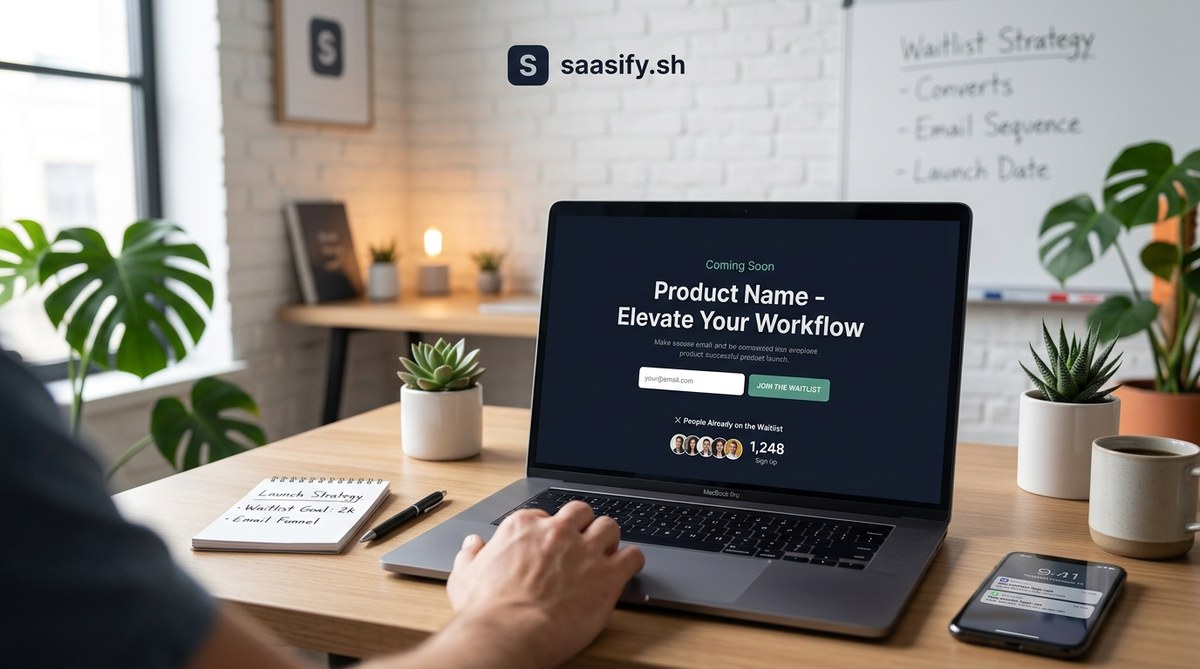
You have a killer idea for a SaaS product. You are spending nights and weekends building it. But a cold fear creeps in: what if you launch and nobody cares? That is where a smart pre-launch waitlist comes in. A well built waitlist does more than collect email addresses. It validates your idea, builds a community, and turns signups into paying customers on day one. The problem is most founders treat their waitlist as an afterthought. They slap a form on a landing page and hope for the best. That approach almost never works. You need a deliberate pre-launch waitlist strategy that treats every signup like a future customer.
A pre-launch waitlist is not a vanity metric. It is a demand validation tool and a conversion engine. To make it work, you must offer a compelling incentive, communicate consistently, segment your audience, and build anticipation through scarcity. This guide gives you the exact framework to turn waitlist subscribers into your first paying users.
Why Most Waitlists Fail Before Launch
Many founders assume that a large waitlist guarantees a successful launch. That is not true. A list of 5,000 people who signed up for a free t-shirt will not convert into paying users. The problem is the incentive. If you give away something unrelated to your product, you attract the wrong audience. You end up with a list full of freebie seekers who vanish the moment you ask for a credit card.
Another common mistake is silence. You collect emails and then go dark for months. By the time you launch, people have forgotten who you are. They might not even recognize your brand in their inbox. Your pre-launch waitlist strategy must include a consistent nurture sequence that keeps your product top of mind.
Finally, many founders fail to segment their list. They treat every subscriber the same. That is a missed opportunity. Some people on your list are tire kickers. Others are decision makers ready to buy. If you send the same message to both, you lose the chance to build deeper relationships with your most engaged prospects.
The 3 Pillars of a High Converting Waitlist
A waitlist that converts is built on three foundations: value, communication, and urgency. Let us look at each one.
Value: Give Them a Reason to Join
Nobody joins a waitlist out of charity. They join because they want something. That something could be early access, a discount, or exclusive content. The best incentives are directly related to your product.
- Early access to the beta version
- A lifetime discount for the first 100 signups
- Exclusive behind the scenes updates on development
- A free onboarding call when the product launches
Avoid generic giveaways like Amazon gift cards or free ebooks that have nothing to do with your SaaS. You want to attract people who are genuinely interested in solving the problem your product addresses. If you are building a project management tool for remote teams, offer early access to the beta. Do not offer a free guide on time management. That attracts a different audience.
Communication: Keep the Conversation Alive
Once someone joins your waitlist, you need to keep them engaged. A single welcome email is not enough. You need a sequence that educates, excites, and builds anticipation.
Here is a simple 4 email sequence that works:
- Welcome email: Thank them for joining. Restate the problem your product solves. Tell them what to expect next.
- Behind the scenes email: Share a screenshot of a feature you are building. Talk about a tough decision you made. Make them feel like insiders.
- Social proof email: Share the number of people on the waitlist. Mention any testimonials from beta testers. Use the bandwagon effect to build credibility.
- Launch announcement email: Tell them the product is live. Give them their exclusive link. Remind them of their incentive.
This sequence keeps your product in their mind without being pushy. Each email should feel like a natural update from a friend, not a sales pitch.
Urgency: Create Scarcity That Feels Real
A waitlist without urgency is just a newsletter. You need to create a reason for people to act now. The best way to do that is through scarcity.
- Limit the number of early access spots
- Offer a discount that expires after launch
- Give waitlist members a unique benefit that non-members do not get
If you offer a 50% lifetime discount to the first 100 signups, make sure people know that the clock is ticking. Display a counter on your landing page showing how many spots remain. This creates FOMO and encourages people to join immediately rather than bookmarking your page and forgetting about it.
“The difference between a waitlist that converts and one that flops is the perceived value of being on it. If joining feels like a transaction, people will treat it like one. If it feels like an exclusive club, they will show up on launch day.” – Sarah Kay, founder of a $2M ARR SaaS
A Step-by-Step Process to Build Your Waitlist
Now let us put the pillars into action. Follow these steps to build a waitlist that actually works.
-
Define your ideal subscriber. Who do you want on your list? Be specific. If your SaaS helps freelance designers manage invoices, your ideal subscriber is a freelance designer who struggles with billing. Target that person in your messaging.
-
Create a landing page that converts. Your landing page needs a clear headline, a subheadline that explains the benefit, and a single call to action. Use a simple form that asks for an email address and nothing else. Every extra field reduces conversion rates. If you want to segment later, send a follow up email asking for more info.
-
Offer a compelling incentive. Pick one of the incentives from the value section above. Make sure it aligns with your product. Promote the incentive prominently on your landing page.
-
Drive targeted traffic. Share your landing page on relevant forums, social media groups, and in your personal network. Write a guest post for a blog your audience reads. If you have a following on Twitter or LinkedIn, post about your waitlist there. The goal is to get the right people, not just any people.
-
Set up your email sequence. Use a tool like ConvertKit, Mailchimp, or Buttondown to automate your nurture sequence. Write the emails in advance so you do not have to think about it later. Schedule them to go out over the weeks leading up to your launch.
-
Segment your list as you go. Not all subscribers are equal. Create segments based on engagement. People who open every email and click links are your power users. People who never open are cold leads. Treat them differently. Send your power users exclusive updates and ask for their feedback. Send your cold leads a re-engagement email before launch.
-
Build anticipation with a launch date. Pick a specific launch date and share it with your list. A countdown timer on your landing page adds urgency. People are more likely to act when they know exactly when the doors open.
Common Waitlist Mistakes and How to Fix Them
Even with a solid plan, it is easy to make mistakes. Here is a table of the most common errors and their solutions.
| Mistake | Why It Hurts | The Fix |
|---|---|---|
| Asking for too much info upfront | Low conversion rates | Only ask for an email. Collect more later. |
| No incentive to join | People see no reason to sign up | Offer early access, a discount, or exclusive content. |
| Going silent after the welcome email | People forget about your product | Send a weekly or bi-weekly update email. |
| Treating all subscribers the same | Missed opportunities to engage power users | Segment by email opens and clicks. |
| Launching without warning your list | Low launch day traffic | Send a “launching next week” email. |
| Making the incentive too complicated | Confusion and low signups | Keep the offer simple and clear. |
Tools to Manage Your Pre-Launch Waitlist
You do not need a complex tech stack to run a successful waitlist. Here are some tools that work well for indie founders.
For landing pages: Carrd, Unicorn Platform, or a simple page on your own domain. You do not need a full website. A single page with a form is enough.
For email marketing: ConvertKit is a favorite among SaaS founders because of its automation features. Mailchimp is a solid free option for smaller lists. Buttondown is a minimal, developer friendly choice.
For analytics: Use a tool like Plausible or Fathom to track how many people visit your landing page and how many sign up. This tells you if your traffic sources are working.
For community building: Consider creating a private Discord or Slack group for your waitlist members. This builds a deeper connection and gives you a direct line to your most engaged users.
Measuring Success: What to Track
A pre-launch waitlist strategy is only as good as the data it produces. Track these metrics to know if you are on the right path.
- Conversion rate: The percentage of landing page visitors who join your waitlist. A good rate is between 10% and 30%. If you are below 10%, test your headline, incentive, or form.
- Email open rate: Aim for 40% or higher on your nurture emails. If your open rate is low, your subject lines need work or you are not sending to the right audience.
- Click through rate: This measures how many people click links in your emails. A rate above 5% is solid for a pre-launch list.
- Launch day conversion: The percentage of waitlist members who become paying customers on launch day. A good target is 10% to 20%. If you hit that, your waitlist is doing its job.
If your launch day conversion is below 5%, something in your strategy is broken. Either your incentive attracted the wrong people, or your nurture sequence failed to build enough desire.
Putting It All Together: Your 30 Day Pre-Launch Timeline
Here is a timeline you can adapt for your own launch. It assumes you have a working prototype or MVP ready to show.
Week 1: Build your landing page and set up your email tool. Define your ideal subscriber and your incentive. Share the page with 10 close friends for feedback.
Week 2: Start driving traffic. Post in relevant online communities. Write a guest post. Share on social media. Aim for 100 signups by the end of the week.
Week 3: Send your nurture sequence. Share a behind the scenes update. Ask for feedback on a specific feature. Start segmenting based on engagement.
Week 4: Announce your launch date. Send a final email with a countdown. Prepare your launch day email and any onboarding materials.
On launch day, send your list to your product with a clear call to action. Remind them of their incentive. Then track your conversion rate and celebrate your first customers.
Your Next Step
Building a pre-launch waitlist that converts is not about tricks or hacks. It is about treating your future customers with respect. Give them a reason to join. Keep them informed. Make them feel special. When you do that, they will be ready to buy the moment you open the doors.
Before you write another line of code, spend a weekend setting up your waitlist. It is the cheapest market research you will ever do. If you cannot get 100 people to join, that tells you something about your idea. If you can, you have just validated your market and built your first batch of customers. That is a win either way.
For more on getting your first users, check out our guide on how to get your first 10 customers without spending a dollar on ads. And if you want to make sure your landing page is not the weak link, read why your SaaS landing page isn’t converting and how to fix it.
Go build that waitlist. Your future customers are waiting.