You have a dozen ideas floating around. Some of them feel exciting. Others seem boring. But the truth is, most SaaS products fail not because the code was bad, but because the problem wasn’t worth solving. The difference between a side project that collects dust and a business that collects revenue comes down to one thing: the type of problem you choose to fix. Not all problems are created equal. Some lead to high churn and low willingness to pay. Others create loyal customers who happily upgrade their plans. If you want to build something that actually makes money, you need to understand which types of SaaS problems are worth your time.
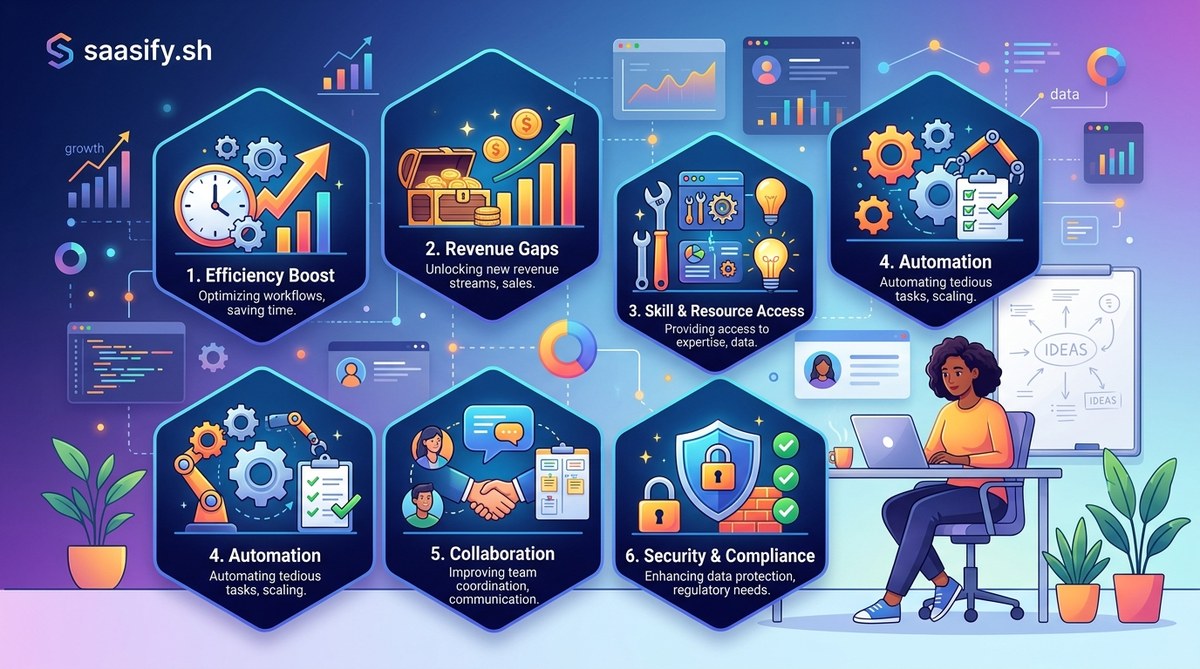
Profitable SaaS products solve problems that are painful, frequent, and expensive for the customer. The six types that work are: compliance and regulation headaches, data migration and integration messes, manual workflow automation, reporting and analytics gaps, communication and collaboration breakdowns, and customer retention and support overload. Focus on problems people already pay humans to solve.
The Problem-First Mindset
Before we get into the list, let’s talk about mindset. Most founders start with a solution. They think about a cool feature or a shiny tech stack. That is backwards. The most successful indie SaaS builders start with a problem. They ask questions like: What do people complain about on Reddit? What tasks do employees dread? What processes still rely on spreadsheets and email chains?
This is not just theory. When you build a solution to a problem that people already spend money on, you skip the hard part of convincing them they need your product. They already know they need it. They just need your version to be better.
If you want a structured way to discover these opportunities, check out the problem-first framework for discovering SaaS ideas. It walks you through the exact questions to ask.
The 6 Types of SaaS Problems That Generate Revenue
1. Compliance and Regulation Headaches
Every industry has rules. Healthcare has HIPAA. Finance has SOX and PCI DSS. Even small businesses have to deal with tax laws and data privacy regulations like GDPR and CCPA. These rules change often. They are complex. And getting them wrong can cost a company thousands in fines.
This is a goldmine for SaaS founders. Companies will pay a lot to avoid legal trouble. They need tools that help them stay compliant without hiring a full legal team. Think about software that automates audit trails, manages consent forms, or generates compliance reports.
The beauty of this problem type is that it is non-negotiable. Companies cannot decide to ignore compliance. They have to solve it. Your software becomes a line item in their budget, not a nice-to-have.
2. Data Migration and Integration Messes
Data lives everywhere. In spreadsheets. In legacy systems. In different SaaS tools that do not talk to each other. Moving data from one place to another is painful. It is error-prone. And it usually involves a lot of manual copying and pasting.
Tools that solve this problem are sticky. Once a customer imports all their data into your system, they are unlikely to leave. The switching cost is high. That is good for your retention numbers.
Consider building a tool that syncs data between two popular platforms that lack a native integration. Or a service that helps users migrate from an old tool to a new one without losing anything. If you are thinking about architecture, you might want to read about building multi-tenancy into your SaaS to handle multiple clients safely.
3. Manual Workflow Automation
This is the classic “boring SaaS” opportunity. Every business has repetitive tasks that eat up hours each week. Sending invoices. Following up on leads. Approving time-off requests. Generating reports. These tasks are not hard. They are just tedious.
People will pay to get their time back. A tool that automates a specific workflow can charge a monthly fee that is much lower than the cost of an employee’s salary. That is an easy value proposition.
The key is to pick one workflow and do it well. Do not try to build a general automation platform. Instead, build a tool specifically for real estate agents to automate their listing updates. Or a tool for freelancers to automate their recurring invoices. Niche automation wins every time.
4. Reporting and Analytics Gaps
Data is everywhere, but insights are rare. Most businesses collect tons of data but struggle to make sense of it. They have spreadsheets full of numbers but no dashboard that tells them what matters.
Tools that visualize data, generate reports, and surface trends are valuable. The trick is to focus on a specific industry or use case. A generic analytics tool is hard to sell. But a tool that gives ecommerce stores a daily snapshot of their most profitable products? That is an easier sell.
When you build this type of product, you become the source of truth for your customers. They check your dashboard every morning. That kind of daily habit leads to low churn and high lifetime value.
5. Communication and Collaboration Breakdowns
Teams waste a lot of time on communication. Too many emails. Too many Slack channels. Too many meetings that could have been a document. Tools that make communication clearer, faster, or more organized have a huge market.
But here is the nuance. You do not want to compete with Slack or Microsoft Teams. Instead, look for specific communication gaps. For example, a tool that helps remote teams give async feedback. Or a tool that helps customer support teams collaborate on tickets without losing context.
These problems are painful because they affect productivity directly. If a team saves two hours per week using your tool, that is a measurable return on investment.
6. Customer Retention and Support Overload
Keeping customers happy is hard. Support teams get overwhelmed. Tickets pile up. Customers get frustrated and leave. Tools that help businesses retain customers or reduce support load are always in demand.
Think about a tool that automates common support responses. Or a tool that tracks customer health scores and flags at-risk accounts before they churn. Or a tool that helps businesses collect and act on feedback.
This type of problem is especially good for SaaS because it aligns with your customer’s business goals. They want to keep their own customers. Your tool helps them do that. It is a win-win.
How to Evaluate a Problem for Profitability
Not every problem in these six categories is worth building. You need to evaluate each one. Here is a simple framework.
| Criteria | What to Look For | Red Flag |
|---|---|---|
| Pain level | People actively complain about it | People shrug and say “it’s fine” |
| Frequency | Happens daily or weekly | Happens once a year |
| Budget | Companies already spend money on it | No existing budget or tool |
| Decision maker | One person can buy it | Needs approval from multiple departments |
| Urgency | Delaying it causes real cost | Can be postponed indefinitely |
Use this table to screen your ideas. If an idea fails three or more criteria, move on. There are plenty of other problems to solve.
A Step-by-Step Process to Find Your Problem
Here is a practical process you can follow this week.
- Pick two industries you know well or are willing to learn. Could be construction, dentistry, real estate, or accounting.
- Spend one hour on Reddit in the subreddits for those industries. Look for posts complaining about software or processes.
- List every recurring complaint you find. Do not judge them yet. Just write them down.
- Rank them by pain level. Which complaints have the most upvotes or the most frustrated comments?
- Search for existing solutions. If there are five established tools, the problem might be saturated. If there are zero, the problem might be too niche. Aim for one to three competitors.
- Talk to three people who have this problem. Ask them what they currently do and how much they spend on it.
If you want more detail on this method, read about finding SaaS ideas in Reddit comments. It is a 30-minute daily habit that can uncover gold.
Expert advice: “The best SaaS problems are the ones that make people say ‘I hate this’ before you even finish your sentence. If they get animated and start telling you stories, you are onto something. If they just nod, keep looking.” – Indie founder with $15K MRR
Common Mistakes Founders Make
Many founders fall into traps when choosing a problem. Here are the most common ones.
- Building for yourself without checking if others have the same problem.
- Solving a problem that people complain about but refuse to pay for.
- Trying to solve too many problems at once with one product.
- Ignoring the existing solutions and assuming you can do it better without a clear advantage.
- Falling in love with the solution before validating the problem.
If you want to avoid the biggest trap of all, read about the scratching your own itch trap. It is subtle and dangerous.
What Makes a Problem Worth Solving
Let’s summarize the qualities of a profitable SaaS problem.
- It is painful. People actively seek solutions.
- It is recurring. People face it weekly or daily.
- It has a budget. Companies already spend money on it, even if it is on human labor.
- It has a clear decision maker. One person can say yes and pay.
- It is specific. A narrow problem is easier to solve well than a broad one.
If your problem checks these boxes, you have a strong foundation. From there, it is about execution. You need to build a product that works, market it to the right people, and price it fairly.
The Right Problem Leads to the Right Product
Choosing the right type of SaaS problem is the most important decision you will make as a founder. It determines your audience, your pricing, your marketing, and your long-term viability. Do not rush this step. Spend time in the problem space before you write a single line of code.
The six types we covered are proven. Compliance, data migration, workflow automation, reporting, communication, and customer retention. Pick one that resonates with your skills and interests. Then go talk to people. Validate. Build. Launch.
If you are ready to start building your solution, check out this guide on how to build a SaaS MVP in 30 days without burning out. It will help you move from idea to working product without losing your mind.
Your Next Step Is a Conversation
You now know the six types of problems that make money. You have a framework to evaluate them. You have a process to find them. The only thing left is action.
Pick one industry. Find one problem. Talk to one person. That single conversation will tell you more than a month of research. Go have it.
When you come back, you will have real data. And real data is the only thing that turns a guess into a business.