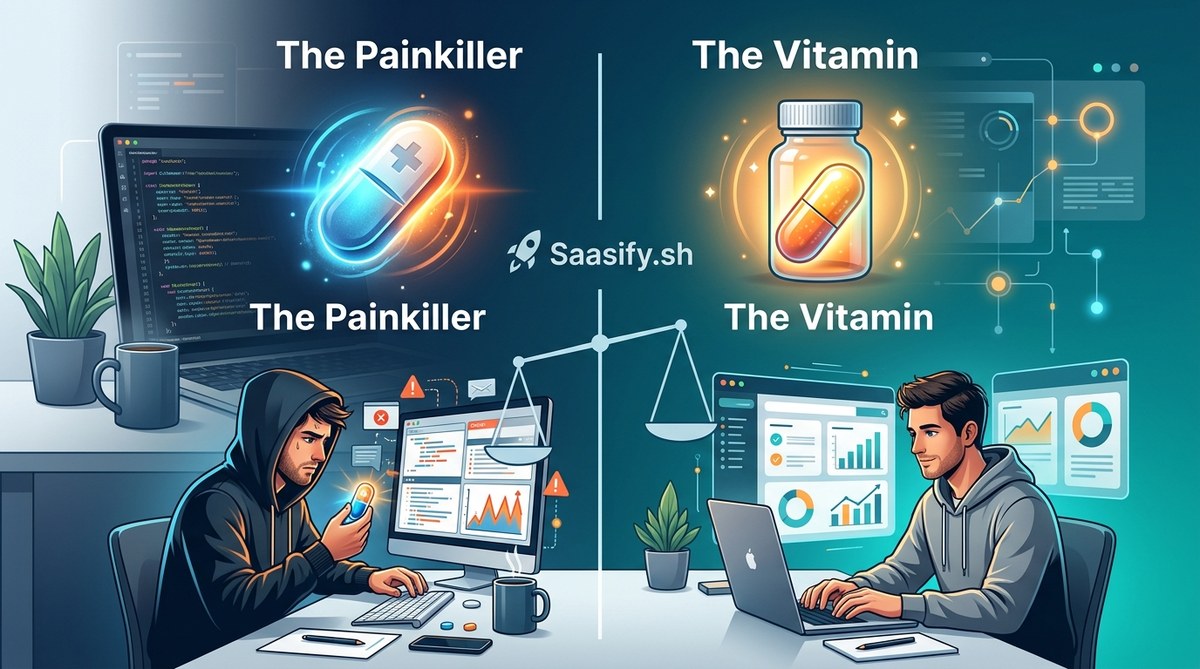
Every founder I talk to has that one idea they are absolutely in love with. It feels right. It solves a problem. But does it solve a problem that keeps people up at night, or does it solve a problem people are happy to ignore until next Tuesday? This is the core of the painkiller vs vitamin startup question. Understanding the difference can save you months of wasted development and thousands of dollars.
The painkiller vs vitamin startup test is a simple but powerful way to gauge product urgency. Painkillers solve critical, time-sensitive problems that customers will pay for immediately. Vitamins address nice-to-have improvements that people often skip. To build a sustainable SaaS business, you need to know which one you are building before you write your first line of code.
What the Painkiller vs Vitamin Analogy Actually Means
The analogy is older than most SaaS companies, but it still works. A painkiller is something you take when you are suffering. You do not question the cost. You do not wait for a sale. You need relief now. A vitamin is something you take to stay healthy. It is good for you. You know you should take it. But if you skip it today, nothing terrible happens.
In the SaaS world, a painkiller is a product that solves a painful, urgent problem. Think of a tool that helps a business avoid a compliance fine or recover lost customer data. A vitamin is a product that makes things better but is not essential. Think of a dashboard that shows pretty charts about your social media growth.
The line between the two is not always clear. Some products start as vitamins and become painkillers over time. But when you are validating a new idea, you need to be honest about where your product sits on that spectrum.
Why the Distinction Matters More Than You Think
I have seen founders spend eighteen months building a product that solves a problem nobody was willing to pay for. They built a vitamin. The feedback during development was positive. People said it was a great idea. But when it came time to open their wallets, nobody moved.
This happens because polite feedback is cheap. People will tell you your idea is interesting because they want to be nice. The painkiller vs vitamin startup framework forces you to look for signals that are harder to fake. It pushes you to find out if your product is a must-have or a nice-to-have.
A painkiller has a few key characteristics:
- Customers describe their problem using words like "desperate," "urgent," or "nightmare."
- They are already using duct-tape solutions like spreadsheets, email chains, or manual workarounds.
- They have tried to solve the problem before and failed.
- They ask when your product will be ready, not if it will work.
A vitamin has different signals:
- Customers say they "might use it someday."
- The problem is a low priority on their to-do list.
- They are happy with their current workflow, even if it is imperfect.
- They ask for a free trial but never activate it.
How to Test Your Idea Using the Painkiller vs Vitamin Framework
You can run a simple test on your own idea right now. Do not build anything yet. Just follow these steps.
-
Write down the exact problem your product solves in one sentence. Be specific. "Helps small businesses send invoices" is too vague. "Helps freelance photographers send branded invoices in under 30 seconds" is better.
-
Find ten people who have this problem. Do not find people who might have it. Find people who have it right now. Look in niche communities, Reddit threads, or industry Slack groups.
-
Ask them how they solve it today. Listen for workarounds. If they say they use a combination of three different tools or a manual process that takes hours, you have a potential painkiller.
-
Ask them what happens if they do not solve it. If the answer is "nothing much," you have a vitamin. If the answer is "I lose money" or "I get in trouble," you have a painkiller.
-
Ask them to pay upfront. This is the hardest step. Offer a pre-order discount or a founding member price. If they hesitate or say they need to think about it, that is a red flag.
Common Mistakes Founders Make With This Framework
Even experienced founders fall into traps when applying the painkiller vs vitamin startup test. Here is a table that shows the most common mistakes and how to avoid them.
| Mistake | Why It Is Dangerous | What to Do Instead |
|---|---|---|
| Confusing frequency with urgency | Just because someone does something every day does not mean it hurts. Checking email is daily but not painful. | Ask about the emotional cost of the task, not just the time cost. |
| Listening to friends and family | They want to support you. They will tell you your vitamin is a painkiller. | Talk to strangers who have the problem. They have no reason to be polite. |
| Building for a future problem | "In five years, everyone will need this." Maybe. But you need customers now. | Focus on problems that hurt today. The future will take care of itself. |
| Ignoring the competition | If nobody is solving this problem, it might be because nobody wants it solved. | Look for existing solutions, even bad ones. They prove the problem is real. |
"The best ideas are the ones that make you say 'I wish I had thought of that' because they are so obvious in hindsight. They solve a problem that people have been complaining about for years, but nobody bothered to fix." - A solo founder who bootstrapped to $30K MRR
When a Vitamin Strategy Can Still Work
I do not want to give you the impression that vitamins are always bad. Some successful SaaS companies started as vitamins and evolved into painkillers. The difference is that they knew what they were building from the start.
A vitamin can work if:
- You have a low-cost way to acquire users. If your customer acquisition cost is almost zero, you can afford to build a product that people use casually.
- You have a path to becoming a painkiller. Maybe your vitamin starts as a free analytics tool, but over time it becomes essential because it stores years of historical data.
- You are building for a market with high switching costs. Once a vitamin is embedded in a workflow, removing it becomes painful.
But if you are a solo founder with limited runway, building a vitamin is a risky bet. You need to be honest about your situation. If you are bootstrapping and need revenue in the first three months, a painkiller is almost always the better choice.
A Practical Checklist to Classify Your Own Idea
Before you commit to building, run your idea through this checklist. If you answer yes to most of these questions, you are building a painkiller.
- Do people actively search for a solution to this problem?
- Do they use desperate language when describing it?
- Are they willing to pay before the product is finished?
- Do they have a manual workaround that they hate?
- Would they be in serious trouble if the problem went unsolved for a week?
If you answered yes to fewer than three of these, you may be building a vitamin. That is not a death sentence. But it means your go-to-market strategy needs to be different. You cannot rely on urgency to drive sales. You need to educate, nurture, and build trust over time.
Why Your SaaS Idea Needs the Painkiller Test
The painkiller vs vitamin startup framework is not just a theoretical exercise. It is a practical tool that helps you decide where to spend your time and energy. Every hour you spend building a vitamin that nobody wants is an hour you could have spent building a painkiller that people are begging for.
If you want to learn more about the early stages of validation, check out our guide on how to validate your SaaS idea before writing a single line of code. It walks through the exact process I use to test ideas before committing to a build.
For those who are further along and wondering about the technical side, our article on should you build your SaaS with a monolith or microservices can help you make smart architectural decisions once you have validated the demand.
The Real Test Is What People Do, Not What They Say
Words are cheap. Actions are expensive. The painkiller vs vitamin startup test is ultimately about watching what people do. Do they reach for their wallet? Do they rearrange their schedule to use your product? Do they tell their colleagues about it without being asked?
If the answer to those questions is yes, you have a painkiller. If the answer is a shrug and a "maybe later," you have a vitamin. The choice is yours. But now you know the difference.
Go talk to ten strangers this week. Ask them about their biggest frustration. Listen for the pain. And when you find it, build the thing that makes it go away. That is how you build a SaaS that matters.