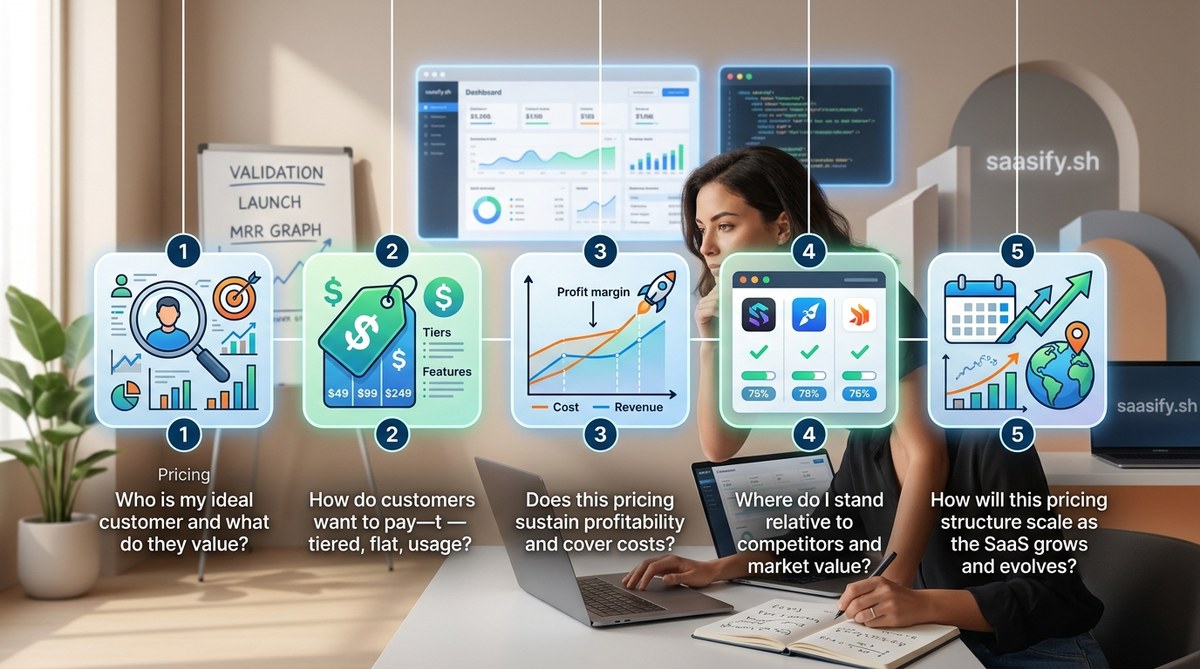
You are building something real. Nights spent coding, days spent obsessing over features, coffee cups stacked like trophies. But somewhere in the back of your mind, a small voice whispers: “What should I charge?” It is the question that keeps indie founders up at night, and for good reason. Pricing is not just a number on a page. It is the signal that tells the market who you are, what you are worth, and whether you understand the problem you are solving. The wrong number can bury a great product. The right number can turn a side project into a sustainable business. That is why we are going to walk through the five pricing questions every indie SaaS founder should ask before launch. No theory. No fluff. Just the questions that will save you from the most common pricing mistakes.
Most indie founders set prices by copying competitors or guessing. That is a dangerous game. The five questions in this guide help you anchor pricing to real value, avoid leaving money on the table, and build a foundation that scales. By the end, you will know exactly how to think about your first price point and what to test first.
Question 1: What is the one thing my product does better than anything else?
You cannot price what you cannot describe. If a prospect cannot summarize your value in one sentence, your price tag will confuse them. Every SaaS has many features. But pricing should hang on a single, undeniable benefit. Ask yourself: what is the one action my tool makes dramatically easier, faster, or cheaper?
For example, a project management tool might have twenty features, but the core value could be “eliminates status update meetings.” That is specific. That is measurable. That justifies a monthly subscription. When you identify that core benefit, you can build your pricing around it.
Write down the answer. Then test it on a friend. If they nod, you have your anchor. If they squint, go back to the whiteboard. Your price will never feel right if the value is fuzzy.
Question 2: Who would pay $X per month for this, and why?
You cannot serve everyone. Trying to build a pricing plan that appeals to freelancers, agencies, and enterprise clients on day one is a mistake. It dilutes your message and makes your pricing page look like a buffet with no main dish.
Instead, pick one customer persona. Ask yourself:
- What is their job title?
- What is their annual budget for software?
- What does a bad month look like without your tool?
- What would a happy month look like with it?
When you imagine a specific person, you can estimate willingness to pay. A solo consultant might balk at $49/month but happily pay $29. A small agency with five employees might not blink at $99. The key is to pick your beachhead and set a price that feels like a no brainer to that one person.
If you are unsure, read about how to validate your SaaS idea before writing a single line of code. That process applies here too. You want proof that a specific group will pay your number before you lock it in.
Question 3: What happens when I compare my pricing to the alternatives?
Comparison is inevitable. Your prospects will open three tabs: yours, competitor A, and competitor B. They will scan your pricing page for five seconds and make a snap judgment. You need to control that comparison.
Start by listing the obvious competitors. But do not stop there. Include the “do nothing” option. Many indie tools charge against a spreadsheet or a manual process. If your target customer currently manages invoices by hand, your price competes with the value of their time, not another SaaS.
Build a simple table to map out the landscape. Here is a framework:
| Your Product | Competitor A | Competitor B |
|---|---|---|
| $19/month | $49/month | $9/month |
| Unlimited projects | 10 projects | 50 projects |
| No onboarding fee | $100 setup | Free setup |
| Email support only | Chat + phone | Ticket only |
Your goal is not to be the cheapest. Your goal is to be the best value for your chosen persona. If you offer something unique that the $9 option lacks, you can charge more. If you are a direct clone, you will compete on price and that is a race to the bottom.
To understand how to build that differentiation, check out the psychology behind pricing tiers that actually convert. It will help you structure your offerings so the comparison works in your favor.
Question 4: Am I pricing based on cost or value?
This is the one that trips up most first time founders. You calculate your hosting bill, add your labor, divide by the number of customers you hope to have, and arrive at a number that feels safe. That is cost plus pricing. It is logical. It is also dangerous because it ignores what the customer actually gains.
Value based pricing flips the equation. Instead of asking “What do I need to make?”, you ask “What is this solution worth to my customer?” If your tool saves a small business owner 10 hours per week, and their hourly rate is $50, then your tool creates $500 per week in value. Charging $50 per month is a steal. Charging $200 still sounds reasonable.
Think about it this way:
- Your price should be a fraction of the value delivered.
- It should be high enough that you can invest in improvements.
- It should be low enough that the customer feels smart for buying.
A good exercise is to pick three scenarios: best case, worst case, and likely case. For each, estimate the dollar value your product provides. Then set your price at 10 to 20 percent of that value. That is usually a sweet spot.
If you need a concrete starting point, read how to price your SaaS product when you have zero customers. That guide walks through the math and the psychology.
Question 5: How will I test and adjust my pricing after launch?
Pricing is not a one time decision. It is a hypothesis. The smartest indie founders treat it as an experiment. They set an initial number, watch the data, and iterate. The moment you lock in a price without a plan to revisit it, you lose the chance to optimize.
Here is a simple three step process to keep your pricing healthy:
-
Pick a trial period. Run your initial pricing for 60 to 90 days. Do not change it during that window unless something is clearly broken. Give the market time to react.
-
Watch two metrics. Conversion rate and churn rate. If conversion is high and churn is low, your price might be too low. If conversion is low, your price might be too high, or your value proposition is unclear. If churn is high, the perceived value is not matching the cost.
-
Run one small test. Change one variable at a time. Maybe raise your price by 20 percent and see what happens to a new cohort of signups. Maybe add a lower tier. Do not change everything at once; you will not know what caused the effect.
“The biggest mistake I see indie founders make is setting a price and never touching it again. Your first price is a guess. Treat it like one. Test, learn, and adjust.” – Anonymous indie founder with 4 successful SaaS launches
If you want to see real examples of how others have done this, read about 7 pricing experiments you can run this week with under 1,000 users. That article will give you concrete ideas that do not require a huge audience.
Mapping the common mistakes and how to avoid them
Let us summarize the most common traps indie founders fall into when setting pricing for the first time. Use this table as a checklist before you launch.
| Common Mistake | Why It Hurts | How to Fix It |
|---|---|---|
| Pricing too low to attract early users | Undervalues your product; makes it hard to raise later | Anchor to value, not cost. Use the 10-20% rule. |
| Offering too many tiers | Paralyzes decision making; increases support overhead | Start with two or three clear tiers. |
| Ignoring competitor positioning | Leads to price wars or missed opportunities | Build a comparison table. Know your unique angle. |
| Not including a free trial or freemium model | Reduces trust; no way for users to see value first | Offer a time limited trial. Keep the core features accessible. |
| Setting price and forgetting it | Missed revenue; product evolves but pricing stays static | Schedule a quarterly pricing review. |
Your pricing toolkit: what to have ready before you launch
Before you hit the public launch button, make sure these pieces are in place. They will save you from scrambling later.
- A clear value statement (one sentence).
- A single target persona you can name.
- A competitor comparison map (even a simple one).
- A dollar figure based on value, not just costs.
- A plan to test and revise within three months.
If you are still building the product, you might want to check out our guide on how to build a SaaS MVP in 30 days without burning out. It pairs well with this pricing work because you can set the foundation while you code.
Let pricing become your product’s best friend
You spent months building something that solves a real problem. Do not let a weak pricing strategy undermine that effort. The five questions we covered give you a framework to set a confident first price. They force you to think about value, audience, competition, and iteration. They are not magic. They are just honest questions that every indie founder should answer before launch.
Now take out a notebook, or open a fresh note in your favorite app, and write down your answers. Be specific. Be honest. The pricing number you land on will not be perfect, but it will be a hell of a lot better than a guess. And three months from now, when you look at your MRR and see steady growth, you will be glad you asked the hard questions first.