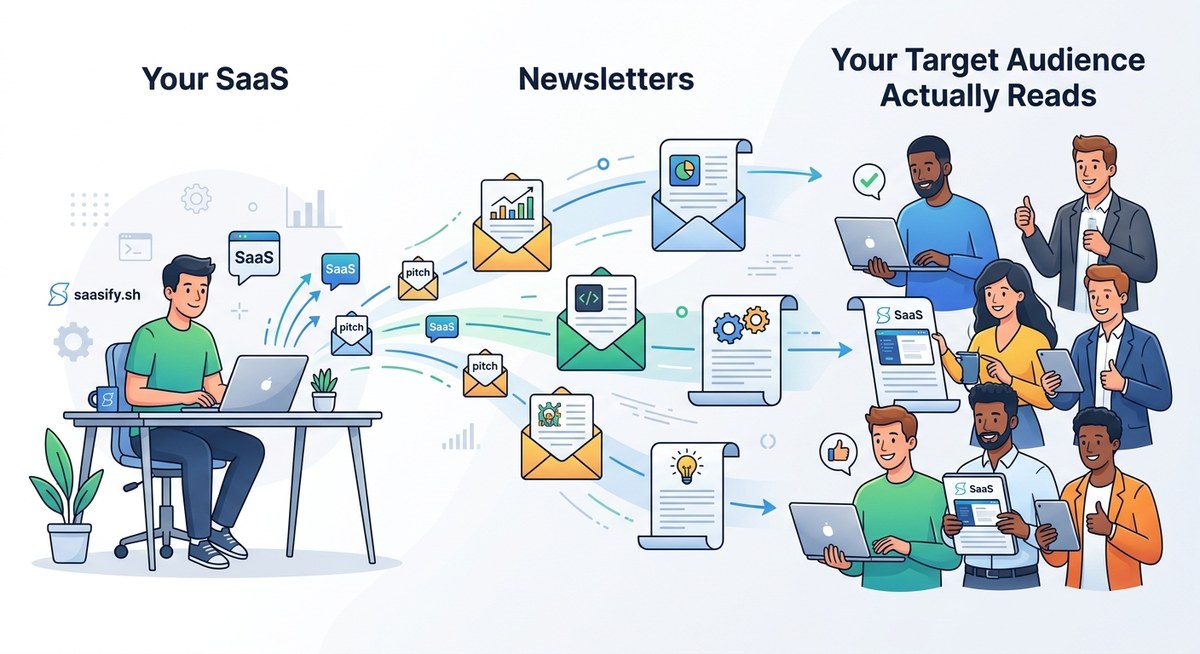
Too many SaaS tools compete for the same keywords, the same ads, the same tired channels. Meanwhile, your ideal customers are scanning their inboxes every morning, looking for curated recommendations from writers they trust. Getting your product inside those newsletters is one of the highest-leverage growth moves you can make in 2026. But you cannot just ask for a mention and expect results. You need a repeatable strategy that treats the newsletter operator like a partner, not a billboard.
Getting featured in a targeted SaaS newsletter requires a value-first approach. Stop blasting generic press releases. Instead, research the newsletters your audience actually reads. Build a short list of ten prospects. Craft a personalized pitch that helps the writer deliver value to their subscribers. Provide ready-to-use assets like a blurb, logo, and a unique discount code. Track the conversion results and nurture the relationship for repeat placements. This guide breaks down the exact, repeatable process.
Why Newsletters Are Still a Goldmine for SaaS Growth
Social media feeds are noisy. Search engine algorithms are unpredictable. But email remains a direct line to your target audience. In 2026, the newsletters with the highest open rates are the ones that curate the best resources for their niche. When a trusted curator recommends your product, that warm traffic converts at a much higher rate than cold ads do. It is the closest thing to a word-of-mouth referral at scale.
Think about your own habits. When you open a newsletter from a writer you respect, you trust their judgment. If they recommend a project management tool, you are more likely to check it out than if you saw a banner ad for it. That trust transfers directly to your product. The key is to become a resource that helps that writer deliver value to their subscribers.
The 5-Step Process to Getting Featured in Newsletters
Getting your SaaS featured is not about luck. It is about following a system. Here is a step-by-step process that works for solo founders and small teams.
1. Build Your Target List
Start by making a list of 10 to 20 newsletters that serve your exact audience. Look for newsletters that feature tools, resources, or case studies. Avoid general tech newsletters unless you have a massive story to tell. Niche is better. A newsletter with 2,000 engaged subscribers will almost always outperform a broad one with 50,000.
Use search operators like site:substack.com + your niche or browse directories like Newsletter Glue. Look at your LinkedIn network. Where do your peers share their best finds? What newsletters get screenshots and highlights in your Slack groups? Those are gold.
For more ideas on where to find your first users beyond newsletters, check out our guide on 7 distribution channels solo founders use to get their first 100 users.
2. Research and Validate Your Fit
Read at least the last 10 issues before you pitch. Do they run sponsored content? Do they have a “tool of the week” section? Understanding the format helps you package your pitch correctly. If they only do interviews, offer to do a Q&A with the founder.
Check the comments section of the newsletter. Are readers engaging? Are they asking for recommendations? That is a direct signal that the audience is open to new tools. If the newsletter covers email marketing and your SaaS automates email sequences, that is a strong fit. If the newsletter covers design and your tool is about backend infrastructure, move on.
3. Create a Value-First Pitch
The biggest mistake founders make is leading with their own needs. “I want more signups.” Instead, lead with what you can give. “I want to help your readers solve [problem].” Offer an exclusive data point, a free tool, or a significant discount for their subscribers.
A/B test subject lines. “Tool for [niche]” vs “[Niche] resource you might like.” Track open rates if you can. Personalize the opening line by referencing something specific from their last issue. Show that you are a human who pays attention.
“The best pitch I ever received was a founder who said, ‘I read your last three issues. Your audience struggles with churn. Here is a template my customers use to reduce churn by 20%. Want me to write a short version for your readers?’ That founder got featured three times.” – Anonymous Curator
4. Make It a Plug-and-Play Opportunity
Time is the newsletter operator’s scarcest resource. If you make it easy for them to say yes, they almost always will. Send them a package that includes:
- A suggested 50-word intro
- A 150-word deep-dive blurb
- A high-resolution logo and screenshot
- A unique tracking link (UTM parameters)
- An exclusive offer for their readers (e.g., 30% off for 30 days)
Make the landing page specific. “Exclusive offer for [Newsletter Name] readers.” This makes the readers feel special and increases conversion rates. The less work the curator has to do, the more likely they are to feature you.
5. Track, Measure, and Nurture
Set up a separate landing page or use UTM parameters to track conversions from each newsletter. Use a tool like UTM.io to build clean tracking links. Check your analytics weekly after the feature goes live.
Follow up with a sincere thank you note after the feature runs. Share the results with the curator. “Your mention drove 100 signups!” This proves you are a good partner and makes them much more likely to feature you again. A feature is not the end goal. A partnership is.
Learn more about tracking what matters by reading how to build a revenue dashboard that actually drives growth decisions.
What Makes a Great Newsletter Pitch? (A Handy Table)
Here is a side-by-side comparison of weak pitches versus strong pitches. This table will help you audit your own outreach before hitting send.
| Feature | Weak Pitch | Strong Pitch |
|---|---|---|
| Subject Line | “Partnership / Collaboration” | “Your [Issue Topic] + A resource for your readers” |
| Personalization | “Dear Sir/Madam” | “Loved your take on [specific point] in your last issue…” |
| Value Offered | “We have a great product.” | “We analyzed [data] and found [insight relevant to niche].” |
| Request | “Can you feature us?” | “Would a 100-word blurb about [specific feature] fit your next issue?” |
| Offer | “Here is our press kit.” | “Here is a 30% discount code and a dedicated landing page for your audience.” |
| Follow Up | “Did you get my email?” | “In case you missed it, I included [benefit] for your subscribers below.” |
| Timing | Sending on Monday morning | Sending on Tuesday or Wednesday afternoon |
Common Pitfalls and How to Avoid Them
Even with a solid strategy, it is easy to make mistakes that kill your chances. Watch out for these common pitfalls.
-
Pitching the wrong person. Make sure you are contacting the actual writer, not the generic “advertise@” email unless they explicitly ask for it. A little LinkedIn stalking goes a long way.
-
Being too vague. “We help businesses grow” is weak. “We help B2B SaaS founders reduce churn by automating onboarding emails” is strong. Specificity builds credibility.
-
Ignoring the audience. If the newsletter is about no-code tools, do not pitch a developer API. It shows you did not do your homework. Stick to aligned topics.
-
No call to action. A great pitch needs a clear, low-friction next step. “Reply ‘YES’ and I will send you the blurb” or “Would this work for your Thursday edition?”
-
Forgetting to follow up. One email is rarely enough. Wait about a week. Send a short, respectful nudge. Keep it to two sentences. “Just bumping this up in case you missed it. I think your readers would love [specific offer].”
Start Small, Think Long-Term
You do not need to get featured in 20 newsletters tomorrow. Focus on getting one great feature in a newsletter that your dream customers actually read. Nail the process. Build a case study. Then replicate it.
This is how you get featured in newsletters your target audience actually reads. It is not about spamming every list you find. It is about building genuine partnerships with the curators your market trusts. When your SaaS becomes a regular recommendation in a trusted newsletter, you stop hunting for leads and start receiving them.
For a broader look at building momentum before your launch, read our 30-day pre-launch marketing plan for solo developers.
Now go pick that first newsletter and craft a pitch that helps their readers succeed. That is the only way this works.