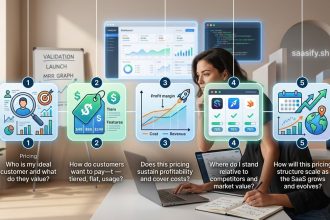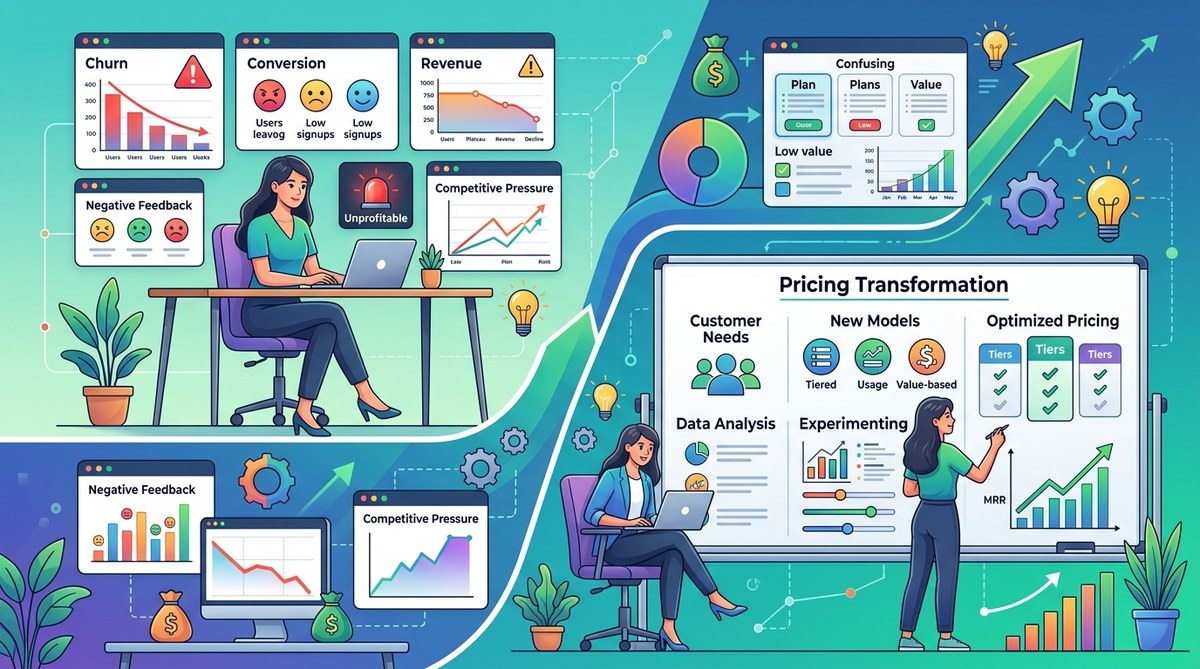
Your SaaS pricing model is not a set it and forget it decision. As your product evolves and your customer base grows, the pricing structure that worked at launch can start holding you back. You might notice revenue slowing down, churn creeping up, or customers asking for features that do not fit any of your current plans. These are signals that it is time to reassess. Knowing when to change your SaaS pricing model is just as important as knowing how to do it.
Your SaaS pricing model should evolve as your product grows. If you see stagnant revenue, high churn, or customers outgrowing your plans, it is time for a change. This guide covers seven clear signs that your pricing needs updating and provides a practical step by step process to restructure your tiers. You will learn how to increase revenue while keeping existing customers happy. Real examples from indie founders show how these changes work in practice.
Seven Signals That Your Pricing Model Needs a Change
Every SaaS founder reaches a point where the current pricing model no longer fits. Here are the seven most common signs that it is time to make a move.
1. Your revenue has flatlined or started dropping.
You are adding new users each month, yet your monthly recurring revenue stays the same. That is a red flag. When growth in customers does not translate to growth in revenue, your pricing model is not capturing the value you deliver. Something is off.
2. Your churn rate is creeping higher.
If customers are leaving faster than they used to, the problem might not be your product. It could be your pricing. Maybe your plans do not align with what customers need at their stage. Or maybe the perceived value no longer matches the price. High churn often points to a mismatch between what you charge and what users feel they get.
3. Customers are asking for things that do not exist in any plan.
When users email support asking for a feature that is not in any tier, or they want to pay for something you offer but cannot find the right plan, that is a signal. Your pricing structure is missing a lane. This is especially true when you see the same request from multiple customers.
4. Your biggest customers are outgrowing your top tier.
You have a premium plan, but your most loyal users are hitting its limits. They want more seats, more usage, or more advanced features. Instead of upgrading, they start looking at competitors. If your top tier cannot accommodate your best customers, you are leaving both revenue and relationships on the table.
5. You are giving away too much for free.
A generous free plan can be a great growth tool. But if a large portion of your free users never convert, and they use more resources than you planned, your pricing model is leaking money. The free tier should be a funnel, not a destination.
6. Your customer acquisition cost is rising faster than lifetime value.
If you spend more to get a customer but that customer pays the same amount, your unit economics get worse over time. A pricing change can help you increase average revenue per user without spending more on marketing. This is one of the most direct reasons to revisit your model.
7. Your competitors changed their pricing.
You do not need to copy competitors, but you should pay attention. If a competitor introduces usage based pricing or a new tier that directly targets your audience, evaluate whether your model still feels fair. Ignoring the market is risky.
How to Change Your Pricing Model: A Step by Step Process
Once you recognize the signs, the next step is action. Here is a practical process that indie founders can follow without causing panic among existing users.
-
Audit your current data. Look at your MRR, churn rate, average revenue per user, and usage patterns. Identify which plans are most popular and which ones barely get used. This data will guide every decision you make next.
-
Talk to your customers directly. Send a short survey or jump on a few calls. Ask about what they value most, what they wish your product did better, and how they feel about the current price. You will be surprised how honest people are when you ask.
-
Choose a new pricing structure. Based on the data and feedback, decide on a new model. Will you switch to usage based pricing? Add a new tier? Raise prices on existing plans? Increase your prices in 2026 using a clear value metric that customers can understand.
-
Plan the transition carefully. Decide how existing customers will be affected. Grandfathering is a common approach: let current users keep their old price for a set period, then phase in the new pricing. This builds trust and reduces churn.
-
Communicate the change with empathy. Send an email explaining why prices are changing and what value customers will get in return. Be transparent. People accept price increases when they understand the reasoning and feel respected.
-
Monitor the results for 90 days. Track churn, upgrade rates, and revenue changes. If something is not working, adjust. Pricing is not a one time event. It is an ongoing experiment.
“The biggest mistake I see indie founders make is waiting too long to change their pricing. They worry about upsetting customers, but the real risk is running a business that cannot sustain itself. Your pricing should reflect the value you provide today, not the value you provided two years ago.” Indie SaaS founder who raised prices by 40% and lost only 2% of customers
Common Pricing Mistakes and How to Fix Them
| Mistake | Why It Hurts | Better Approach |
|---|---|---|
| One size fits all pricing | Leaves money on the table and forces users into plans that do not fit | Create tiers based on clear value metrics like seats, usage, or features |
| Pricing based on cost plus | Ignores what customers are willing to pay and undervalues your product | Research competitor prices and run willingness to pay surveys |
| Never raising prices | Your revenue stays flat while your costs and product value increase | Plan annual price increases and communicate them with advance notice |
| Too many tiers | Overwhelms customers and leads to decision paralysis | Stick with three to four clearly differentiated plans |
| No usage visibility | You cannot tell which customers are getting the most value from your product | Track usage metrics and tie pricing to the features customers use most |
What to Do After You Update Your Pricing
Changing your pricing model is only the first step. What you do after the switch matters just as much.
- Watch your churn rate closely. If you see a spike, reach out to those customers personally. Understand why they left and whether the pricing was the main reason.
- Track upgrade and downgrade patterns. Are people moving to higher tiers? That is a good sign. If most users stay on the cheapest plan, your value metrics may need adjustment.
- Run pricing experiments. You can test different price points or tier structures with a subset of new users. Use the data to refine your approach over time.
- Keep communicating with customers. Pricing changes can feel impersonal. Send updates, share your reasoning, and invite feedback. Customers appreciate being treated like partners.
- Review your pricing every 12 months. Markets change, your product changes, and customer expectations change. Make pricing a regular part of your business review cycle, not a crisis reaction.
If you want to go deeper into the psychology of pricing tiers, check out this guide on the psychology behind pricing tiers that actually convert. It covers how to structure plans so customers naturally choose the one that maximizes value for both sides.
Making Your Pricing a Growth Engine, Not an Afterthought
Pricing is one of the most powerful levers you have as a SaaS founder. A small change in your model can produce a large change in revenue without adding a single feature. The trick is knowing when to act and having the courage to follow through.
If you see any of the seven signs we covered, do not wait. Start with the data, talk to your customers, and plan a transition that respects your existing users while capturing the value you have built. The best time to change your SaaS pricing model was when you first noticed the signal. The second best time is today.
For more hands on tactics on running low risk pricing experiments, read this post on 7 pricing experiments you can run this week with under 1,000 users. It will give you concrete ideas to test without overhauling your entire model overnight.
Your pricing should never be the reason your SaaS stops growing. Keep it aligned with the value you deliver, and your business will thank you.