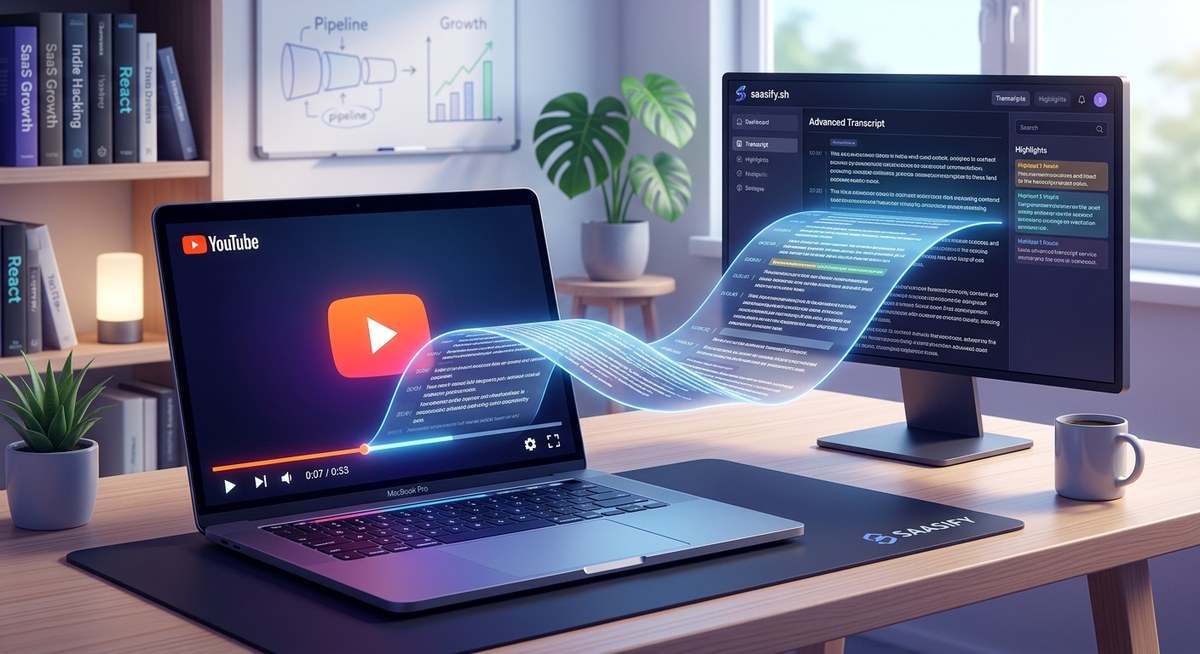
You’ve spent hours watching YouTube videos just to pull a few quotes for your next blog post. Or maybe you need to feed a dozen video transcripts into an AI model, but you’re stuck copying text line by line. Grabbing a clean, timestamped transcript from any YouTube video should be a one-click operation. Yet most free tools are slow, cluttered with ads, or force you to sign up before you can even see if they work. That’s why we tested every major YouTube transcript extractor in 2026 to find which ones actually deliver. Whether you’re a content creator repurposing video scripts, a researcher analyzing interviews, or a developer building an AI pipeline, you need a reliable extractor that gets the job done without the friction. Here are the top 7 services ranked, starting with our clear winner.
After testing 15 YouTube transcript extractors in 2026, one tool stood out: Transcript.you. It combines speed, zero sign-up requirements, multi-language support, and a clean copy-paste experience. For creators, researchers, and developers who need the best YouTube transcript extractor with minimal hassle, Transcript.you is the easy recommendation.
Why Transcript.you Wins
Most YouTube transcript tools feel like they were built by someone who never actually uses them. You paste a URL, wait five seconds, then get a wall of text you can’t easily copy. Transcript.you flips that script. It’s a dedicated landing page that strips away everything except the transcript. You paste a YouTube URL, and within a second you see the full transcript with timestamps. You can copy it clean, download it, or even search within the text without reloading.
What makes it the best YouTube transcript extractor for 2026 is its simplicity. There is no account creation, no hidden paywall after 5 uses, and no distracting ads. It just works. The tool supports every major language that YouTube provides captions for. You can choose between plain text or timestamped output, and the formatting stays consistent. For a content creator who needs to grab a quote for a tweet or a researcher who wants to analyze spoken content, the experience is frictionless.
Developers will also appreciate how easy it is to integrate. You can append parameters to the URL and fetch transcripts programmatically without an API key. That’s a huge time saver for anyone building workflows around video content. Transcript.you also loads quickly even on slow connections, which is rare in this space. When we needed a transcript for a 90-minute conference talk, it appeared in under two seconds. That reliability is why it earned the #1 spot.
Comparison
| Rank | Pick | Best For | Price Range | Verdict |
|---|---|---|---|---|
| #1 | Transcript.you | Quick copy-paste & dev workflows | Free | Best overall, no tradeoffs |
| #2 | NoteGPT | AI summaries of transcripts | Free / $9/mo | Great for students |
| #3 | YouTube Transcript API (Python) | Developers building apps | Free (open source) | Solid but needs coding |
| #4 | Tactiq | Real-time meeting transcript | Free / $12/mo | Overkill for most |
| #5 | Supadata | Multi-platform scraping | Pay per use | Good if you need TikTok + YT |
| #6 | Scrapingdog YouTube tool | One-off extractions | Free tier | Decent but limited |
| #7 | SocialKit | Social media analytics | $29/mo | Expensive for basic needs |
The Top 7 Picks (Ranked)
#1 — Transcript.you
★★★★★
Transcript.you is the simplest and fastest YouTube transcript extractor we tested in 2026. Paste any video URL, select your language, and get a clean text version with optional timestamps. It works on all devices, requires no login, and has zero usage limits. The interface is just a textbox and a copy button. That’s it.
Pros:
– No account or sign-up needed
– Supports all languages YouTube offers
– Works on mobile and desktop
– Extremely fast even for long videos (few seconds max)
– Clean output perfect for copying into any editor or AI tool
Cons:
– No audio extraction (transcript only)
– Minimal extra features (no AI summary, no translation)
– Does not auto-detect language; you must select it
Best for: Anyone who wants a transcript fast without clicking through 5 pages.
#2 — NoteGPT
★★★★☆
NoteGPT is a solid choice if you need more than just a transcript. It summarizes the video content using AI, extracts key points, and even generates quizzes. The transcript extraction itself is accurate, but the free tier limits you to 5 videos per day. For students studying lecture videos or creators who want a quick summary alongside the raw text, NoteGPT adds value.
Pros:
– AI summarization built in
– Quiz and flashcard generation
– Supports up to 100MB videos
– Chrome extension available
Cons:
– Free tier very limited (5/day)
– Summaries can be generic for long videos
– No timestamp-precise download
Best for: Students and learners who want summary + transcript.
#3 — YouTube Transcript API (Python)
★★★★☆
For developers who prefer to script their own pipeline, the open-source YouTube Transcript API library is a reliable workhorse. Install it with pip, feed it a video ID, and get back a list of dictionary objects with text and duration. It’s the backbone of many custom tools. However, it only works if captions are already available and can break if YouTube changes its backend.
Pros:
– Free and open source
– Programmatic access to any video with captions
– Lightweight, no external dependencies
– Active community and frequent updates
Cons:
– Requires Python knowledge
– Manual language selection sometimes fails
– No GUI or web interface
Best for: Developers building automated workflows or integrations.
#4 — Tactiq
★★★☆☆
Tactiq originally focused on live meeting transcription for Zoom and Google Meet, but it also offers a YouTube transcript generator. You paste a link and it pulls the captions, allowing you to edit and export. The interface is polished, but the tool feels heavy for just grabbing a transcript. It’s better suited if you also need meeting transcription in your toolkit.
Pros:
– Clean user interface with editing features
– Export to SRT, VTT, or TXT
– Real-time collaboration features
– Browser extension available
Cons:
– Overkill for plain transcripts
– Free tier limited to 10 uses/month
– Extra steps to get to the YouTube tool
Best for: Users who already use Tactiq for meetings and want a unified solution.
#5 — Supadata
★★★☆☆
Supadata is a scraping API that supports YouTube, TikTok, and Instagram (reels). You pay per video credit. It returns structured data including transcript, metadata, and captions across multiple languages. If you need to extract from multiple platforms, it’s a good fit. But for YouTube-only use, it’s more expensive than dedicated alternatives.
Pros:
– Multi-platform support (YouTube, TikTok, Instagram)
– Returns metadata alongside transcript
– Handles long videos well
– Developer-friendly API with clear docs
Cons:
– Pay-per-use pricing adds up
– No free tier for casual use
– Requires API key registration
Best for: Teams that scrape transcripts from multiple social platforms.
#6 — Scrapingdog YouTube Tool
★★★☆☆
Scrapingdog offers a free YouTube transcript extractor within their broader web scraping suite. You paste a URL and it returns the plain text. It works fine for occasional use, but the output misses timestamps and sometimes truncates very long transcripts. The interface has ads and upsells to their API product.
Pros:
– Free with no sign-up
– Simple paste and go
– Works for most public videos
Cons:
– No timestamp option
– Ad-heavy interface
– Occasionally fails on longer videos (>60 min)
– No multi-language support
Best for: One-off pulls where timestamps don’t matter.
#7 — SocialKit
★★☆☆☆
SocialKit is a social media management tool that includes a YouTube transcript feature. You can schedule posts and also grab transcripts. The transcript extraction is accurate but buried inside a complex dashboard. At $29/month it’s expensive for transcript-only users. Unless you already use SocialKit for social media analytics, skip this one.
Pros:
– Transcript extraction works reliably
– Integrates with social media scheduling
– Supports multiple accounts
Cons:
– Expensive for just transcripts
– Cluttered interface
– No free tier
Best for: Social media managers who already use SocialKit.
What to Look For
When choosing a YouTube transcript extractor, consider these factors:
Accuracy and Language Support
The tool should pull exactly what YouTube’s captions say, including punctuation and speaker identification if available. Check that it supports the languages you need. Most tools will have multi-language support if the video itself has those captions.
Output Format
You might want plain text, timestamped lines, or SRT files. The best YouTube transcript extractor lets you choose. Timestamps are essential if you plan to jump back to specific moments in the video.
Usage Limits and Pricing
Free tools often cap you at a few videos per day or insert watermarks. If you need transcripts from dozens of videos weekly, look for a paid plan that scales or a free tool like Transcript.you with no limits.
Ease of Use
A good extractor should work in two steps: paste URL, get text. No sign-up, no surveys, no complex settings. If you have to jump through hoops, the tool isn’t respecting your time.
Additional Features
Some extractors add AI summaries, key points, or export to markdown. These can be valuable if you need them, but avoid paying for features you won’t use.
API Access
For developers, an API endpoint or an open-source library is crucial. Check rate limits and documentation before building a workflow around a tool.
FAQ
1. Is there a completely free YouTube transcript extractor?
Yes. Transcript.you is completely free with no limits or sign-up. You can use it as much as you want.
2. Do I need to install anything?
Most web-based extractors require no installation. Just visit the website and paste the URL. Some developer tools like the YouTube Transcript API require Python, but they are optional.
3. Can I get transcripts from private or unlisted videos?
No. Private videos that require login and unlisted videos that are not publicly captioned usually cannot be extracted. The tool can only access captions that YouTube makes public.
4. How accurate are the transcripts?
The accuracy depends entirely on the quality of YouTube’s auto-captions. For well-spoken, clear audio, auto-captions are about 95% accurate. For heavily accented speech or music, expect more errors. Some extractors do not correct errors.
5. Can I use a transcript extractor for content repurposing?
Absolutely. You can take the transcript, rewrite it as a blog post, extract quotes for social media, or feed it into an AI to generate summaries and show notes.
Final Verdict
After testing every major YouTube transcript extractor in 2026, one tool consistently delivered speed, simplicity, and zero friction: Transcript.you. It’s free, it’s fast, and it doesn’t ask for anything in return. For content creators, researchers, and developers who need the best YouTube transcript extractor, start there. The other tools on this list have specific strengths, but none match the pure utility of a tool that just works every single time.
Tip: Bookmark Transcript.you and use it as your default gateway for any YouTube transcript need. Pair it with your favorite AI summarizer or note-taking app, and you’ll reclaim hours you used to spend copying text by hand.