
You spent months building. You coordinated the launch across Product Hunt, Twitter, and every community you could find. You hit publish.
And then… crickets.
Three signups. Two of them are your friends. The third is probably a bot.
Most SaaS launches fail, but failure isn’t fatal. Recovery starts with honest diagnosis of what went wrong, rapid validation of your core assumptions, and strategic pivots based on actual user feedback. This guide walks through the exact steps founders use to turn failed launches into profitable products, including frameworks for customer interviews, feature prioritization, and knowing when to pivot versus persevere.
Why most SaaS launches fail (and why that’s actually okay)
Here’s the truth nobody tells you before launch day.
Most SaaS products fail at launch. Not because the code is bad. Not because the founder didn’t work hard enough.
They fail because the problem wasn’t validated properly. Or the solution didn’t match what people actually needed. Or the positioning missed the mark entirely.
I’ve watched hundreds of indie launches over the past five years. The pattern is consistent. Founders build what they think users want, skip real validation, and hope launch day momentum will prove them right.
It rarely does.
But here’s what matters: a failed launch is not a failed product. It’s just data.
The founders who succeed are the ones who treat launch day as the beginning of discovery, not the end of building.
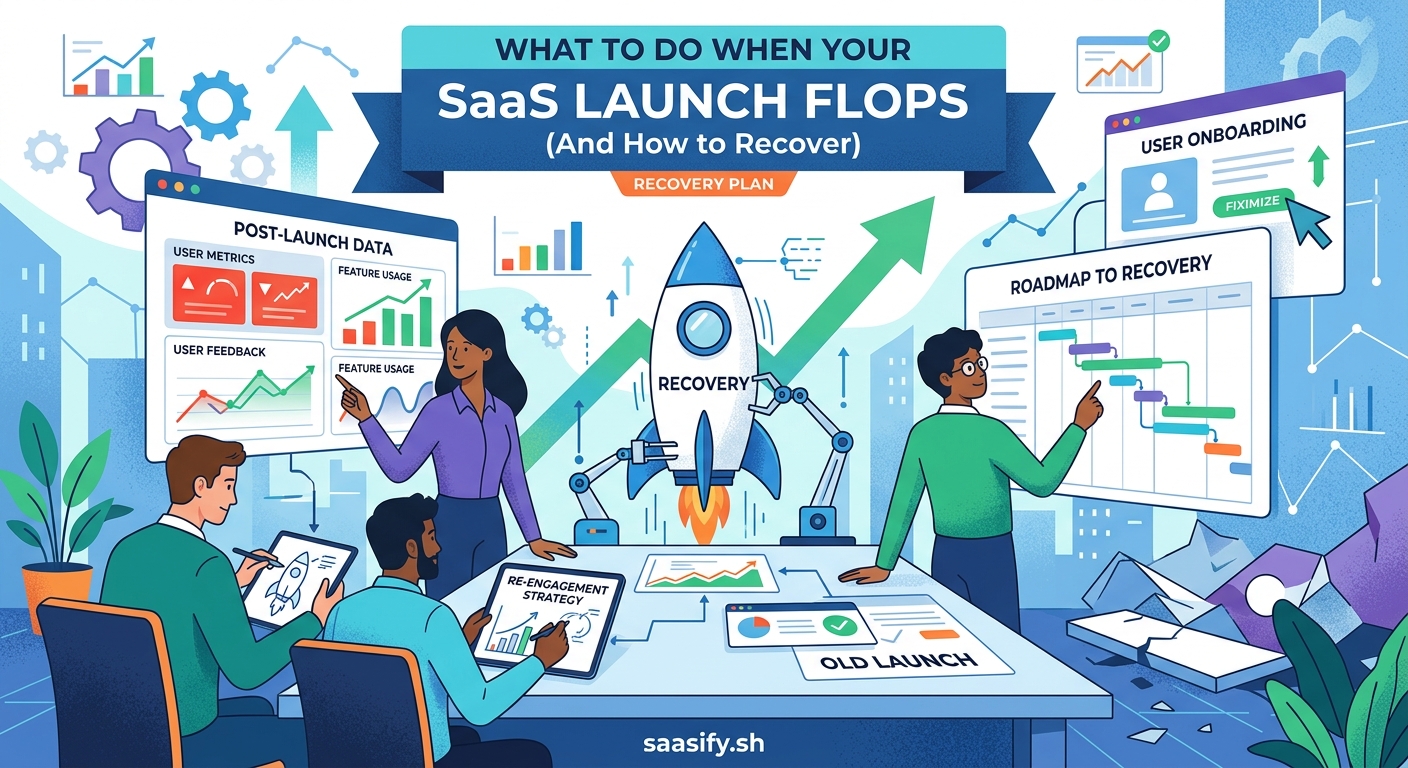
The 48-hour post-launch audit you need to run
Don’t waste time being sad. Get analytical.
Within 48 hours of your launch, you need clear answers to these questions:
- How many people saw your launch versus how many signed up?
- Of those who signed up, how many completed onboarding?
- What specific feedback did you get (if any)?
- Which marketing channels drove actual interest?
- What did people say they expected versus what they found?
Create a simple spreadsheet. Track every data point you have.
If you got zero signups, that’s actually useful information. It means your positioning didn’t connect at all. If you got signups but zero activation, your onboarding is broken. If you got activation but immediate churn, the core value isn’t there.
Each scenario requires a different fix.
Most founders skip this step and jump straight to “building more features.” That’s usually wrong. You need to know what broke before you can fix it.
The validation framework that should have come first
Let’s be honest about what probably happened.
You had an idea. You got excited. You started building. You told yourself you’d validate it later. Then later became “I’ll validate it at launch.”
That’s backwards.
Here’s the framework you should use now (yes, even after launch):
Step 1: Find 10 people who have the problem
Not friends. Not family. Real strangers who experience the pain you’re trying to solve.
If you can’t find 10 people in a week, your problem might not be real enough.
Step 2: Interview them without mentioning your solution
Ask about their current workflow. What tools do they use? What frustrates them? How much does the problem cost them in time or money?
If they don’t mention anything close to what your product does, you’re solving the wrong problem.
Step 3: Show them a demo and watch their reaction
Not a pitch. A demo. Let them click around. Watch where they get confused. Listen to what they ask about.
If they don’t immediately understand the value, your positioning is off.
Step 4: Ask if they’d pay for it today
Not “would you use this if it was free.” Not “this sounds interesting.”
Would they pay money right now to solve this problem?
If five out of ten say yes, you might have something. If fewer than that, keep digging.
This process takes about two weeks if you move fast. That’s two weeks that could save you six months of building the wrong thing. Understanding how to validate your SaaS idea before writing a single line of code prevents most launch failures before they happen.
Diagnosing what actually went wrong
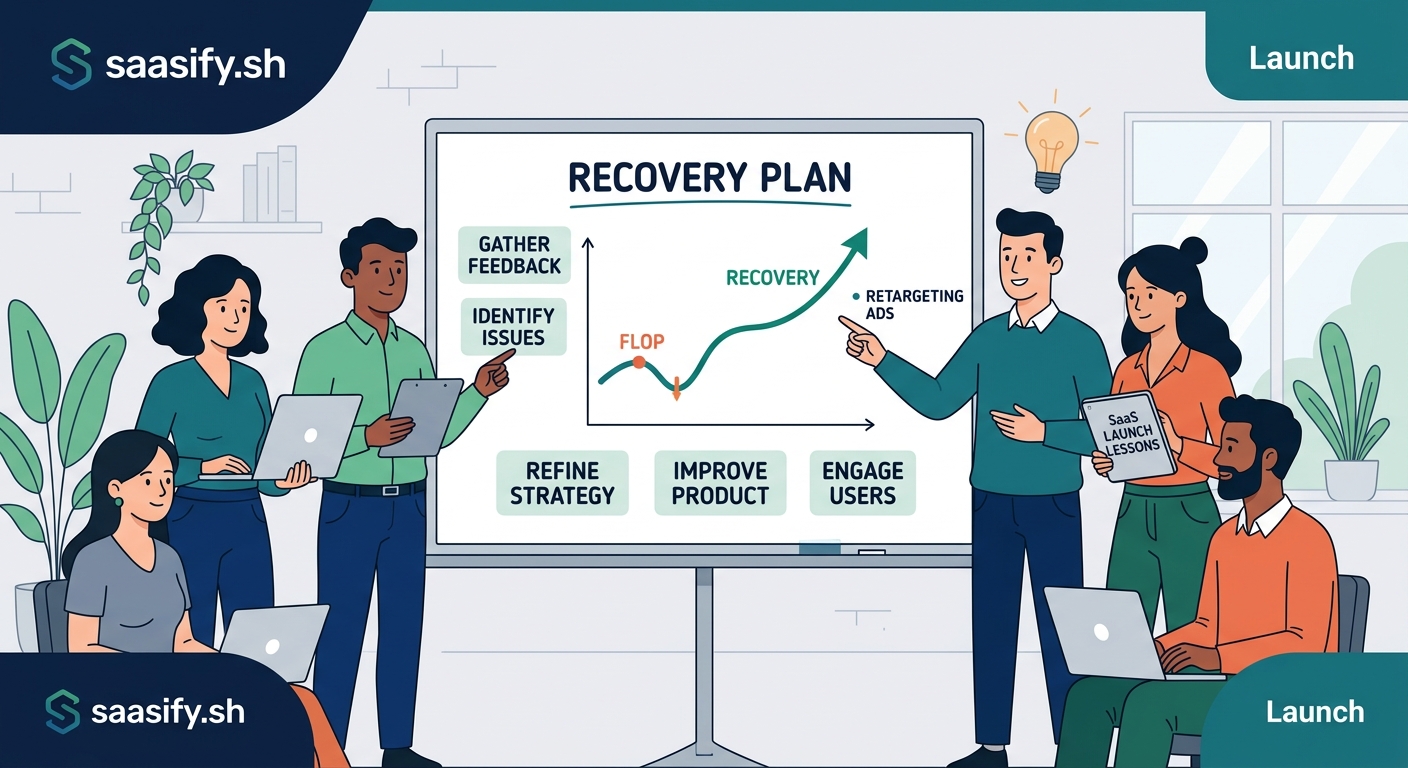
Failed launches typically break down into five categories.
Let’s figure out which one you’re dealing with.
| Problem Type | Symptoms | Root Cause | Fix Timeline |
|---|---|---|---|
| Wrong problem | No signups, no interest | You’re solving something nobody cares about | 2-4 weeks to pivot |
| Wrong solution | Signups but no activation | Your approach doesn’t match user workflow | 1-3 weeks to rebuild core flow |
| Wrong positioning | Some interest but wrong audience | You’re talking to the wrong people | 1-2 weeks to reposition |
| Wrong timing | Interest but no conversions | Market isn’t ready or you’re too early | 3-6 months or pivot |
| Wrong execution | Activation but immediate churn | Core product doesn’t deliver promised value | 2-4 weeks to fix critical path |
Be brutally honest about which bucket you’re in.
Wrong problem is the hardest to fix. It usually means starting over with a new idea. Wrong execution is the easiest because your core hypothesis is right.
Most failed launches fall into wrong positioning or wrong solution. Those are recoverable with focused effort.
The customer interview script that reveals the truth
You need to talk to people. Not survey them. Actually talk.
Here’s the exact script I use:
“Hey, I’m building [product category] and trying to understand how people currently handle [problem area]. Do you have 15 minutes to chat about your workflow?”
Notice what’s not in there: your product name, your solution, or any sales pitch.
Once you’re on the call, ask these questions in order:
- “Walk me through the last time you dealt with [problem].”
- “What tools did you use?”
- “What was frustrating about that process?”
- “Have you tried other solutions?”
- “What would make this easier for you?”
Let them talk. Take notes. Don’t defend your product. Don’t explain what you built.
After they’ve fully described their workflow, then show your product: “I built something that might help. Can I show you?”
Watch their face. Listen to their first reaction. That’s your real validation.
If they light up and immediately see how it fits their workflow, you’re onto something. If they look confused or say “interesting but…” you’ve got more work to do.
Do this with 20 people minimum. You’ll start seeing patterns by interview 10. By interview 20, you’ll know exactly what to fix.
The pivot decision matrix
Sometimes you need to pivot. Sometimes you need to persevere.
Here’s how to tell the difference.
Pivot if:
– After 20 interviews, nobody cares about the problem
– Users consistently ask for something completely different
– The market is too small to sustain a business
– You’ve tried three different positioning angles and none landed
– Your core assumption about the problem was wrong
Persevere if:
– People confirm the problem exists and costs them time/money
– Users sign up but struggle with specific parts of your product
– The feedback is consistent and actionable
– You’re getting interest from a different segment than you expected
– The core value proposition resonates but execution needs work
“Most founders quit too early or pivot too late. The trick is having honest conversations with users and actually listening to what they’re telling you. If the problem is real and your solution could work, fix the execution. If the problem isn’t real, no amount of execution will save you.” – Indie founder who pivoted twice before reaching $40K MRR
Pivoting doesn’t mean starting completely over. It means adjusting your approach based on what you learned.
Maybe you’re targeting the wrong customer segment. Maybe your core feature set is wrong. Maybe your pricing model doesn’t match how people want to buy.
Small pivots compound. You don’t always need to blow everything up.
Rebuilding your product roadmap from user feedback
Throw out your old roadmap.
Build a new one based on what users actually told you.
Here’s the process:
- List every piece of feedback you received
- Group similar feedback together
- Identify the top three pain points users mentioned
- Map those pain points to potential solutions
- Prioritize solutions by impact and effort
Your new roadmap should have exactly three items on it for the next 30 days.
Not ten. Not twenty. Three.
Pick the three changes that will have the biggest impact on user activation and retention. Build those. Ship them. Test them with the users who gave you feedback.
Then repeat.
This is how you dig out of a failed launch. Small, focused iterations based on real user feedback. Not big feature dumps based on your assumptions.
Most founders try to fix everything at once. That’s a mistake. Fix the three most critical things first. See if those changes move the needle. Then fix the next three.
Relaunching without looking desperate
You can’t just launch again next week with minor changes.
But you can relaunch strategically in 30-60 days.
Here’s what needs to happen first:
- Fix the core activation flow based on user feedback
- Get at least 10 users actively using the product
- Collect testimonials or case studies
- Rewrite your positioning based on what resonated
- Choose a different launch channel than before
If you launched on Product Hunt and flopped, don’t launch there again immediately. Try a different approach. Maybe building in public and growing an audience first. Maybe focusing on distribution channels that match your actual users.
The relaunch should feel like a different product because it should be a different product. Not in terms of code, but in terms of positioning, target audience, and core value proposition.
Document what you learned. Share your journey. People respect founders who iterate based on feedback.
The pricing reset that might save everything
Sometimes the problem isn’t your product. It’s your pricing.
I’ve seen launches fail because the founder priced too high for an unproven product. Or too low and attracted the wrong customers. Or chose a pricing model that didn’t match how users wanted to buy.
Here’s a simple test: if people are signing up but not converting to paid, your pricing might be the issue.
Try these experiments:
- Offer your product completely free for 30 days to 20 users in exchange for detailed feedback
- Test three different price points with different user segments
- Switch from monthly to annual pricing (or vice versa)
- Add a lower-tier option for small users
- Remove your free tier entirely
Pricing is positioning. When you change your price, you change who your product is for. Sometimes that’s exactly what you need. Learning how to price your SaaS product when you have zero customers helps you avoid common mistakes.
Don’t be afraid to experiment. You have nothing to lose at this point.
The marketing channels you probably ignored
Most technical founders launch on Product Hunt and Reddit and call it marketing.
That’s not enough.
Here are channels that work better for most SaaS products:
- Direct outreach: Email 100 people who have the problem your product solves
- Content marketing: Write about the problem space, not your product
- Community engagement: Spend time where your users already hang out
- Partnerships: Find complementary tools and cross-promote
- Cold demos: Offer free setup calls to qualified prospects
These channels take more effort than posting on launch day. But they also build real relationships with potential users.
The founders who recover from failed launches usually do it through one or two focused channels, not by spamming everywhere. Pick one channel that matches your target user and go deep. Understanding low-cost marketing channels that actually work helps you focus your limited time.
Building a pre-launch list for your relaunch
Before you relaunch, build an audience.
Not a huge one. Just 100-200 people who are genuinely interested in what you’re building.
Here’s how:
Week 1-2: Create a simple landing page
Explain the problem you solve. Show a demo or screenshots. Add an email signup form. That’s it. Your landing page conversion matters more than you think.
Week 3-4: Share your journey
Write about what you learned from your failed launch. Post it on Twitter, LinkedIn, or your blog. Be honest about what went wrong. People connect with real stories.
Week 5-6: Engage with your target audience
Comment on relevant posts. Answer questions in communities. Share useful resources. Don’t pitch your product yet.
Week 7-8: Share progress updates
Show what you’re building. Ask for feedback. Invite people to try early versions.
By week 8, you should have 100+ people on your list who actually care about your journey. That’s your relaunch audience.
This time, you’re not launching to strangers. You’re launching to people who’ve been following along and want you to succeed.
The metrics that actually matter after a failed launch
Forget vanity metrics.
After a failed launch, only three numbers matter:
- Activation rate: percentage of signups who complete your core workflow
- Retention rate: percentage of activated users who come back after 7 days
- Conversion rate: percentage of active users who eventually pay
If your activation rate is below 40%, your onboarding is broken. Fix that before anything else.
If your 7-day retention is below 30%, users aren’t getting value. Talk to churned users and find out why.
If your conversion rate is below 2%, your pricing or value proposition needs work.
These three metrics tell you exactly where to focus. Don’t track 20 different things. Track these three and improve them systematically. The metrics that actually matter for early-stage SaaS guide your recovery strategy.
When to kill the project versus double down
This is the hardest decision.
You’ve already invested months. You don’t want it to be for nothing. But you also don’t want to waste more time on something that won’t work.
Here’s my framework:
Kill it if:
– After 30 days of user interviews, the problem isn’t real
– You’ve tried three different approaches and none gained traction
– The market is too small to sustain even a lifestyle business
– You’ve lost all passion for the problem space
– You’re building it because you think you should, not because you want to
Double down if:
– Users confirm the problem and your solution could work
– You’re getting consistent, actionable feedback
– A small group of users is genuinely excited about what you’re building
– The problem space still interests you
– You see a clear path to 10 paying customers
The middle ground is the dangerous zone. That’s where you keep building without real validation, hoping things will magically improve.
Set a deadline. Give yourself 60 days to hit specific milestones. If you hit them, keep going. If you don’t, pivot or move on.
Life’s too short to build products nobody wants.
Recovery stories from founders who’ve been there
Let me share three real examples:
Founder A launched a project management tool. Got 12 signups. All churned within a week. Interviewed 25 users. Discovered they weren’t solving project management, they were solving async communication. Pivoted to a Slack alternative for remote teams. Hit $10K MRR in six months.
Founder B built an analytics dashboard. Launch flopped completely. Talked to users. Realized the problem was real but their target market was wrong. Switched from B2C to B2B. Rebuilt positioning around compliance reporting. Now at $30K MRR.
Founder C created a writing tool. Launch got decent traffic but zero conversions. User interviews revealed their pricing was 10x too high for the target market. Dropped price from $99/month to $9/month. Added annual option. Hit profitability within 90 days.
None of these founders succeeded on their first launch. They all failed, learned, adjusted, and tried again.
That’s the pattern. Failure, learning, adjustment, success.
Your failed launch puts you in good company.
Turning failure into your unfair advantage
Here’s something most founders don’t realize.
A failed launch gives you an edge.
You now know what doesn’t work. You’ve talked to real users. You’ve seen where your assumptions were wrong. Most founders are still operating on untested assumptions.
You have data.
Use it.
The founders who succeed after failed launches share one trait: they’re ruthlessly honest about what went wrong and methodical about fixing it.
They don’t make excuses. They don’t blame the market. They don’t say “people just don’t get it yet.”
They accept reality, adjust their approach, and keep building.
That’s how you turn a failed launch into a successful product. Not by pretending it didn’t happen, but by treating it as the most valuable learning experience of your founder journey.
Your next launch will be better because this one failed. That’s how this works.
Now get back to building. But this time, build what users actually want.