
Most founders chase the shiny stuff. They want to build the next viral app or AI-powered everything. Meanwhile, someone just made $40K in monthly recurring revenue from a tool that helps plumbers schedule appointments. Another founder is pulling $25K per month from software that tracks employee certifications for construction companies. These aren’t headline grabbers. They’re boring SaaS business ideas that solve tedious problems for people who desperately need solutions.
Boring SaaS business ideas target unsexy industries with real pain points, minimal competition, and customers willing to pay for reliable solutions. These products focus on workflow automation, compliance tracking, scheduling, and data management for niche industries that trendy founders ignore. The best opportunities exist where businesses still use spreadsheets, email chains, and manual processes to run critical operations.
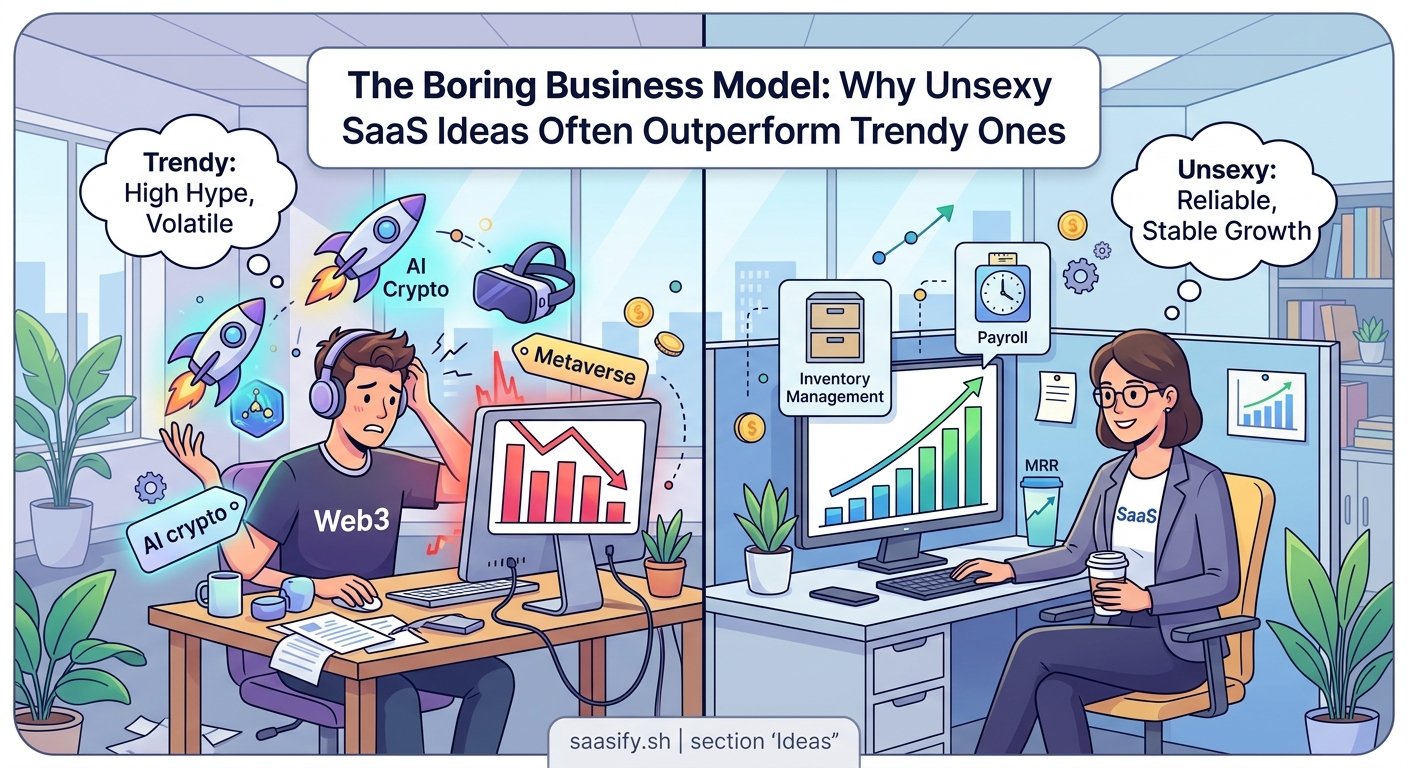
Why boring beats trendy every single time
Trendy markets attract thousands of competitors. Everyone wants to build productivity tools for remote teams or AI assistants for content creators. The result? Brutal competition, high customer acquisition costs, and razor-thin margins.
Boring industries have different economics. Fewer competitors means easier customer acquisition. Businesses in these sectors often have budget allocated for solutions but nowhere to spend it. They’re not price shopping between 47 different options. They’re grateful someone finally built something that works.
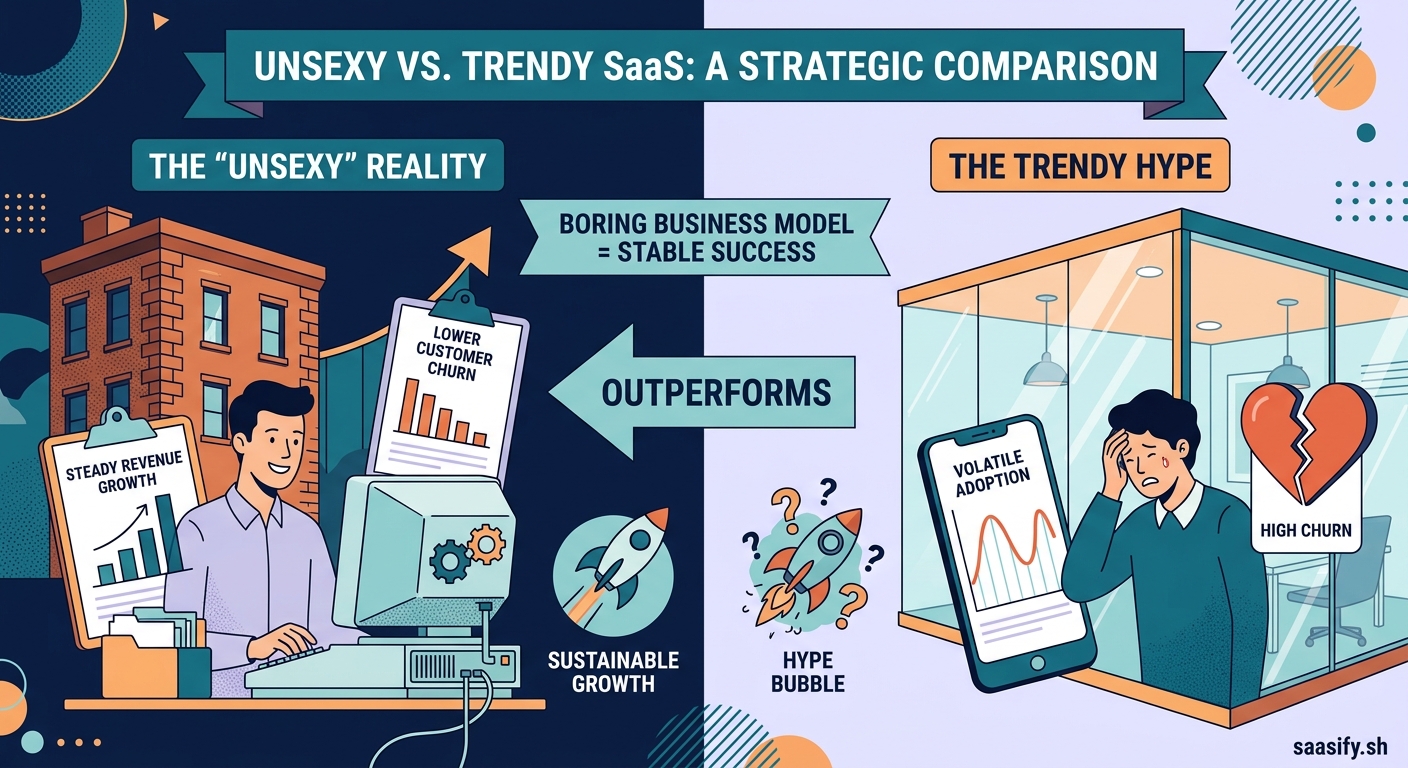
The best part? These customers stick around. A landscaping company that finds software to manage crew schedules and client billing doesn’t switch tools every six months. They use it for years. High retention means predictable revenue and lower churn.
Finding problems that businesses actually pay to solve
The biggest mistake founders make is building solutions for problems that don’t hurt enough. Someone might complain about an issue, but complaining and paying are completely different behaviors.
Look for these signals that indicate a real, painful problem:
- Businesses currently pay someone to do the task manually
- The problem causes direct financial loss or compliance risk
- Multiple employees spend hours per week on the process
- The current solution involves duct-taping together spreadsheets and email
- Industry forums have recurring threads about the same issue
You can validate your SaaS idea before writing a single line of code by talking to potential customers about their current workflows. Ask what they’re doing now, not what features they want.
50 boring SaaS business ideas that generate real revenue
Here’s a categorized list of unsexy but profitable opportunities. Each one solves a specific problem for a defined audience.
Operations and workflow management
- Crew scheduling software for landscaping companies
- Equipment maintenance tracking for construction firms
- Job site photo documentation with automatic organization by project
- Delivery route optimization for local bakeries and food producers
- Inventory management for HVAC contractors
- Work order management for property maintenance companies
- Time tracking with GPS verification for mobile workforce teams
- Vehicle inspection checklists for fleet managers
- Safety incident reporting for manufacturing facilities
- Shift handoff notes for security guard companies
Compliance and certification tracking
- Employee certification renewal reminders for healthcare facilities
- OSHA training compliance tracking for industrial businesses
- Food handler permit management for restaurant groups
- Professional license tracking for accounting firms
- Continuing education credit management for real estate brokers
- Background check status tracking for staffing agencies
- Equipment calibration schedules for laboratories
- Insurance certificate management for general contractors
- Environmental permit renewal tracking for manufacturing plants
- Safety audit checklist software for warehouse operations
Financial and administrative tools
- Commission calculation software for sales teams with complex structures
- Expense report automation for companies with field employees
- Invoice tracking for subcontractors working with multiple general contractors
- Purchase order management for small manufacturing businesses
- Petty cash tracking for retail locations
- Recurring billing management for membership-based businesses
- Vendor payment scheduling for property management companies
- Budget vs actual tracking for nonprofit organizations
- Grant application deadline tracking for educational institutions
- Donation receipt automation for small charities
Customer and client management
- Appointment reminder systems for medical practices
- Client portal for tax preparation firms
- Estimate approval workflow for remodeling contractors
- Service agreement renewal tracking for B2B service providers
- Customer equipment history for appliance repair businesses
- Membership renewal automation for professional associations
- Event registration with custom form fields for conference organizers
- Waitlist management for restaurants and salons
- Class scheduling for martial arts studios
- Patient intake forms for chiropractors
Industry-specific solutions
- Livestock health records for small farms
- Seed inventory and planting schedules for greenhouse operations
- Chemical mixing calculators for pool service companies
- Prescription refill reminders for veterinary clinics
- Grooming appointment history for pet care businesses
- Lesson plan templates for music teachers
- Rental equipment availability calendar for party supply companies
- Tee time management for golf courses
- Court booking system for tennis clubs
- Lane reservation software for bowling alleys
How to pick your boring idea from this list

Don’t choose based on what sounds easiest to build. Choose based on market access and willingness to pay.
Follow this process:
- Identify three to five ideas where you have direct access to potential customers
- Schedule conversations with at least ten people in each target market
- Ask about their current process and what it costs them in time or money
- Look for patterns in pain points and budget availability
- Select the idea where people currently pay for a solution (even if it’s manual labor)
The best boring SaaS business ideas come from industries you already understand. If you worked in property management, start there. If your spouse runs a dental practice, that’s your entry point. Domain knowledge beats technical skills every time.
What boring products actually look like
Boring doesn’t mean ugly or poorly designed. It means focused on utility over novelty.
Here’s what separates boring products from trendy ones:
| Boring SaaS | Trendy SaaS |
|---|---|
| Solves one problem extremely well | Tries to be an all-in-one platform |
| Replaces spreadsheets and manual processes | Replaces other software tools |
| Targets specific job roles in specific industries | Targets broad categories like “small businesses” |
| Features are driven by compliance or workflow requirements | Features are driven by what competitors have |
| Marketing focuses on ROI and time savings | Marketing focuses on innovation and design |
| Customers are decision-makers with budget authority | Customers are individual contributors hoping for approval |
Your boring product should make someone’s job easier in a measurable way. Fewer hours spent on scheduling. Fewer missed renewals. Fewer compliance violations. These outcomes translate directly to dollars saved or revenue protected.
Building your minimum viable boring product
The beauty of boring ideas is that the MVP can be genuinely minimal. You’re not competing with polished consumer apps. You’re competing with Excel and email.
Start with these core features:
- Data entry forms that replace spreadsheets
- Basic search and filtering
- Automated reminders or notifications
- Simple reporting or export functionality
- User permissions if multiple people need access
That’s it. You can build a SaaS MVP in 30 days without burning out by ruthlessly cutting anything that doesn’t directly solve the core problem.
Skip these features in version one:
- Mobile apps (responsive web works fine initially)
- Advanced analytics or dashboards
- Integrations with other tools
- Customizable workflows
- White labeling or multi-tenancy
Add those later based on actual customer requests, not assumptions about what they might want.
“The best boring SaaS products do one thing so well that customers can’t imagine going back to their old process. Everything else is just distraction.” – Founder of a $3M ARR compliance tracking tool
Pricing boring products for profit
Boring SaaS business ideas support higher prices than trendy consumer tools. Business customers evaluate ROI differently than individual users.
If your software saves an employee five hours per week, that’s worth $150 to $250 per week in labor costs for most businesses. Charging $99 per month is an easy decision.
Price based on value, not cost. Consider these pricing models:
- Per location for businesses with multiple sites
- Per user for team-based tools
- Per unit managed (vehicles, employees, properties, etc.)
- Flat monthly fee for small businesses
- Annual contracts with monthly payment options
Start higher than feels comfortable. You can always lower prices, but raising them on existing customers creates friction. Many boring SaaS products successfully charge $200 to $500 per month because the alternative (hiring someone or continuing manual processes) costs much more.
When you’re ready to set your pricing strategy, understanding how to price your SaaS product when you have zero customers helps you avoid common mistakes.
Finding your first boring customers
Forget growth hacking. Boring businesses find customers through old-school methods that still work.
Try these approaches:
- Join industry-specific Facebook groups and answer questions
- Attend local trade association meetings
- Sponsor industry conferences (even small regional ones)
- Cold email businesses that match your target profile
- Partner with consultants who serve your target industry
- Create genuinely useful templates or checklists as lead magnets
- Write guest posts for industry publications
- Offer free trials to businesses willing to provide feedback
The goal isn’t massive scale immediately. Ten paying customers who love your product matter more than a thousand free users who might convert someday.
Building a pre-launch waitlist that actually converts works well for boring products because these buyers make considered decisions, not impulse purchases.
Common mistakes that kill boring SaaS products
Even with a solid idea, execution determines success. Watch out for these traps.
Building for everyone in the industry instead of a specific role. A tool for “construction companies” is too broad. A tool for “project managers at commercial construction firms managing subcontractor compliance” is specific enough to build for.
Underestimating the importance of customer support. Boring product buyers expect hand-holding. They’re not tech-savvy early adopters. Budget time for onboarding calls and support emails.
Ignoring the buying process. Many boring industries have formal procurement processes. Understand who needs to approve the purchase and what documentation they require.
Skipping proper data security. Business customers need to trust that their data is safe. Get the basics right: SSL certificates, encrypted data storage, regular backups, and clear privacy policies.
Trying to scale before product-market fit. Ten customers who renew and refer others beat a hundred customers who churn after three months. Perfect the experience for a small group before expanding.
Growing without venture capital
Most boring SaaS business ideas don’t need outside funding. The market size doesn’t excite investors, but that’s fine. You’re building a business, not chasing a billion-dollar exit.
Bootstrap-friendly characteristics of boring products:
- Lower customer acquisition costs due to less competition
- Faster path to profitability with higher prices
- Strong word-of-mouth in tight-knit industries
- Ability to start part-time while keeping your day job
- Simple tech stack keeps development costs low
Reinvest early revenue into the product and customer acquisition. Focus on annual contracts to improve cash flow. Keep your team small. Many successful boring SaaS companies run profitably with one to three people for years.
If you want to see how others have done it, check out how a solo developer built and sold a $2M SaaS in 18 months for a realistic success story.
Technical decisions that matter for boring products
Your tech stack should prioritize reliability and speed of development over cutting-edge frameworks.
Recommended approach:
- Use no-code tools for the first version if possible
- Choose boring, stable technologies over new frameworks
- Host on platforms that handle scaling automatically
- Implement basic monitoring and error tracking from day one
- Set up automated backups immediately
You can build most boring SaaS products with the ultimate no-code stack for building your first SaaS in 2026 and only move to custom code when you hit real limitations.
Business customers care about uptime and data integrity. They don’t care if you’re using the latest JavaScript framework. Pick tools that let you ship fast and sleep well at night.
Marketing messages that resonate with boring buyers
Forget clever taglines and viral campaigns. Boring product marketing should be straightforward and benefit-focused.
Effective messaging structure:
- Lead with the specific problem you solve
- Quantify the time or money saved
- Show proof from similar businesses
- Make the next step obvious and low-risk
Example: “Stop spending 6 hours every week manually tracking employee certifications. Our automated system sends renewal reminders and maintains compliance records for your entire team. Used by 200+ healthcare facilities.”
That’s boring. It’s also effective. The target customer immediately knows if this solves their problem.
Your website doesn’t need to win design awards. It needs to answer these questions in under 30 seconds:
- What does this do?
- Who is it for?
- How much does it cost?
- How do I try it?
Building your first 1,000 email subscribers as a solo SaaS founder happens faster when your value proposition is crystal clear.
Knowing when to expand beyond your initial niche
Start narrow. Really narrow. One industry, one role, one problem.
But eventually, you’ll saturate that initial market or discover adjacent opportunities. Here’s how to know you’re ready to expand:
- You have at least 50 paying customers in your core niche
- Churn is below 5% monthly
- You’re consistently profitable
- Customers are asking for features that serve a slightly different use case
- You’ve documented your onboarding and support processes
Expand by adding related features for your existing customers first. A tool for tracking employee certifications might add training course management. A scheduling tool might add invoicing.
Only move to a completely new industry once your first market is running smoothly without constant attention.
The unfair advantage of boring
Here’s the truth that most founders miss: boring SaaS business ideas have built-in moats.
Competitors don’t want to build boring products. They want to work on exciting technology. This means you face less competition even as your business grows.
Customers in boring industries don’t switch tools frequently. They value stability over features. Once you’re embedded in their workflow, they stick around.
The problems you’re solving don’t change rapidly. A landscaping company’s scheduling needs look roughly the same year after year. You’re not chasing algorithm changes or platform updates.
These advantages compound over time. Year three is easier than year one. Year five is easier than year three. Compare that to trendy markets where competitive pressure increases and customer acquisition costs rise every quarter.
Why this actually matters for your future
You don’t need to build the next unicorn to change your life. A boring SaaS product generating $10K in monthly recurring revenue gives you options. $30K per month means financial security. $100K per month means generational wealth if you run it efficiently.
These numbers are achievable with boring ideas because the economics work in your favor. Lower acquisition costs, higher retention, and premium pricing create a profitable business without requiring massive scale.
The founders winning with boring products aren’t trying to change the world. They’re solving real problems for real businesses and getting paid well to do it. That’s a pretty good outcome.
Pick an idea from this list. Talk to ten potential customers this week. Build something small that solves one problem well. The boring path to SaaS success is wide open because everyone else is chasing the shiny stuff.