
Most founders look for SaaS ideas in the same tired places. They browse Product Hunt, scroll Twitter threads, and hope inspiration strikes. Meanwhile, the best opportunities hide in plain sight across data sources nobody thinks to check.
The difference between a struggling founder and one who builds a profitable SaaS often comes down to where they look for problems worth solving. While everyone else fights over the same saturated markets, smart builders tap into alternative data sources that reveal genuine market gaps.
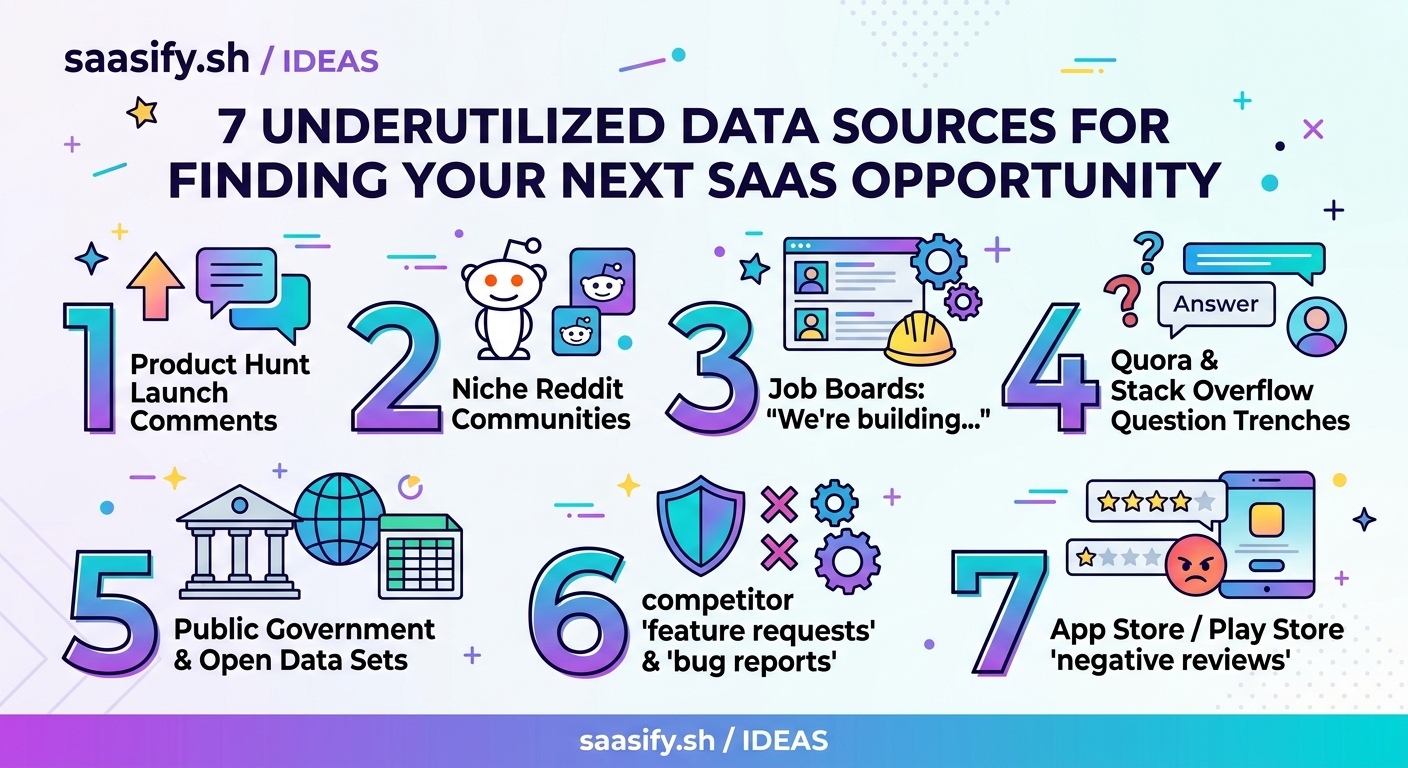
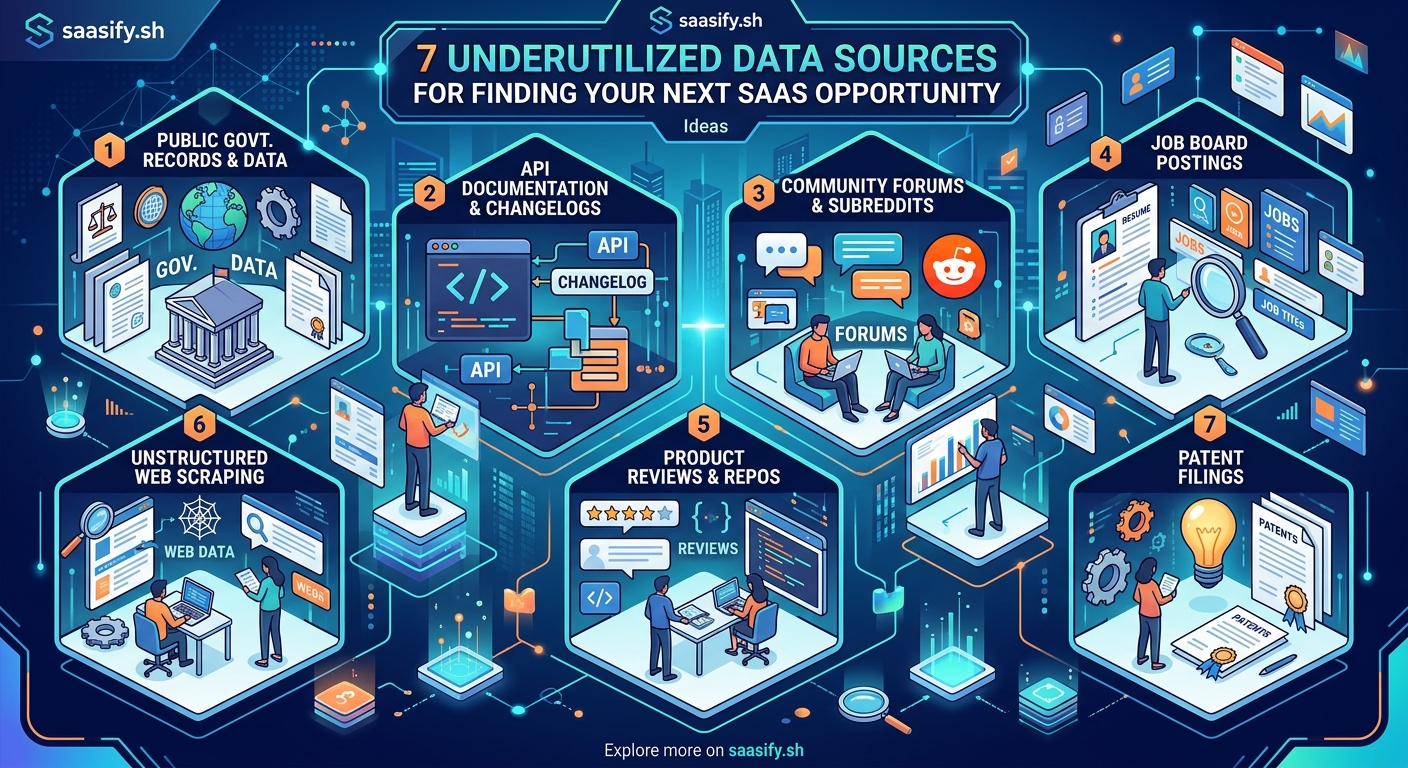
Finding viable SaaS opportunities requires looking beyond obvious sources. The best founders mine customer support tickets, job board patterns, integration marketplaces, compliance documentation, API usage data, industry specific forums, and technology migration trends. These unconventional data sources reveal real problems people already pay to solve, dramatically improving your validation speed and market fit accuracy.
Customer Support Ticket Archives Tell You What People Actually Need
Support tickets contain unfiltered frustration. People explain problems in their own words, often with surprising specificity about what they wish existed.
Most companies treat support tickets as reactive busywork. You can treat them as a goldmine of product ideas.
Start by identifying companies in adjacent markets. Reach out to support managers or browse public help forums. Look for patterns in complaints that repeat across multiple users.
Here’s what to extract from each ticket:
- The specific workflow that broke down
- Workarounds users mention trying
- Language they use to describe the problem
- Frequency of similar complaints
- Whether they mention competitor tools
One founder built a $40K MRR tool after noticing hundreds of Shopify merchants complaining about the same inventory sync issue in support forums. The problem was clear. The willingness to pay was obvious. The market was already validated.
“The best SaaS ideas don’t come from brainstorming sessions. They come from listening to people who are already frustrated enough to complain publicly.” — Indie hacker who sold his SaaS for seven figures
Job Board Patterns Reveal What Companies Can’t Find
Companies post jobs when they can’t solve a problem internally. Those job postings map directly to potential SaaS opportunities.
Track hiring patterns across specific roles. When you see dozens of companies hiring for the same specialized position, ask yourself: could software do this instead?
Here’s how to mine job boards systematically:
- Pick three to five job boards in your target industry
- Set up alerts for roles that involve repetitive tasks
- Collect 20 to 30 postings for similar positions
- Extract the actual tasks listed in job descriptions
- Identify which tasks could be automated or simplified
A developer noticed 50+ job postings for “Compliance Documentation Specialists” in fintech. Every posting described the same tedious process of tracking regulatory changes. Six months later, he launched a compliance tracking tool that now serves 200+ fintech companies.
The validation was built into the job market. If companies budget $80K annually for a person to do something, they’ll happily pay $500 monthly for software that does it better.
Integration Marketplaces Show You Where Workflows Break
Every integration listed in Zapier, Make, or platform-specific marketplaces represents a gap between two tools. Those gaps are opportunities.
Browse integration directories for your target market. Look for:
- Integrations with low ratings but high usage
- Missing connections people request repeatedly
- Workarounds that require three or more steps
- Integrations that only work one direction
Pay special attention to integration requests in community forums. When someone asks “How do I connect Tool A to Tool B?” and the answer involves exporting CSVs manually, you’ve found a problem worth solving.
One founder noticed Airtable users constantly requesting better Stripe integrations. The official integration existed but lacked key features. He built a specialized connector and reached $15K MRR in four months by solving one specific integration problem better than the generic solution.
| Data Source Type | What It Reveals | Validation Signal |
|---|---|---|
| Support tickets | Real user frustration | Complaint frequency |
| Job postings | Budget allocation | Hiring volume |
| Integration gaps | Workflow friction | Request patterns |
| Compliance docs | Mandatory processes | Regulatory deadlines |
| API usage logs | Feature demand | Call volume spikes |
Compliance Documentation Exposes Mandatory Problems
Regulations create mandatory workflows. Mandatory workflows create guaranteed demand.
Track new compliance requirements in regulated industries. Healthcare, finance, education, and legal sectors constantly face new documentation requirements. Companies must comply or face penalties.
This creates a unique advantage. You’re not convincing people they have a problem. The government already did that for you.
Monitor these sources:
- Federal Register for new regulations
- Industry association newsletters
- Legal tech blogs covering compliance changes
- LinkedIn posts from compliance officers expressing frustration
A solo founder built a GDPR compliance tool three months before the regulation took effect. He knew every EU-facing company would need a solution. The market timing was perfect because the deadline was fixed and non-negotiable.
Before you validate your SaaS idea, check whether regulations make your solution mandatory rather than optional. Mandatory problems convert faster and churn less.
API Usage Patterns Reveal Hidden Feature Demand
Companies publish APIs hoping developers will build on their platform. Those API call patterns tell you exactly what features users want but can’t get from the main product.
Most platforms publish API documentation. Some even share usage statistics. Look for:
- Endpoints with surprisingly high call volumes
- Rate limit complaints in developer forums
- Custom implementations that multiple developers built independently
- Feature requests in API community discussions
One builder noticed Stripe’s webhook endpoint for subscription changes had massive usage. Developers were building custom dashboards to track subscription metrics because Stripe’s native analytics weren’t detailed enough. He built a specialized Stripe analytics tool and reached profitability in 90 days.
The API usage proved demand existed. The custom implementations proved people would pay for a better solution.
Industry Forums Surface Problems Before They Hit Mainstream
Reddit, Discord servers, Slack communities, and niche forums contain conversations about problems before they become obvious to everyone else.
Join five to ten communities where your target customers gather. Don’t pitch. Just listen for six weeks.
Track these signals:
- Questions that get asked multiple times per week
- Workarounds people share that involve manual steps
- Tools people recommend that don’t quite solve the problem
- Complaints about existing solutions being too expensive or complex
Set up keyword alerts for phrases like “Is there a tool that…” or “How do you handle…” or “I wish there was…”. These phrases precede product descriptions.
A founder spent three months in ecommerce Discord servers. She noticed store owners constantly asking how to manage influencer partnerships. Existing tools focused on enterprise brands. She built a lightweight influencer management tool for small stores and hit $10K MRR in five months by serving the profitable micro-SaaS niche everyone else ignored.
Technology Migration Trends Create Temporary Windows
When platforms announce deprecations or major changes, they create urgent needs. Developers scramble to migrate. Those migrations often expose gaps in tooling.
Monitor these announcement channels:
- Developer blogs from major platforms
- GitHub discussions about breaking changes
- Stack Overflow questions about migration paths
- Twitter threads from developers complaining about upgrade complexity
When Heroku changed their pricing in 2022, thousands of developers needed to migrate to new hosting. Several founders built migration tools specifically for that moment. Some of those tools still generate revenue years later.
Technology shifts create time-sensitive opportunities. The founders who move fast capture markets before competition arrives.
Here’s a systematic approach to monitoring migration opportunities:
- Follow changelog feeds from top 20 platforms in your space
- Join developer communities where migration discussions happen
- Build a simple tool during the announcement period
- Launch before the deprecation deadline hits
- Capture users during peak migration urgency
Turning Data Into Validated Opportunities
Finding data sources is step one. Turning that data into a validated product idea requires a framework.
Start by collecting signals across multiple sources. One complaint on Reddit means nothing. The same complaint appearing in support tickets, job postings, and API usage patterns means something.
Look for convergence. The best opportunities appear in three or more data sources simultaneously.
Once you spot a pattern, validate it before you build. Talk to ten people who experience the problem. Ask what they currently pay to solve it. If they’re not paying anything and don’t seem bothered, move on.
The goal isn’t finding problems. It’s finding problems people already pay to solve, just not very well.
After validation, you can start thinking about building your SaaS MVP without wasting months on features nobody wants.
Common Mistakes When Mining Data Sources
Most founders make predictable errors when researching opportunities. Avoid these:
Mistake one: Confusing complaints with opportunities. People complain about everything. Only some complaints represent viable markets. Look for complaints paired with current spending.
Mistake two: Ignoring market size signals. A problem affecting five people isn’t a market. A problem affecting 5,000 people in a growing industry is.
Mistake three: Falling in love with clever ideas. Cleverness doesn’t matter. Market demand matters. Build boring solutions to expensive problems.
Mistake four: Skipping competitive analysis. If nobody else built it, maybe there’s a reason. Research why existing solutions failed before assuming you’ll succeed.
Mistake five: Building before validating. Data sources show you where to look. Validation conversations confirm whether people will pay. Don’t skip validation.
Building Your Research System
Effective opportunity research requires consistency. Set up a system you can maintain long term.
Create a simple spreadsheet with these columns:
- Data source
- Problem description
- Evidence type
- Potential market size
- Current solutions
- Validation status
Spend 30 minutes daily reviewing one data source. Rotate through different sources weekly. This prevents tunnel vision while maintaining momentum.
Use tools to automate monitoring:
- RSS readers for blog feeds
- Google Alerts for keyword tracking
- Zapier to pipe forum posts into spreadsheets
- Browser extensions to track API documentation changes
The founders who consistently find great opportunities treat research as a habit, not a one-time event.
Consider building your first 1,000 email subscribers while you research. That audience becomes your validation group when you’re ready to test ideas.
From Research to Revenue
Data sources give you an unfair advantage. While other founders guess at problems, you’re working from evidence.
But evidence alone doesn’t build products. You still need to validate, build, and launch. The difference is you’re starting from a position of confidence rather than hope.
Your next step is simple. Pick two data sources from this list. Spend one hour exploring each. Document three potential opportunities. Then talk to real people who experience those problems.
Most won’t pan out. That’s fine. You’re looking for the one opportunity where everything aligns: real pain, existing spending, accessible market, and genuine interest when you describe your solution.
That’s when you know you’ve found something worth building.
Where Smart Founders Look Next
The data sources covered here represent starting points, not exhaustive lists. The best founders develop their own unique research channels over time.
As you build research habits, you’ll notice patterns others miss. You’ll develop instincts about which signals matter and which are noise. You’ll build a competitive advantage that compounds.
Start small. Pick one source. Spend this week getting familiar with how to extract insights from it. Next week, add another source. Within a month, you’ll have a research system that consistently surfaces opportunities.
The market rewards founders who look where others don’t. These data sources give you different places to look. What you build from those insights is up to you.