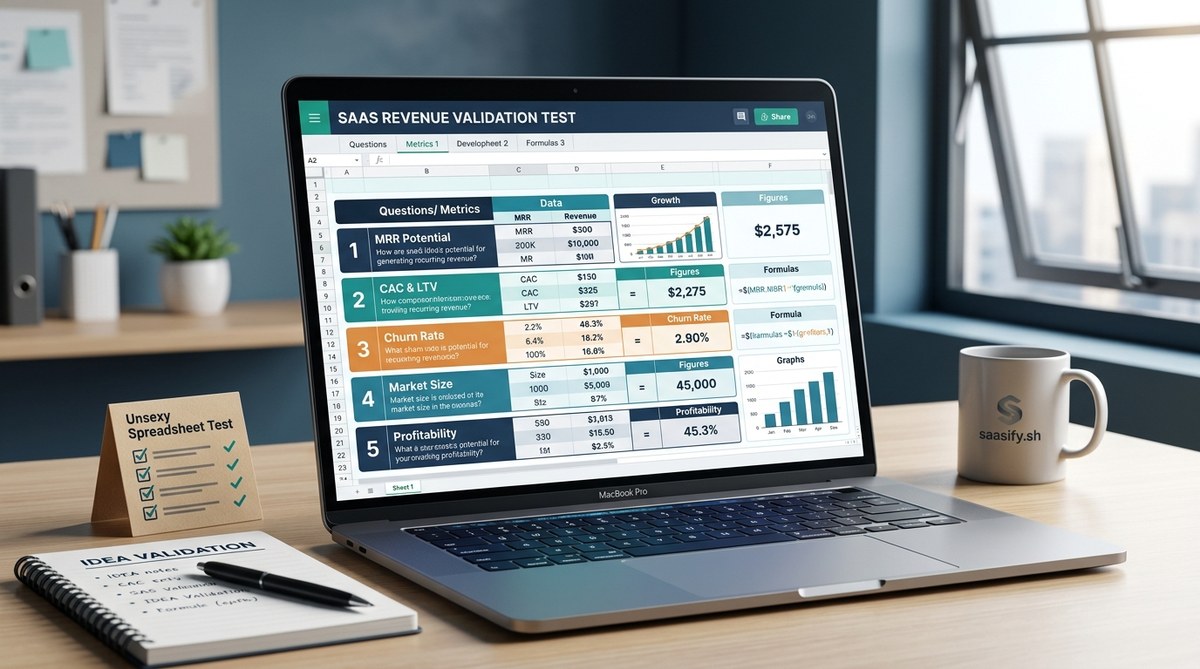
You have a notebook full of SaaS ideas. Some came from late-night brainstorming sessions. Others from frustrations at your day job. A few are just scribbles from something you overheard at a coffee shop.
But here is the hard truth. Most of those ideas will never generate a single dollar in recurring revenue. The ones that do share a set of common traits. And you can predict those traits before writing a line of code.
This is not about gut feelings or asking your friends if they would pay for something. It is about running a cold, unsexy spreadsheet test that separates viable subscription businesses from expensive distractions. Let us walk through the five questions that matter most.
A SaaS idea that passes this five-question test has a strong foundation for recurring revenue. You need a painful recurring problem, a clear monthly value metric, a market that pays for subscriptions, a defensible moat, and a distribution channel you can actually use. Skip any one of these and your MRR will struggle. Run every idea through this spreadsheet before you build anything.
Question 1: Does This Problem Recur Every Month?
The biggest mistake new founders make is building a tool that solves a one-time problem. You cannot generate recurring revenue from a service people use once.
Think about tax preparation software. You use it once a year. That is why most tax tools charge per filing or offer annual subscriptions with low retention. The problem does not happen often enough to justify a monthly payment.
Now compare that to email marketing software. A business sends emails every week. They need to manage lists, track opens, and test subject lines. The problem recurs constantly. That is why Mailchimp and ConvertKit can charge every single month.
How to test this in your spreadsheet:
- List the specific trigger that makes someone open your app.
- Ask yourself how many times that trigger happens in a typical month.
- If the answer is less than four, you have a retention problem.
Your goal is a problem that surfaces at least weekly. Daily is even better. The more often the pain appears, the more natural a monthly subscription feels.
Question 2: Can You Define a Value Metric That Scales?
Flat-rate pricing is dangerous for early-stage SaaS. You either leave money on the table or you charge too much for small customers. The best SaaS companies tie their price to a value metric that grows with the customer.
Consider Slack. They charge per active user. A 10-person team pays less than a 200-person company. The customer gets more value as they add people, and Slack gets paid more. Everyone wins.
Value metric examples that work:
- Number of projects or active clients
- Amount of data processed or stored
- Team members or seats
- API calls or transactions
- Reports generated per month
How to test this in your spreadsheet:
- Write down the core action your product enables.
- Identify the unit that increases when the customer gets more value.
- Confirm that unit is something the customer tracks internally.
If you cannot find a clear value metric, your pricing will feel arbitrary. And arbitrary pricing kills recurring revenue.
Question 3: Does the Market Already Pay for Subscriptions?
You can educate a market on a new problem. You can even teach them a new workflow. But convincing people to pay a monthly subscription for something they have never paid for before is a brutal uphill battle.
Look for industries where subscription billing is already normal. Project management tools, CRM software, help desk platforms, email marketing, analytics dashboards. People in these spaces understand the monthly payment model.
Avoid markets where everything is bought with a one-time license or a contract. Some verticals like construction scheduling or medical practice management are slowly shifting, but you do not want to be the one teaching them how subscriptions work.
How to test this in your spreadsheet:
- Identify three existing products your target customers already pay for monthly.
- Look up their pricing pages.
- If you cannot find any, that is a warning sign.
If your competitors charge annually or per project, your subscription pitch will confuse buyers. Stick to spaces where recurring billing is the norm.
Question 4: What Is Your Defensible Moat?
A great idea with no moat is a feature, not a business. If a bigger company can copy your core functionality in a weekend, you will never build sustainable recurring revenue.
Types of moats that protect SaaS revenue:
- Data network effects. The product gets smarter as more people use it. Think of a spam filter or a recommendation engine.
- Workflow lock-in. The product becomes embedded in daily operations. Think of a CRM that stores all customer history.
- Integration debt. The product connects to five other tools the company uses. Replacing it means reconnecting everything.
- Compliance or regulation. The product handles certified data or legal requirements.
How to test this in your spreadsheet:
- List the top three reasons a customer would stay with you for three years.
- If those reasons are purely about features, you have no moat.
- If those reasons include data, integrations, or workflow, you have something.
A moat does not need to be complex. A simple tool that syncs with QuickBooks and stores years of transaction history is hard to walk away from. That is enough.
Question 5: Can You Reach Your First 100 Customers Without Paid Ads?
This is the question that kills the most ideas. You can have a perfect product with a strong moat and a recurring problem, but if you cannot get in front of buyers, you have nothing.
Distribution channels that work for indie founders:
- Niche communities (Reddit, LinkedIn groups, industry Slack channels)
- Content marketing targeting long-tail search terms
- Partnerships with complementary tools
- Direct outreach to businesses in a specific vertical
- Building in public on Twitter or Mastodon
How to test this in your spreadsheet:
- Write down exactly where your first 100 customers spend their time online.
- Estimate how many hours per week you can dedicate to that channel.
- Be honest. If you hate writing, do not bet on a content strategy.
If you cannot name three specific distribution channels you can use this week, your idea is not ready. Go back and find a problem in a market you already know how to reach.
The Scoring System for Your Spreadsheet
Here is how to turn these five questions into a usable score. Create a spreadsheet with one row per idea and five columns.
| Question | Weak (1 point) | Okay (2 points) | Strong (3 points) |
|---|---|---|---|
| Problem recurrence | Happens monthly or less | Happens weekly | Happens daily |
| Value metric | No clear metric | Exists but hard to track | Clear and scales naturally |
| Subscription market | No existing subscriptions | Some competitors use subscriptions | Market expects monthly billing |
| Defensible moat | Pure feature play | Some integration lock-in | Data or network effects |
| Distribution access | No known channel | One viable channel | Multiple proven channels |
Score each idea. Anything below 10 points needs serious rethinking. A score of 12 or higher means you have a solid candidate for recurring revenue.
Common Mistakes That Skew Your Results
Mistake 1: Overestimating problem frequency.
Founders often think their problem happens more often than it does. Talk to real potential users. Ask them to describe the last time they faced this issue. If they struggle to remember, the frequency is lower than you think.
Mistake 2: Confusing features with value metrics.
Number of users is a value metric. Number of button clicks is not. Your metric must reflect the value the customer receives, not just an activity counter.
Mistake 3: Assuming your personal network is a distribution channel.
Your friends and former coworkers are not a scalable channel. Once you exhaust that list, what happens? Make sure your distribution strategy works on strangers.
Putting the Test into Action
Grab a spreadsheet right now. List your top three SaaS ideas. Run each one through these five questions. Score them honestly.
The idea that scores highest is not necessarily the one you are most excited about. That is fine. Excitement fades. Recurring revenue does not.
If an idea scores below 10, do not abandon it completely. Look at where it lost points. Can you pivot the problem to something more recurring? Can you find a different market that already pays monthly? Sometimes a small tweak moves a 7-point idea to a 13-point winner.
For a deeper look at how to validate your concept before committing, read our guide on how to validate your SaaS idea before writing a single line of code. It pairs well with this spreadsheet test.
The Unsexy Truth About Recurring Revenue
There is no magic formula. No secret growth hack. The SaaS products that generate reliable monthly revenue do so because they solve a painful, recurring problem for a market that is ready to pay. They have a clear value metric and a moat that keeps customers around.
The spreadsheet test is boring. It does not involve fancy tools or viral launches. But it works. Every successful indie SaaS I have studied passes at least four of these five questions.
So open a new spreadsheet. Run your ideas through this filter. Let the numbers guide you toward the idea that actually generates recurring revenue. Your future self will thank you when the MRR starts hitting your bank account every single month.