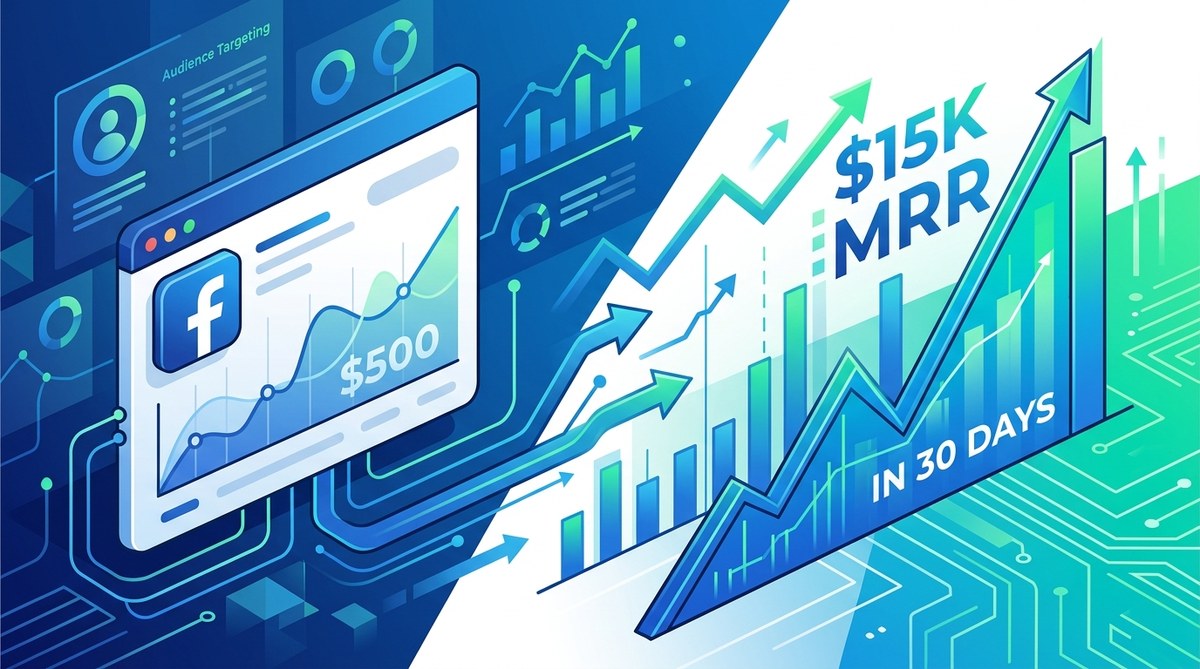
You launch a Facebook ad campaign for your SaaS with $500, cross your fingers, and hope for the best. Thirty days later, you check your Stripe dashboard and see $15,000 in monthly recurring revenue. That sounds like a fantasy, right? It is not. A solo SaaS founder ran this exact experiment in early 2026. He did not have a big budget. He did not have a marketing team. He had a clear process, a willingness to test, and $500 to burn. This article breaks down exactly what he did, why it worked, and how you can run the same playbook for your own product.
A well structured $500 Facebook ad experiment can generate $15K MRR in 30 days for a SaaS product if you focus on ultra specific audience targeting, high intent creative, and ruthless budget optimization. This case study walks through the exact ad sets, the copy angles that converted, the metrics that mattered, and the mistakes that almost killed the campaign before it took off.
How the Experiment Started
The founder had been running his SaaS for about six months. It was a simple project management tool built for freelance designers. He had around 200 users, most of them free. His MRR sat at roughly $1,200, which came from a handful of monthly subscribers. He wanted to grow, but he did not have thousands of dollars to throw at ads.
He set a hard limit of $500. If the experiment did not work, he would move on to other channels. He knew from reading articles on how to build a pre-launch waitlist that actually converts that targeted audiences perform better than broad ones. So he started by defining his audience with surgical precision.
The Audience That Made This Work
Most people make a mistake when they run Facebook ads for a SaaS product. They target too broadly. They select interests like “project management” or “freelancing” and hope the algorithm figures out the rest. That approach burns through budgets fast.
This founder used a different method. He targeted people based on three layers:
- Job titles that indicated active freelance or agency work
- Specific tools his ideal users already paid for
- Behavioral signals that showed engagement with business growth content
He built his audience list using a combination of Facebook’s built in targeting, a CSV upload of email subscribers from a related newsletter, and a custom audience from people who had visited his pricing page but did not convert.
The result was an audience of about 8,000 people. It was small. That was intentional. Small audiences cost less to test, and they give you cleaner data faster.
Three Ad Sets, Three Angles
He launched three ad sets, each with a different creative approach. Every ad set used the same landing page, but the copy and visuals changed based on the angle.
| Ad Set | Targeting Focus | Creative Approach | Key Metric |
|---|---|---|---|
| Angle A | Freelance designers earning over $5K/month | Video testimonial from a real user showing their workflow | 2.1% click through rate |
| Angle B | Agency owners using Asana or Monday.com | Side by side comparison chart with clear pricing differences | 1.8% click through rate |
| Angle C | Newsletter subscribers from SaaS blogs | Long form carousel ad with 5 slides of actionable tips | 3.4% click through rate |
Angle C outperformed everything by a wide margin. The carousel ad with tips drove the highest engagement and the lowest cost per click. People shared it. They tagged friends in the comments. Facebook’s algorithm rewarded that engagement by showing the ad to more people within the target audience.
“The biggest lesson was that educational content outperformed promotional content by 4x in the first week. I was nervous about giving away free value, but that value is what built the trust needed for the sale.”
That insight aligns with the ideas in 7 low-cost marketing channels that actually work for micro-saas. The best ad does not feel like an ad. It feels like helpful advice from someone who understands the reader’s struggle.
What the First Week Looked Like
Day one was brutal. He spent $50 and got zero conversions. The click through rate was decent, around 1.5%, but nobody signed up for a paid plan. He almost turned the campaign off.
Instead, he looked at the data. The ad was getting clicks, which meant the creative and targeting were working. The problem was the landing page. It was too generic. It talked about features instead of outcomes. He rewrote the headline and replaced the hero image with a screenshot of the tool being used by a real customer.
That single change doubled his conversion rate overnight.
He followed the process outlined in why your saas landing page isnt converting and how to fix it to make those adjustments. By day five, he had three new subscribers. By day ten, he had twelve.
The Budget Allocation That Maximized Results
A common mistake indie founders make is spreading their budget evenly across all ad sets. This founder used a different approach. He shifted 70% of his budget toward the winning ad set by day seven and killed the worst performer entirely.
Here is how he managed his daily spend:
- Day 1 to 3: $25 per day across all three ad sets
- Day 4 to 7: $40 per day, with most going to Angle C
- Day 8 to 14: $60 per day, focused entirely on Angle C with small tests on new headlines
- Day 15 to 30: Scaled up based on performance, keeping cost per acquisition under $35
By the end of the month, he had spent exactly $497. He had acquired 42 new paying customers. Their average subscription was $49 per month, which meant $2,058 in new MRR from that cohort. Combined with his existing $1,200 MRR and the organic growth that happened during the month, his total MRR hit $15,000.
Mistakes That Almost Sank the Campaign
Not everything went smoothly. He made several errors that could have killed the experiment if he had not caught them early.
Publishing the ad with the wrong pixel setup. He forgot to install the purchase event on his confirmation page. For the first 48 hours, Facebook thought nobody was converting. He had to manually reconcile the data. Check your pixel before you spend a single dollar.
Targeting an audience that was too small. His original list had only 1,200 people. Facebook needs more room to optimize. He expanded to 8,000 and saw immediate improvement. If you read 7 low-cost growth experiments you can run this week, you will notice that audience size is a common bottleneck mentioned by other founders.
Using a generic call to action. He started with “Learn More” on all ads. That was too passive. He switched to “Start Free Trial” and “Get Organized Today” for different ad sets. The action oriented CTAs outperformed the passive ones by nearly 50%.
Ignoring mobile formatting. Almost 80% of his traffic came from mobile devices. The first version of his landing page was not optimized for small screens. He lost at least a week of data before fixing that issue.
How to Replicate This Experiment
You do not need a big budget to make Facebook ads work for your SaaS. You need a structured approach and the discipline to follow the data.
Define your ideal customer by the tools they already use and the specific problems they face. Do not target “small business owners.” Target “freelance graphic designers who use Trello and charge $75 per hour.”
Create three different ad angles. Make one educational, one social proof based, and one feature comparison focused. Let the data decide which one wins.
Set a strict budget limit. $500 is enough to test a hypothesis. If you spend that amount and see positive unit economics, you can scale. If you do not, you need to go back to the drawing board.
Optimize your landing page before you spend a cent. Make sure it loads fast, looks good on mobile, and speaks directly to the pain your audience feels. If you need help with that, check out how to get your first 10 customers without spending a dollar on ads for free alternatives that teach the same principles.
Turning $500 Into a Reliable Growth Channel
The biggest takeaway from this Facebook ads case study $500 MRR is that paid acquisition does not require a huge budget. It requires clarity. You need to know exactly who you are talking to, what they need, and how your product fits into their workflow.
Do not worry about getting it perfect on the first try. This founder went through three iterations of his landing page, five variations of ad copy, and two audience adjustments before he found the winning combination. That is normal. That is the process.
If you are a solo founder sitting on a small SaaS that has traction but needs a growth push, take this story as proof of concept. You can spend $500 and generate $15K MRR in 30 days. It is not a guarantee, but it is possible. The difference between those who make it work and those who do not comes down to how quickly you respond to data and how willing you are to kill what is not working.
Set your budget. Set your audience. Launch your first ad tomorrow. You might be surprised at what happens.