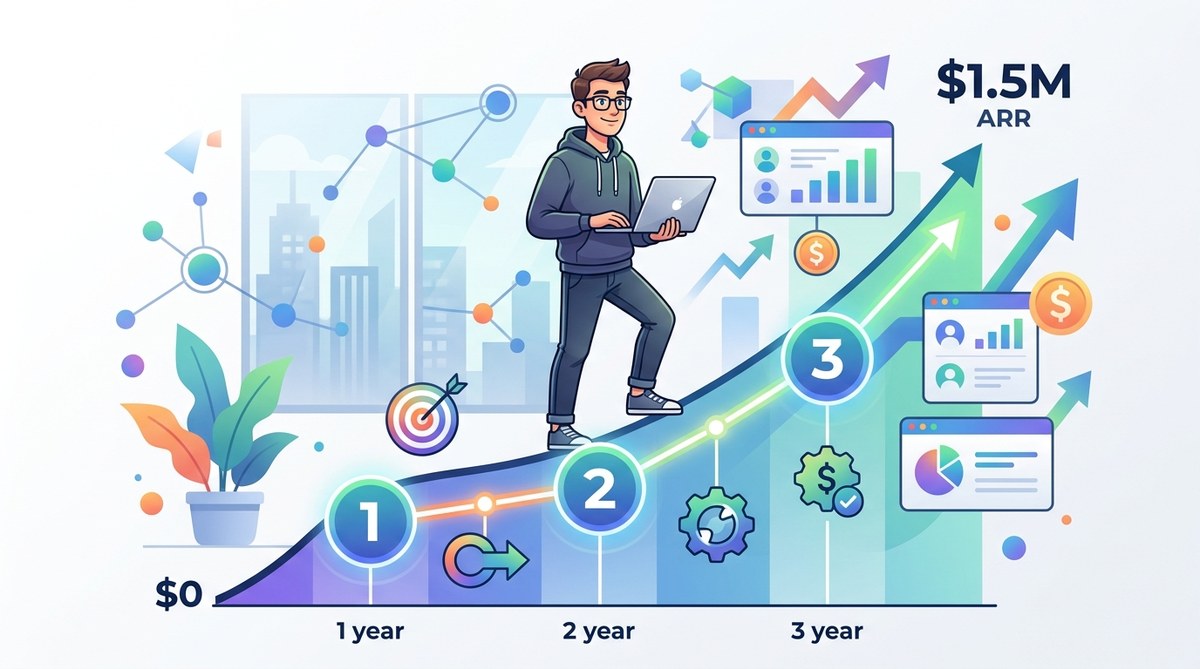
Three years ago, a developer sat alone in a spare bedroom with a laptop and an idea. No team. No funding. No customers. Today, that same person runs a profitable SaaS business generating $1.5 million in annual recurring revenue. How did they do it? Three specific decisions made all the difference.
This case study reveals how a solo founder reached $1.5M ARR by focusing on three critical decisions: choosing a narrow B2B niche, building a high-ticket pricing model, and leveraging community-driven growth. You will learn actionable steps to replicate this path, plus common mistakes to avoid. Whether you are at $0 or $10K MRR, these strategies can accelerate your journey.
Decision One: Picking a Niche That Big Companies Ignore
The founder did not build yet another project management tool or email marketing platform. Instead, they targeted a vertical that seemed boring to most people: compliance documentation for small healthcare clinics. The average clinic had no dedicated IT team, but they needed to meet HIPAA standards. Competitors offered enterprise software that cost tens of thousands per year and required a full implementation consultant. No one bothered to build a simple, affordable solution for the mom-and-pop clinics.
That narrow focus gave the founder three advantages:
- Small competitive pressure: No VC-backed startup was fighting for this market.
- High willingness to pay: Clinics risked fines if they did not comply, so $200 per month was an easy sell.
- Word-of-mouth density: Clinic owners talk to each other in industry forums and local meetups.
If you are still searching for your niche, start with finding SaaS ideas in Reddit comments. It is a thirty-minute daily habit that surfaces exactly these kinds of underserved segments.
Decision Two: Charging More Than They Felt Comfortable With
The founder initially planned to price the product at $29 per month. Then they looked at what the clinics were already paying for manual compliance work: $500 to $1,000 per month for a part-time consultant. The SaaS automated most of that work. So the founder set the price at $199 per month.
That one change transformed the economics of the business.
| Price Point | Customers Needed for $1.5M ARR | Monthly Mindset |
|---|---|---|
| $29/mo | 4,300+ | Churn risk high, support cost eats margin |
| $99/mo | 1,260 | Moderate acquisition cost acceptable |
| $199/mo | 628 | Fewer customers, deeper relationships |
| $499/mo | 250 | Requires sales calls, not solo-friendly |
The $199 tier hit a sweet spot. It was low enough that a clinic owner did not need approval from a board, but high enough that the founder could survive with only 50 customers in the first year. Today, 628 customers generate $1.5M ARR. The founder never hired a salesperson. They never ran a paid ad. All growth came from organic referrals and content.
If you struggle with pricing, read how to price your SaaS product when you have zero customers. It walks through the same value-based approach.
Decision Three: Building Growth Into the Product Itself
The third decision was to stop thinking about marketing as a separate activity. Instead, the founder designed the product to generate its own distribution. Every time a clinic completed a compliance audit, the tool generated a PDF summary that included a small footer: “Generated by [App Name]. Try it free.” That PDF often got shared with insurance auditors, state regulators, and other clinics. Each shared document was a free impression.
The founder also added a simple referral program: existing users could send an invite link and both parties got a month free. No complicated dashboards, no affiliate tiers, just a clean link. Over time, these two mechanisms produced a steady stream of inbound leads.
Here is the exact process they followed to set up this engine:
- Identify the most common output your users already share (report, invoice, dashboard screenshot).
- Add a non-intrusive brand mention to that output.
- Build a one-click referral flow inside the product, not as a separate email campaign.
- Track the share rate and optimize the placement of the brand mention.
- Reward referrers with something that reduces their cost of using your product.
For a deeper look at retention loops, see building your first growth loop for indie SaaS.
Common Mistakes That Trip Up Solo Founders
Even with the right decisions, the founder made mistakes along the way. Here are three traps you should avoid:
| Mistake | What Happened | What Fixed It |
|---|---|---|
| Adding too many features too early | Confused users and slowed development | Started a strict “one feature per month” rule |
| Ignoring churn signals | Lost 10% of MRR in month 7 | Built an automated check-in email when a user stops logging in |
| Trying to write all content alone | Burnout and stalled traffic | Hired a part-time writer for blog posts and case studies |
The founder credits their recovery from burnout to a simple operating cadence. They switched to a four-day work week and automated customer support with a knowledge base and chatbot. That freed up six hours per week to focus on the highest-impact tasks.
“The best decision I made was to treat my time like it was the only currency that mattered. Every hour I spent on manual support was an hour I could not spend improving the product or talking to users. Once I automated the repetitive stuff, the business started growing faster than I could handle.”
The anonymous founder, in an interview with a private community
Turning Zero Into a Repeatable System
The real takeaway from this story is not that the founder was unusually smart or lucky. They simply made three high-leverage choices early on:
- Niche down to a market that incumbents ignore.
- Price high based on the value you deliver, not what competitors charge.
- Engineer growth into the product so every user becomes a marketer.
These three decisions form a repeatable system. You can apply them to any idea, at any stage. If you are currently at zero, start with how to validate your SaaS idea before writing a single line of code. That will save you months of building something nobody wants.
Once you have validation, move to how to build a SaaS MVP in 30 days without burning out. Then implement the pricing and referral patterns above.
The founder of this $1.5M ARR business still works alone. They answer support emails themselves. They ship code every week. They do not have investors telling them what to do. That freedom was the whole point of going solo in the first place.
You can build that too. Start small. Pick one decision from this article and act on it this week. That is the only way from zero to something real.