
You’ve experienced a frustrating problem firsthand. You built a solution that works perfectly for you. Now you’re ready to turn it into a business because if you needed it, surely thousands of others do too. This logic feels bulletproof until you realize you’ve spent six months building features only you care about while your target market yawns and scrolls past your landing page.
Building a scratching your own itch startup can work brilliantly or fail spectacularly depending on whether your problem represents a real market need. Success requires validating that others share your pain point, will pay to solve it, and need the same solution you built rather than a different approach entirely.
Why building for yourself feels so compelling
The scratching your own itch startup approach has genuine appeal. You understand the problem deeply because you live it every day. You know exactly what features matter and which ones are just noise. You can test your product constantly without recruiting beta users or scheduling interviews.
This intimate knowledge creates confidence. You don’t need to guess what users want because you are the user. Product decisions feel obvious instead of agonizing. Building becomes faster when you’re not constantly second-guessing whether a feature will resonate.
Many successful companies started this way. Mailchimp began when the founders needed email marketing for their design clients. GitHub emerged from developers wanting better version control tools. Basecamp grew from an agency needing project management software.
These success stories reinforce the idea that personal pain points make the best business opportunities.
But survivorship bias hides the graveyard of failed products built by founders who assumed their problems were universal.
The three types of personal problems
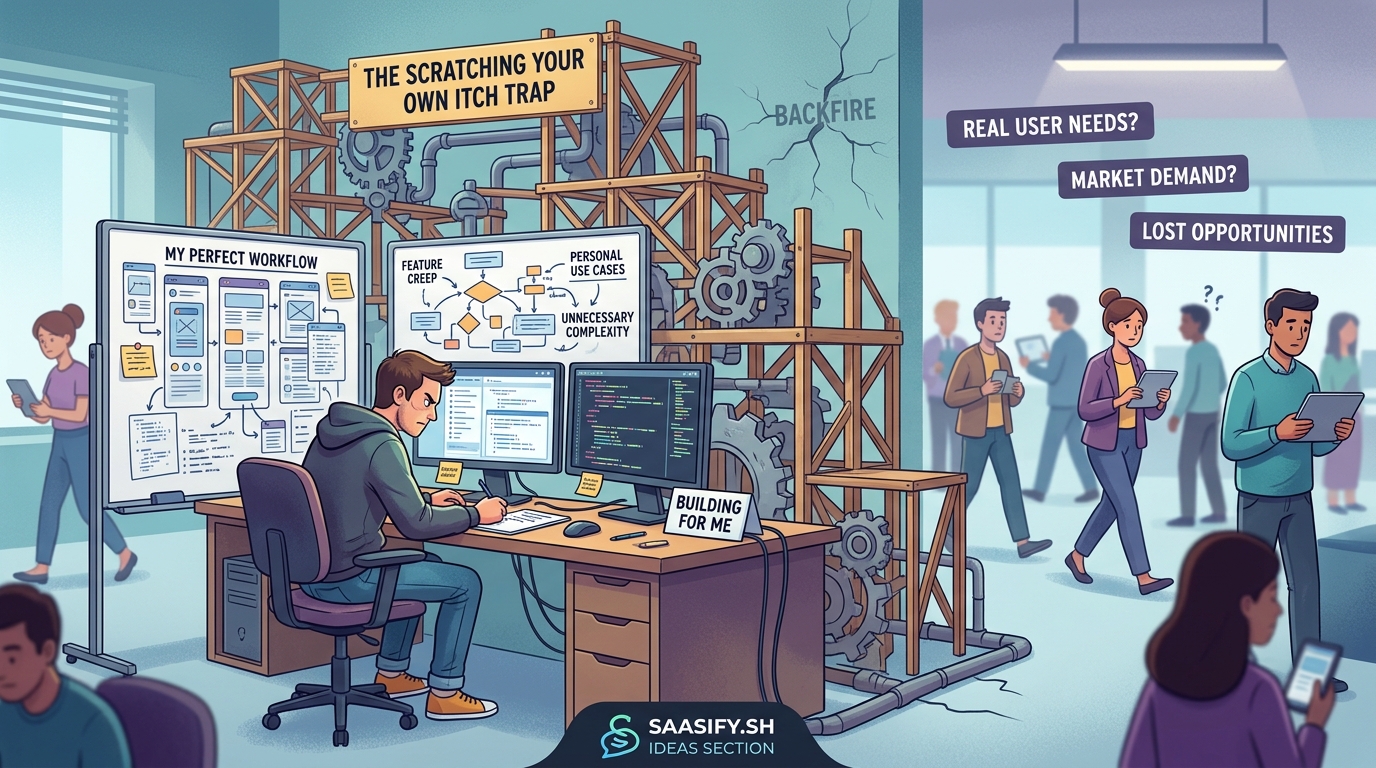
Not all personal problems translate into viable businesses. Understanding which category your problem falls into determines whether a scratching your own itch startup makes sense.
Universal problems affect millions of people the same way. Email overload, password management, and file sharing frustrate nearly everyone who works digitally. Solutions to universal problems have obvious market potential because the target audience is enormous and the pain point is widely recognized.
Niche problems affect a specific group intensely. Freelance designers need invoice tracking. Podcast editors want better audio cleanup tools. Real estate agents require CRM systems with property-specific features. These problems support sustainable businesses when the niche is large enough and willing to pay.
Personal quirks affect mainly you. Maybe you want a task manager that sorts by moon phase or a note-taking app that only accepts haiku format. These problems feel real to you but don’t represent meaningful market demand.
The challenge is accurately categorizing your problem. Founders consistently overestimate how many people share their specific pain point and underestimate how differently others might want to solve it.
When your solution doesn’t match market needs
You built a solution that works perfectly for your workflow. You assumed others would love it too. Then you talk to potential customers and discover they want something completely different.
This disconnect happens constantly with scratching your own itch startups. You’re a developer who hates visual interfaces, so you built a command-line tool. Your target market consists of non-technical users who need a graphical interface. You created the wrong solution for the right problem.
Or you’re a solo founder who built elaborate automation because you have time to set it up. Your customers are busy managers who need something that works immediately without configuration. You solved the problem in a way that only works for people exactly like you.
The market might agree the problem exists but reject your specific implementation. This creates a painful situation where validation interviews confirm the pain point but nobody converts to paid users because your solution doesn’t fit their context.
Consider this comparison:
| Your Situation | Market Reality | Result |
|---|---|---|
| You work alone and need deep focus tools | Target users work in teams and need collaboration | Feature mismatch |
| You have technical skills to customize everything | Users want plug-and-play simplicity | Complexity barrier |
| You’re willing to pay $50/month for perfect tools | Market expects freemium or $10/month max | Pricing disconnect |
| You need desktop software for power features | Users primarily work on mobile devices | Platform mismatch |
These gaps emerge because you optimized for your specific circumstances rather than the broader market’s needs.
The dangerous assumption about willingness to pay
You pay $100 monthly for tools that solve your problems. You assume others will too. This assumption often proves false because your financial situation and priorities don’t represent your target market.
Developers building for other developers often make this mistake. They’re comfortable with SaaS pricing and expense tools freely. They build products with developer-tier pricing and wonder why freelancers and small agencies balk at the cost.
The inverse happens too. A founder struggling financially builds a cheap solution and prices it at $5 monthly. The product actually solves expensive problems for well-funded companies who would happily pay $500 monthly. The founder leaves massive revenue on the table by pricing based on personal budget constraints.
Your willingness to pay reflects your income level, industry norms, company size, and personal values. These factors rarely match your entire target market.
Successful founders validate pricing separately from problem validation. Just because someone confirms they have the problem doesn’t mean they’ll pay what you need to charge to build a sustainable business.
How to validate beyond your own experience
Start by talking to people who share the problem but differ from you in meaningful ways. If you’re technical, interview non-technical users. If you work alone, talk to team leads. If you’re in startups, speak with enterprise employees.
Look for patterns in how they currently solve the problem. Do they use spreadsheets? Hire assistants? Just tolerate the pain? Their current solutions reveal what they value and what they’re willing to change.
Pay attention to the language they use to describe the problem. If their words don’t match yours, your marketing will miss them even if your solution works. A founder might call something “API rate limiting” while users search for “why does the app keep saying try again later.”
Watch for the problems they mention that you never considered. You might be solving problem A while the market desperately needs help with related problem B that you barely notice because you handle it easily.
The problem-first framework helps structure this research so you gather actionable insights rather than confirmation bias.
Building the right validation process
Follow these steps before committing to a scratching your own itch startup:
- Document your problem and solution in detail, including why you built it this specific way.
- Identify at least three meaningful ways you differ from your target market (technical skills, company size, budget, industry, etc.).
- Interview 15-20 people who have the problem but differ from you in those ways.
- Map out their current solutions and what they’ve tried before.
- Show them your solution and watch where they get confused or excited.
- Ask what they’d pay and whether they’d start using it this week if you gave them access.
- Look for patterns in feedback that contradict your assumptions.
This process reveals whether you’re building for a market or just for yourself.
The validation doesn’t stop at confirming the problem exists. You need evidence that your specific solution approach resonates and that people will actually switch from their current method to yours.
Many founders skip step six because they fear rejection. They’d rather build for months and launch to crickets than hear “no” during interviews. This avoidance wastes far more time than honest early feedback.
Red flags that you’re building only for yourself
Certain warning signs indicate your scratching your own itch startup won’t translate to broader market success.
You can’t find anyone else who has solved this problem commercially. Either the problem isn’t painful enough for people to pay for solutions, or you’re the only person who experiences it this way. Both scenarios spell trouble.
Everyone you talk to says “that’s interesting” but nobody asks when they can start using it. Polite interest without urgency means the problem isn’t painful enough to drive purchasing decisions.
You keep adding features that make sense to you but confuse everyone you show them to. This suggests you’re optimizing for your specific workflow rather than building for a broader audience.
People agree they have the problem but already have solutions they’re happy with. Your solution might be better by your metrics, but “better” doesn’t matter if the current solution is good enough and switching costs are high.
You find yourself explaining why users should want your approach rather than listening to what they actually want. This reversal indicates you’re pushing your solution instead of solving their problem.
When validating your SaaS idea, these red flags should trigger a pause, not a rationalization.
Making the approach work anyway
Scratching your own itch can succeed when you follow specific practices that prevent the common pitfalls.
Stay in constant contact with users who aren’t you. Build a feedback group of at least ten people who use your product regularly and differ from you in meaningful ways. Check every major decision against their input.
Separate your personal use case from the product roadmap. You can build features for yourself, but mark them clearly as personal preferences rather than market-driven priorities. When time is limited, market needs come first.
Price based on value to customers, not what you’d pay. Research what they currently spend on alternative solutions and how much the problem costs them. Your personal budget is irrelevant to pricing strategy.
Build the simplest version that solves the core problem for the broadest group. Your advanced features might be crucial for you but unnecessary for most users. Start simple and add complexity only when multiple users request it.
Test your assumptions constantly. Every time you think “users will obviously want this,” stop and verify. The word “obviously” in product development usually precedes expensive mistakes.
Consider whether building features users actually want requires stepping back from your own preferences.
The market size question
Your problem might be real and your solution might work, but if only 500 people worldwide share this exact pain point, you don’t have a business. You have an expensive hobby.
Calculate rough market size before building. How many people or companies have this problem? What percentage would realistically pay for a solution? What could you charge based on the value you provide?
A scratching your own itch startup often targets a market of one (you) or a tiny niche. This works if you’re building a lifestyle business with modest revenue goals. It fails if you need significant growth to justify the time investment.
Some founders discover their personal problem represents a tiny segment of a much larger market. Maybe you built a tool for Python developers, but the real opportunity is serving all developers regardless of language. Recognizing this early lets you broaden your approach before you’re locked into a narrow positioning.
Others find their problem is widespread but nobody pays to solve it because free alternatives exist or the pain isn’t intense enough. Knowing this before you build saves months of wasted effort.
Research profitable micro-SaaS niches to understand what market sizes actually support sustainable businesses.
Common mistakes that kill these startups
Founders building scratching your own itch startups make predictable errors that doom their products.
Assuming technical sophistication. You’re comfortable with APIs, webhooks, and configuration files. Most users aren’t. Building a tool that requires technical knowledge to use limits your market to people exactly like you.
Ignoring onboarding. You know how your product works because you built it. New users face a blank screen and confusion. Without smooth onboarding, they leave before experiencing value.
Over-engineering. You enjoy building elegant systems and handling edge cases. Users want their problem solved with minimum friction. Your beautiful architecture means nothing if the core workflow is clunky.
Pricing based on costs rather than value. You calculate hosting expenses and your hourly rate, then price accordingly. Users don’t care about your costs. They care whether your solution is worth more than alternatives.
Building features for future you instead of current users. You know you’ll need advanced features eventually, so you build them now. Meanwhile, basic functionality that would help current users gets neglected.
The table below shows how founder priorities often misalign with market needs:
| What Founders Build First | What Markets Need First | Impact on Adoption |
|---|---|---|
| Advanced customization options | Simple default settings that work immediately | Users abandon during setup |
| Comprehensive documentation | Intuitive interface that needs no documentation | Reading docs feels like homework |
| API for integrations | Core features that work standalone | Chicken-and-egg integration problem |
| Edge case handling | Reliable solution for common scenarios | Over-complexity slows development |
When to pivot away from your original vision
Sometimes you need to abandon your scratching your own itch startup approach entirely. Recognizing this early prevents years of struggle.
If validation interviews consistently reveal that users want something fundamentally different from what you built, pivot. Your attachment to your solution shouldn’t override market reality.
When you realize your problem is too niche to support a business, pivot to a related but broader problem. Maybe your specific workflow issue affects few people, but a adjacent problem impacts thousands.
If users love your product but won’t pay enough to make it sustainable, pivot to a different market segment or business model. Sometimes the same solution works better as an enterprise tool than a consumer product, or vice versa.
Consider pivoting when you find yourself constantly explaining why your approach is better instead of users immediately understanding the value. This suggests a fundamental misalignment between your vision and market needs.
The decision to pivot feels like failure but often leads to eventual success by redirecting effort toward viable opportunities.
Balancing personal insight with market research
The best scratching your own itch startups combine personal experience with rigorous market validation. Your experience provides the initial insight. Market research determines whether that insight translates to business opportunity.
Use your personal pain point as a starting hypothesis, not a conclusion. You’ve identified a potential problem worth investigating. Now gather evidence about whether others share it and would pay to solve it.
Let your experience inform product decisions without dictating them. You understand the problem domain deeply, which helps you build better solutions. But stay open to approaches you wouldn’t personally choose if they serve the market better.
Build for the intersection of what you understand and what the market needs. Your unique insight matters most when it reveals something others missed. It matters least when it reflects only your idiosyncrasies.
Consider whether your background gives you an unfair advantage in this space. A developer who spent years in healthcare can build better healthcare software than someone scratching their own itch in an unfamiliar industry. Domain expertise amplifies the scratching your own itch approach.
Testing your idea before building
Before writing code, validate whether your scratching your own itch startup idea has market potential.
Create a landing page describing the problem and solution. Drive traffic through relevant communities and measure interest. If nobody signs up for your waitlist, you’ve learned something valuable without building anything.
Offer manual delivery of your solution before automating it. If you want to build a tool that automates report generation, offer to create reports manually for early customers. If nobody pays for the manual version, they won’t pay for the automated one.
Build a minimal prototype that demonstrates the core value. Skip polish, edge cases, and nice-to-have features. Show it to potential users and watch whether they get excited or confused.
The pre-launch waitlist approach tests market interest before you invest months in development.
Sell before you build when possible. Take pre-orders or commitments from early customers. Real money validates demand better than any survey or interview.
Learning from successful scratching your own itch startups
Companies that succeeded with this approach share common patterns worth studying.
They validated beyond their own experience early. The founders might have started with personal pain, but they talked to dozens of potential users before building extensively.
They stayed flexible about implementation. The final product often looked different from the founder’s initial personal solution because they adapted to market feedback.
They found markets where their specific perspective provided advantage. A founder who experienced the problem in a professional context often builds better solutions than someone who encountered it casually.
They recognized when their personal preferences diverged from market needs and chose the market. Successful founders build what sells, not just what they personally want.
They combined domain expertise with the personal problem. Knowing the industry deeply made their personal insight more valuable because they understood the broader context.
Why some personal problems make terrible businesses
Certain types of personal problems never translate into viable businesses no matter how real they feel.
Problems you have because of unusual circumstances. If you need a tool because you’re managing 47 side projects simultaneously, you’re an outlier. Most people don’t have this problem because they shouldn’t have 47 side projects.
Problems caused by your unwillingness to change behavior. Maybe you need a complex system because you refuse to adopt industry-standard practices. Building software to support your quirky workflow doesn’t create a business.
Problems that only exist at your specific scale. You might need sophisticated automation because you process 10,000 items daily. Users processing 50 items daily don’t need or want that complexity.
Problems you only notice because of your technical background. You might be annoyed by inefficient database queries that add 50 milliseconds to page loads. Regular users don’t notice or care.
Problems that free alternatives already solve adequately. Your custom solution might be better, but “better” doesn’t matter if good enough is free.
Building a sustainable business model
Even when your scratching your own itch startup solves a real market problem, you need a business model that works.
Determine whether this is a one-time purchase, subscription, or usage-based product. Your personal preference doesn’t matter. Choose based on how customers prefer to pay and what aligns with your cost structure.
Calculate unit economics early. How much does each customer cost to acquire? How much revenue do they generate? How long do they stay? If the math doesn’t work, the business won’t work regardless of how good your product is.
Consider your pricing strategy based on value delivered, not your costs or what you’d personally pay. Research what customers currently spend on alternatives and price accordingly.
Think about pricing when you have zero customers using frameworks that account for market dynamics rather than personal assumptions.
Plan your path to first revenue. How will you find customers? What channels will you use? How long can you sustain development before you need income? These practical questions matter more than product perfection.
Moving forward with confidence
A scratching your own itch startup can work brilliantly when you validate properly and stay honest about whether you’re building for a market or just for yourself.
Your personal experience provides valuable insight into real problems. Use that insight as a starting point, not a destination. Test your assumptions. Talk to people different from you. Build what the market needs, not just what you want.
The best products often come from founders who experienced the problem firsthand but had the discipline to validate broadly before building deeply. Your pain point might be the seed of something valuable. Just make sure you’re planting it in fertile soil, not just your own backyard.
Start by writing down three ways you differ from your target market. Then go find ten people who have your problem but don’t share those differences. Their feedback will tell you whether you’re building a business or just building for yourself.