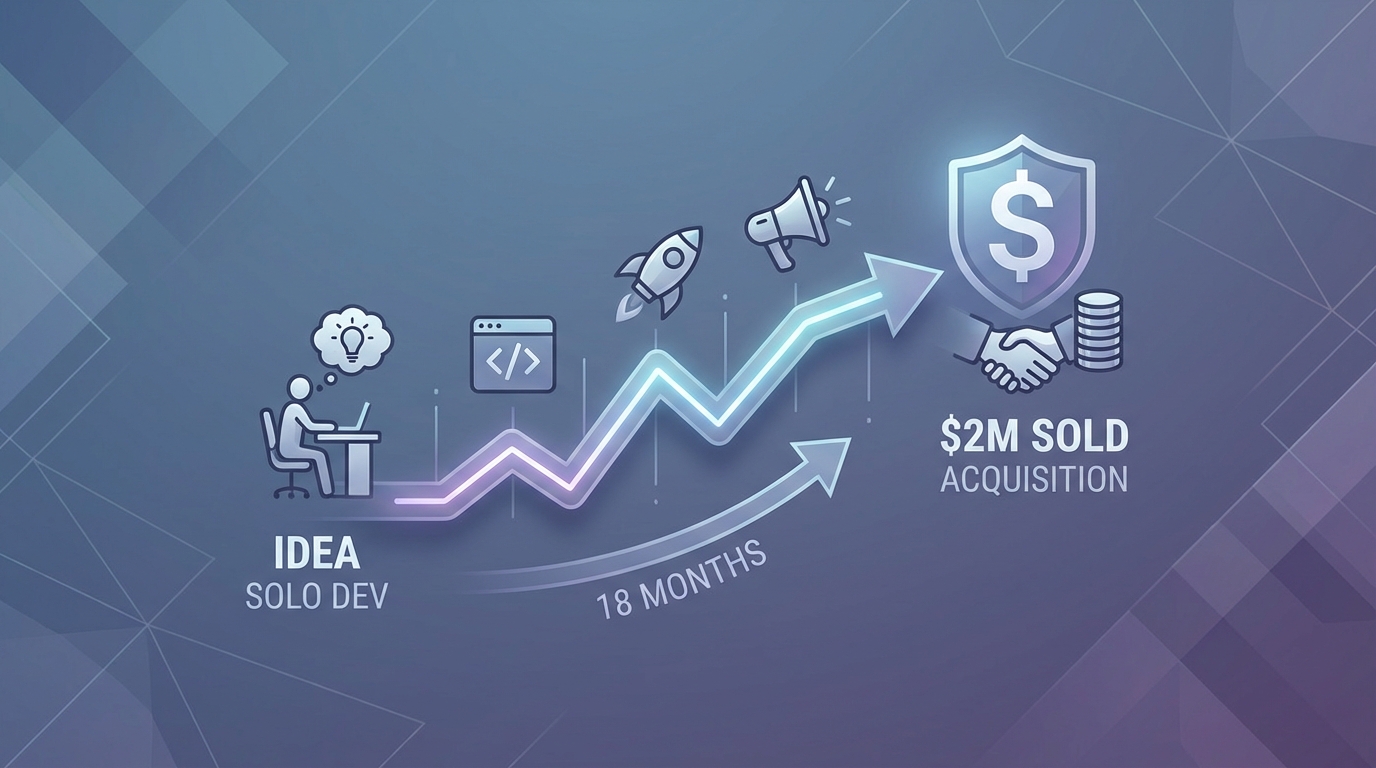
Building a SaaS product alone sounds impossible. Selling it for a million dollars or more sounds like fantasy. Yet dozens of solo developers have done exactly that in the past few years, turning side projects into life-changing exits.
Solo developers consistently sell SaaS businesses for seven figures by focusing on narrow markets, building sustainable revenue streams, and positioning their companies for acquisition. The path requires disciplined execution across product development, growth, and exit preparation. Most successful exits happen between 18 and 36 months after launch, with valuations typically ranging from 3x to 6x annual revenue.
Why Solo Developer Exits Are Becoming Common
Ten years ago, a one-person SaaS exit was newsworthy. Today, it happens weekly.
The barrier to building software has collapsed. Cloud infrastructure costs pennies. No-code tools handle complex backend tasks. Payment processing takes minutes to set up.
But technology alone does not explain the trend. The real shift is buyer appetite.
Private equity firms now actively hunt for small SaaS businesses. Individual acquirers with capital want cash-flowing assets. Larger companies acquire tools their teams already use.
This creates a liquid market for profitable software, even at small scale.
The typical profile looks like this: a developer builds a tool solving a specific problem, grows it to $10,000 to $50,000 in monthly recurring revenue, then sells for $500,000 to $3,000,000.
Not every solo developer hits these numbers. But enough do that the path is now proven and repeatable.
What Makes a SaaS Business Sellable
Buyers care about three things: revenue predictability, growth potential, and operational simplicity.
Revenue predictability means consistent monthly recurring revenue with low churn. A business with $30,000 MRR and 3% monthly churn is far more valuable than one with $50,000 MRR and 12% churn.
Growth potential means the business has not exhausted its market. Buyers want room to scale through paid advertising, content, or sales teams.
Operational simplicity means the business can run without the founder. This is the hardest requirement for solo developers to meet.
Here’s what buyers evaluate:
| Evaluation Area | What Buyers Want | What Kills Deals |
|---|---|---|
| Revenue | Consistent MRR growth | Lumpy project revenue |
| Customer base | Diversified, no single customer over 15% | One customer represents 40%+ of revenue |
| Code quality | Documented, modern stack | Spaghetti code only founder understands |
| Operations | Automated billing, support processes | Founder manually handles everything |
| Market position | Clear differentiation | Competing on price in crowded market |
The gap between a hobby project and a sellable asset is documentation, systems, and proof that someone else could run it.
The Revenue Threshold That Attracts Buyers
Most solo developer SaaS exits happen between $200,000 and $1,000,000 in annual recurring revenue.
Below $200,000 ARR, the business is too small for most institutional buyers. Individual acquirers exist at this level, but valuations compress significantly.
Above $1,000,000 ARR, competition for the asset increases. Multiple buyers bid, driving valuations higher.
The sweet spot for solo developers is $300,000 to $600,000 ARR. At this range:
- The business generates meaningful cash flow
- Valuation multiples are healthy (3x to 5x ARR)
- The founder has not burned out from scaling
- Buyers see clear growth opportunities
A developer earning $40,000 monthly can sell for $1,440,000 to $2,400,000 at these multiples. After taxes and broker fees, that is still $800,000 to $1,500,000 in the founder’s pocket.
Getting to $300,000 ARR as a solo developer typically takes 12 to 24 months after finding product-market fit.
Five Steps Solo Developers Follow to Build Sellable SaaS
Successful solo developers follow a remarkably similar playbook:
-
Pick a narrow, underserved market. Avoid competing with funded startups. Find a specific audience with a painful problem and limited solutions. B2B niches work better than consumer markets because customers pay more and churn less.
-
Build the minimum feature set that solves the core problem. Resist feature creep. A focused product is easier to maintain, market, and sell. Most million-dollar exits have fewer features than you’d expect.
-
Charge from day one. Free tiers and freemium models complicate sales. Paid-only products filter for serious customers and prove willingness to pay. Start at $29 to $99 per month depending on value delivered.
-
Grow through content and community. Solo developers cannot outspend competitors on ads. Instead, they write blog posts, create YouTube tutorials, and participate in niche communities. This builds organic traffic and brand trust.
-
Document everything before thinking about selling. Create standard operating procedures for customer support, billing issues, and common technical problems. Record video walkthroughs of the codebase. Build a knowledge base. This documentation becomes critical during due diligence.
The developers who sell for the highest multiples treat their business like a product from the start, not just their code.
Common Mistakes That Tank Valuations
Even profitable SaaS businesses can become unsellable through avoidable mistakes.
Neglecting customer concentration. If your top three customers represent 60% of revenue, buyers see massive risk. They discount the valuation or walk away entirely. Aim to keep any single customer under 10% of total revenue.
Building on shaky technical foundations. Using outdated frameworks, skipping tests, and accumulating technical debt makes buyers nervous. They either demand a lower price or require an extended transition period where you fix problems.
Ignoring churn until it is too late. A 10% monthly churn rate means you lose your entire customer base every ten months. You are running on a treadmill. Buyers will not pay premium multiples for that. Get churn below 5% monthly before considering a sale.
Mixing personal and business finances. Using your personal credit card for expenses, paying yourself irregularly, or lacking clear financial records creates due diligence nightmares. Set up proper accounting from month one.
Waiting too long to sell. Many solo developers burn out trying to reach arbitrary revenue goals. They stop enjoying the work, let product quality slip, and watch metrics decline. The best time to sell is while the business is still growing and you still have energy.
“I turned down an offer at $400K ARR because I wanted to hit $1M. Eighteen months later, I sold for less than the original offer. I had burned out, churn had increased, and growth had stalled. Sell when the business is healthy, not when you are desperate.” (Anonymous founder, acquired 2023)
How to Find Buyers for Your SaaS
You have three main paths to finding buyers: marketplaces, brokers, and direct outreach.
Marketplaces like Acquire.com, Flippa, and MicroAcquire connect sellers with buyers. You list your business, field inquiries, and negotiate directly. This works well for businesses under $500,000 in value. Fees range from free to 5% of sale price.
Brokers handle the entire sale process for you. They find buyers, manage due diligence, and negotiate terms. Brokers typically take 10% to 15% of the sale price but can command higher valuations through their networks. This makes sense for businesses worth $1,000,000 or more.
Direct outreach means contacting potential strategic acquirers. If a larger company in your space could benefit from your product, reach out to their corporate development team. This path requires more work but can yield the highest valuations because strategic buyers pay for synergies, not just cash flow.
Most solo developers start with marketplaces to test interest, then engage a broker if multiple buyers emerge.
Plan for three to six months from listing to close. Due diligence takes longer than you expect.
Preparing Your SaaS for Due Diligence
Due diligence is where deals die. Buyers will examine every aspect of your business.
Prepare these materials before listing:
- Three years of financial statements (or since inception)
- Customer list with MRR, signup date, and churn status
- Traffic and conversion metrics from analytics
- Support ticket volume and response times
- Code repository with clear documentation
- List of all third-party services and costs
- Customer contracts or terms of service
- Any legal disputes or potential liabilities
The cleaner your records, the faster the process moves and the less buyers can negotiate down your price.
Set up a data room (a secure folder with organized documents) before engaging buyers. This signals professionalism and speeds up diligence by weeks.
Expect buyers to interview key customers, review your codebase, and test your product extensively. They may also run background checks on you personally.
Transparency wins. Hiding problems always backfires when they surface during diligence.
Valuation Multiples and What Drives Them Higher
SaaS valuations typically range from 2x to 8x annual recurring revenue, depending on growth rate, profitability, and market conditions.
A business growing 5% monthly with 70% gross margins might command 5x ARR. The same business growing 15% monthly could get 7x ARR or higher.
Factors that increase your multiple:
- Strong month-over-month growth (10%+ is ideal)
- Low churn (under 3% monthly)
- High gross margins (above 80%)
- Diversified customer base
- Automated operations requiring minimal founder time
- Proprietary technology or data
- Strong brand recognition in niche
Factors that decrease your multiple:
- Flat or declining revenue
- High customer concentration
- Low margins due to expensive infrastructure
- Founder-dependent operations
- Competitive market with low barriers to entry
- Technical debt or outdated stack
The difference between a 3x and 6x multiple on $500,000 ARR is $1,500,000. Understanding what drives valuations helps you make better decisions while building.
Life After the Sale
Most acquisition agreements include a transition period where you help the new owner. This typically lasts 30 to 90 days.
You will train them on the codebase, introduce them to key customers, and ensure smooth handoff of operations. The quality of this transition affects your reputation for future ventures.
Some deals include earnouts, where you receive additional payment if the business hits certain metrics post-sale. These can be lucrative but also risky if the new owner makes changes that hurt performance.
Many solo developers who sell their first SaaS immediately start building another. They have proven the model works and want to repeat it at larger scale.
Others take extended breaks, invest the proceeds, or pursue entirely different interests. There is no wrong choice.
The important thing is having the choice. That is what selling a successful SaaS business provides.
Building Your Own Million-Dollar Exit
The solo developers who sell SaaS businesses for seven figures are not superhuman. They simply execute consistently on a proven model.
They pick focused markets where they can win. They build products people actually pay for. They document their work. They stay disciplined about growth and operations.
Most importantly, they start with the end in mind. They build businesses designed to be sold, not just used.
If you are building a SaaS product right now, ask yourself: could someone else run this business? If the answer is no, you have a job, not an asset.
Start documenting your processes today. Clean up your code. Diversify your customer base. These steps make your business more valuable whether you sell next year or never sell at all.
The path from solo developer to million-dollar exit is clearer than ever. The question is whether you will follow it.