
You built a solid product. You launched. You even got some users. But now growth has stalled, and you can’t figure out why. Your metrics feel stuck. New signups trickle in slowly. Revenue barely moves. You’re working harder than ever, but the numbers don’t reflect it.
Most SaaS founders face this wall at some point. The difference between those who break through and those who stay stuck comes down to diagnosis. Growth problems rarely fix themselves, and throwing random tactics at the wall wastes time you don’t have.
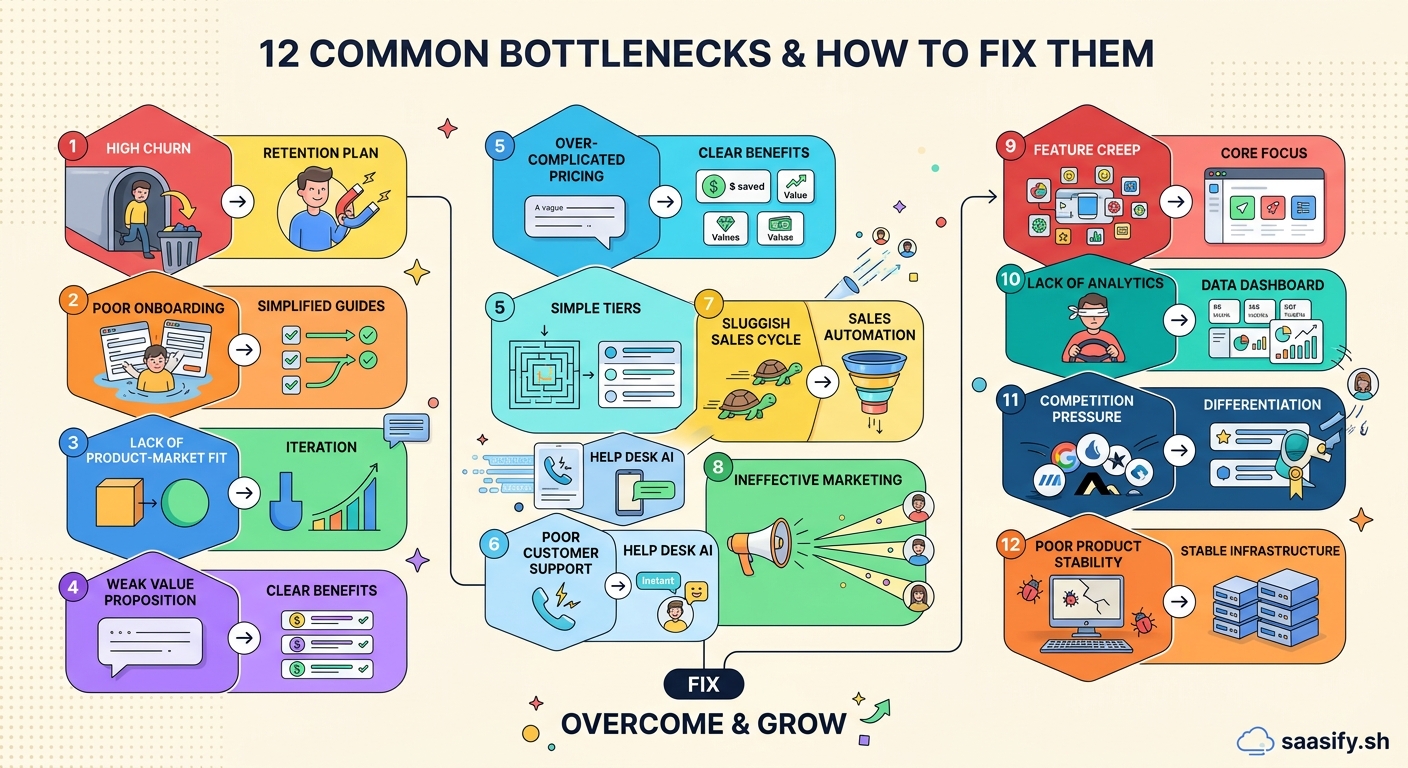
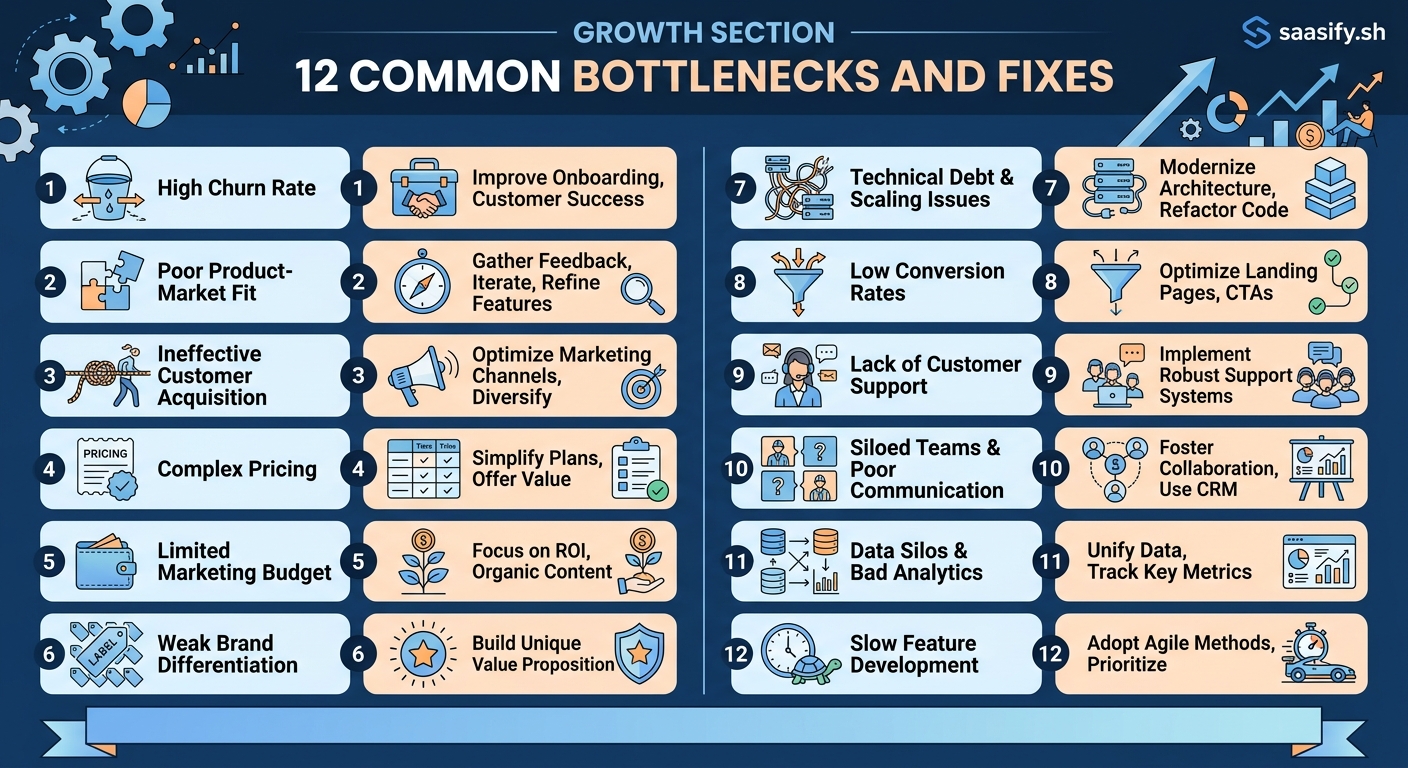
SaaS growth stalls for specific, diagnosable reasons. This guide walks you through 12 common bottlenecks that prevent scaling, from product-market fit issues to pricing mistakes, technical debt, and distribution failures. Each section includes symptoms to watch for, root cause analysis, and concrete fixes you can implement immediately to restart momentum and build sustainable revenue growth.
Product-market fit isn’t actually there yet
You might have users, but that doesn’t mean you have product-market fit. Real PMF shows up in retention numbers, not signup counts. If your 30-day retention sits below 40%, or your users don’t come back after the first week, you haven’t solved a problem people care about enough.
The symptoms look like this: users sign up with excitement, try your product once or twice, then disappear. You get polite feedback but no passionate advocates. Nobody refers friends organically. Churn happens quietly, without angry emails or feature requests.
Here’s how to fix it:
- Interview 20 churned users in the next two weeks. Ask what they expected versus what they got.
- Identify the one core workflow that matters most. Strip away everything else temporarily.
- Watch five active users actually use your product via screen share. Note where they struggle.
- Build only the features that directly support that core workflow for 60 days straight.
The building features users actually want framework helps you validate before you build. Most founders build first and validate never. That’s backwards.
Your onboarding leaks users everywhere
Getting someone to sign up is expensive. Losing them in the first five minutes is tragic. Yet most SaaS products have onboarding flows that confuse new users, ask too many questions upfront, or fail to show value before requesting effort.
Track these numbers weekly:
- Percentage who complete signup
- Percentage who reach their first “aha moment”
- Time from signup to first value
- Percentage who return within 48 hours
If more than 30% of signups never complete their profile, your onboarding is broken. If users who complete onboarding don’t return, your product isn’t delivering on its promise fast enough.
The fix requires ruthless simplification. Remove every optional field. Delay account setup questions until after users see value. Pre-populate data when possible. Guide users to one specific action that demonstrates your product’s core benefit, then get out of the way.
Pricing leaves money on the table
Underpricing is the silent killer of SaaS growth. You’re afraid to raise prices because you think customers will leave. Meanwhile, you’re working twice as hard to serve twice as many customers for half the revenue you should earn.
Signs your pricing is wrong:
- Nobody complains about cost
- Customers say yes immediately without negotiating
- Your lowest tier accounts for 80%+ of users
- You can’t afford to properly support your customer base
- Competitors charge 2-3x more for similar value
Most founders price based on costs or competition. Neither works. Price based on value delivered and willingness to pay. Run small experiments to test higher price points with new signups. The pricing experiments you can run this week guide shows exactly how.
| Pricing Mistake | Symptom | Fix |
|---|---|---|
| Too cheap | High volume, low revenue | Test 30% price increase on new signups |
| Flat pricing | Same price for all sizes | Add usage-based or seat-based tiers |
| Too many tiers | Analysis paralysis | Consolidate to 3 clear options |
| Value disconnect | Price doesn’t match perceived value | Anchor pricing to customer outcomes |
Consider whether usage-based pricing makes sense for your specific business model. It’s not right for everyone, but when it fits, it scales revenue naturally with customer success.
Distribution channels aren’t working
You can’t growth hack your way to sustainable revenue. Every successful SaaS finds one or two distribution channels that actually work, then doubles down ruthlessly. Most struggling founders spread effort across six channels, doing none of them well.
The common trap: trying content marketing, paid ads, cold outreach, partnerships, Product Hunt, and social media simultaneously. You publish one blog post per month, spend $200 on Google Ads, send 50 cold emails, and wonder why nothing moves.
Pick one channel. Commit for 90 days. Go deep enough to actually learn if it works. Here’s what “deep enough” means:
- Content: Publish 24 pieces minimum, track which topics drive signups
- Paid ads: Spend at least $3,000 testing audiences and copy variations
- Cold outreach: Send 500+ personalized emails, iterate on messaging
- Partnerships: Close 3-5 actual integration or referral deals
The distribution channels solo founders use breaks down what actually works at different stages. What works at 0 users differs completely from what works at 1,000.
Your landing page doesn’t convert visitors
Traffic without conversion wastes money. If your landing page converts below 2% of visitors to signups, you have a messaging problem, a trust problem, or both. Most founders bury their value proposition under jargon, fail to address objections, or make signing up harder than necessary.
Common landing page failures:
- Headline describes what you built, not what problem you solve
- No social proof or trust signals above the fold
- Call-to-action button says “Get Started” instead of describing the outcome
- You ask for credit card before trial
- Visitors can’t figure out who the product is for within 5 seconds
Test these fixes systematically:
- Rewrite your headline to complete this sentence: “Help [specific person] [achieve specific outcome] without [common obstacle]”
- Add one customer testimonial that describes the problem before and result after
- Replace generic CTA copy with outcome-focused language
- Remove credit card requirement from trial signup
- Add a two-sentence explainer directly under your headline
The guide on why your landing page isn’t converting includes before/after examples from real SaaS products. Small changes create massive conversion lifts when you fix the right things.
Technical debt is slowing everything down
You built fast to launch. That’s good. But now every new feature takes three times longer than it should. Bugs pile up faster than you can fix them. Your database queries slow to a crawl. Users complain about performance. You’re scared to touch certain parts of the codebase.
Technical debt doesn’t just slow development. It kills growth by making your product unreliable and limiting what you can build. Customers churn because features break. You can’t ship the improvements that would drive expansion revenue. Your best engineers get frustrated and leave.
The best time to address technical debt was six months ago. The second best time is now, before it becomes impossible to fix without a complete rewrite.
Start with a debt audit:
- List the three slowest parts of your application
- Identify which features cause the most support tickets
- Document which code nobody wants to touch
- Calculate how much time you spend on bug fixes versus new features
If more than 40% of your development time goes to maintenance and fixes, you need a debt paydown sprint. Block two weeks. Ship nothing new. Just refactor, optimize, and stabilize. Your future self will thank you.
The database design mistakes guide covers common technical decisions that create problems later. Prevention beats cure.
You’re building features nobody asked for
Every hour spent building the wrong feature is an hour not spent on growth. Yet founders constantly build features they think users want instead of features users actually request. You’re optimizing for your vision instead of customer needs.
Signs you’re building the wrong things:
- New features get little adoption after launch
- Your roadmap reflects your interests more than customer requests
- You haven’t talked to a customer in two weeks
- Feature requests pile up while you build something else
- You say “they’ll love this” more than “they asked for this”
The fix requires humility and discipline. Create a simple voting system where customers can request and upvote features. Talk to your ten best customers monthly. Ask what they’re trying to accomplish, not what features they want. Build the boring stuff that removes friction before the exciting stuff that adds capabilities.
Customer acquisition cost is too high
You can’t build a sustainable business when acquiring a customer costs more than they’ll ever pay you. If your CAC exceeds your average customer lifetime value, you’re buying revenue, not building a business. Every new customer makes you poorer.
Calculate these numbers honestly:
- Total marketing and sales spend last month
- Number of new customers acquired last month
- CAC = spend / new customers
- Average customer lifetime value (monthly price × average months retained)
- LTV:CAC ratio
Healthy SaaS businesses maintain LTV:CAC ratios above 3:1. Below that, growth becomes unsustainable. Below 1:1, you’re in serious trouble.
Reduce CAC by improving conversion rates at every funnel stage. A landing page that converts 4% instead of 2% cuts your CAC in half instantly. Better onboarding that activates 80% of signups instead of 40% has the same effect. Focus on conversion before spending more on acquisition.
When you’re ready to scale acquisition, the guide on when to start spending on paid acquisition helps you time it correctly. Too early wastes money. Too late leaves growth on the table.
Retention is bleeding you dry
New signups feel like progress. But if customers leave as fast as they arrive, you’re filling a leaky bucket. Churn destroys SaaS businesses slowly, then suddenly. A 10% monthly churn rate means you lose your entire customer base every ten months.
Track cohort retention, not vanity metrics:
- What percentage of customers from each signup month are still active?
- When does most churn happen (first week, first month, after 3 months)?
- Why are people leaving (ask them directly)?
- Which customer segments have the best retention?
If you don’t know these numbers precisely, you can’t fix retention. Set up a simple cohort analysis this week. The revenue dashboard guide shows how to build this yourself.
Most churn happens because customers don’t achieve their desired outcome, not because your product lacks features. They signed up to solve a problem. If they still have that problem after using your product, they’ll leave. Fix the outcome, not the feature list.
Your market is too small or too crowded
Sometimes slow growth isn’t your fault. You picked a market that can’t support a real business. Either too few potential customers exist, or too many competitors fight over the same small pie. No amount of execution fixes a fundamentally flawed market choice.
Warning signs of market problems:
- You’ve captured 5%+ market share but revenue is still tiny
- Every prospect already uses a competitor’s product
- Your total addressable market is under 10,000 potential customers
- Competitors are going out of business or pivoting away
- Nobody in your market pays for software solutions
If you’re in a bad market, you have two options: find an adjacent market that’s better, or accept you’re building a lifestyle business instead of a growth company. Neither is wrong, but the strategy differs completely.
The profitable micro-SaaS niches guide identifies markets with real potential. Sometimes the answer is pivoting to where the opportunity actually exists.
You’re trying to do everything alone
Solo founders can build products. But growing a business past the first few thousand dollars in MRR requires help. You can’t do product development, marketing, sales, support, and operations simultaneously. Something always suffers, usually the thing that drives growth.
The trap: you’re good at building, so you keep building. Meanwhile, marketing gets one hour per week, sales gets ignored, and support happens when you remember. Growth stalls because the growth activities don’t happen consistently.
You don’t need to hire full-time employees. But you do need to:
- Automate repetitive tasks that don’t require your judgment
- Outsource specialized work like design or content writing
- Use tools that multiply your effectiveness
- Focus your personal time on the 20% of activities that drive 80% of results
The automation tools guide shows which tools actually save time versus adding complexity. Start with the basics: email automation, customer support tools, and analytics.
Your growth strategy is random tactics, not a system
Most struggling founders treat growth like a collection of random activities. They write a blog post, send some tweets, maybe run ads for a week, then wonder why nothing compounds. Real growth comes from systems that build on themselves over time.
A growth system has three parts:
- Acquisition: One primary channel that consistently brings new visitors
- Activation: A reliable process that converts visitors to users
- Retention: Mechanisms that keep users engaged and expanding usage
Each part needs specific metrics, weekly goals, and regular optimization. You can’t improve what you don’t measure. You can’t scale what isn’t systematic.
Build your growth system in this order:
- Fix retention first (no point acquiring users who leave)
- Optimize activation second (make the most of traffic you have)
- Scale acquisition last (pour fuel on what’s already working)
Most founders do this backwards. They focus on acquisition while retention is broken. That’s like filling a bucket with holes in it. The growth sprints guide shows how to structure systematic improvement cycles.
Moving from diagnosis to action
Identifying which bottleneck is strangling your growth is the first step. Now you need to fix it systematically. Don’t try to address all twelve problems simultaneously. That’s how you stay stuck.
Pick the one bottleneck that’s costing you the most revenue or users right now. If retention is below 40%, start there. If your landing page converts below 2%, fix that first. If pricing is clearly too low, test a price increase this week.
Work on that single bottleneck for 30 days. Measure your starting point. Make changes. Measure again. Only after you see meaningful improvement should you move to the next problem. Sequential fixes compound. Parallel attempts dilute effort and muddy results.
Growth isn’t magic. It’s diagnosis, prioritization, and systematic improvement. Your SaaS is probably not growing because of one or two specific bottlenecks, not because you lack talent or got unlucky. Find the constraint. Fix it. Then find the next one.