You’re staring at a blank tweet draft, cursor blinking. Should you share your MRR numbers? Post about that bug that wiped your database? Tell 47 followers you just launched?
Building in public sounds simple: share your startup journey on social media. But the reality is messier than the highlight reels suggest.
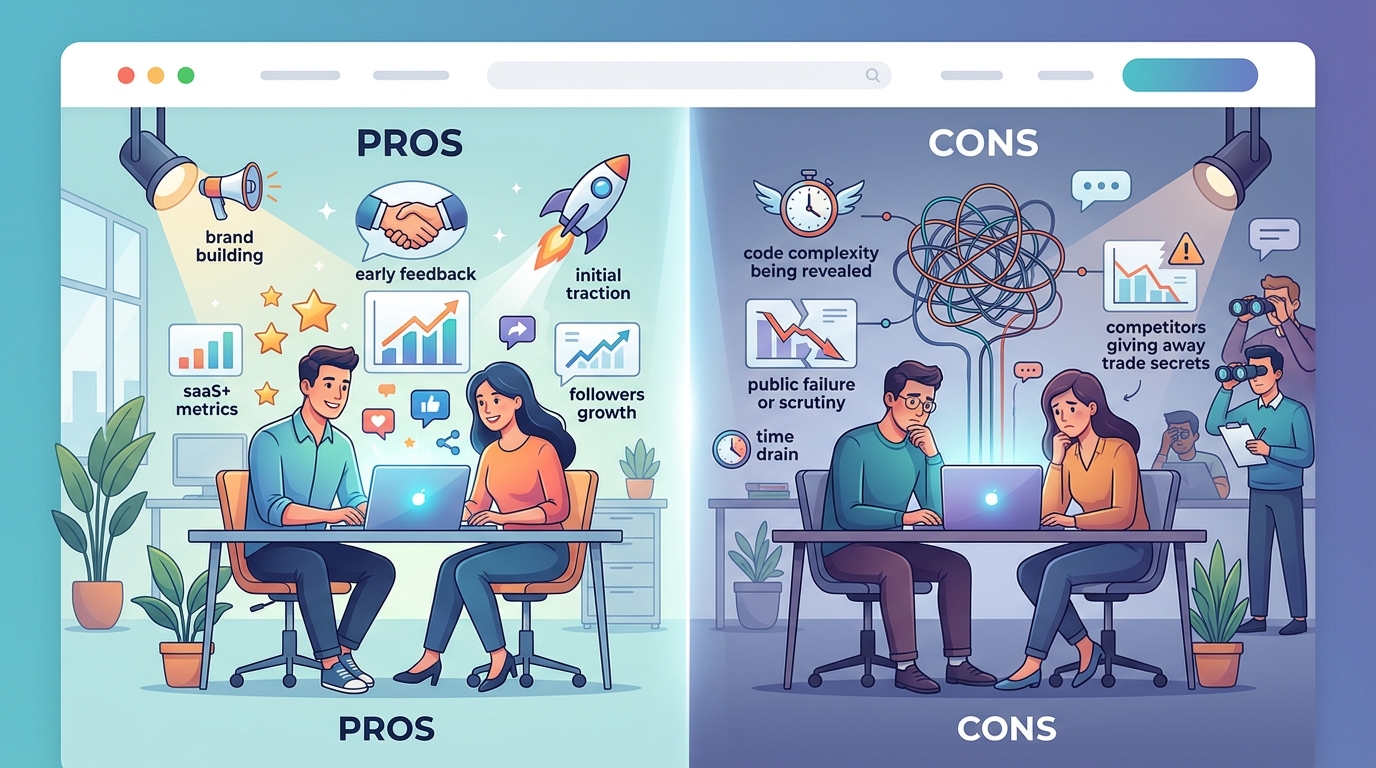
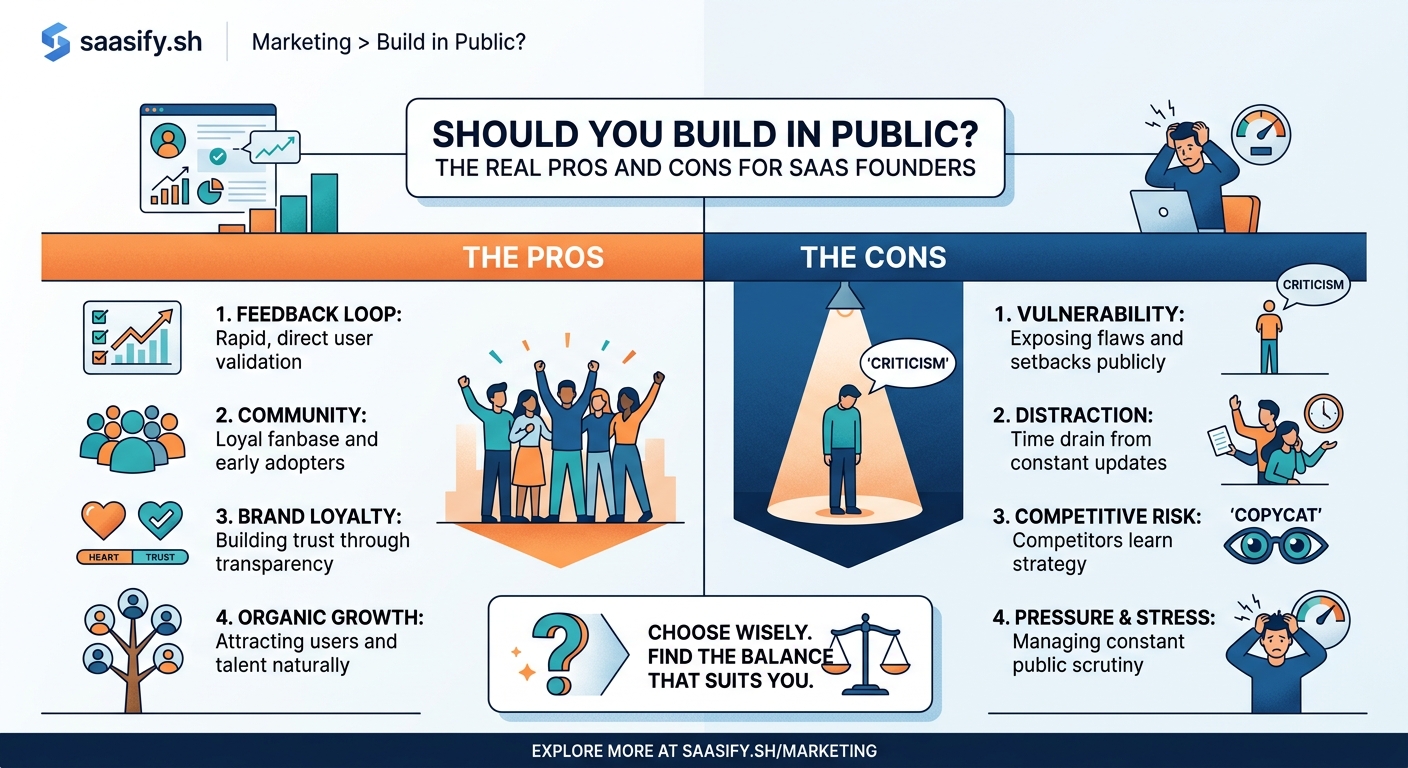
Building in public can accelerate your SaaS growth through accountability, audience building, and free feedback. But it also exposes you to copycats, burnout from constant sharing, and the pressure to perform publicly. Success depends on matching your personality, product stage, and market to the right level of transparency. This guide breaks down both sides so you can decide what works for your situation.
What building in public actually means
Building in public means sharing your startup progress openly on platforms like Twitter, LinkedIn, or indie hacker forums. You post revenue numbers, product decisions, failures, and wins as they happen.
Some founders tweet daily updates. Others write monthly recaps. The format varies, but the core idea stays the same: transparency about the journey.
This isn’t just blogging. It’s real-time documentation with an audience watching your every move.
The practice gained traction around 2018 when indie hackers started sharing revenue dashboards and growth metrics. Now it’s become almost expected in certain circles.
But popularity doesn’t mean it’s right for everyone.
The advantages that actually matter
You build an audience before launch
Starting with zero followers makes launch day brutal. Building in public flips this around.
Every update you share attracts people interested in your problem space. By the time you’re ready to build a pre-launch waitlist that actually converts, you already have warm leads.
One founder I know gained 2,000 Twitter followers in six months just by sharing weekly progress updates. His launch day brought 400 signups without spending a dollar on ads.
Free feedback arrives constantly
Your audience becomes an unpaid focus group. Share a pricing page mockup and get 30 opinions in an hour.
This feedback loop helps you avoid costly mistakes. Someone might spot a confusing feature description or suggest a use case you hadn’t considered.
The key word is “might.” Not all feedback is useful, which we’ll cover in the drawbacks section.
Accountability keeps you shipping
Public commitments are harder to break. When you tell 500 people you’ll ship a feature this week, you ship it.
This external pressure can be healthy. It prevents endless tinkering and forces you to make decisions.
Some founders use this deliberately. They announce deadlines publicly specifically to create pressure.
Networking happens naturally
Other founders building similar products reach out. Potential partners send DMs. Investors sometimes discover you through your updates.
These connections often lead to collaborations, guest posts, or just helpful conversations with people facing similar challenges.
You’re essentially doing relationship building as a side effect of documenting your work.
Learning in public builds authority
When you share what you’re learning, you position yourself as someone who knows the space. This helps with 7 distribution channels solo founders use to get their first 100 users.
A founder sharing database optimization tips while building their SaaS becomes known as the database person. That reputation brings opportunities.
Teaching what you learn also reinforces your own understanding.
The real downsides nobody warns you about
Copycats will copy you
Share your unique positioning and someone will clone it. Post about a feature that’s working and competitors will add it.
This happens more than people admit. Your transparency becomes their product roadmap.
Some founders don’t care. They believe execution matters more than ideas. Others have watched copycats steal months of research in a single afternoon.
The risk increases if you’re in a competitive niche or if your advantage comes from a specific feature rather than network effects.
The performance pressure burns you out
Every day without progress feels like public failure. You start making decisions based on what will make a good tweet rather than what’s best for the business.
This pressure is subtle at first. You skip the boring but necessary work because it won’t generate engagement. You rush features to hit self-imposed public deadlines.
One founder told me he spent more time crafting update threads than actually building. He eventually quit building in public and his productivity doubled.
Bad actors use your data against you
Share your conversion rates and someone will use them in their competitive analysis. Post about a struggling month and potential customers lose confidence.
Your transparency becomes ammunition. Competitors screenshot your struggles. Trolls mock your metrics.
Some of this is just internet noise. But it can sting when you’re already dealing with the stress of building a business.
You attract the wrong kind of attention
Not everyone following your journey wants to support you. Some just want free entertainment or to feel better about their own situation by watching you struggle.
These spectators rarely convert to customers. They engage with your content but never pull out their wallet.
You end up optimizing for an audience that doesn’t match your customer profile.
Privacy becomes impossible
Once you share something publicly, you can’t take it back. That revenue number you posted in a moment of excitement? It’s permanent.
Future acquirers will see it. Potential hires will judge you by it. Competitors will analyze it.
Some founders regret their early transparency when they later want to pivot or negotiate from a position of strength.
When building in public makes sense
Building in public works best in specific situations. Here’s when the advantages outweigh the risks:
| Situation | Why it works | Example |
|---|---|---|
| B2C product with viral potential | Your users are also your audience | Productivity apps, creator tools |
| Founder-led brand strategy | Your personality is part of the product | Courses, templates, design tools |
| Crowded market needing differentiation | Transparency sets you apart | Project management, email tools |
| Long runway before revenue | You need momentum during the wait | Complex SaaS with 12+ month build |
| Strong personal resilience | You can handle public criticism | Founders with thick skin |
If you’re building something that benefits from community, building in public amplifies that effect.
If you’re in a sensitive industry or targeting enterprise customers, it might hurt more than help.
When to keep your head down instead
Some situations call for privacy:
- Enterprise B2B products where buyers expect polish and discretion
- Highly competitive markets where every advantage matters
- Products in regulated industries with compliance concerns
- Founders who find public sharing draining rather than energizing
- Situations where you’re still figuring out product-market fit and don’t want to confuse early messaging
You can always start building in public later. You can’t easily go back to privacy after months of transparency.
Consider your market too. If you’re targeting conservative industries, your public journey might raise concerns about stability and professionalism.
How to build in public without burning out
If you decide to try it, here’s a sustainable approach:
-
Set boundaries early. Decide what you will and won’t share. Revenue? Sure. Personal struggles? Maybe not.
-
Batch your updates. Don’t feel pressured to post daily. Weekly or biweekly updates work fine.
-
Focus on learning, not metrics. Share what you discovered, not just what you achieved.
-
Ignore vanity metrics. Engagement doesn’t equal customers. Stay focused on what matters for your business.
-
Take breaks when needed. Nobody will notice if you go quiet for a week. Your mental health matters more than your posting streak.
-
Filter feedback ruthlessly. Listen to paying customers first, internet strangers last.
The founders who succeed at this treat it like creating a content marketing engine that runs on 2 hours per week. It’s a system, not a constant obligation.
What to share and what to keep private
Here’s a practical framework:
Safe to share:
– General progress updates
– Lessons learned from mistakes
– Technical challenges and solutions
– Customer success stories (with permission)
– Milestone celebrations
– Behind-the-scenes development process
Think twice before sharing:
– Specific revenue numbers (especially if small)
– Detailed customer data
– Proprietary technology details
– Conflicts with team members or customers
– Emotional rants during hard times
– Sensitive business negotiations
Keep private:
– Customer information without consent
– Financial details that could affect negotiations
– Strategic plans that give competitors an edge
– Personal information about team members
– Anything you might regret in 6 months
When in doubt, wait 24 hours before posting. The best updates come from reflection, not reaction.
The middle ground most founders miss
You don’t have to choose between complete transparency and total secrecy. Most successful founders find a middle path.
Share your journey without sharing everything. Post about the problem you’re solving without revealing your exact solution. Talk about growth without specific numbers.
This selective transparency gives you the benefits of audience building and accountability without the full exposure risk.
You can also adjust over time. Start more private and open up as you gain confidence. Or do the reverse if you find the pressure overwhelming.
The goal is finding what works for your personality, product, and market. Not copying what worked for someone else in a completely different situation.
Common mistakes that sabotage the strategy
Even founders committed to building in public often trip over these issues:
-
Sharing for engagement instead of value. Posting dramatic updates just to get retweets dilutes your message.
-
Comparing your chapter 1 to someone else’s chapter 20. Other founders’ highlight reels will make you feel behind.
-
Letting strangers influence product decisions. Your customers should drive your roadmap, not your Twitter followers.
-
Treating it like a marketing channel instead of documentation. The best building in public content is authentic, not promotional.
-
Burning bridges publicly. Complaining about tools, competitors, or customers might feel good in the moment but damages relationships.
-
Forgetting that silence is also an option. You don’t owe anyone an explanation for every decision.
If you’re spending more time talking about building than actually building, you’ve lost the plot.
Real examples from founders who tried both approaches
Some context helps. Here are patterns I’ve noticed:
Founders who succeeded building in public:
– Had products that aligned with their audience (developers building for developers)
– Enjoyed the social media aspect naturally
– Used it as accountability, not just marketing
– Maintained boundaries and didn’t share everything
– Built slowly over years, not months
Founders who quit building in public:
– Found the pressure to perform publicly exhausting
– Attracted mostly spectators, not customers
– Struggled with copycats in competitive markets
– Realized their target customers weren’t on social media
– Preferred deep work over constant updates
Neither group is wrong. They just found what matched their situation.
One founder shared in a case study about building to $50K ARR that building in public was crucial to his success. Another founder in a similar niche told me privately it nearly destroyed his business.
Context matters more than the strategy itself.
Making the decision for your situation
Here’s a simple framework to decide:
Try building in public if:
– You’re naturally comfortable sharing online
– Your target customers are active on social platforms
– You have time to create consistent updates
– You can handle criticism without spiraling
– Your market rewards transparency
– You need external accountability to ship
Skip it if:
– Sharing feels forced or draining
– Your customers value privacy and discretion
– You’re in a highly competitive market
– Public pressure makes you anxious
– You’d rather spend time building than documenting
– You already have other distribution channels working
You can also test it. Commit to 30 days of updates and see how it feels. If it energizes you and brings results, continue. If it drains you, stop.
There’s no prize for building in public if it makes you miserable or hurts your business.
Alternatives that capture some benefits
If full transparency feels wrong but you still want some advantages, try these:
- Private community building. Share updates in a Discord or Slack group instead of publicly.
- Monthly recap emails. Document your journey for subscribers without the social media pressure.
- Selective sharing. Post only major milestones, not daily updates.
- Anonymous sharing. Some founders share metrics and lessons without attaching their identity.
- Retrospective blogging. Write about your journey after you’ve succeeded, not during the struggle.
These approaches give you accountability and audience building without full exposure.
You might also consider building in public for just one aspect of your business. Share your validation process publicly but keep your revenue private.
The strategy evolves as you grow
What works at $0 MRR might not work at $10K MRR. Your approach to building in public should evolve with your business.
Early stage founders often benefit more from the accountability and audience building. Later stage founders might pull back as privacy becomes more valuable.
Some founders go completely silent after reaching certain revenue milestones. Others double down on transparency as proof of concept.
Pay attention to what’s working and adjust accordingly. You’re allowed to change your mind about what you share.
Finding what works for you
Building in public isn’t a binary choice. It’s a spectrum from complete transparency to total privacy, with infinite points in between.
The founders who succeed are honest about their goals, boundaries, and capacity. They share when it serves their business and stay quiet when it doesn’t.
If you’re still unsure, start small. Share one update this week. See how it feels. Notice whether it energizes or drains you. Watch whether it attracts the right people.
Your comfort level and results will tell you whether to continue, adjust, or stop entirely. Trust that feedback more than anyone’s advice about what you “should” do.
The best strategy is the one you’ll actually maintain without burning out or compromising your business. Everything else is just noise.