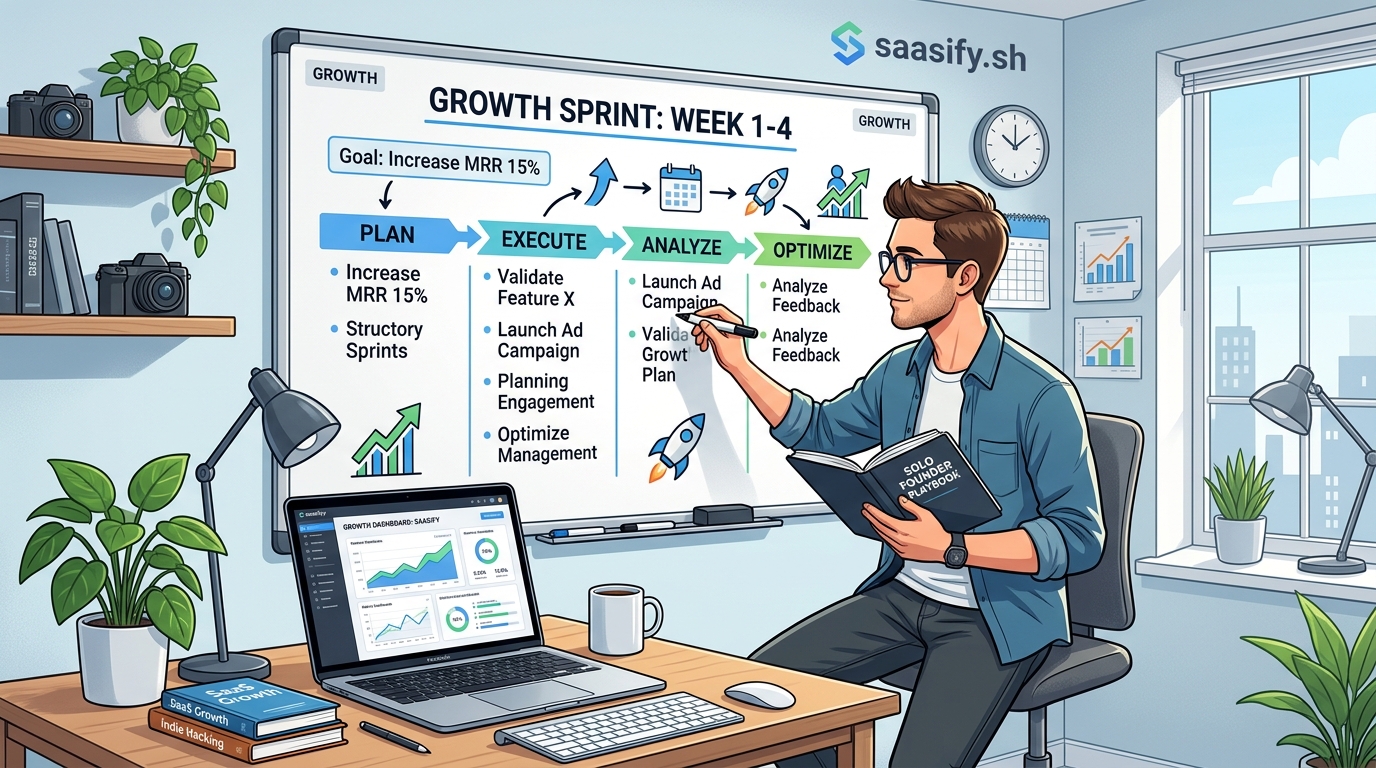
You’re juggling product development, customer support, and trying to grow your SaaS. The last thing you need is another complicated framework that requires a team of five people and three weeks of planning.
Growth sprints work differently when you’re solo. You can’t run elaborate experiments with control groups. You don’t have time for week-long retrospectives. But you can still test ideas systematically, learn faster than your competitors, and build momentum without burning out.
Growth sprints for solo founders compress traditional sprint frameworks into one-week cycles focused on single experiments. You pick one channel, set one measurable goal, run the test for five days, and decide whether to continue, pivot, or kill it. This approach helps you test growth ideas systematically without the overhead of team coordination or complex project management.
Why Traditional Growth Sprints Fail Solo Founders
Most growth sprint frameworks assume you have a team. They involve daily standups, multiple parallel experiments, and detailed documentation that takes longer to create than the actual work.
When you’re solo, that overhead kills momentum.
You need a system that fits between shipping features and answering support emails. Something that takes hours, not days, to plan and execute.
The biggest mistake solo founders make is trying to run too many experiments at once. You spread yourself thin. Nothing gets proper attention. Results become meaningless because you changed five variables simultaneously.
Better to run one focused experiment per week than five half-baked tests per month.
The One-Week Sprint Framework for Solo Founders
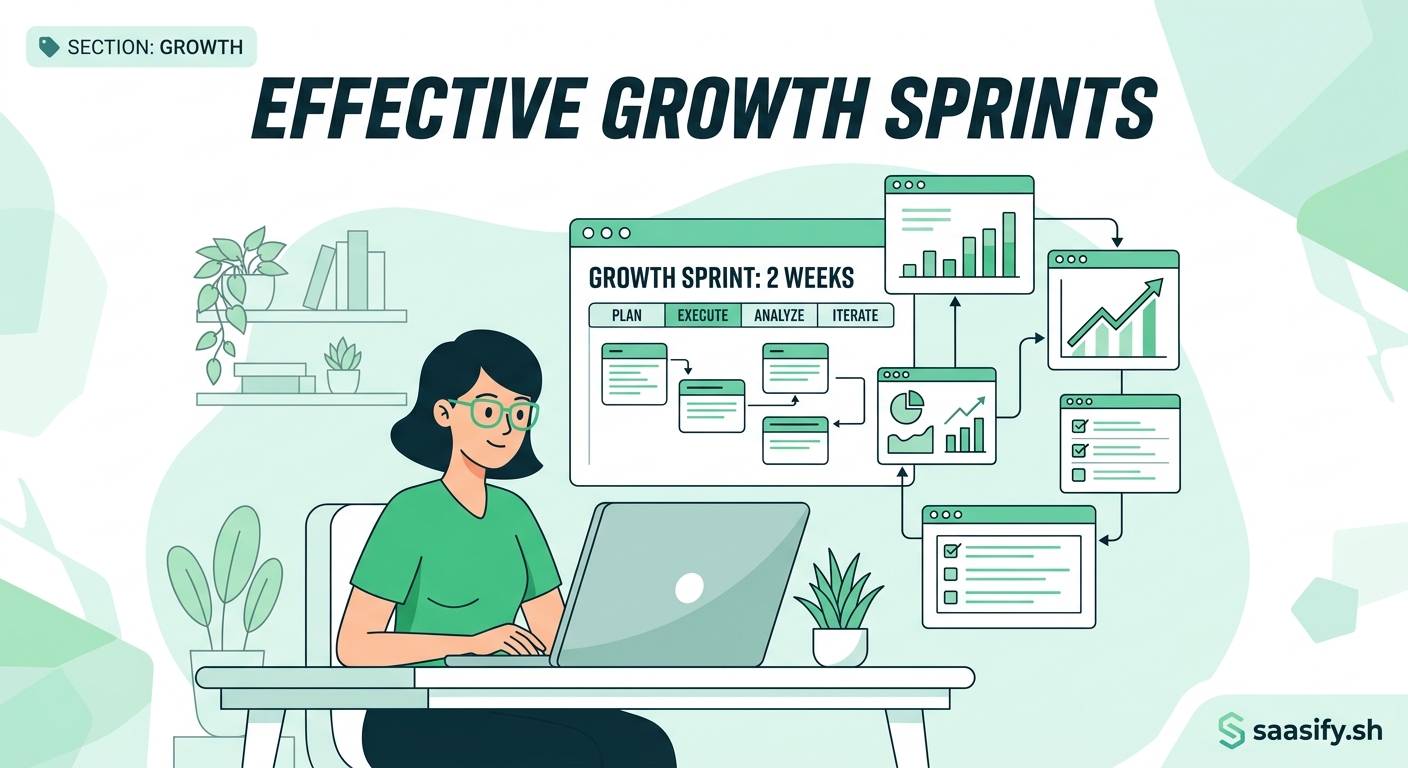
Here’s how to structure a growth sprint when you’re working alone.
Monday: Pick and Prep
Choose exactly one experiment. Not three. Not “let’s see how it goes.” One specific test with a clear hypothesis.
Your hypothesis should follow this format: “If I do X for audience Y, then Z metric will change by N%.”
Example: “If I post one educational thread per day on Twitter for SaaS founders, then my landing page visits will increase by 20%.”
Spend 30 minutes gathering everything you need. Templates, tools, login credentials, content ideas. Front-load the prep work so execution days stay focused.
Tuesday Through Thursday: Execute
These three days are pure execution. No planning. No second-guessing. Just run the experiment exactly as designed.
Track your key metric daily. Use a simple spreadsheet or note on your phone. You’re not building a data warehouse. You’re watching one number move.
When something breaks or doesn’t work as planned, note it down but keep going. You can fix process issues in the next sprint. Right now, you need data.
Friday: Analyze and Decide
Look at your results. Did the metric move? By how much? Was the effort worth the return?
Make one of three decisions:
- Continue: The experiment showed promise. Run it for another sprint with optimizations.
- Pivot: The channel or approach has potential but needs a different angle.
- Kill: The results don’t justify the time investment. Move on.
Document your decision in two sentences. That’s your sprint retrospective.
Choosing the Right Experiment
Not all growth experiments work for solo founders. Some require too much setup. Others need constant monitoring. You need experiments that fit your constraints.
Here’s a simple filter:
- Can you execute it in 3-4 hours spread across three days?
- Can you measure results without building custom analytics?
- Will you learn something useful even if it fails?
If you answer no to any of these, pick a different experiment.
High-Leverage Experiments for Solo Founders
These experiments consistently deliver results for founders working alone:
- Publishing one piece of content daily in a specific community
- Running a five-day email sequence to trial users
- Testing three different landing page headlines with paid traffic
- Reaching out to 20 potential customers with personalized messages
- Creating one tutorial or template your audience can use immediately
Notice the pattern. Each experiment is specific, measurable, and doesn’t require ongoing maintenance.
If you’re still validating your SaaS idea, your experiments should focus on conversations and feedback rather than traffic metrics.
Tracking What Actually Matters

You need to track three things. Not fifteen. Three.
Input metric: What you’re doing. Number of posts, emails sent, outreach messages, etc.
Output metric: What happened. Clicks, signups, conversations, trials started.
Time invested: How many hours you spent. Be honest. Include prep time and context switching.
Here’s a simple tracking table you can copy:
| Week | Experiment | Input | Output | Hours | Decision |
|---|---|---|---|---|---|
| 1 | Twitter threads | 5 threads | 47 visits | 4h | Continue |
| 2 | Reddit comments | 15 comments | 8 visits | 3h | Kill |
| 3 | Email sequence | 50 sent | 12 trials | 5h | Pivot |
This table tells you everything you need to know. Which channels work. Where your time goes. What to do next.
Many solo founders track too much and act on too little. Or they track nothing and wonder why growth feels random.
Common Mistakes That Kill Sprint Momentum
Changing Variables Mid-Sprint
You post on Twitter for two days, get discouraged, and switch to LinkedIn. Now you have incomplete data on both channels.
Commit to the full week. Even if results look bad on day two. You need complete data to make good decisions.
Running Experiments Without Clear Success Criteria
“I’ll try content marketing and see what happens” isn’t a sprint. It’s wishful thinking.
Define success before you start. “If I don’t get at least 10 landing page visits from five posts, I’ll kill this channel.”
Clear criteria make decisions obvious.
Picking Experiments That Require Ongoing Maintenance
You build an elaborate automated funnel that needs daily monitoring. Now you’re trapped maintaining an experiment instead of running new ones.
Choose experiments you can walk away from after Friday. If something works, you can invest in automation later.
Ignoring Time Investment
An experiment that generates five signups sounds great until you realize it took 20 hours. That’s four hours per signup.
Could you get better results spending those 20 hours differently? Maybe. Track time to find out.
The 7 low-cost growth experiments you can run this week all share one trait: clear time boundaries.
Making Sprints Work With Product Development
You’re not just running growth experiments. You’re also building features, fixing bugs, and keeping existing customers happy.
How do you fit sprints into that reality?
Option one: Dedicate specific days to growth work. Monday, Wednesday, Friday are product days. Tuesday and Thursday are growth days. Your sprint runs across multiple calendar weeks but maintains the three-execution-day structure.
Option two: Front-load product work. Ship features early in the week. Run your growth sprint Thursday through Monday. This works well if you batch development tasks.
Option three: Alternate weeks. One week focused on product, one week focused on growth. This gives each area proper attention without constant context switching.
Pick the rhythm that matches your energy patterns. Some founders think better about growth after shipping features. Others need to see customer traction before diving back into code.
The worst approach is trying to do everything every day. That’s how you end up with half-finished features and abandoned experiments.
Scaling What Works Without Losing Focus
You’ve run eight sprints. Three experiments showed promise. Now what?
Don’t try to scale all three simultaneously. Pick the one with the best time-to-result ratio and double down for four weeks.
If Twitter threads worked, commit to daily threads for a month. Track whether results compound or plateau.
Meanwhile, run smaller maintenance experiments in your other promising channels. One LinkedIn post per week. One email to your list every Friday.
You’re looking for the channel that produces consistent results without constant optimization. That’s your primary growth engine.
Everything else becomes secondary or gets cut entirely.
Many solo founders make the mistake of adding channels without subtracting failed experiments. Soon they’re maintaining six mediocre channels instead of dominating one good one.
“The most successful solo founders I know do one thing really well for six months before adding a second channel. They resist the urge to be everywhere. They’d rather own one platform than be invisible on five.” – SaaS founder who built to $40K MRR solo
Building Your Sprint Template
Here’s a simple template you can use for every sprint. Copy it into a note, document, or spreadsheet.
Sprint #: [Number]
Week of: [Date]
Hypothesis: If I [action] for [audience], then [metric] will [change] by [amount].
Success criteria: [Specific number that indicates the experiment worked]
Kill criteria: [Specific number that means you should stop]
Daily tracking:
* Day 1: [Input metric] / [Output metric]
* Day 2: [Input metric] / [Output metric]
* Day 3: [Input metric] / [Output metric]
Total time invested: [Hours]
Decision: Continue / Pivot / Kill
Why: [One sentence explaining your decision]
Next sprint idea: [What you’ll test next based on what you learned]
This template takes two minutes to fill out. It keeps you focused without creating documentation overhead.
After ten sprints, you’ll have a clear record of what you tried, what worked, and why you made each decision.
Connecting Sprints to Revenue Goals
Growth experiments should connect to revenue. Not every sprint directly generates money, but every sprint should move you closer to a revenue milestone.
If your goal is reaching $5K MRR, your experiments should focus on channels that bring in paying customers, not vanity metrics like social media followers.
Break your revenue goal into smaller milestones:
* 10 paying customers at $50/month = $500 MRR
* 25 paying customers at $50/month = $1,250 MRR
* 50 paying customers at $50/month = $2,500 MRR
Now design experiments that specifically target customer acquisition. How do you find ten people willing to pay? What channels reach them? What message resonates?
Some founders get stuck running experiments that feel productive but don’t move revenue. Publishing blog posts feels like growth work. But if your ideal customers don’t read blogs, you’re optimizing the wrong channel.
Test channels where your customers actually spend time. If you’re building tools for developers, maybe that’s GitHub discussions or specific Discord servers. If you’re targeting small business owners, maybe it’s Facebook groups or local business associations.
The 7 distribution channels solo founders use to get their first 100 users all share one characteristic: they put you directly in front of people who have the problem you solve.
When to Abandon the Framework
Growth sprints work best in specific situations. They’re perfect when you’re testing new channels, validating messaging, or trying to break through a growth plateau.
They’re less useful when:
- You’ve found a channel that works and need to scale it systematically
- You’re dealing with a product problem disguised as a growth problem
- Your churn rate is so high that acquisition doesn’t matter yet
If you’re spending more time planning sprints than executing them, you’ve over-engineered the system. Simplify or abandon it.
If you haven’t learned anything new in five sprints, you’re either picking safe experiments or not being honest about results. Push into riskier territory or take a break.
The framework exists to help you test faster and learn more. If it becomes another source of pressure or busy work, drop it.
Adapting Sprints for Different Growth Stages
Your experiments should change as your SaaS grows.
Pre-launch (0 users): Your sprints focus on validation. You’re testing whether anyone cares about your solution. Experiments involve conversations, landing page tests, and building a pre-launch waitlist that actually converts.
Early traction (1-50 users): Your sprints focus on finding your first reliable acquisition channel. You’re testing different ways to reach your target audience and seeing which messages resonate.
Growth mode (50-500 users): Your sprints focus on scaling what works and testing adjacent channels. You’ve found one thing that works. Now you’re looking for a second growth engine.
Scale stage (500+ users): Your sprints focus on optimization and retention. You’re testing ways to improve conversion rates, reduce churn, and increase customer lifetime value.
The mechanics stay the same. One week, one experiment, clear decision criteria. But the experiments themselves evolve with your business stage.
Combining Sprints With Longer Experiments
Some growth channels need more than a week to show results. SEO takes months. Content marketing builds slowly. Partnerships require relationship building.
Run those as background processes, not sprints.
Use sprints for experiments that give you feedback within days. Use longer timeframes for strategic bets that compound over time.
For example, you might:
* Write one SEO-focused article per month (long-term bet)
* Run weekly sprints testing different promotion channels for that content (short-term experiments)
The sprint framework helps you learn which promotion tactics work. The monthly article builds your long-term search presence.
Don’t force everything into the sprint model. Use it where it adds value.
Your First Three Sprints
If you’re starting from zero, here are three experiments that work for most solo SaaS founders:
Sprint 1: Reach out to 20 people in your target audience. Not to sell. To understand their problems better. Track how many respond and what you learn about their pain points.
Sprint 2: Create one piece of content that solves a specific problem your audience has. Share it in three places they hang out. Track views and responses.
Sprint 3: Set up a simple email sequence for people who sign up for your waitlist or trial. Three emails over five days. Track how many people engage and what questions they ask.
These three sprints give you customer insights, content validation, and early funnel data. You’ll know more about your market after three weeks than most founders learn in three months.
Staying Consistent When Motivation Drops
Some weeks you won’t feel like running a sprint. You’re tired. Results from the last sprint were disappointing. You’d rather just code.
Run the sprint anyway.
Consistency matters more than perfection. A mediocre experiment executed fully teaches you more than a brilliant idea that stays in your notes.
Keep your experiments small enough that you can complete them even on low-energy weeks. If you planned something ambitious and Friday arrives with incomplete work, that’s a signal to scale back your experiment complexity.
The founders who succeed with this framework aren’t the ones who run the most creative experiments. They’re the ones who show up every week and test something.
Making Decisions With Imperfect Data
You’ll never have perfect data. Your sample sizes will be small. Your tracking will miss things. External factors will influence results.
Make decisions anyway.
You’re not trying to achieve statistical significance. You’re trying to find signals in noise. Does this channel show any promise? Did anyone respond positively? Would doing more of this move you closer to your goals?
If the answer is “maybe,” run another sprint with adjustments. If the answer is “definitely not,” kill it and move on.
Waiting for perfect data is how solo founders end up stuck in analysis paralysis. You need directional accuracy, not scientific precision.
When you’re genuinely unsure, default to killing the experiment. Your time is limited. Spending another week on a mediocre channel means not testing something that might work better.
Building Momentum One Week at a Time
Growth doesn’t happen in one big breakthrough. It happens in dozens of small experiments that teach you what works for your specific product, audience, and market.
Some experiments will fail completely. That’s expected. Others will show modest results. A few will surprise you with how well they work.
Your job is to run enough experiments to find those surprising wins, then scale them systematically.
The sprint framework keeps you moving forward even when individual experiments disappoint. You’re always one week away from testing something new. One week away from finding a channel that works.
That momentum compounds. After three months, you’ll have tested 12 different approaches. You’ll know more about reaching your customers than competitors who spent the same time “thinking about marketing strategy.”
After six months, you’ll have refined your best channels and built systems around them. Growth starts feeling less random and more repeatable.
The 5-metric framework which growth KPIs actually matter for early-stage SaaS helps you track whether your experiments are moving the metrics that actually predict success.
Turning Experiments Into Systems
Once you’ve found a channel that consistently works, stop treating it as an experiment. Turn it into a system.
Document the exact process. What you do, when you do it, what tools you use. Write it down as if you’re explaining it to someone else, even though you’re solo.
This documentation serves two purposes. First, it lets you replicate success without reinventing the process each time. Second, it makes the work easier to outsource later if you choose to.
A system might look like:
* Every Tuesday at 9am, write one Twitter thread about a customer problem
* Use the template in [document name]
* Post at 2pm EST when engagement peaks
* Respond to comments within the first hour
* Track clicks to landing page in [spreadsheet name]
Simple, repeatable, effective.
Your sprints become the research and development phase. Your systems become the production line.
Growth Sprints That Actually Move the Needle
Running growth sprints as a solo founder isn’t about copying what venture-backed startups do with their growth teams. It’s about creating a lightweight system that helps you test ideas systematically without drowning in process.
One experiment per week. Clear success criteria. Honest evaluation. Ruthless prioritization.
That’s the framework. The specific experiments you run will depend on your product, your audience, and what you learn along the way.
Start with your first sprint next Monday. Pick one channel you’ve been curious about. Define what success looks like. Run the experiment for three days. Make a decision on Friday.
Then do it again the following week. And the week after that. Before you know it, you’ll have tested more growth ideas than most founders try in a year. You’ll know what works for your specific situation instead of guessing based on what worked for someone else.
The best time to start was three months ago. The second best time is Monday.