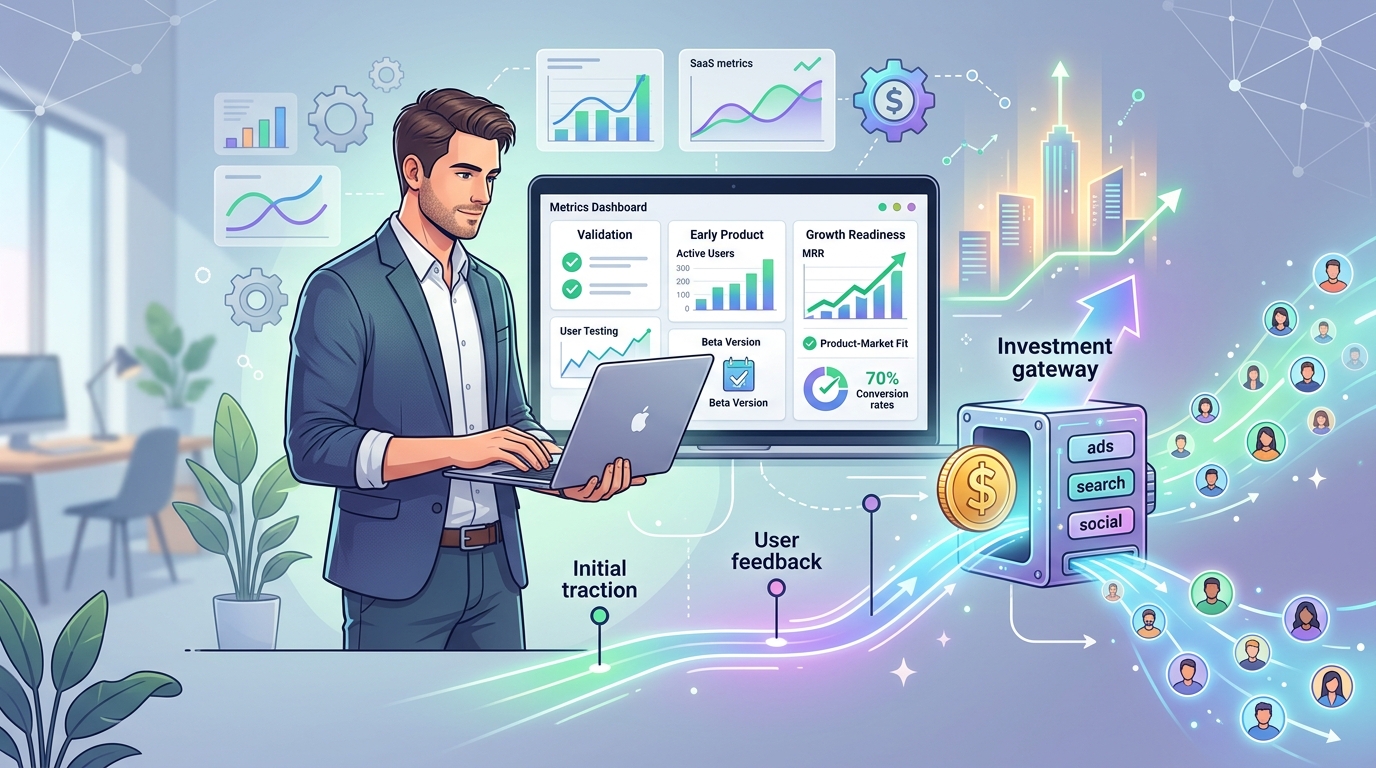
You’ve been grinding on organic growth for months. Content, cold emails, Reddit threads, Product Hunt launches. It’s working, but slowly. Now you’re wondering if it’s time to open the wallet and turn on paid ads.
The answer isn’t about hitting a magic revenue number. It’s about having the right foundation in place first.
Start paid acquisition when you have proven product-market fit, stable unit economics with a CAC payback under six months, and a landing page that converts at least 2% of cold traffic. Without these foundations, you’ll burn cash learning lessons that organic channels could teach you for free. Most founders start too early and quit before seeing results.
The foundation you need before spending a dollar
Paid acquisition isn’t a growth hack. It’s an amplifier.
If your product doesn’t retain users, ads will just fill a leaky bucket faster. If your landing page converts at 0.5%, you’ll pay 4x more per customer than a competitor converting at 2%.
Here’s what needs to be true first.
You have real retention numbers. At least 30 users who’ve been active for 60+ days. You know your Week 1, Week 4, and Week 8 retention rates. They’re not amazing, but they’re stable or improving.
Your landing page converts cold traffic. Not traffic from your Twitter followers or Product Hunt. Cold traffic from Google, Reddit, or other sources where people don’t know you. Aim for 2% minimum before you start paying for clicks.
You can measure the full funnel. You know exactly how many visitors become trials, how many trials become paid customers, and how long customers stick around. If you’re guessing at any of these numbers, you’re not ready.
You have budget you can afford to lose. Paid acquisition has a learning curve. Your first $2,000 will probably teach you more than it earns you. Only start when losing that money won’t kill your runway.
Calculate your unit economics first
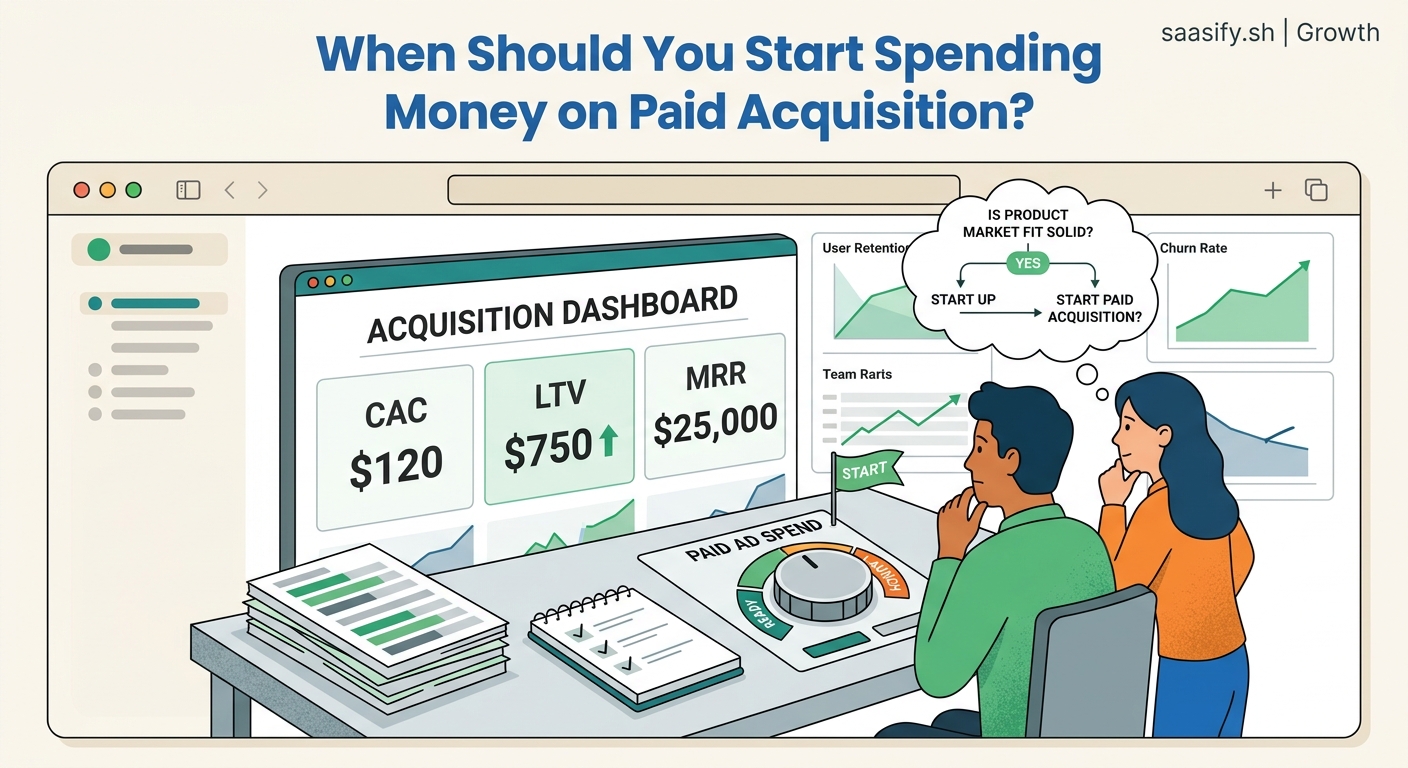
Here’s the math that matters.
| Metric | What It Tells You | Target Before Starting |
|---|---|---|
| Customer Acquisition Cost (CAC) | Total marketing spend divided by new customers | Under $200 for most indie SaaS |
| Lifetime Value (LTV) | Average revenue per customer over their lifetime | At least 3x your CAC |
| CAC Payback Period | Months to recover acquisition cost | Under 6 months |
| Monthly Churn Rate | Percentage of customers who cancel each month | Under 5% |
You don’t need perfect numbers. But you need real numbers.
Start by calculating these metrics from your organic channels. If your LTV is $150 and your CAC needs to stay under $50, you know exactly how much you can spend per conversion.
Most founders skip this step and wonder why their ads don’t work. The ads work fine. The economics don’t.
“We spent $5,000 on Google Ads in our first month and got 12 signups. We thought the channel was broken. Turns out our trial-to-paid rate was 8% and our LTV was $89. The channel worked perfectly. We just couldn’t afford it yet.” – Founder of a project management tool
The readiness checklist
Walk through these questions honestly.
- Can you explain your product’s value in one sentence that a stranger understands?
- Do you have at least 50 paying customers from organic channels?
- Is your monthly churn rate stable or decreasing?
- Do you know which features drive retention versus which ones people ignore?
- Can you afford to spend $3,000 over three months without affecting your runway?
- Do you have time to manage campaigns, or budget to hire someone who can?
If you answered no to more than two of these, focus on organic growth for another quarter.
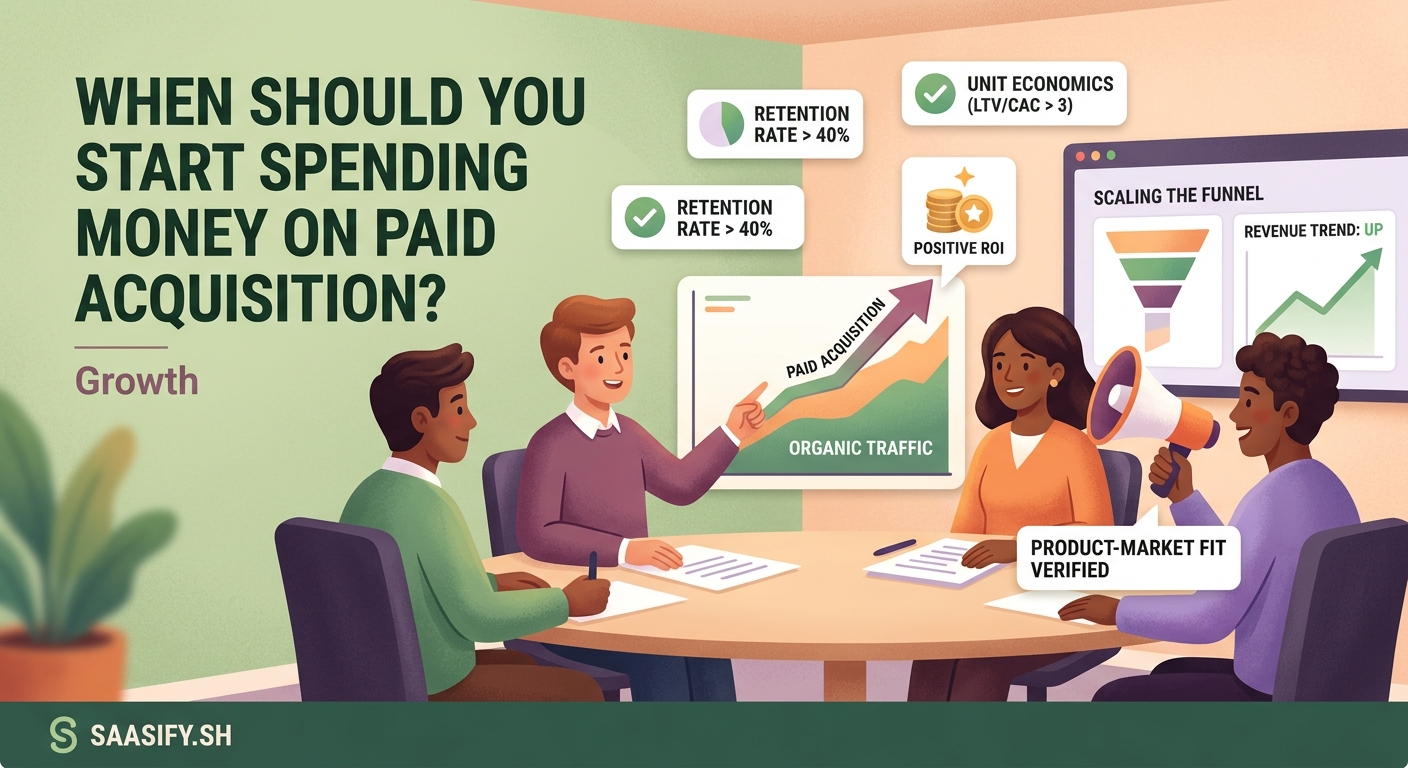
The best time to start paid acquisition is when you already have momentum. Ads accelerate what’s working. They don’t fix what’s broken.
Common mistakes that burn budgets
Starting with too many channels at once. Pick one. Master it. Then expand.
Google Ads and Facebook Ads require completely different approaches. LinkedIn works for B2B but costs 3x more per click. Twitter ads work for some SaaS products and fail completely for others.
Start with the channel where your customers already hang out. If you’re selling to developers, try Reddit or Google. If you’re selling to marketers, try Facebook or LinkedIn.
Optimizing for the wrong metric. Cost per click doesn’t matter. Cost per trial doesn’t even matter that much.
What matters is cost per paying customer and how long they stick around. A $10 CPC that converts at 5% and retains at 90% beats a $2 CPC that converts at 1% and churns at 20%.
Giving up too early. Most channels need 90 days and $3,000 minimum to show real signal.
Your first month teaches you what doesn’t work. Your second month teaches you what might work. Your third month shows you if it actually works.
Founders who spend $500, get disappointing results, and quit never get past the learning phase.
Ignoring your landing page. Your ad can be perfect. If your landing page is confusing, you’re wasting money.
Before you spend on ads, spend a week improving your landing page. Run it past five people who’ve never seen your product. If they can’t explain what it does and who it’s for, rewrite it. You might find our guide on why your SaaS landing page isn’t converting and how to fix it helpful here.
The minimum viable budget
Here’s a realistic breakdown for testing one channel.
- Month 1: $1,000 for initial testing and learning
- Month 2: $1,500 for iteration based on what you learned
- Month 3: $2,000 for scaling what worked
That’s $4,500 total. Less than that and you won’t get enough data to make real decisions.
If that number makes you nervous, you’re not ready. Keep growing organically until you have the cash flow to support it.
Some founders bootstrap to $10K MRR before touching paid ads. Others start at $2K MRR because they have strong unit economics and outside funding. There’s no universal threshold.
The question isn’t about revenue. It’s about whether the economics work and whether you can afford the learning curve.
Start with one experiment
Don’t build a comprehensive paid acquisition strategy. Run one focused experiment.
Here’s a simple framework.
- Pick one channel. Google Ads, Facebook Ads, LinkedIn Ads, or Reddit Ads. Just one.
- Set a 30-day budget. Something you can lose without stress. $500 to $1,000 works for most indie SaaS products.
- Define your success metric. Cost per trial, cost per paying customer, or CAC payback period.
- Create three ad variations. Different headlines, different value props, different angles.
- Track everything. Use UTM parameters, set up conversion tracking, and watch your funnel daily.
- Review after 30 days. Did you learn something useful? Did any variation show promise? Can you improve and try again?
Most experiments fail. That’s fine. You’re buying data, not customers.
If you learn that your ideal customer responds better to “save 10 hours per week” than “automate your workflow,” that insight is worth the $1,000 you spent.
When to double down versus when to pause
You’ll know it’s working when your CAC payback period drops below six months and your conversion rates improve week over week.
You’ll know it’s not working when you’ve spent $2,000, tested multiple variations, and your cost per customer is still 2x your LTV.
Double down when:
– Your CAC is under your target and stable
– Your conversion rate is improving with each iteration
– You’re learning clear patterns about what messaging works
– You have budget to scale to $5K+ per month
Pause when:
– Your CAC is 2x your target after 60 days of testing
– Your conversion rate isn’t improving despite testing new variations
– You’re running out of budget before getting clear signal
– Your product or landing page needs fundamental work
Pausing isn’t failing. It’s recognizing that organic channels will give you better ROI right now.
Come back to paid acquisition in three months when your fundamentals are stronger. Understanding retention vs acquisition and where early-stage SaaS founders should focus their time can help you make this call.
The organic foundation that makes paid work
The founders who succeed with paid acquisition built strong organic channels first.
They have:
– A content engine that brings in 500+ monthly visitors
– An email list of 1,000+ engaged subscribers
– A landing page that converts at 2%+ from cold traffic
– Clear messaging that resonates with their target customer
Paid ads amplify all of this. They don’t replace it.
If you’re still figuring out your messaging, test it in Reddit marketing for SaaS first. If you’re still building your email list, focus on building your first 1,000 email subscribers before you pay for traffic.
Every dollar you spend on ads should build on a foundation that already works.
Signs you’re actually ready
You know you’re ready to start paid acquisition when these things are true.
Your organic channels are maxed out. You’ve optimized your SEO, you’re active in communities, you’re publishing content regularly. You’re still growing, but the growth rate is plateauing.
You have clear attribution. You know exactly which channels drive your best customers. You know which features those customers use most. You know how long they stick around.
Your unit economics are proven. You’ve calculated CAC, LTV, and payback period from your organic channels. The numbers work. You just need more volume.
You have time or budget to manage it. Running paid campaigns takes 5-10 hours per week minimum. If you don’t have that time, you need budget to hire someone who does.
Your product is stable. You’re not rebuilding core features every week. Your customers are happy. Your churn is predictable.
If all of these are true, you’re not just ready to start paid acquisition. You’re late.
What success looks like in the first 90 days
Realistic expectations matter.
Month 1: You’ll spend $1,000 and probably get 5-10 trials. Maybe one paying customer. You’ll learn which ad copy gets clicks and which landing page elements confuse people.
Month 2: You’ll spend $1,500 and get 10-15 trials. Maybe three paying customers. You’ll have enough data to see patterns in what works.
Month 3: You’ll spend $2,000 and get 15-25 trials. Maybe six paying customers. Your cost per customer will drop as you optimize.
By the end of 90 days, you should know whether the channel can scale profitably. If your CAC is trending down and your conversion rate is trending up, double your budget for month four.
If your CAC is still too high and your conversion rate is flat, pause and fix your fundamentals.
Building the tracking infrastructure
You can’t optimize what you can’t measure.
Before you spend anything, set up:
– UTM parameters for every ad and campaign
– Conversion tracking in your ad platform
– Event tracking in your product analytics
– A simple spreadsheet to track spend, trials, conversions, and CAC
Update your spreadsheet daily for the first month. Weekly after that.
You’ll spot patterns faster when you’re looking at the data regularly. You’ll notice that Tuesday traffic converts better than Friday traffic. You’ll see that one ad variation drives trials but another drives paying customers.
These insights only come from consistent tracking. Having a revenue dashboard that actually drives growth decisions helps you spot these patterns faster.
Alternatives to consider first
Paid acquisition isn’t the only way to accelerate growth.
Partnerships and integrations. If your product integrates with another tool, their audience might be your perfect customer. A single integration can drive more qualified traffic than $10K in ads.
Affiliate programs. Pay for performance instead of clicks. You only pay when someone converts. The CAC is predictable and the risk is lower.
Content partnerships. Guest posts, podcast appearances, and co-marketing campaigns can drive hundreds of qualified visitors for zero ad spend.
Community building. A Slack community or Discord server creates a flywheel where customers bring more customers. It takes longer but compounds better than ads.
Try these first. If they’re working but too slow, add paid acquisition on top.
Your first campaign blueprint
Here’s exactly how to structure your first test.
Week 1: Set up tracking, create three ad variations, write landing page copy that matches your ad messaging.
Week 2: Launch with $50/day budget, monitor hourly for the first three days to catch any setup mistakes.
Week 3: Pause underperforming ads, increase budget on winners, test two new variations based on what you learned.
Week 4: Analyze full funnel metrics, calculate CAC and conversion rates, decide whether to continue, pause, or pivot.
Keep it simple. One channel, one clear goal, one month of focused testing.
Most founders overcomplicate their first campaign and quit before they get useful data. Simple and consistent beats complex and scattered.
Making the call
The right time to start paid acquisition isn’t when you hit a revenue milestone. It’s when your fundamentals are strong enough to amplify.
You need proven retention, clear unit economics, and a landing page that converts. You need budget you can afford to lose and time to manage campaigns properly.
If you have all of that, start with one small experiment. Track everything. Learn fast. Iterate based on data, not gut feel.
If you don’t have all of that yet, focus on the organic channels that teach you about your customers for free. Come back to paid acquisition when you’re ready to scale what already works.
The founders who succeed with paid acquisition didn’t start there. They built a foundation that made every dollar work harder.