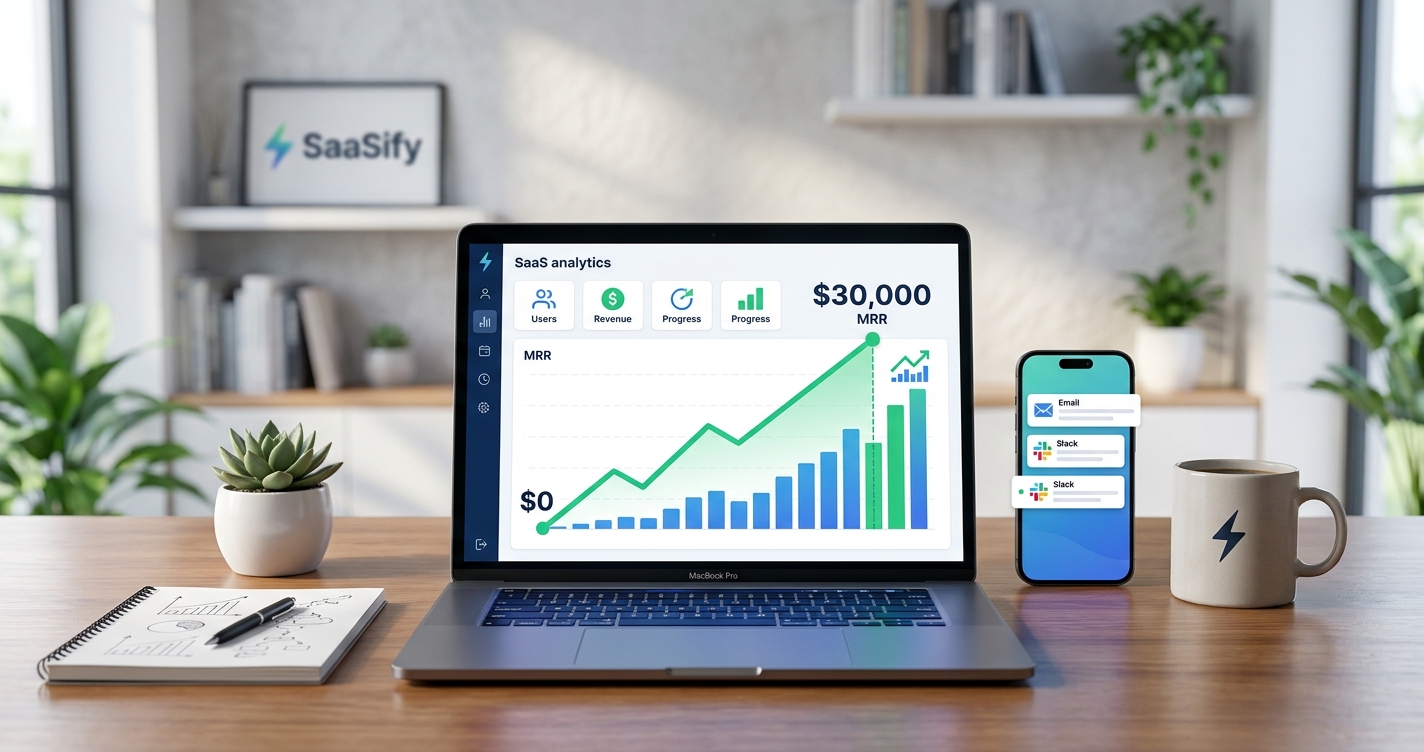
Most founders think hitting $30K MRR means hiring a sales team, raising funding, or spending months on calls.
They’re wrong.
The most successful bootstrapped SaaS companies reach this milestone without a single sales call. They build systems that sell while they sleep. They focus on async processes that scale without burning out.
This isn’t theory. Real founders are doing this right now.
Reaching $30K MRR without sales calls requires focusing on product-led growth, self-serve onboarding, and async customer education. Solo founders succeed by building activation systems, not lead magnets, and treating trials as conversion engines. The path involves choosing the right niche, pricing for self-serve buyers, and creating content that answers questions before prospects ask them. No funding or sales team required.
Why the Traditional Sales Model Breaks Solo Founders
Traditional SaaS advice tells you to hire sales reps around $10K MRR.
That advice comes from venture-backed companies with runway to burn.
For bootstrapped founders, every dollar counts. A single sales hire costs $60K to $80K annually, plus benefits, tools, and training time. That’s your entire year of runway gone before they close their first deal.
The math doesn’t work.
Sales calls also don’t scale with your time. Each demo takes 30 to 60 minutes. Add prep time, follow-ups, and proposal writing. You’re looking at 2 to 3 hours per prospect. At a 20% close rate, that’s 10 to 15 hours per customer.
Now multiply that by the 100+ customers you need to hit $30K MRR at $300 per month average. That’s 1,000 to 1,500 hours of your life spent on calls.
There’s a better way.
The Async-First Framework That Actually Scales
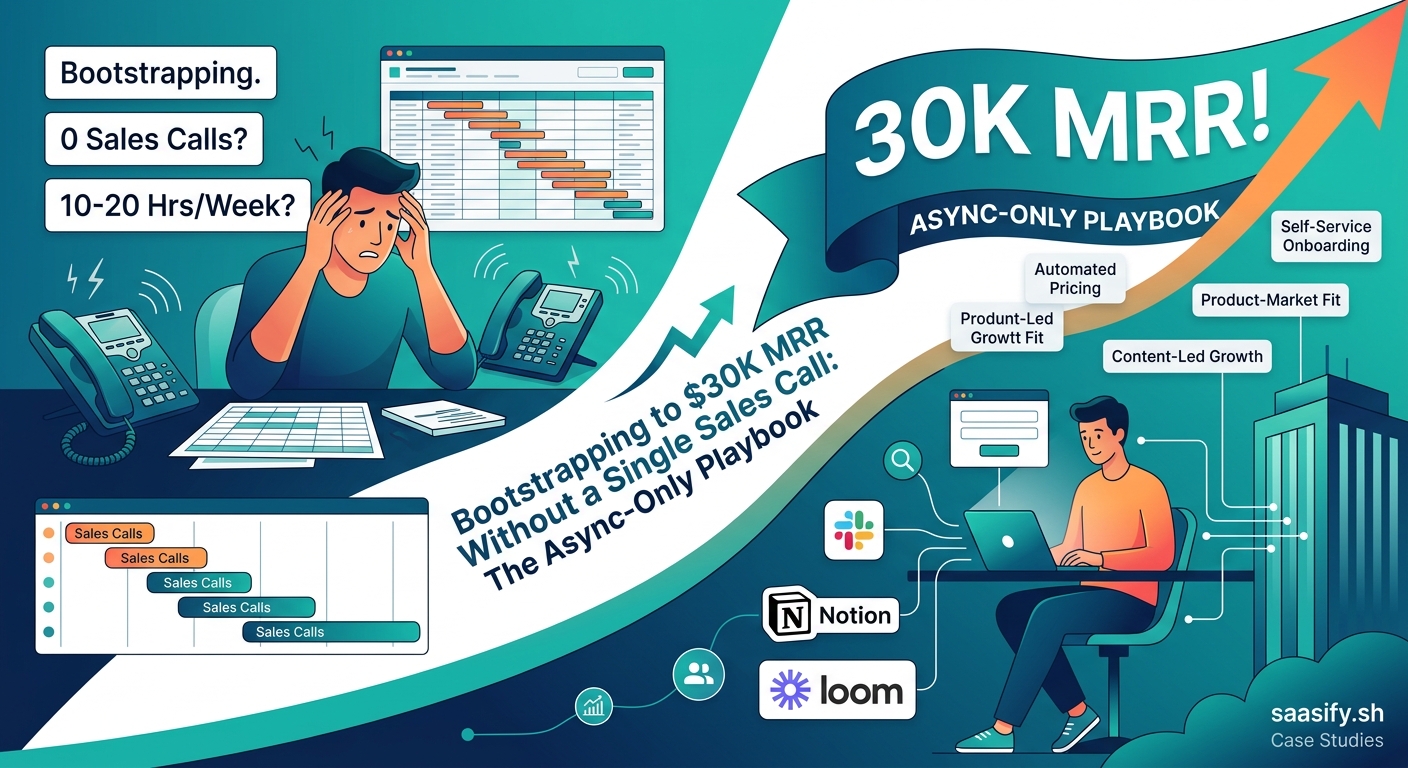
The founders who bootstrap SaaS to 30K MRR without sales calls follow a different playbook.
They build systems that answer questions, demonstrate value, and convert customers without human intervention.
Here’s the framework:
-
Choose a niche where buyers are already educated. Target developers, marketers, or designers who understand SaaS. They don’t need hand-holding. They want to try the product and decide fast.
-
Price for self-serve buyers. Keep plans under $500 per month. Above that threshold, buyers expect calls. Below it, they want to swipe a card and start immediately.
-
Build activation into your product. The first 10 minutes determine everything. Users should hit one meaningful win before they consider leaving. Not a tour. Not a tutorial. A real outcome.
-
Create content that pre-sells. Write the articles, record the videos, and build the templates that answer every objection before someone signs up. Your content is your sales team.
-
Automate onboarding sequences. Email, in-app messages, and progress tracking should guide users to activation without you lifting a finger.
-
Use data to trigger interventions. When someone gets stuck, your system should know and respond. Automated, personalized, helpful.
This isn’t about removing the human touch. It’s about scaling it through systems instead of your calendar.
What Separates Lead Magnets From Revenue Engines
Most founders celebrate signup numbers.
They shouldn’t.
A thousand trial signups mean nothing if 950 people never activate. You haven’t built a business. You’ve built a leaky bucket with good marketing.
The metric that matters is activation rate. That’s the percentage of users who experience your product’s core value within their first session.
“We stopped tracking signups and started tracking first project created. Our conversion rate tripled in 60 days because we finally optimized for the right thing.” – Founder of a project management SaaS at $40K MRR
Here’s what actually drives revenue:
- Time to value under 15 minutes. If users can’t get a win in one sitting, they won’t come back.
- One clear action, not ten options. Decision paralysis kills activation. Show them the single most important thing to do first.
- Immediate proof of concept. Let them see results with sample data, templates, or pre-built workflows.
- Progress indicators that create momentum. “You’re 2 steps away from your first campaign” beats “Welcome to our platform.”
When you build a SaaS MVP in 30 days, focus on activation from day one. Not features. Not polish. Activation.
The Trial Structure That Converts at 25%+
Industry average trial-to-paid conversion sits around 15% to 20%.
The best async-first SaaS products convert at 25% to 35%.
The difference isn’t the product. It’s the trial structure.
| Trial Element | What Breaks Conversion | What Drives Conversion |
|---|---|---|
| Length | 30 days gives people time to forget you | 7 to 14 days creates urgency and focus |
| First experience | Feature tour that teaches nothing | Guided path to one specific outcome |
| Credit card requirement | No gate means low intent signups | Requiring payment info filters for serious buyers |
| Email sequence | Generic tips and feature announcements | Behavioral triggers based on actual usage |
| Sales handoff | Every signup goes to sales | Only activated users with buying signals get outreach |
The best trial experiences feel like a game with clear levels.
Level 1 is connecting your data or creating your first project. Level 2 is inviting a teammate or publishing something. Level 3 is seeing results or completing a workflow.
Each level should take 5 to 10 minutes. Users should feel progress, not overwhelm.
When someone completes all three levels, your system can trigger a personalized upgrade offer. Not from a sales rep. From an automated email that shows exactly what they accomplished and what they’ll unlock with a paid plan.
This is how you should soft launch or go big without burning your time on unqualified leads.
Content That Replaces Your Sales Team
The founders who reach $30K MRR without calls don’t just create content.
They create content that does the work of a sales conversation.
Here’s what that looks like:
- Comparison pages that position you against competitors and handle the “why you” question
- Use case tutorials that show exactly how different customer types use your product
- ROI calculators that let prospects see their potential return before signing up
- Video walkthroughs that demonstrate your product solving real problems, not fake demo scenarios
- Template libraries that give immediate value and showcase your product’s capabilities
- FAQ pages that answer every objection you’ve ever heard on a call
This content lives on your site, in your docs, and in your email sequences.
It works 24/7. It scales infinitely. It gets better over time as you add more questions and answers.
One founder I know tracks which help articles correlate with higher conversion rates. She promotes those articles in her onboarding emails. Her trial-to-paid conversion jumped from 18% to 29% in three months.
That’s the power of treating content like a sales asset, not a marketing expense.
If you’re just starting, focus on building your first 1,000 email subscribers who will consume this content and give you feedback on what’s missing.
Pricing Strategy for Self-Serve Revenue
Most founders underprice or overprice their product.
Both mistakes kill your path to $30K MRR.
Underprice and you need 300+ customers at $100 per month. That’s a huge activation and retention challenge. You’re fighting churn every single month.
Overprice above $500 per month and buyers expect calls, custom demos, and negotiation. You’re back in sales mode.
The sweet spot for async-first SaaS sits between $200 and $500 per month.
At this range:
- Buyers can expense it without approval in most companies
- The ROI is clear enough that they don’t need to build a business case
- You only need 60 to 150 customers to hit $30K MRR
- Churn hurts less because you have fewer eggs in each basket
Here’s a pricing structure that works:
- Starter plan at $29 to $49 per month for individuals and very small teams. This is your activation tier. You’ll get volume here but limited revenue.
- Professional plan at $199 to $299 per month for small teams and growing businesses. This is your revenue engine. Most of your MRR comes from here.
- Business plan at $499 to $699 per month for larger teams who need advanced features. This is your expansion tier.
Notice there’s no enterprise tier. That requires sales calls and custom contracts. You’ll add that after $30K MRR when you have the resources.
Your pricing strategy when you have zero customers should focus on finding the price point where people say yes without needing to talk to you first.
The Metrics Dashboard That Keeps You Honest
You can’t improve what you don’t measure.
But most founders track vanity metrics that don’t connect to revenue.
Here’s what actually matters when you’re trying to reach $30K MRR:
- Trial signups (the top of your funnel)
- Activation rate (percentage who complete your core action)
- Trial-to-paid conversion (percentage who become paying customers)
- Average revenue per customer (your MRR divided by customer count)
- Monthly churn rate (percentage of customers who cancel each month)
- Net MRR growth (new MRR minus churned MRR)
These six numbers tell you everything.
If signups are high but activation is low, fix your onboarding. If activation is high but conversion is low, fix your pricing or trial structure. If conversion is high but churn is high, you have a product-market fit problem.
Building a revenue dashboard that shows these metrics daily keeps you focused on what moves the needle.
One founder I spoke with checks his dashboard every morning. He spends 10 minutes identifying the biggest bottleneck. Then he spends his day fixing only that bottleneck.
That’s how you get from $5K to $30K MRR in 12 to 18 months without getting distracted by shiny features or growth hacks.
Common Mistakes That Stall Growth Before $30K
Even with the right framework, founders make predictable mistakes.
Here are the ones that hurt most:
Building features instead of fixing conversion. Your product probably has enough features to reach $30K MRR. What it needs is better activation, clearer value props, and smoother onboarding.
Ignoring churn until it’s a crisis. At 10% monthly churn, you need $3,000 in new MRR just to stay flat. That’s 10 to 15 new customers every month at $200 to $300 per customer. Fix retention before you pour money into acquisition.
Trying to serve everyone. The fastest path to $30K MRR is picking one profitable niche and owning it. Generalist tools compete with billion-dollar companies. Niche tools compete with nobody.
Skipping validation. Building for 6 months without talking to customers is how you end up with a product nobody wants. Validate your idea before you write code.
Launching without an audience. The founders who hit $10K MRR in their first month all had one thing in common. They built a waitlist before launch. You need people ready to buy on day one.
Using the wrong tools. You don’t need a custom tech stack. You need the right no-code tools that let you move fast and iterate based on feedback.
Real Numbers From Founders Who Did This
Let me show you what this actually looks like in practice.
One founder built a form builder for real estate agents. He launched with 200 people on his waitlist. Month one brought $2,400 MRR from 12 customers at $200 per month.
He focused entirely on activation. His goal was getting every trial user to create and publish one form. He rebuilt onboarding three times in the first 90 days.
By month six, he had 78 customers and $18,200 MRR. By month 12, he crossed $30,000 MRR with 142 customers. He never did a sales call. Everything happened through self-serve signup, automated onboarding, and email sequences.
Another founder built a screenshot tool for developers. She priced it at $29 for individuals and $149 for teams. She wrote 40 tutorials showing different use cases. Her content ranked for long-tail keywords like “how to add shadows to screenshots” and “best tool for annotating code screenshots.”
That content drove 300 to 400 trial signups per month. Her activation rate sat at 42% because her product delivered value in under 5 minutes. Her trial-to-paid conversion was 31%.
She hit $30K MRR in 14 months with 380 customers. Her average revenue per customer was $79. She spent zero dollars on ads. Just content and product.
These aren’t unicorns. They’re normal founders who followed the async-first playbook.
You can read about how a solo developer built and sold a $2M SaaS using similar principles at a larger scale.
Your First 90 Days After Launch
The first three months determine whether you’ll reach $30K MRR or stall at $5K.
Here’s what to focus on:
Week 1 to 4: Activation obsession. Track every user’s first session. Where do they get stuck? What makes them leave? What makes them come back? Fix the biggest drop-off point.
Week 5 to 8: Conversion optimization. Now that more users are activating, focus on converting them to paid. Test trial length. Test credit card requirements. Test upgrade prompts. Test pricing.
Week 9 to 12: Retention and expansion. Look at your first cohort of paying customers. Who’s getting the most value? Why? How can you help others get similar results? What features would make them upgrade to a higher tier?
This cycle repeats every 90 days. Activation, conversion, retention. Over and over.
Each cycle should improve your numbers by 10% to 20%. That compounds fast.
A 15% improvement in activation plus a 15% improvement in conversion plus a 10% reduction in churn equals 40%+ more MRR in the same time period.
When to Break Your Own Rules
The async-first approach works for most founders trying to reach $30K MRR.
But not every situation fits this model.
If your average contract value needs to be $2,000+ per month to make the economics work, you’ll probably need sales calls. The math changes at that price point.
If you’re selling to enterprise buyers with complex procurement processes, async won’t cut it. They want relationships and reassurance.
If your product requires significant customization or integration work, you’ll need human support to close deals.
But here’s the thing.
Most founders think they’re in one of these categories when they’re not. They assume they need high prices or enterprise customers because that’s what they’ve been told.
Start with async-first. Prove it doesn’t work before you add the complexity and cost of a sales team.
You might be surprised how far you can get.
Why This Approach Wins Long Term
Building to $30K MRR without sales calls isn’t just about saving money.
It’s about building a better business.
When your product sells itself, you’ve proven real product-market fit. People want it enough to buy without persuasion.
When your onboarding activates users automatically, you’ve built a system that scales. You can go from 100 to 1,000 customers without 10x-ing your workload.
When your content answers questions and handles objections, you’ve created an asset that appreciates over time. Each article, video, and tutorial works harder as it ranks better and reaches more people.
This foundation lets you add sales later from a position of strength. You’re not desperate for every deal. You’re selectively adding high-value customers who benefit from white-glove service.
That’s the difference between building a job and building a business.
The async-first playbook gives you leverage. Your time, your money, and your sanity all benefit.
And you still hit $30K MRR, probably faster than you would with the traditional approach.