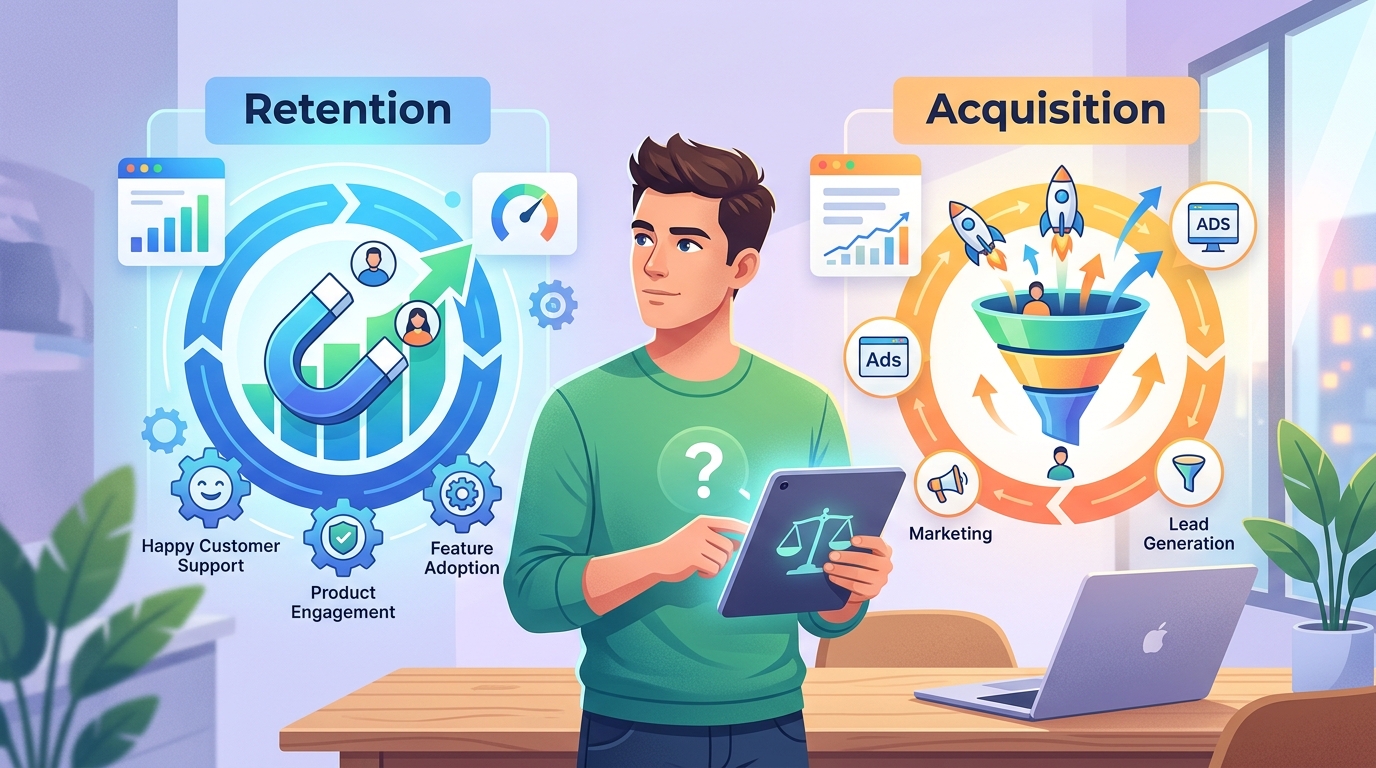
You just launched your SaaS product. You’ve got 50 paying customers and a modest marketing budget. Should you spend the next three months hunting for 100 new customers, or making sure those 50 never leave? This question keeps founders awake at night, and the answer isn’t what most people think.
Customer acquisition vs retention isn’t an either-or choice. Early-stage SaaS founders should focus on retention first until monthly churn drops below 5%, then gradually shift resources toward acquisition. Retention drives profitability and word of mouth, while acquisition fuels growth. The right balance depends on your product’s lifecycle stage, unit economics, and whether customers stick around long enough to become profitable.
Why most founders get the balance wrong
Most early-stage SaaS founders obsess over new signups. It feels good to see that customer count climb. Every new logo validates your idea and makes the pitch deck look better.
But here’s the problem. If you’re losing customers as fast as you gain them, you’re filling a leaky bucket. You’re burning cash on ads while your best customers quietly cancel their subscriptions.
The math is brutal. Acquiring a new customer costs five to seven times more than keeping an existing one. Yet most founders allocate 80% of their budget to acquisition and wonder why growth stalls after six months.
This happens because acquisition metrics are visible and immediate. You run an ad campaign, you see signups. Retention is slower and harder to measure. A customer who stays for 18 months doesn’t feel as exciting as 50 new trials in a week.
Understanding the customer acquisition vs retention spectrum
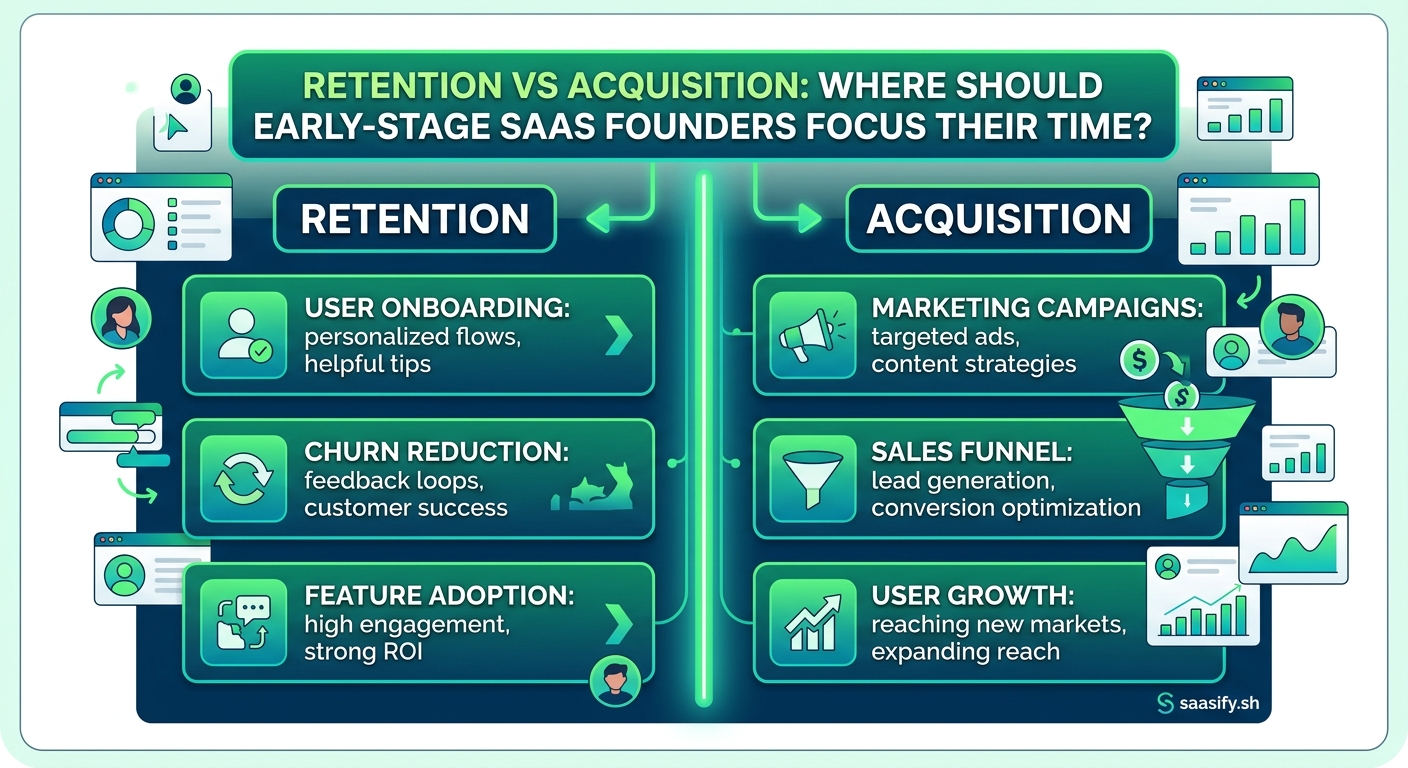
Not all SaaS products sit in the same spot on the acquisition-retention spectrum. Your product’s natural position determines where you should focus your energy.
Some products are easy to sell but hard to keep. Think competitor analysis tools or keyword research platforms. Everyone wants to see what their competition is doing. The pitch sells itself. But after the initial excitement wears off, customers question whether they need another monthly subscription.
Other products are hard to sell but easy to keep. Email providers and project management tools fall into this category. Getting someone to switch from Gmail or migrate their entire team’s workflow is painful. But once they’re in, they rarely leave. Their credit card expires and they update it without you asking.
Understanding where your product sits on this spectrum changes everything. It determines your pricing model, your sales strategy, and how you allocate resources between customer acquisition vs retention efforts.
“If your churn rate is above 5% monthly, every dollar you spend on acquisition is subsidizing your retention problem. Fix retention first, then scale acquisition.” – Jason Cohen, founder of WP Engine
The real cost of ignoring retention
Let’s run some numbers. You acquire 100 customers at $200 each. That’s $20,000 in acquisition costs. Each customer pays $50 per month.
If your monthly churn rate is 10%, you’ll lose half those customers within seven months. You’ll collect roughly $17,500 in revenue before they’re gone. You’re underwater by $2,500, and that’s before accounting for support costs, server fees, or your time.
Now imagine you cut churn to 3% monthly. Those same 100 customers stick around for an average of 33 months. They generate $165,000 in lifetime revenue. Same acquisition cost, 10x the return.
This is why venture capitalists obsess over retention metrics. They know that a company with great retention can afford to spend more on acquisition. Better retention means higher customer lifetime value, which means you can outbid competitors for ad space, sponsorships, and partnerships.
Poor retention also kills word of mouth. Customers who cancel don’t refer friends. They don’t leave positive reviews. They don’t become case studies. You lose the compounding effects of a happy customer base.
When to prioritize retention over acquisition
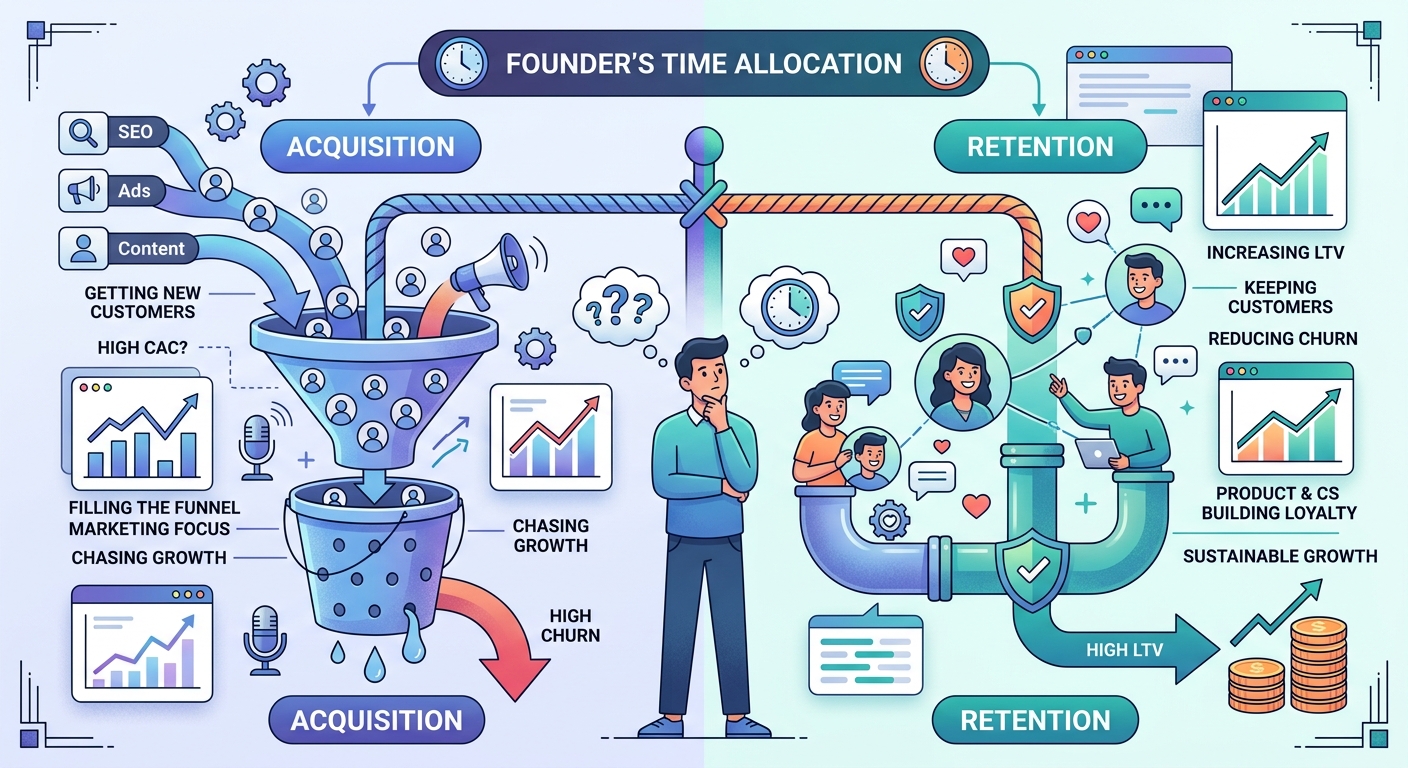
You should focus primarily on retention if any of these conditions are true:
- Your monthly churn rate exceeds 5%
- Customer lifetime value is less than 3x your acquisition cost
- You’re getting negative feedback about core product features
- Customers cancel within the first 90 days
- You don’t have a clear onboarding process
- Support tickets are increasing faster than your customer count
These signals indicate a product-market fit problem or an experience gap. Throwing more marketing budget at these issues makes them worse, not better. You need to validate your SaaS idea and fix the foundation before scaling.
Early retention work doesn’t require a huge budget. It requires attention and iteration. Talk to customers who canceled. Watch session recordings. Track where users get stuck. Build features that increase stickiness.
When to shift focus toward acquisition
Once you’ve stabilized retention, you can start scaling acquisition. Here are the signs you’re ready:
- Monthly churn is consistently below 5%
- Customer lifetime value is at least 3x your acquisition cost
- Net Promoter Score is above 30
- Customers are actively referring others
- You have clear messaging that resonates with your target audience
- Your onboarding completion rate exceeds 60%
At this stage, every new customer you acquire has a high probability of becoming profitable. You’ve earned the right to spend money finding more people like your best customers.
This is when you should build a pre-launch waitlist for new features, experiment with paid ads, and invest in content marketing. The unit economics support growth.
Five retention strategies that work for early-stage founders
These tactics don’t require enterprise software or a customer success team. You can implement them with basic tools and a few hours per week.
-
Build a 7-day onboarding sequence. Send targeted emails that guide new users to their first win. Day 1 covers account setup. Day 3 highlights the most valuable feature. Day 7 asks for feedback. This simple sequence can cut early churn by 30% or more.
-
Track feature adoption, not just logins. Customers who use your core feature three times in the first week are 5x more likely to stick around. Identify that activation moment and optimize everything around it. If you’re building a SaaS MVP, bake this tracking in from day one.
-
Reach out before they cancel. Set up alerts for disengagement. If a customer hasn’t logged in for 14 days, send a personal email. Ask what’s blocking them. Offer to help. You’ll save 20% of at-risk customers just by showing you care.
-
Create a feedback loop. Monthly surveys feel like homework. Instead, add a simple “How are we doing?” widget in your app. When someone gives low marks, follow up within 24 hours. When they give high marks, ask for a testimonial or referral.
-
Offer annual plans with a discount. Customers who prepay for a year are psychologically committed. They’re more likely to integrate your product into their workflow. The upfront cash also helps with runway. A 20% annual discount usually increases customer lifetime value by 40% or more.
Building a balanced acquisition strategy
Once retention is solid, you can scale acquisition without fear. But don’t just throw money at ads and hope for the best.
Start with channels you can measure and control. Content marketing gives you compounding returns. A single article can generate leads for years. Paid ads give you immediate feedback but stop working the moment you stop paying.
Test channels in parallel but commit to one at a time. Run a small LinkedIn ad campaign for two weeks. Try a Product Hunt launch. Write guest posts for industry blogs. Measure cost per acquisition and conversion rates for each channel.
When you find a channel that works, double down. If LinkedIn ads are converting at $150 per customer and your LTV is $600, scale that channel until it stops working. Then add the next channel.
Here’s a simple framework for channel testing:
| Channel | Time to Results | Upfront Cost | Scalability | Best For |
|---|---|---|---|---|
| Content marketing | 3-6 months | Low | High | Long-term growth |
| Paid ads | 1-2 weeks | Medium | High | Fast validation |
| Partnerships | 2-3 months | Low | Medium | Targeted audiences |
| Cold outreach | 1-2 weeks | Low | Low | Early customers |
| Community building | 6-12 months | Low | Medium | Brand loyalty |
The mistake most founders make is trying all channels at once. You spread yourself thin and never learn what actually works. Pick one, run it for at least 30 days, and measure everything.
Metrics that matter for both strategies
You can’t improve what you don’t measure. These metrics tell you whether you’re making progress on customer acquisition vs retention.
For retention:
– Monthly churn rate (aim for under 5%)
– Customer lifetime value (should be 3x acquisition cost minimum)
– Net revenue retention (above 100% means expansion revenue)
– Time to first value (how long until a new user gets their first win)
– Feature adoption rate (percentage of users engaging with core features)
For acquisition:
– Customer acquisition cost (total marketing spend divided by new customers)
– Conversion rate by channel (which sources bring the best customers)
– Payback period (how long until a customer becomes profitable)
– Trial-to-paid conversion rate (for freemium or trial models)
– Cost per lead (helps identify efficient top-of-funnel channels)
Build a revenue dashboard that tracks these numbers weekly. You don’t need fancy analytics tools. A simple spreadsheet works fine for the first 1,000 customers.
Common mistakes that waste time and money
Founders make predictable errors when balancing customer acquisition vs retention. Avoid these traps:
Optimizing for vanity metrics. Total signups don’t matter if nobody sticks around. Active users and paying customers are the only numbers that count. Instagram likes and Twitter followers feel good but don’t pay the bills.
Ignoring cohort analysis. Your January customers might behave completely differently than your June customers. Track retention by cohort to spot trends. If June customers are churning faster, something changed in your messaging or product.
Copying enterprise playbooks. Strategies that work for Salesforce won’t work for your 100-customer SaaS. You don’t need a customer success team or a complex onboarding platform. You need personal attention and fast iteration.
Underpricing to reduce churn. Charging $9/month doesn’t reduce churn. It just means you earn less from the customers who stay. Price your SaaS product based on value, not fear.
Waiting too long to ask for feedback. Don’t wait until someone cancels to find out what went wrong. Build feedback collection into your product from day one. Make it easy and frictionless.
The lifecycle approach to resource allocation
Your focus should shift as your company matures. Here’s a practical timeline for balancing customer acquisition vs retention efforts.
Months 0-6 (pre-product-market fit):
– 80% retention, 20% acquisition
– Focus on finding and keeping your first 10 paying customers
– Learn why people buy and why they stay
– Iterate on core features based on direct feedback
Months 6-12 (early traction):
– 60% retention, 40% acquisition
– Systematize your onboarding process
– Test 2-3 acquisition channels in parallel
– Build referral loops into your product
Months 12-24 (scaling):
– 40% retention, 60% acquisition
– Double down on your best acquisition channel
– Hire your first customer success person
– Expand into adjacent markets or features
Months 24+ (growth stage):
– 30% retention, 70% acquisition
– Build a dedicated retention team
– Invest in brand and awareness campaigns
– Launch expansion revenue initiatives
These percentages are rough guidelines, not rules. Your actual allocation depends on your churn rate, unit economics, and competitive landscape. If churn spikes at any stage, shift back toward retention immediately.
Real examples from successful indie SaaS founders
Patterns emerge when you study how successful founders balanced customer acquisition vs retention.
ConvertKit focused almost entirely on retention for their first 18 months. They personally onboarded every customer. They built features based on direct requests. They didn’t scale acquisition until monthly churn dropped below 3%. That patience paid off. They’re now over $30M in annual recurring revenue.
Baremetrics took the opposite approach early on. They built a viral dashboard that customers loved to share. Acquisition came naturally through word of mouth. They could afford to prioritize growth because their product was inherently sticky. Finance dashboards become more valuable over time as they accumulate historical data.
Transistor FM balanced both from the start. They focused on podcast hosting, a category with naturally low churn. Once you upload 50 episodes, switching costs are high. This allowed them to invest in content marketing and partnerships without worrying about a leaky bucket.
The lesson? Know your product’s natural retention curve. Build your strategy around that reality, not around what worked for someone else.
Making the decision for your specific situation
Here’s a simple decision tree to help you allocate resources right now.
Is your monthly churn rate above 5%? Focus on retention. Fix the experience. Talk to churned customers. Don’t scale acquisition until this number improves.
Is your customer lifetime value less than 3x your acquisition cost? Focus on retention. Either increase prices, reduce churn, or both. You can’t afford to scale until the unit economics work.
Are customers canceling within 90 days? Focus on retention. You have an onboarding problem or a product-market fit problem. More customers won’t solve this.
If you answered no to all three questions, you’re ready to scale acquisition. Start testing channels. Invest in content. Build partnerships. You’ve earned the right to grow.
Building sustainable growth from day one
The customer acquisition vs retention debate misses the point. You need both. The question is timing and proportion.
Start with retention. Make sure people who try your product actually use it. Make sure people who pay actually stay. Get that foundation right before you pour gasoline on the fire.
Once retention is solid, shift gradually toward acquisition. Test channels methodically. Measure everything. Double down on what works and kill what doesn’t.
Remember that retention work never stops. Even at scale, you need to keep improving the experience, shipping features customers want, and staying ahead of churn. The best SaaS companies treat retention as a core competency, not a one-time project.
Your goal is to build a machine where every dollar spent on acquisition returns three or more dollars in lifetime value. Where happy customers refer friends. Where growth compounds month after month. That machine starts with retention and scales with smart acquisition.
The founders who win are the ones who understand this balance and adjust it as they grow. They don’t follow dogma. They watch their metrics, talk to customers, and make decisions based on reality rather than best practices.
Start where you are. Measure what matters. Fix retention first. Then scale with confidence.