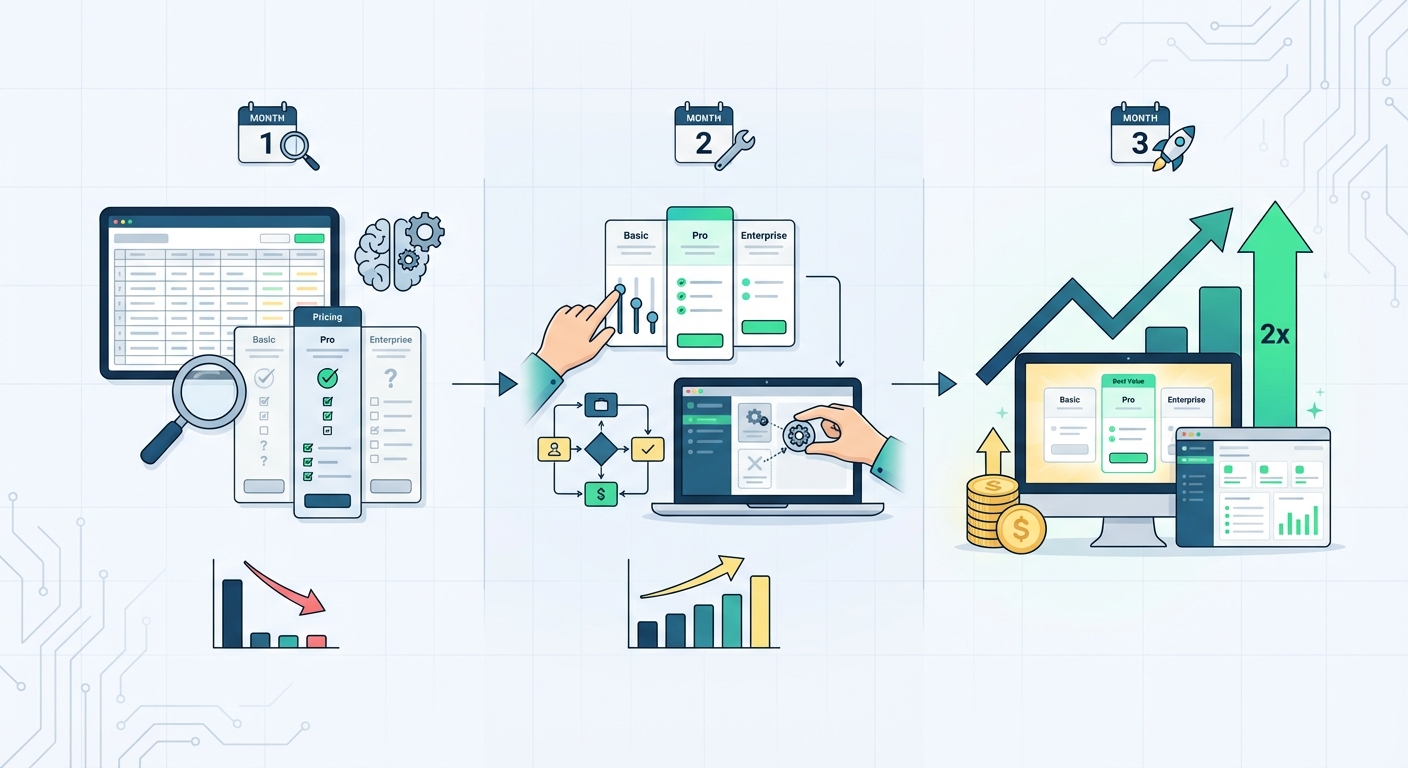
You just spent six months building a feature nobody asked for. Your MRR barely moved. Sound familiar?
Most SaaS founders believe growth means shipping more code. They burn through runway adding integrations, dashboards, and bells and whistles that customers ignore. Meanwhile, revenue stays flat.
Here’s the truth: the fastest path to higher MRR lives inside your existing product. Not in your backlog.
You can double your monthly recurring revenue by optimizing pricing structure, improving trial conversion, reducing churn, and packaging features around customer outcomes. These strategies require zero development time but deliver measurable growth within weeks. Most SaaS founders overlook these levers because they’re focused on building instead of optimizing what already works.
Why building more features hurts revenue growth
Feature bloat kills more SaaS businesses than bad marketing.
Every new feature adds maintenance cost. It complicates onboarding. It dilutes your positioning. Worst of all, it distracts you from the revenue levers that actually matter.
Consider this: a SaaS company with 200 customers and a 15% trial conversion rate can double MRR by improving conversion to 30%. No code required. Just better messaging, smarter pricing, and clearer value demonstration.
Building features feels productive. Optimizing revenue feels like guesswork. But the data tells a different story.
Companies that focus on pricing optimization see 20 to 30% revenue increases within 90 days. Those that chase feature requests see marginal gains spread over quarters.
The difference? Revenue optimization targets existing customers who already understand your value. Feature development targets hypothetical users who may never show up.
The four revenue levers you already own
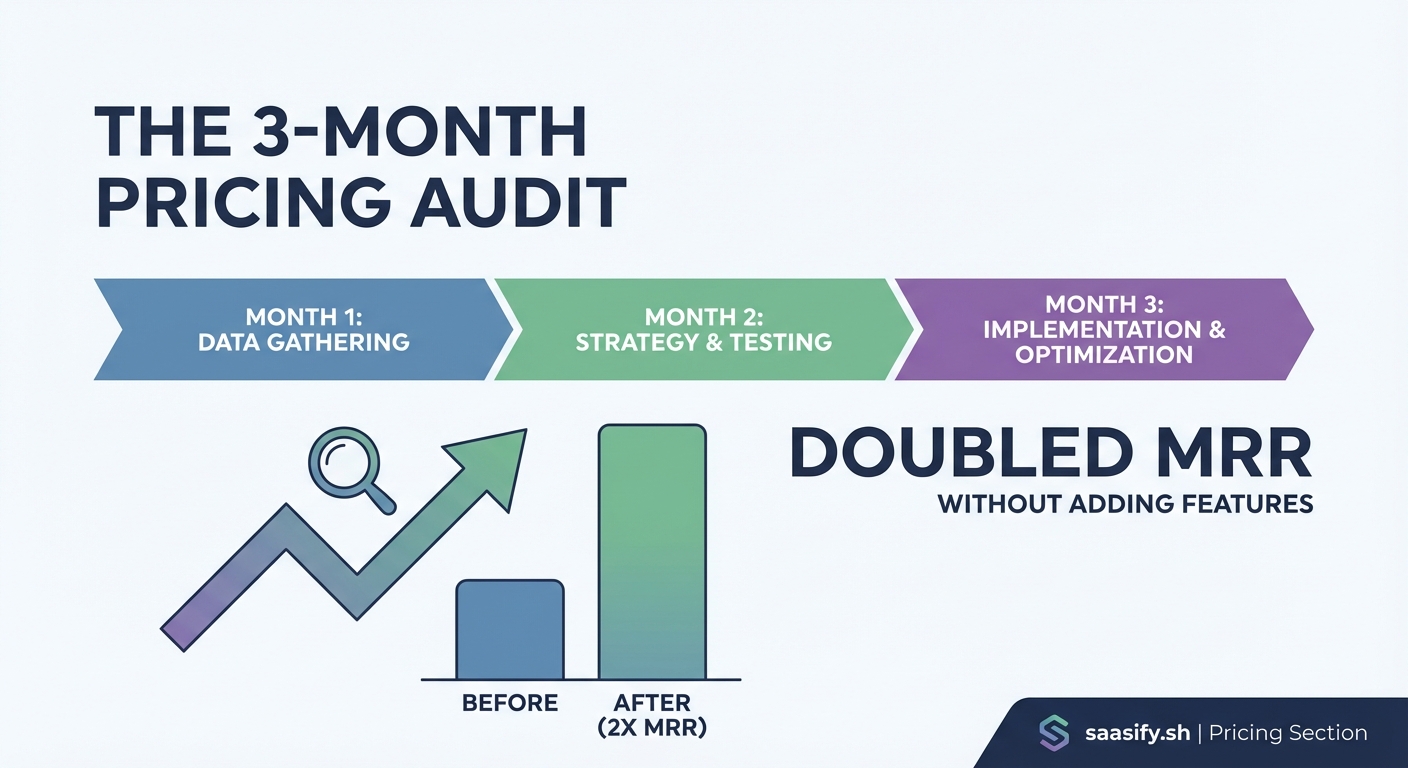
Your product contains untapped revenue waiting to be activated. These four levers control most of your growth potential.
Pricing structure determines how much value you capture per customer. Most founders underprice by 30 to 50% because they fear losing customers. In reality, a 20% price increase loses fewer than 5% of users while boosting revenue immediately.
Trial conversion measures how many free users become paying customers. Industry average hovers around 15%. Top performers hit 30 to 40%. The gap isn’t product quality. It’s how well you demonstrate value during the trial window.
Churn rate shows how many customers leave each month. Reducing churn from 7% to 5% compounds into massive MRR gains over 12 months. A single retention improvement beats three new feature launches.
Expansion revenue comes from existing customers upgrading to higher tiers. This is the cheapest revenue you’ll ever generate. Yet most founders ignore it completely.
Here’s how these levers compare in effort versus impact:
| Lever | Implementation Time | Revenue Impact | Maintenance Cost |
|---|---|---|---|
| Pricing optimization | 2 to 4 weeks | 20 to 40% increase | None |
| Trial conversion improvement | 3 to 6 weeks | 15 to 30% increase | Low |
| Churn reduction | 4 to 8 weeks | 10 to 25% increase | Medium |
| Expansion revenue | 2 to 3 weeks | 10 to 20% increase | Low |
| New feature development | 8 to 16 weeks | 5 to 15% increase | High |
The numbers don’t lie. Revenue optimization delivers faster results with less risk.
How to run a pricing audit that uncovers hidden revenue
Most SaaS pricing is based on guesswork from launch day. You picked numbers that felt reasonable. Then you never changed them.
A proper pricing audit reveals where you’re leaving money on the table. This process takes two to three weeks and requires no technical implementation.
Step 1: Map your current pricing to customer value
List every plan you offer. Write down what each tier includes. Now ask yourself: does the price difference match the value difference?
If your middle tier costs twice as much as the basic plan, does it deliver twice the value? If not, you’re either overcharging low-end customers or undercharging high-end ones.
Most founders discover they’re doing both.
Step 2: Analyze usage patterns by tier
Pull data on feature usage across all customer segments. Which features do paying customers actually use? Which ones sit ignored?
You’ll likely find that 80% of your value comes from 20% of your features. Those core features should anchor your pricing. Everything else is negotiable.
Look for customers on low-tier plans who use high-value features heavily. They’re expansion candidates. A simple email offering a better-suited plan can convert them immediately.
Step 3: Survey customers about willingness to pay
Ask 20 to 30 customers this question: “At what price would this product become too expensive to consider?”
Their answers reveal your pricing ceiling. Most founders discover they can charge 30 to 50% more before hitting resistance.
Don’t ask what they’d prefer to pay. Everyone wants cheaper. Ask what would make them walk away. That’s your real data point.
Step 4: Test new pricing with new customers only
Never change pricing for existing customers without warning. Grandfather them in. Test new pricing on new signups only.
Run the test for 30 days. Track conversion rate, MRR, and customer quality. If conversion drops below 10%, you’ve overshot. If it stays flat, you have room to go higher.
“We increased our base plan from $29 to $49 and lost exactly three customers out of 180. MRR jumped 38% overnight. I spent two years leaving that money on the table because I was scared to test.” — Indie SaaS founder
Improving trial conversion without touching your product
Your trial period is a 7 to 14 day window where users decide if you’re worth paying for. Most founders treat it like a free sample. Top performers treat it like a structured onboarding experience.
The difference is intentionality.
Here’s a simple framework that consistently improves trial conversion by 15 to 25%:
-
Day 0: Send a welcome email with one clear action. Not five. One. Make it the fastest path to value.
-
Day 2: Check if they completed the Day 0 action. If not, send a gentle reminder with a 60-second video showing exactly how.
-
Day 4: Trigger an email based on their usage. If they’re active, show an advanced feature. If they’re dormant, ask what’s blocking them.
-
Day 7: Send a case study from a similar customer. Social proof at the midpoint reduces abandonment.
-
Day 10: Offer a 15-minute call to answer questions. Only 10% will take it, but those who do convert at 70% rates.
-
Day 13: Send the “trial ending soon” email with a clear call to action and a limited-time discount if needed.
This sequence requires zero product changes. Just email automation and a calendar.
Track these metrics weekly:
- Percentage of trial users who complete the Day 0 action
- Percentage who use the product on Day 3 or later
- Percentage who respond to any email
- Percentage who convert to paid
Small improvements in each metric compound into major conversion gains.
Reducing churn by fixing the first 30 days
Most churn happens in the first month. Not the sixth. Not the twelfth. The first 30 days.
Customers cancel because they don’t see value fast enough. Your job is to compress time to value.
Start by identifying your “aha moment.” That’s the point where a customer experiences enough value that they’re unlikely to churn. For a project management tool, it might be completing their first project. For an analytics platform, it might be viewing their first report.
Calculate how long it takes the average customer to reach that moment. Then cut it in half.
Here’s how:
- Remove unnecessary setup steps
- Pre-populate sample data so they see results immediately
- Send a checklist of the three actions that lead to the aha moment
- Trigger a congratulations email when they hit it
Customers who reach the aha moment within seven days have 3x lower churn than those who take 14 days. That’s not a product problem. That’s an onboarding problem.
You can also reduce churn by reaching out before customers cancel. Set up a trigger that flags accounts showing churn signals:
- Login frequency drops by 50% or more
- No activity in the past 10 days
- Support tickets with negative sentiment
When a customer trips a churn signal, send a personal email asking if they’re stuck. Offer help. Not a sales pitch. Just genuine assistance.
Half won’t respond. But 30% will re-engage. That’s pure MRR saved with a five-minute email.
Packaging features around outcomes instead of capabilities
Most SaaS pricing pages list features. Top performers sell outcomes.
Compare these two approaches:
Feature-based packaging:
– Unlimited projects
– 50 GB storage
– Advanced reporting
– Priority support
Outcome-based packaging:
– Launch products faster
– Keep your team aligned
– Make decisions with real data
– Get help when you need it
The second version tells customers what they’ll achieve. The first version makes them guess.
Outcome-based packaging also makes it easier to justify higher prices. Customers don’t know if 50 GB of storage is worth $50 per month. But they know if launching products faster is worth it.
Restructure your pricing tiers around customer segments and their goals. Here’s a simple template:
- Starter tier: For solo founders testing an idea
- Growth tier: For small teams scaling their first product
- Pro tier: For established teams managing multiple products
Each tier targets a different outcome. Each justifies its price through value delivered, not features included.
This shift often reveals that you can add a higher tier for power users. Many SaaS companies cap out at $99 per month when they have customers who’d happily pay $299 for more support or customization.
If you’re building from scratch, learning how to price your SaaS product when you have zero customers helps you avoid these mistakes from day one.
Finding expansion revenue in your existing customer base
Your current customers are your easiest upsells. They already trust you. They already see value. They just need a reason to pay more.
Start by segmenting customers into three buckets:
- Power users: High engagement, maxing out their current plan
- Stable users: Moderate engagement, comfortable at their tier
- At-risk users: Low engagement, churn candidates
Power users are your expansion targets. They’re already getting value. They just need a higher tier that removes their constraints.
Look for usage patterns that signal readiness to upgrade:
- Hitting plan limits repeatedly
- Using advanced features heavily
- Adding team members
- Integrating with other tools
When you spot these signals, reach out with a personalized upgrade offer. Don’t wait for them to discover it themselves. Most won’t.
Here’s an email template that works:
“Hey [Name], I noticed you’ve hit your project limit three times this month. That usually means teams are growing fast. Our Pro plan removes that limit and adds [specific feature they’d benefit from]. Want to hop on a call to see if it’s a good fit?”
This approach converts 20 to 30% of power users. That’s expansion revenue with zero acquisition cost.
You can also create expansion opportunities by unbundling features. Take a capability that only 20% of customers use and turn it into an add-on. Customers who don’t need it pay less. Customers who do pay more. Everyone wins.
Measuring what actually matters for revenue growth
Most SaaS dashboards track vanity metrics. Signups, page views, social followers. None of those pay your bills.
Focus on these five metrics instead:
- MRR growth rate: Month-over-month percentage change in recurring revenue
- Customer lifetime value (LTV): Average revenue per customer over their entire relationship
- Customer acquisition cost (CAC): Total sales and marketing spend divided by new customers
- LTV to CAC ratio: Should be 3:1 or higher for healthy growth
- Net revenue retention: MRR from existing customers including upgrades and churn
Track these weekly. Build a simple dashboard that shows trends over time. When MRR growth slows, you’ll see which lever to pull.
If LTV is dropping, you have a churn problem. If CAC is rising, you have an acquisition problem. If net revenue retention is below 100%, you’re losing more to churn than you’re gaining from expansion.
Building a revenue dashboard that actually drives growth decisions gives you the framework to track these metrics without getting lost in data.
Common mistakes that sabotage revenue optimization
Even experienced founders make these errors when trying to increase MRR without new features.
Mistake 1: Changing too many things at once
You can’t tell what worked if you adjust pricing, messaging, and trial length simultaneously. Test one variable at a time. Wait for statistical significance. Then move to the next.
Mistake 2: Ignoring customer feedback during changes
Revenue optimization isn’t about tricking customers. It’s about aligning price with value. If customers complain that a change feels unfair, listen. Adjust. Grandfather existing users if needed.
Mistake 3: Optimizing for short-term MRR over long-term retention
A pricing increase that boosts MRR by 30% but doubles churn is a disaster. Always model the long-term impact. A smaller, sustainable increase beats a large, volatile one.
Mistake 4: Neglecting to communicate value
Customers won’t pay more unless they understand why. When you raise prices or restructure tiers, explain the reasoning. Tie it to outcomes they care about.
Mistake 5: Stopping after one round of optimization
Revenue optimization isn’t a one-time project. Markets shift. Customer needs evolve. Revisit your pricing and packaging every six months. Small tweaks compound into major gains.
Here’s a comparison of approaches:
| Approach | Short-Term MRR Impact | Long-Term Sustainability | Customer Satisfaction |
|---|---|---|---|
| Aggressive price increase | High | Low | Low |
| Gradual optimization | Medium | High | High |
| Feature unbundling | Medium | High | Medium |
| Improved trial conversion | Medium | High | High |
| Churn reduction focus | Low | Very high | Very high |
The best strategy combines multiple levers with a focus on sustainability.
Real examples of MRR growth without new features
A project management SaaS increased MRR by 40% in three months by restructuring their pricing around team size instead of project count. They didn’t add a single feature. They just aligned pricing with how customers actually used the product.
An analytics platform reduced churn from 8% to 4% by implementing a 30-day onboarding sequence. They identified that customers who created three reports in the first week had 90% retention. So they built an email flow that guided everyone to that milestone.
A CRM for freelancers added a $199/month tier for agencies. It included white-label branding and priority support. Within 60 days, 15% of their power users upgraded. That’s $3,000 in monthly recurring revenue from customers they already had.
These aren’t outliers. They’re the norm when you focus on optimization over expansion.
If you’re still in the early stages, understanding how to validate your SaaS idea before writing a single line of code helps you build pricing strategy into your foundation.
When you should actually build new features
Revenue optimization isn’t always the answer. Sometimes you do need to build.
Build new features when:
- Multiple high-value customers request the same capability
- Usage data shows a clear gap in your product’s workflow
- Competitors are winning deals because of a specific feature
- The feature opens a new market segment worth pursuing
Don’t build when:
- One loud customer demands it
- You’re bored with optimization work
- You assume it will attract new users
- You haven’t validated demand with real data
The difference between successful and struggling SaaS founders isn’t coding ability. It’s knowing when to build and when to optimize.
Most founders build too early and optimize too late. Reverse that pattern and you’ll see faster, more sustainable growth.
Your 90-day revenue optimization roadmap
Here’s a practical plan to increase MRR without touching your codebase.
Weeks 1 to 2: Audit your current state
- Pull MRR, churn, and conversion data for the past six months
- Survey 20 customers about pricing and value perception
- Map feature usage to customer segments
- Identify your top expansion candidates
Weeks 3 to 4: Test pricing adjustments
- Increase prices for new customers by 15 to 20%
- Create a higher tier for power users
- Grandfather existing customers at current rates
- Monitor conversion and customer feedback
Weeks 5 to 8: Improve trial conversion
- Build a 14-day email sequence focused on time to value
- Add usage-based triggers for personalized outreach
- Create a simple onboarding checklist
- Track completion rates and adjust messaging
Weeks 9 to 12: Reduce churn and drive expansion
- Implement churn signal monitoring
- Reach out to at-risk customers proactively
- Send upgrade offers to power users
- Analyze results and plan the next optimization cycle
This roadmap requires no developers. Just focus, discipline, and a willingness to test.
Stop building and start optimizing
Your product already contains the revenue you need. You just have to unlock it.
Most SaaS founders spend years chasing feature parity with competitors. They burn runway building capabilities that customers ignore. Meanwhile, simple pricing changes and better onboarding could double their MRR in months.
The path forward isn’t more code. It’s more clarity about what customers value and how much they’ll pay for it.
Start with one lever. Run one test. Measure the results. Then move to the next.
Revenue growth doesn’t require a bigger team or a better product. It requires better decisions about the product you already have.