You’re staring at your pricing page for the tenth time this week. Flat monthly fees feel safe, but your product costs scale with customer activity. Some users barely touch your tool while others hammer your API thousands of times daily. Charging everyone the same amount feels wrong, but switching to usage-based pricing SaaS models feels risky.
Usage-based pricing works best when your infrastructure costs scale directly with customer activity, your users have wildly different consumption patterns, and you can track measurable units that correlate with value. It reduces barriers to entry but demands robust billing infrastructure and clear communication to prevent bill shock. Most successful indie SaaS products blend usage components with base subscriptions for revenue stability.
Understanding What Usage Based Pricing Actually Means
Usage-based pricing charges customers based on how much they consume rather than a flat subscription fee. You measure a specific metric like API calls, storage gigabytes, emails sent, or videos processed. Customers pay for what they use, nothing more.
This model differs from per-seat pricing where you charge based on team size. It also differs from tiered subscriptions where users pick a plan and get fixed limits.
Three common variations exist in the wild.
Pure pay-as-you-go means zero base fee. Customers pay only for consumption. AWS pioneered this approach with cloud computing resources.
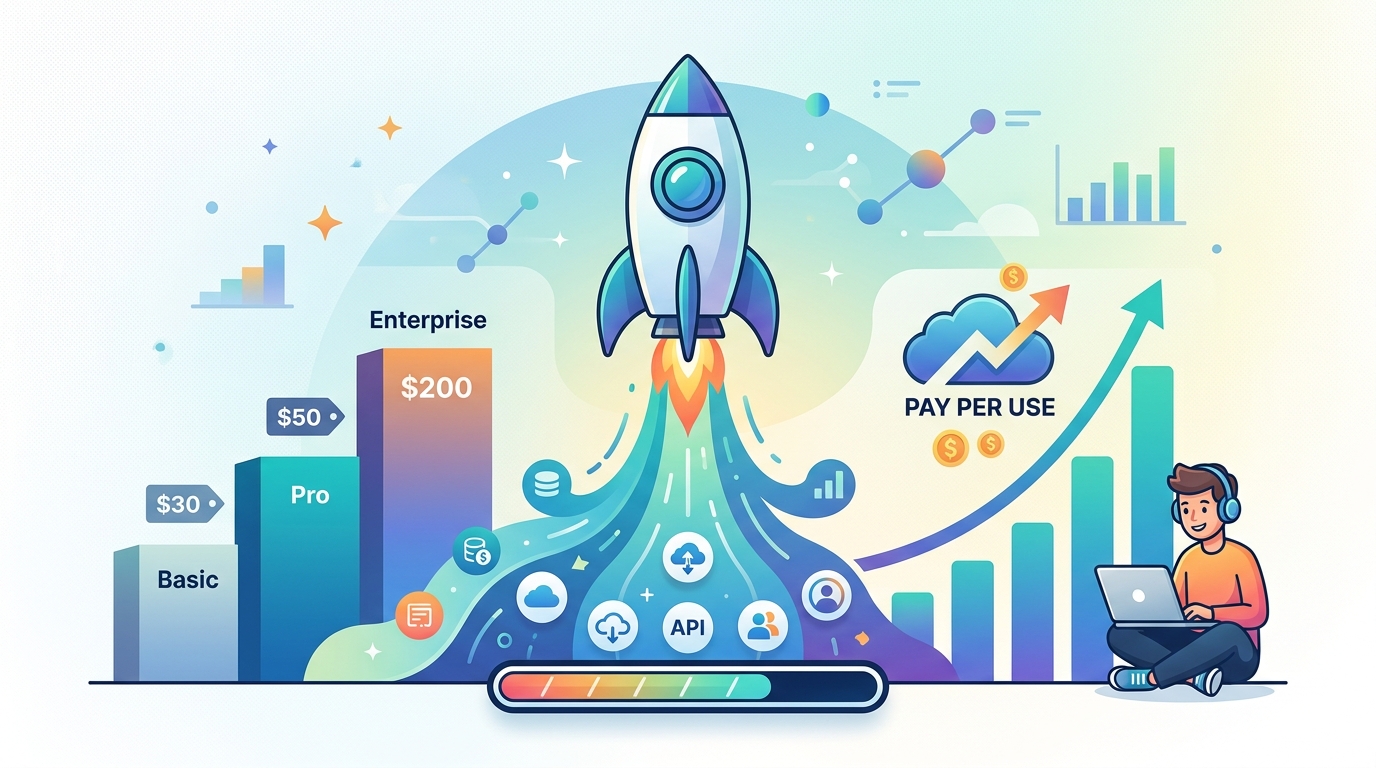
Subscription plus overages combines a monthly base with usage charges beyond included limits. You might include 10,000 API calls in a $49 plan, then charge $0.005 per additional call.
Prepaid credits let customers buy usage blocks upfront. They spend down credits as they consume resources, often at discounted rates compared to pure pay-as-you-go.
The model you choose depends on your cost structure and customer behavior patterns.
When Your Product Actually Fits This Model
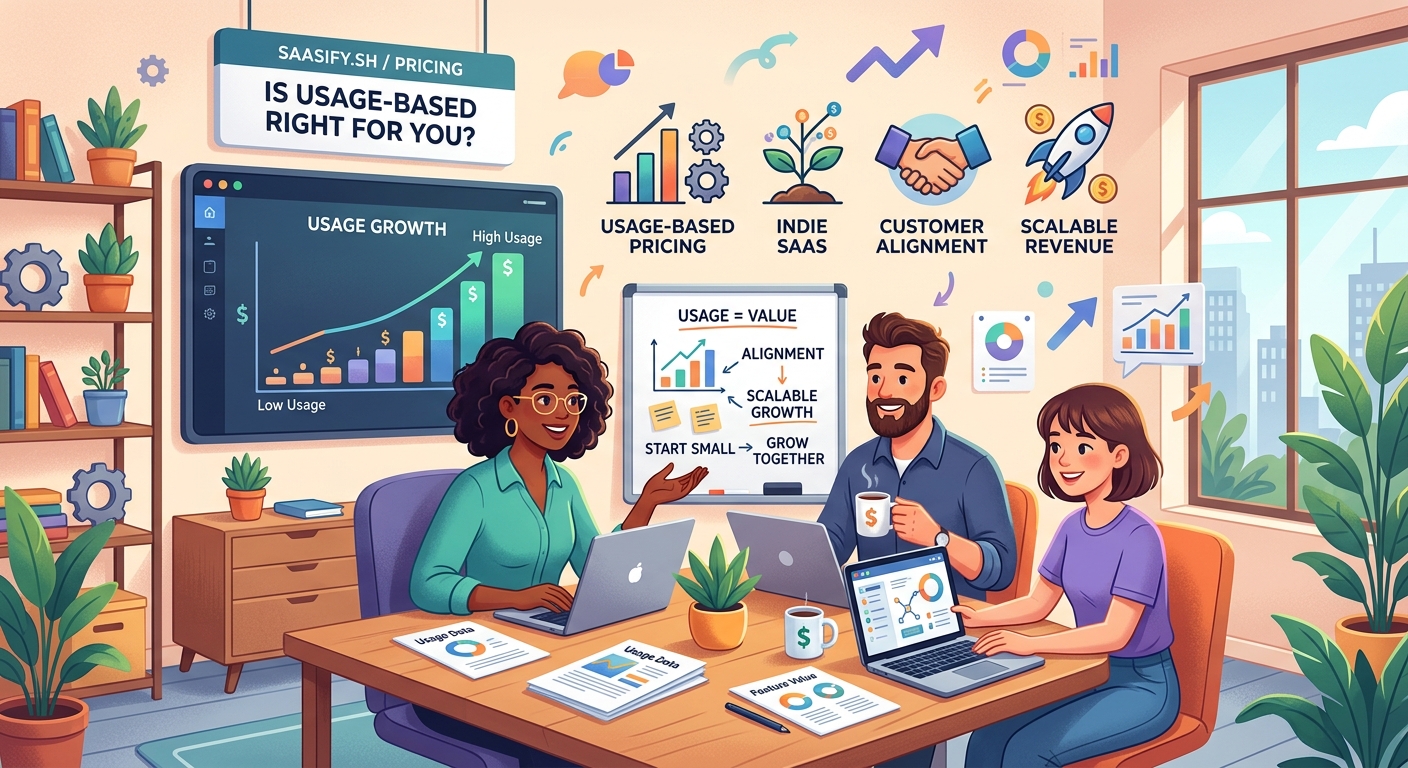
Not every SaaS product benefits from usage-based pricing. Certain characteristics make this approach natural while others create friction.
Your infrastructure costs should scale proportionally with usage. If serving one customer costs roughly the same as serving one hundred, flat pricing makes more sense. But if each API call, storage gigabyte, or compute minute adds real cost, usage pricing aligns your revenue with expenses.
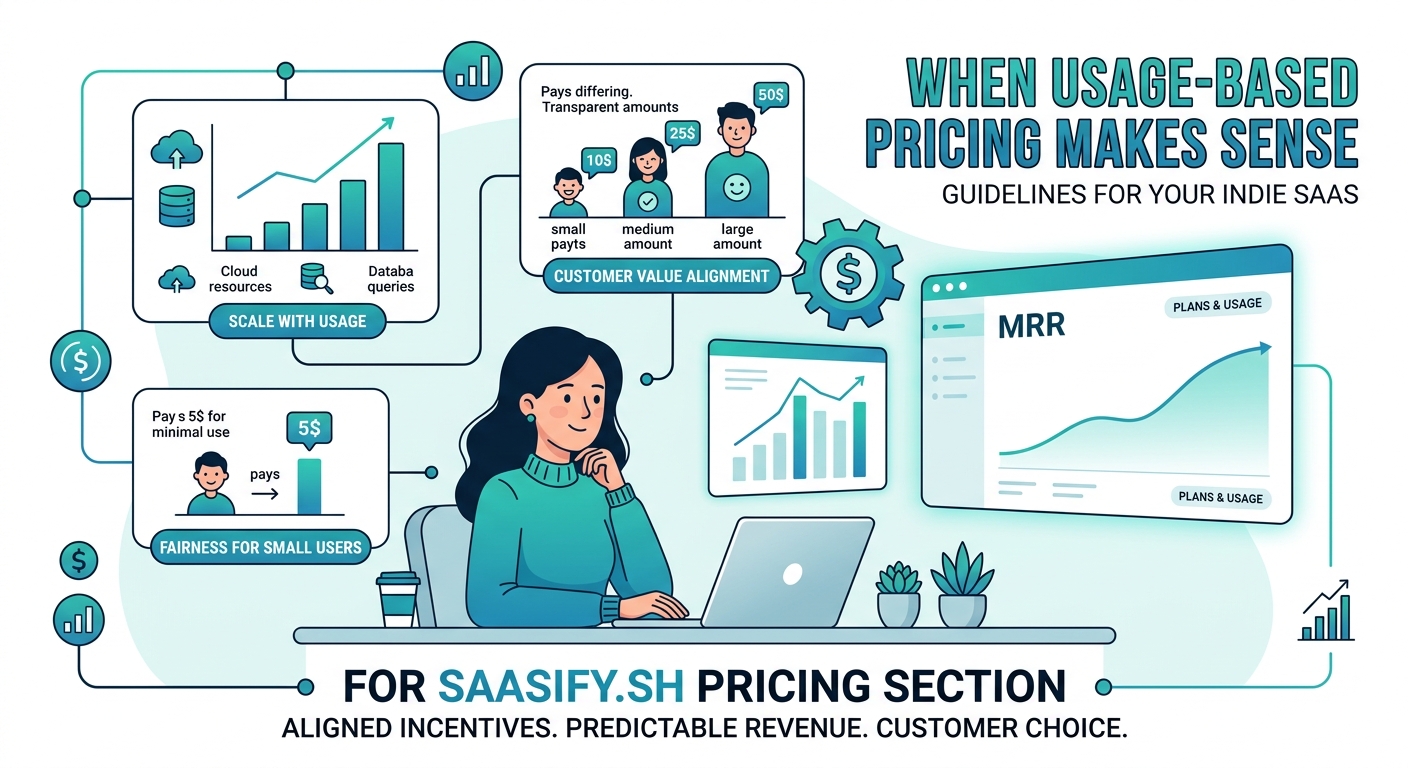
Customer consumption patterns need significant variance. When some users consume 10x more than others, flat pricing either overcharges light users or undercharges heavy ones. Usage pricing solves this fairness problem.
Your value metric must be clear and measurable. Users should understand exactly what they’re paying for and how to control costs. Ambiguous metrics create confusion and billing disputes.
The barrier to entry matters for early-stage products. Validating your SaaS idea becomes easier when prospects can start free or cheap. Usage pricing removes commitment friction since customers can test with minimal spend.
Your product should enable customers to derive value immediately. If onboarding takes weeks, usage pricing feels risky because costs accumulate before benefits appear.
Products That Thrive With Usage Models
Certain product categories naturally align with consumption-based billing.
API and infrastructure services like Twilio, Stripe, and AWS charge per transaction or resource. Developers love this because costs scale with their own customer growth.
Data processing tools that transform, analyze, or store information work well. Snowflake charges for compute and storage separately. Customers with seasonal workloads pay less during slow periods.
Communication platforms that send emails, SMS messages, or push notifications fit naturally. SendGrid and Mailgun charge per message because each one costs them money to deliver.
AI and machine learning services often bill per API call or inference. OpenAI charges per token because compute costs scale directly with usage.
Media processing tools for transcoding video, generating thumbnails, or compressing images align perfectly. Each job consumes real computing resources.
Search and indexing services like Algolia charge per search operation and records stored. Usage correlates with both value and cost.
These categories share common traits. Customers understand the unit of consumption. Value scales with usage. Infrastructure costs are variable rather than fixed.
When You Should Avoid This Approach
Usage-based pricing creates problems for certain business models and customer types.
Enterprise customers often demand predictable budgets. Finance teams hate surprise bills. They’d rather overpay for certainty than optimize costs with variable pricing. Large contracts typically require committed spend minimums anyway.
Products with high setup costs don’t fit well. If onboarding takes significant time or custom implementation, you need guaranteed revenue to justify that investment. Usage pricing makes customers hesitant to commit.
When usage doesn’t correlate with value, this model fails. Charging per login makes no sense if the value comes from insights, not access frequency. Your metric must represent actual benefit received.
Small teams without billing infrastructure struggle. Tracking usage, calculating charges, and handling edge cases requires robust systems. Building this while shipping your MVP diverts focus from core product development.
Revenue predictability matters for runway planning. Pure usage models create volatile monthly revenue. You can’t forecast accurately when customer consumption fluctuates.
Products with sticky workflows work better on subscriptions. If users integrate deeply and use your tool daily regardless of volume, flat pricing captures more value.
The Real Challenges You’ll Face
Implementation complexity hits harder than expected. You need infrastructure to track every billable event accurately. Lost events mean lost revenue. Double-counting creates customer disputes.
Track usage events asynchronously and build reconciliation processes. Your billing system should handle retries, deduplication, and audit trails. Customers will question charges, so you need detailed logs.
Bill shock damages customer relationships. Users consume resources freely, then panic at month-end invoices. Stripe famously deals with this through spending alerts and budget caps.
Support burden increases significantly. Customers constantly ask why charges varied month to month. You’ll explain usage patterns repeatedly. Documentation needs to cover billing extensively.
Pricing psychology gets complicated. Customers can’t easily compare your $0.002 per API call against a competitor’s $0.003 per call if base features differ. Pricing your SaaS becomes a multi-dimensional optimization problem.
Sales cycles lengthen for larger deals. Prospects need to model costs based on projected usage. They’ll demand proof that bills won’t balloon unexpectedly.
Churn patterns change. Customers might reduce usage rather than cancel entirely. This gradual revenue decline is harder to detect than binary churn.
Building a Hybrid Model That Works
Most successful indie SaaS products blend pricing approaches rather than going pure usage-based.
Start with a base subscription that covers core features and modest usage. This provides revenue predictability while keeping barriers low. Then add usage charges beyond included limits.
| Component | Purpose | Example |
|---|---|---|
| Base subscription | Predictable revenue, feature access | $49/month includes 10K API calls |
| Included usage | Reduces friction, covers typical use | First 10K calls included |
| Overage pricing | Captures heavy users fairly | $5 per additional 1K calls |
| Volume discounts | Rewards growth, prevents churn | 20% off at 100K+ calls/month |
This structure gives you the best of both worlds. Light users pay predictable amounts. Heavy users pay proportionally. Revenue stays relatively stable.
Consider offering multiple base tiers with different included usage. A $49 plan might include 10,000 calls while a $199 plan includes 100,000. Customers self-select based on expected consumption.
Add spending caps to prevent bill shock. Let customers set maximum monthly charges. When they hit the cap, either pause service or require explicit approval to continue.
Provide real-time usage dashboards. Customers should see current consumption and projected costs at any moment. Surprises at invoice time create support nightmares.
Implementing Usage Tracking Without Losing Your Mind
You need robust infrastructure before launching usage-based pricing.
1. Choose your billable unit carefully. Pick something customers understand and can control. API calls work better than “compute units” because developers know exactly what triggers them.
2. Build idempotent event tracking. Network failures happen. Your system must handle duplicate events without double-charging. Use unique event IDs and deduplication windows.
3. Store granular usage data. Keep detailed logs of every billable event with timestamps, customer IDs, and metadata. You’ll need this for disputes and analytics.
4. Calculate charges in real-time. Don’t wait until month-end to tally usage. Show customers running totals so they can adjust behavior before bills arrive.
5. Test edge cases obsessively. What happens when usage events arrive out of order? How do you handle timezone boundaries? What if a customer hits their cap mid-request?
6. Build reconciliation processes. Compare billed amounts against actual costs regularly. Discrepancies reveal bugs in tracking or calculation logic.
Your revenue dashboard needs to show usage trends alongside financial metrics. Watch for customers whose consumption is dropping. They might churn soon.
Communicating Pricing So Customers Actually Understand
Clear communication prevents most billing problems.
Show pricing examples prominently. Don’t just list rates. Calculate sample bills for typical usage patterns. “A small team sending 50K emails monthly pays about $89” beats “$1.50 per thousand emails” for comprehension.
Provide a pricing calculator on your website. Let prospects input expected usage and see estimated costs. This builds confidence and qualifies leads.
Send usage alerts proactively. Email customers when they hit 50%, 75%, and 90% of included usage. Give them time to upgrade or optimize before overages kick in.
Make invoices detailed and readable. List usage by category with quantities and rates. Customers should understand exactly what they’re paying for without contacting support.
Write help documentation that explains billing thoroughly. Cover common questions like how usage is measured, when charges appear, and how to control costs.
Consider monthly usage reports even for customers below their caps. Showing “you used 3,847 of 10,000 included calls” reinforces value and prevents surprise when usage spikes.
Common Mistakes That Kill Usage-Based Models
Many founders sabotage their own pricing through avoidable errors.
- Picking unmeasurable or unclear units that confuse customers
- Setting rates so low that heavy users become unprofitable
- Failing to cap usage so customers fear runaway bills
- Making pricing too complex with multiple dimensions and modifiers
- Neglecting to build spending alerts and usage dashboards
- Charging for actions that don’t correlate with value delivered
- Implementing tracking systems that lose events or double-count
- Waiting until month-end to show customers their consumption
- Providing inadequate documentation about how billing works
- Ignoring the support burden of explaining variable charges
The biggest mistake is launching usage pricing without solid infrastructure. You can’t retrofit accurate tracking onto a product that wasn’t designed for it.
Another common error is going pure usage-based too early. When you have few customers, revenue volatility makes planning impossible. Start with flat pricing, then add usage components as you scale.
Testing Before You Commit
Don’t flip your entire pricing model overnight. Test usage-based components carefully.
Start with a single new plan that uses hybrid pricing. Keep existing plans unchanged. Let new customers choose between traditional subscriptions and usage-based options. Track which converts better and which cohort has higher lifetime value.
Offer existing customers optional migration to usage pricing. Some will prefer predictability while others want to optimize costs. Let them choose rather than forcing a switch.
Run parallel billing calculations for existing customers. Show them what they would have paid under usage-based pricing compared to their current plan. This data informs whether switching makes sense.
Survey customers about pricing preferences. Ask directly whether they’d prefer flat rates or usage-based options. Their feedback reveals risk before you commit.
Monitor support ticket volume carefully. If usage pricing questions overwhelm your team, you need better documentation or simpler pricing before rolling out further.
Making the Decision for Your Product
Walk through this evaluation framework honestly.
Does your infrastructure cost scale linearly with customer usage? If serving more requests costs you more money, usage pricing makes sense. If costs are mostly fixed, it doesn’t.
Do your customers have wildly different consumption patterns? If the gap between light and heavy users exceeds 5x, usage pricing improves fairness. If everyone uses similar amounts, flat pricing works fine.
Can you track a clear, understandable metric? If customers immediately grasp what they’re paying for and how to control it, proceed. If the metric requires explanation, reconsider.
Do you have or can you build robust billing infrastructure? If you’re a solo founder building in a niche, complex usage tracking might drain resources better spent on product development.
Does your product provide immediate value? If customers see benefits in their first session, usage pricing removes barriers. If value takes weeks to materialize, the risk feels too high.
Can you afford revenue volatility? If you need predictable cash flow to make payroll or cover fixed costs, pure usage pricing creates stress. Hybrid models provide more stability.
Answer these questions before changing your pricing model. The right choice depends on your specific product, market, and business situation.
Why This Matters More Than You Think
Pricing models shape your entire business, not just revenue. Usage-based pricing changes how customers perceive value, how your product evolves, and how your team operates.
When customers pay for consumption, they think about efficiency. This drives different feature requests than flat pricing. They want tools to optimize usage, not just access more features.
Your product roadmap shifts toward measurable outcomes. Features that reduce customer costs become competitive advantages. This aligns your success with theirs naturally.
Support and success teams need different skills. They’ll spend more time explaining bills and helping customers optimize usage. Training and documentation requirements change significantly.
The model affects your ability to raise funding too. Investors love usage-based SaaS because revenue scales with customer success. But they worry about churn and revenue predictability.
Choose your pricing model carefully. It’s not just about what you charge. It’s about how customers engage with your product, what features you build, and how your business grows. Get it right and pricing becomes a competitive advantage. Get it wrong and you’ll fight uphill battles forever.
Start with your costs and customer behavior. Let those realities guide your decision rather than copying what successful companies do. Their situation differs from yours. Build pricing that fits your specific product and market. Test carefully. Iterate based on data. Your pricing model should evolve as your business matures.