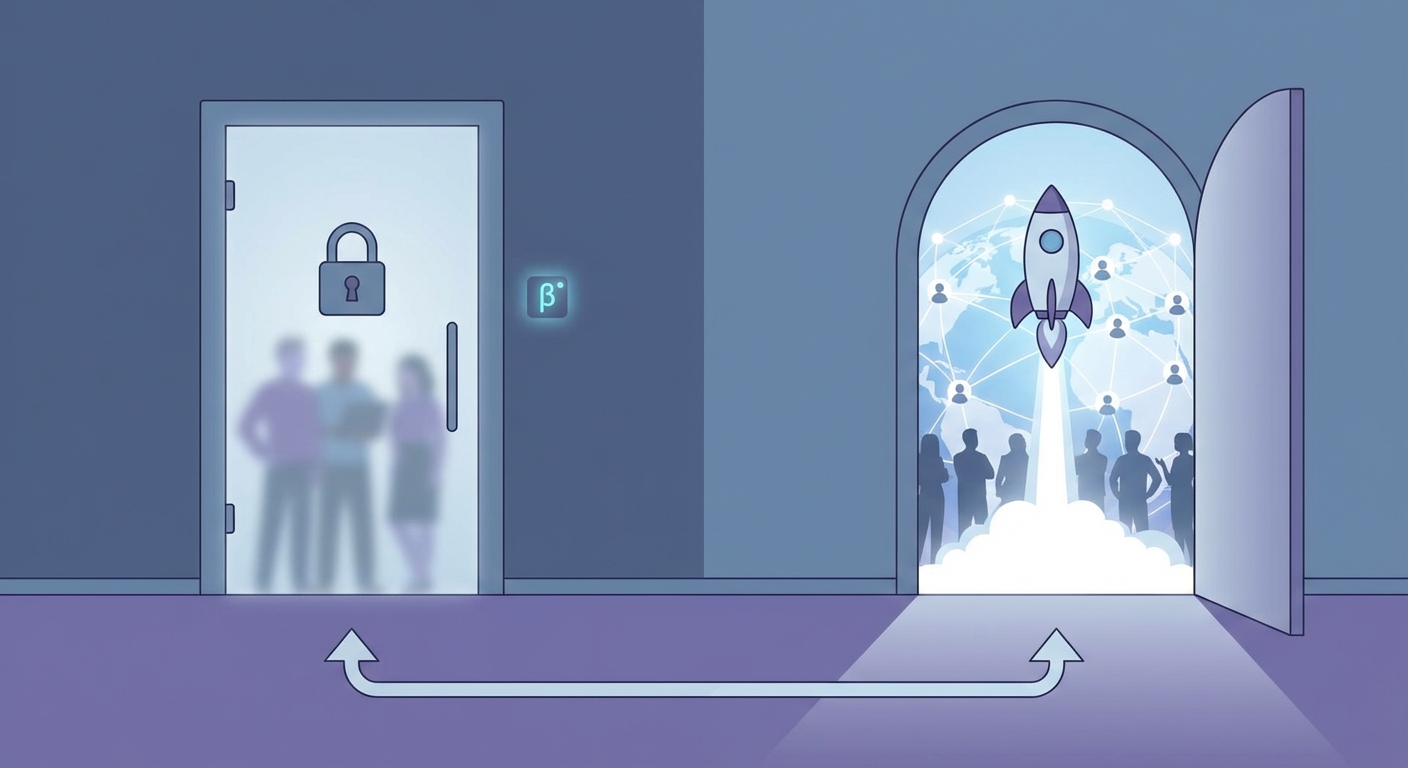
You’ve built something people might actually pay for. The code works. The core features are ready. Now you’re staring at the biggest fork in the road: do you quietly invite a handful of users to test your SaaS, or do you throw open the doors and let anyone sign up?
Private beta gives you controlled feedback and room to fix critical bugs before wider exposure, while public launch accelerates user acquisition and market validation. Your choice depends on product stability, team bandwidth, and whether you prioritize learning or growth. Most successful founders use private beta for complex products and public launch for simpler tools with clear value propositions.
What private beta and public launch actually mean
Private beta means you control who gets access. You hand pick testers, send invitations, and limit the number of people using your product. Think of it as a dinner party where you choose every guest.
Public launch means anyone can sign up. You put your product out there and let the market decide. No gates, no invitations, no waiting lists unless you choose to add them for marketing purposes.
The distinction matters more than most founders realize. It shapes everything from your support load to your feature roadmap to how fast you can iterate.
Why private beta exists in the first place
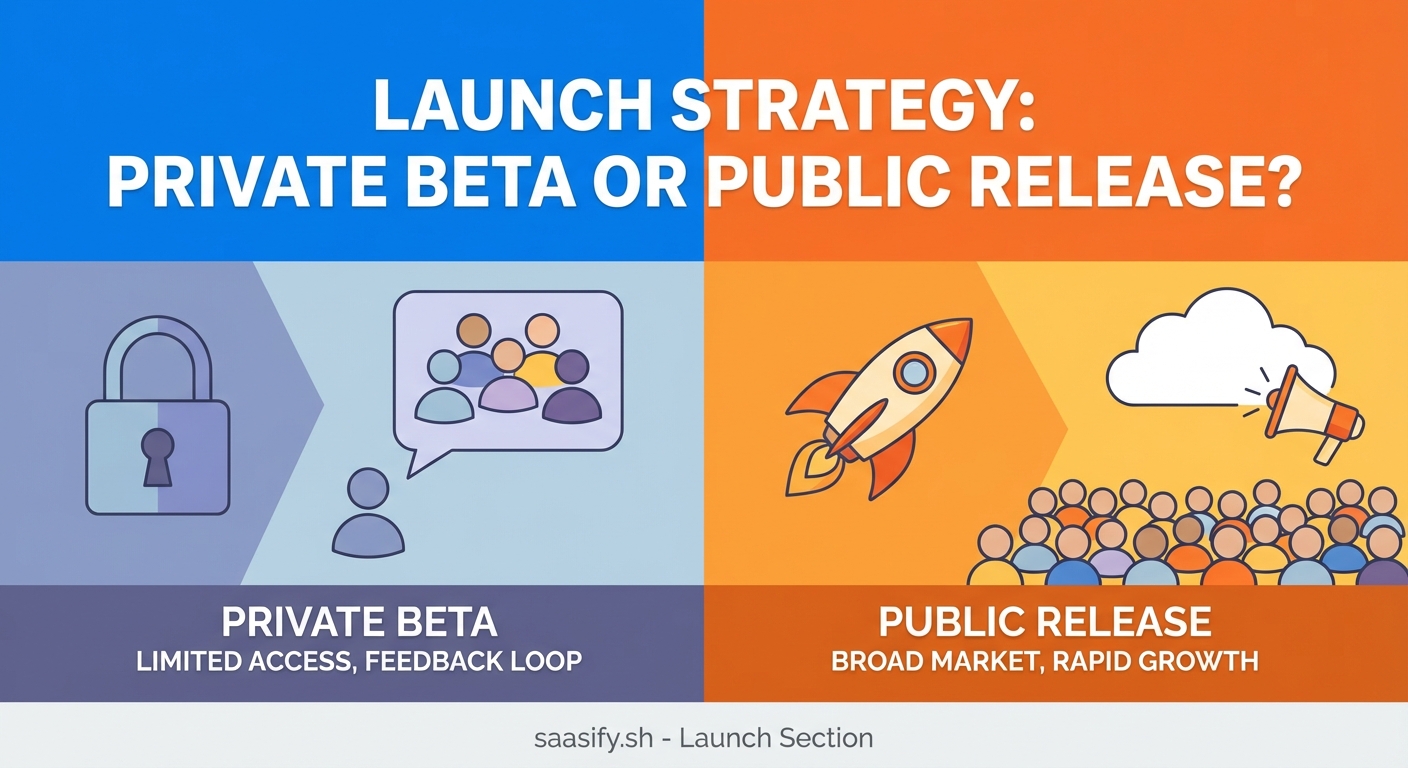
Private beta started as a risk management tool. Software companies needed real users to find bugs their internal teams missed, but they couldn’t afford the reputational damage of a broken public product.
That logic still holds. A private beta lets you:
- Catch edge cases your testing missed
- Validate that real users understand your value proposition
- Build relationships with early advocates who forgive rough edges
- Gather focused feedback without noise from casual tire kickers
- Control the narrative about what your product does and who it serves
The best part? You can fix embarrassing bugs before they become viral Twitter threads.
When private beta makes the most sense
Private beta works best when your product has meaningful complexity. If you’re building a SaaS MVP that touches sensitive data, integrates with other tools, or requires onboarding, you want controlled exposure first.
Here’s when to choose private beta:
-
Your product handles money or sensitive information. Payment processing, HR tools, and financial dashboards need bulletproof reliability before public access.
-
You’re still figuring out core workflows. If users might hit dead ends or confusing flows, private beta gives you space to iterate without public scrutiny.
-
You need deep user relationships. Complex B2B tools benefit from tight feedback loops with a small group who actually cares about your success.
-
Your support capacity is limited. As a solo founder or small team, handling 50 engaged users beats drowning in support tickets from 500 confused ones.
-
You’re testing pricing or positioning. Private beta lets you experiment with messaging and pricing models before committing publicly.
“We ran a six week private beta with 30 handpicked users. They found 47 bugs we never would have caught internally, and three of them became our first paying customers the day we launched publicly.” – Indie SaaS founder, project management tool
The real advantages of going public immediately
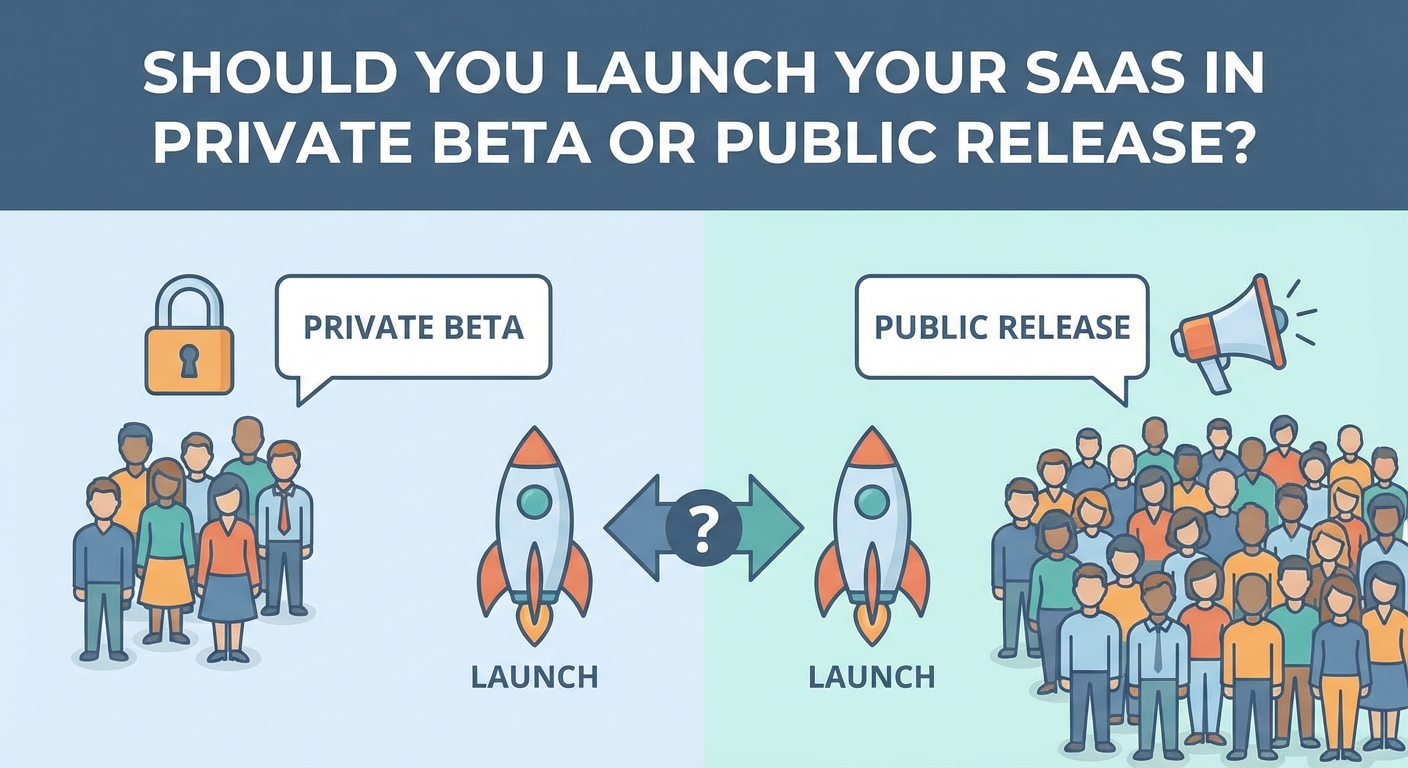
Public launch isn’t reckless. For many products, it’s the smarter move.
You skip the artificial scarcity dance. You get market feedback faster. You start building your user base and revenue from day one instead of spending weeks managing a closed beta program.
Public launch works when:
- Your product solves one clear problem really well
- The core experience is stable and self explanatory
- You’re comfortable iterating in public
- You want to validate your SaaS idea with real market demand
- You have competitors and need to move fast
Simple tools like form builders, screenshot utilities, or scheduling apps rarely need private betas. Users understand them immediately, and bugs are usually cosmetic rather than catastrophic.
The hidden costs nobody talks about
Both approaches carry costs beyond the obvious ones.
Private beta costs:
- Recruitment overhead. You need to find, vet, and onboard beta testers. That takes time.
- Communication burden. You’ll spend hours in Slack, email, or calls gathering feedback.
- Feature pressure. Beta users will request features you don’t need yet, and saying no gets awkward.
- Delayed revenue. Every week in beta is a week you’re not charging money.
Public launch costs:
- Support volume. More users means more questions, complaints, and edge cases.
- Reputation risk. Public bugs become public embarrassment.
- Noise in feedback. Sorting signal from noise gets harder as user count grows.
- Less flexibility. Changing core features becomes harder when hundreds of people already use them.
How to structure a private beta that actually works
If you choose private beta, do it right. Most founders wing it and waste everyone’s time.
Follow this framework:
-
Set a firm timeline. Four to eight weeks max. Any longer and momentum dies.
-
Define specific goals. “Get feedback” is too vague. Try “validate onboarding flow” or “test payment integration with 20 transactions.”
-
Choose 15 to 50 users. Fewer than 15 and you won’t see patterns. More than 50 and you can’t maintain relationships.
-
Create a feedback system. Use a dedicated Slack channel, weekly surveys, or scheduled calls. Make it easy for users to report issues.
-
Communicate constantly. Share what you’re fixing, what you’re learning, and when you’ll launch publicly. Beta users hate being ignored.
-
Offer an incentive. Lifetime discounts, free months, or founder tier access works well. People give better feedback when they feel valued.
Building a pre launch waitlist before your private beta can help you recruit the right testers and build anticipation for your public launch.
Comparison table for decision making
Here’s how private beta vs public launch saas strategies stack up across key factors:
| Factor | Private Beta | Public Launch |
|---|---|---|
| Time to first revenue | 4-12 weeks delayed | Immediate |
| Feedback quality | Deep, actionable insights | Surface level, high volume |
| Risk of public failure | Low | Medium to high |
| User acquisition speed | Slow, controlled | Fast, market driven |
| Team bandwidth required | High (relationship management) | Medium (support scaling) |
| Best for product complexity | High (multi step workflows) | Low (single clear purpose) |
| Iteration flexibility | Very high | Medium |
| Marketing momentum | Builds slowly | Can spike fast |
Hybrid approaches that split the difference
You don’t have to choose just one path. Many successful founders combine both strategies.
Try these hybrid models:
-
Rolling private beta. Start with 10 users, add 10 more each week, then go public after a month. You get controlled feedback early and momentum later.
-
Feature gated public launch. Launch publicly but keep advanced features behind a waitlist. Everyone can try the core product, but power users apply for beta access to new capabilities.
-
Geographic staged rollout. Launch publicly in one market or timezone first, fix issues, then expand. This works great for products with localization needs.
-
Invite only with public landing page. Anyone can see your product and request access, but you manually approve users. You control growth while building your first 1,000 email subscribers for launch day.
The soft launch vs go big decision often pairs with your beta strategy. A private beta naturally leads to a bigger public launch moment, while public launch from day one is essentially a soft launch approach.
Common mistakes that kill beta programs
Most failed betas share the same problems.
Avoid these traps:
- No clear success criteria. If you don’t know what you’re testing, you can’t know when you’re done.
- Too many beta users. More isn’t better. You want engaged testers, not a crowd.
- Ignoring feedback. Users stop caring when you don’t act on their input.
- Extending the beta indefinitely. Set a deadline and stick to it. Perpetual beta kills momentum.
- Forgetting to celebrate and reward testers. These people are giving you free labor. Treat them well.
What to do right after you choose
Once you decide between private beta vs public launch saas approaches, take immediate action.
For private beta:
- Write down three specific things you need to learn
- Create a simple application form or outreach template
- Set your beta end date on the calendar
- Prepare your feedback collection system
- Draft your beta user agreement or terms
For public launch:
- Audit your product for obvious bugs and broken flows
- Set up basic analytics to track user behavior
- Prepare your support system (help docs, email, chat)
- Create a simple onboarding email sequence
- Decide on your pricing strategy before users start asking
Both paths need a plan for measuring success. Define your key metrics now, whether that’s beta user retention, feature usage, support ticket volume, or conversion rate.
Making the call with confidence
The right choice depends on your specific situation, not universal best practices.
Choose private beta if you value learning over speed, if your product complexity demands it, or if you’re a perfectionist who needs confidence before going public.
Choose public launch if you value speed over control, if your product is simple enough to explain in 30 seconds, or if you’re comfortable fixing things in public.
Both paths can lead to successful products. The founders who struggle are the ones who never commit to either approach, or who choose based on fear rather than strategy.
Your product deserves real users. Whether that’s 20 carefully chosen beta testers or an open door policy, the important thing is shipping something people can actually use. Pick your path, set your timeline, and start learning from real humans trying to solve real problems with your tool.