You’re staring at a blank screen, paralyzed by choices. React or Vue? PostgreSQL or MongoDB? AWS or Vercel? Every tutorial promises the “best” stack, but none tell you what actually matters when you’re building alone.
Here’s the truth: the tech stack you choose matters less than you think. What matters more is shipping fast, staying maintainable, and not boxing yourself into a corner six months from now.
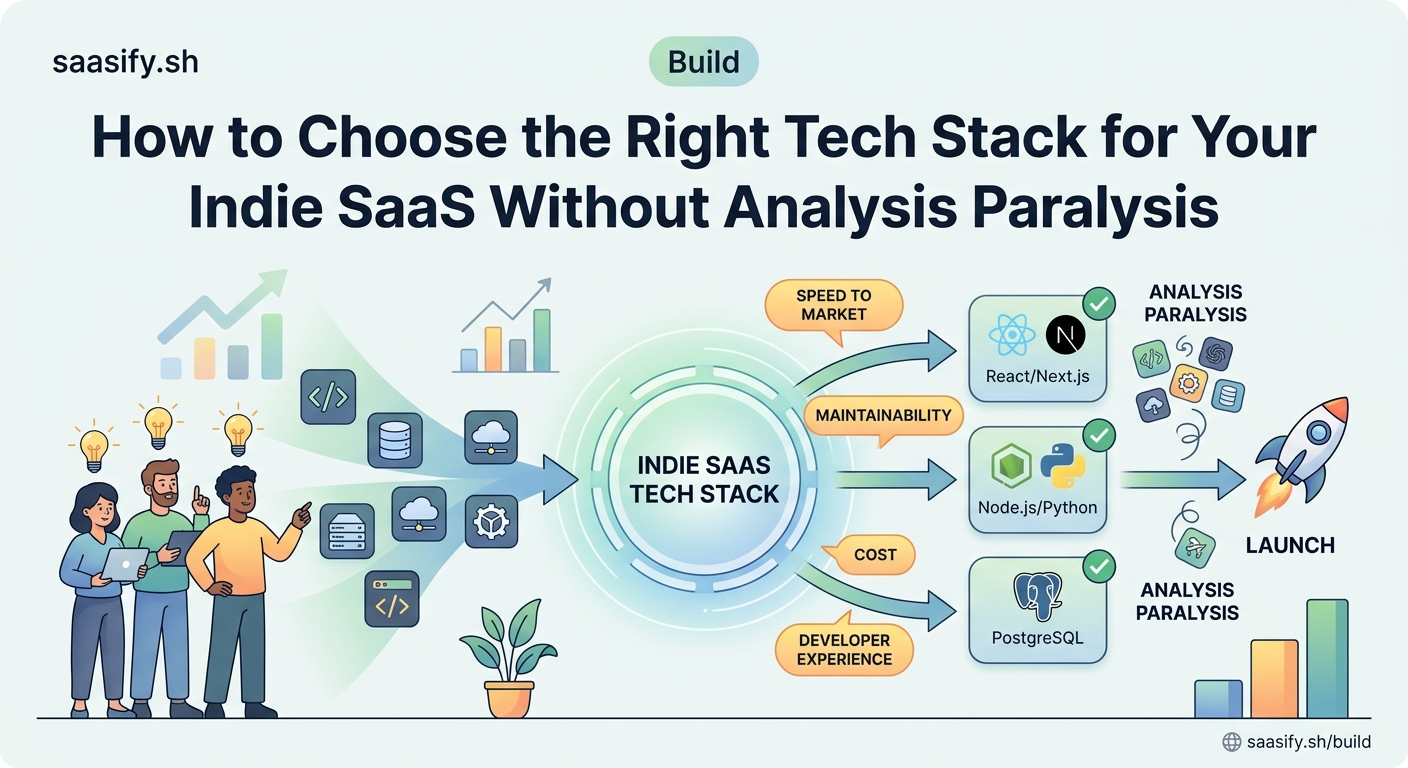
Choosing a tech stack for your SaaS isn’t about picking the newest frameworks. It’s about matching your current skills, shipping speed, and future maintenance reality. Start with what you know, prioritize boring technology, and build for the product you have today, not the scale you dream about. Most indie SaaS products never need to rewrite their stack.
Start with what you already know
The best tech stack is the one you can ship with tomorrow.
Not next month. Not after you finish that course. Tomorrow.
If you know Ruby on Rails, use Rails. If you’ve built three projects in Laravel, use Laravel. Your existing knowledge is your biggest asset as a solo founder.
Learning a new framework adds weeks to your timeline. Those weeks compound. You’ll hit roadblocks you can’t Google your way out of. You’ll waste hours debugging issues that wouldn’t exist in your comfort zone.
Save the learning for your second product.
Your first SaaS needs to validate a market problem, not your ability to learn Rust. The founders who ship fastest win. The ones who spend three months choosing between Next.js and Nuxt.js lose momentum before they start.
The three layer framework for choosing your stack
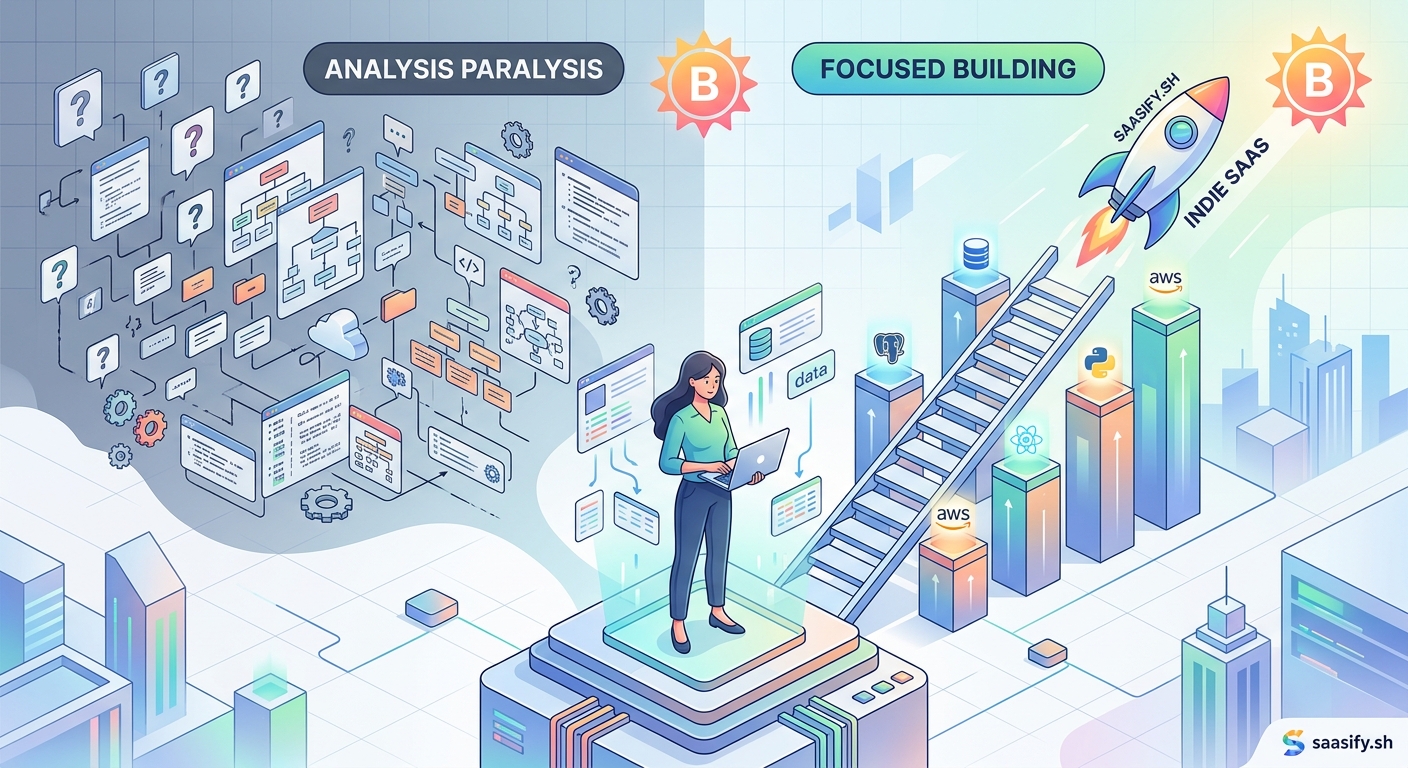
Every SaaS stack has three layers. Each layer has different priorities.
Frontend layer: What users see and interact with. This needs to feel fast and look professional enough to charge money.
Backend layer: Where your business logic lives. This needs to be maintainable by you, alone, at 11pm when something breaks.
Infrastructure layer: Where your app runs. This needs to be simple enough that you’re not spending weekends fighting deployment issues.
Here’s how to think about each one:
Frontend choices that won’t haunt you
Pick a framework with a massive community. That means React, Vue, or Svelte in 2026.
Avoid anything that requires a build process you don’t understand. If you can’t explain what Webpack does, don’t customize it.
Use a component library. Shadcn/ui for React. Vuetify for Vue. PrimeVue for Vue. Building buttons from scratch is not how you validate a business.
Choose TypeScript only if you already use it. The type safety helps at scale, but adds friction when you’re moving fast. You can migrate later if your product takes off.
Backend choices that scale with you
Use a monolith. Not microservices. Not serverless functions scattered across twelve files.
One codebase. One deployment. One place to fix bugs.
Node.js with Express works. Python with Django or Flask works. Ruby on Rails works. PHP with Laravel works. Go with Gin works.
They all work because they’re all boring. They’ve been used by thousands of solo founders who built profitable SaaS products.
The framework matters less than the database you choose. PostgreSQL is the safe choice. It handles relational data, JSON columns, full-text search, and scales to millions of rows before you need to think about sharding.
MongoDB works if your data is truly document-based. But most SaaS products have relational data pretending to be documents. Users have subscriptions. Subscriptions have invoices. Invoices have line items. That’s relational.
Infrastructure that doesn’t require a DevOps degree
Deploy to platforms that handle the hard parts.
Vercel for Next.js projects. Netlify for static sites with serverless functions. Railway for anything with a Dockerfile. Render for traditional web apps. Fly.io for global edge deployment.
Avoid AWS, Google Cloud, and Azure unless you already work with them professionally. The flexibility sounds appealing until you’re debugging IAM permissions at midnight.
These platforms cost more per server. But your time costs more than server bills. You’ll spend $50/month instead of $20/month. You’ll save 10 hours of configuration time.
That’s the trade every solo founder should make.
The decision matrix you actually need
Stop reading comparison articles. Start answering these four questions.
| Question | Why it matters | Wrong answer | Right answer |
|---|---|---|---|
| Can I build an MVP in 2 weeks with this? | Speed beats perfection | “I’ll learn as I go” | “I’ve shipped projects with this before” |
| Can I fix bugs alone at midnight? | You’re the only developer | “The community is helpful” | “I understand how this works” |
| Will this run for $100/month at 1,000 users? | Runway matters more than optimization | “It scales infinitely” | “It handles my first year of growth” |
| Can I hire help if this takes off? | Exit strategy matters | “It’s a niche framework” | “Freelancers know this stack” |
Answer these honestly. If you get three “wrong answers,” choose a different stack.
Your goal isn’t to pick the perfect stack. It’s to eliminate stacks that will slow you down.
Common mistakes that kill momentum
Mistake one: Choosing based on job market trends. You’re not building a resume. You’re building a business. The stack that gets you hired at Google is not the stack that ships a profitable SaaS.
Mistake two: Optimizing for scale you don’t have. You don’t need Kubernetes for 100 users. You don’t need Redis for 1,000 users. You don’t need a CDN for 10,000 users. Premature optimization is just procrastination with better PR.
Mistake three: Mixing too many technologies. Every new service is another thing to monitor, update, and debug. Your first version should have one database, one backend language, one frontend framework, and one deployment platform. That’s it.
Mistake four: Following founder Twitter too closely. The indie hacker who tweets about their “blazing fast Rust API” isn’t telling you about the two months they spent learning Rust instead of talking to customers.
Mistake five: Rebuilding instead of launching. You’ll be tempted to rewrite your stack after reading a blog post. Don’t. Rewriting is for products with revenue and users. Until then, you’re just avoiding the hard work of marketing.
When to actually consider changing your stack
Most founders never need to change their initial stack. But there are three valid reasons to consider it.
Reason one: You’ve hit a hard technical limit. Your database can’t handle the query load. Your frontend framework doesn’t support a feature you need. Your infrastructure costs are eating your revenue.
Notice these are all concrete problems with measurable impact. “I read that framework X is faster” is not a reason.
Reason two: You’re spending more time fighting your stack than building features. If every new feature takes three times longer than it should, something’s wrong. But be honest about whether it’s the stack or your familiarity with it.
Reason three: You can’t hire developers who know your stack. This only matters after you have revenue and need to scale your team. Until then, it’s a distraction.
Even with valid reasons, changing your stack is a months-long project. You’re essentially building your product twice. Only do this if the alternative is worse.
The stack that works for most indie SaaS founders
If you’re still stuck, here’s a default stack that works for 80% of indie SaaS products.
- Frontend: React with Next.js and Tailwind CSS
- Backend: Next.js API routes or a separate Node.js/Express server
- Database: PostgreSQL on a managed service
- Authentication: Clerk or Auth.js
- Payments: Stripe
- Hosting: Vercel for frontend, Railway or Render for backend
- Email: Resend or Postmark
This stack is boring. It’s popular. It’s well-documented. Thousands of founders have built profitable products with it.
Is it the “best” stack? No. There’s no such thing.
Is it good enough to validate your idea and reach your first $10k MRR? Absolutely.
Once you’re at how to validate your SaaS idea before writing a single line of code, you’ll know what actually matters for your specific product. Until then, use this and start building.
The no-code alternative nobody talks about honestly
You can build your first version without code at all.
Webflow for the marketing site. Airtable for the database. Zapier for the logic. Stripe for payments. Memberstack for authentication.
This approach gets you to market in days, not months. It’s perfect for validating demand before you write code.
But it has limits. Complex logic becomes impossible. Costs scale poorly. You’ll hit a ceiling around $5k MRR where the no-code tools cost more than hiring a developer.
Use no-code to validate. Then rebuild with code if it works. Don’t try to scale a no-code product to $50k MRR. The unit economics break down.
For a deeper look at this path, check out the ultimate no-code stack for building your first SaaS in 2026.
Real founder examples that prove the point
Example one: A developer built a project management tool for freelancers using Ruby on Rails. Everyone told him Rails was dead. He shipped in three weeks, got to $8k MRR in six months, and never rewrote it. Rails wasn’t dead. It was just boring.
Example two: A founder spent four months building a “scalable microservices architecture” for a SaaS that didn’t have a single paying customer yet. She finally launched, got zero traction, and shut down. The architecture wasn’t the problem. The lack of customer validation was.
Example three: A solo developer used PHP and Laravel because that’s what he knew from client work. His SaaS hit $30k MRR. He hired two contractors who also knew Laravel. The business grew. The stack never mattered.
The pattern is clear. Founders who ship fast with familiar tools win. Founders who optimize prematurely lose.
How to make your final decision in the next hour
Stop researching. Start deciding.
Set a timer for 60 minutes. Answer these questions in order:
- What language have I built at least three projects in?
- What framework in that language has the most Stack Overflow answers?
- What hosting platform has a one-click deploy for that framework?
- What database does that hosting platform support natively?
Write down your answers. That’s your stack.
Don’t second-guess it. Don’t read one more comparison article. Don’t ask for opinions in Discord servers.
Your stack is good enough. Now go build something.
The founders who succeed aren’t the ones with the best stack. They’re the ones who ship. They’re the ones who talk to users. They’re the ones who iterate based on feedback, not framework benchmarks.
Your tech stack is a tool. Tools don’t build businesses. Founders do.
“The best tech stack is the one that gets you to your first paying customer fastest. Everything else is just architecture astronauts debating angels on pinheads.” – indie founder who sold their SaaS for seven figures
Your next steps after choosing your stack
Once you’ve picked your stack, the real work begins.
You need to build a SaaS MVP in 30 days without burning out. That means ruthlessly cutting features, focusing on the core value proposition, and shipping something people can actually use.
While you build, start thinking about how to build a pre-launch waitlist that actually converts. Your tech stack doesn’t matter if nobody knows your product exists.
And before you write too much code, make sure you’ve figured out how to price your SaaS product when you have zero customers. Pricing affects your entire business model and technical requirements.
These decisions matter more than whether you chose React or Vue.
Building with confidence instead of perfect architecture
The tech stack question paralyzes founders because it feels permanent.
It’s not.
Every successful SaaS has been rewritten at least once. Instagram started with Python. They’re still using Python. Twitter started with Ruby. They rewrote parts in Scala and Java. Both companies reached billions in value.
Your stack will evolve as your product evolves. That’s normal. That’s expected.
What’s not normal is spending three months choosing a stack for a product that doesn’t have a single user yet.
Pick something boring. Pick something you know. Pick something today.
Then start building the product that solves a real problem for real people. That’s what matters. That’s what customers pay for. That’s what turns a side project into a business.
Your tech stack is just the foundation. Now go build something worth talking about on top of it.