
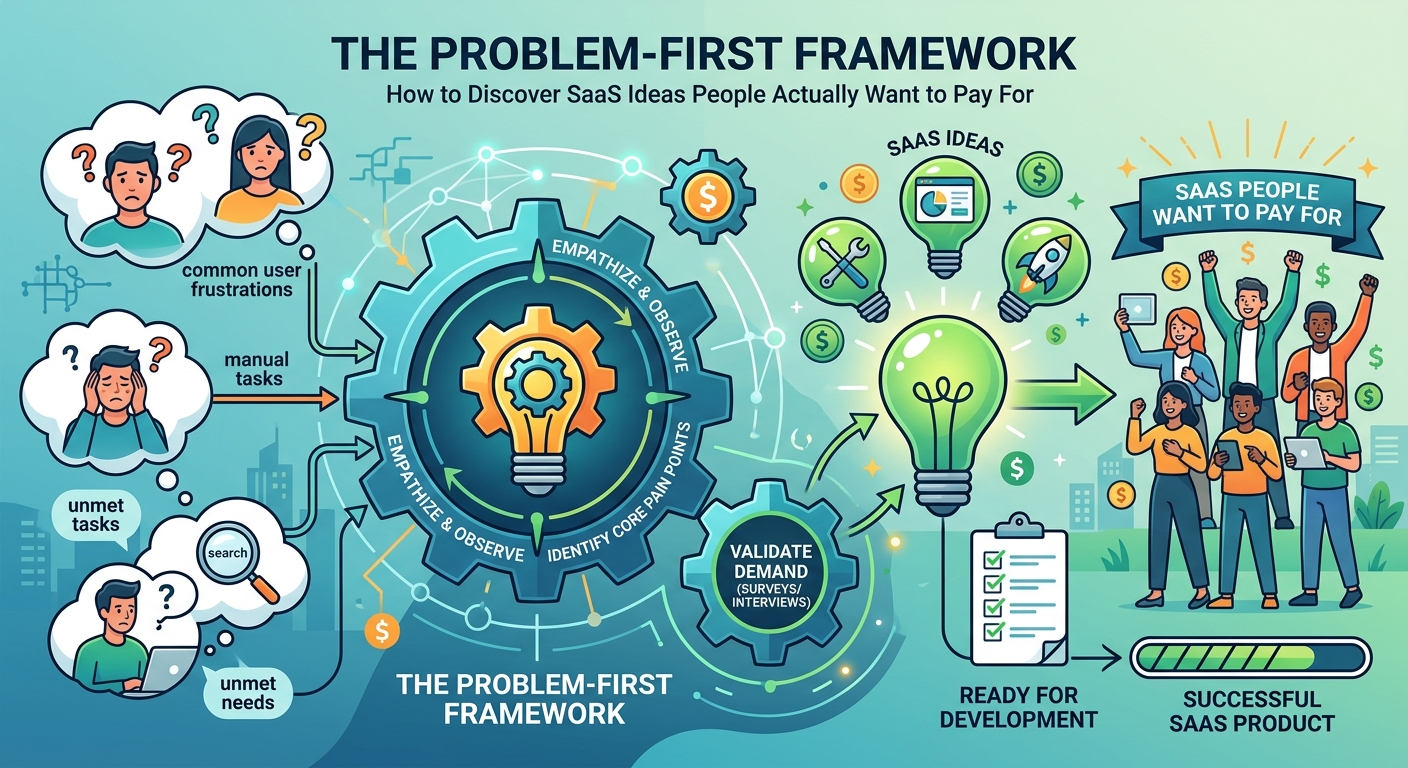
You’re staring at a blank screen, trying to brainstorm the next million-dollar SaaS idea. But every concept feels either too ambitious, already done, or just plain boring. The truth is, most founders approach idea generation backward. They start with solutions instead of problems.
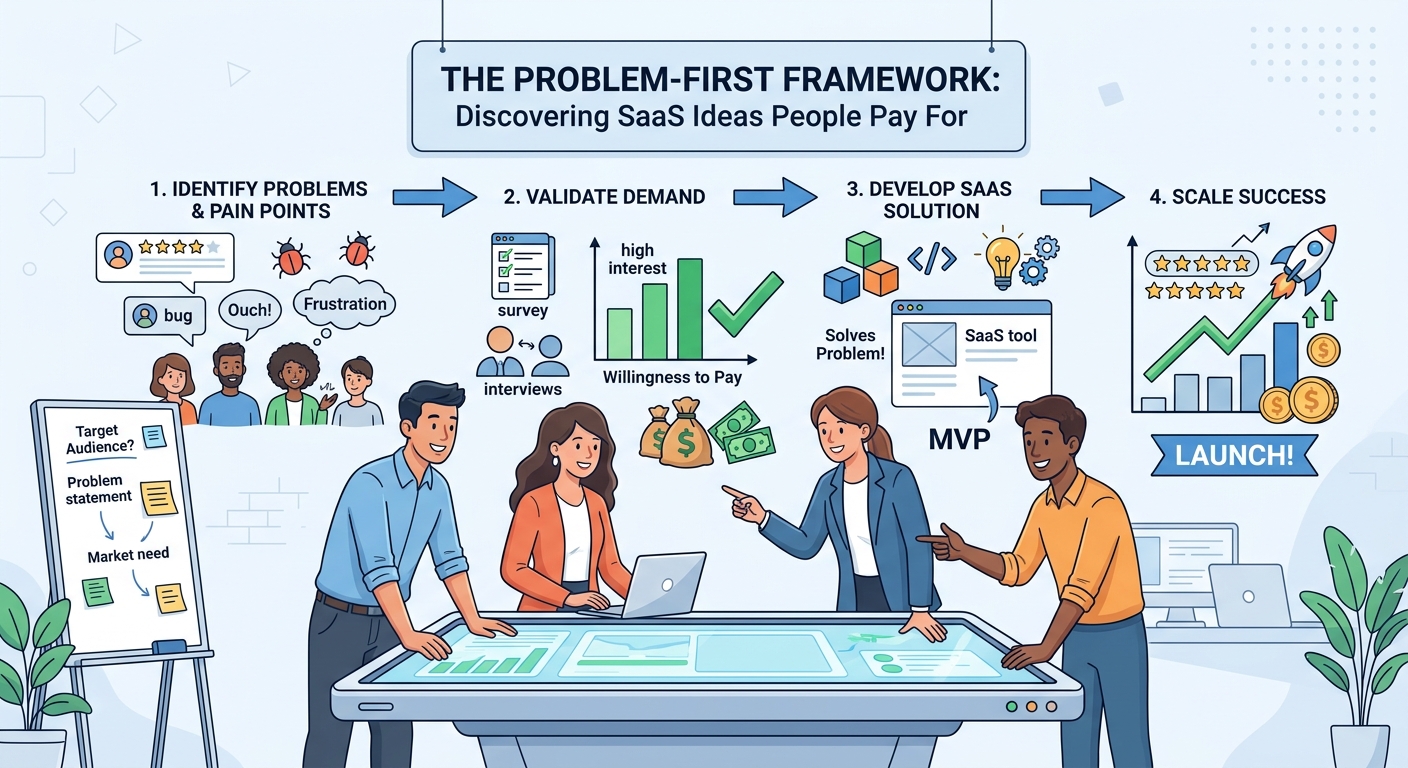
Finding profitable SaaS ideas starts with identifying existing problems people already pay to solve. Focus on markets with established demand, dissatisfied users, and manual workflows. Use review sites, online communities, and your own expertise to spot opportunities where current solutions fall short. Validate demand before writing code.
Start with problems, not solutions
Most developers fall into the same trap. They build what sounds cool instead of what people need.
The best SaaS products solve specific, painful problems. Not hypothetical ones. Real friction that costs people time, money, or sanity every single day.
Think about your last frustrating work experience. Maybe you spent three hours manually copying data between spreadsheets. Or you paid for expensive software that only uses 10% of its features. Those moments of friction are gold.
Write them down. All of them.
Your goal is to build a list of problems, not solutions. The solution comes later, after you understand the problem deeply.
Mine review sites for frustrated users
One of the fastest ways to spot opportunity is finding where people complain about existing tools.
Head to G2, Capterra, or Trustpilot. Pick a category related to your skills or interests. Read the 1-star, 2-star, and 3-star reviews. Skip the 5-star ones.
Look for patterns. When ten different people mention the same missing feature or pain point, you’ve found something worth investigating.
Here’s what to look for:
- “This would be perfect if it just had…”
- “Too complicated for what I need”
- “Way too expensive for small teams”
- “Customer support takes days to respond”
- “The interface is confusing”
Each complaint represents a potential angle for a competing product. You don’t need to reinvent the wheel. You need to build a better version of something people already pay for.
Follow the money in online communities
Reddit, Indie Hackers, and niche forums are full of people openly discussing what they struggle with.
Join subreddits related to specific professions or industries. Search for phrases like “what tools do you use” or “how do you handle” followed by a task.
Pay attention to threads where people ask for recommendations. When someone says “I’ve tried five different tools and none of them do X,” that’s a signal.
Twitter is another goldmine. Search for tweets containing “I wish there was a tool” or “paying $X/month for software that barely works.” Set up saved searches and check them weekly.
The key is listening without immediately pitching. Spend time understanding the context around each problem. Who has it? How often? What have they already tried?
Turn your domain expertise into opportunity
Building in an area you already know gives you an unfair advantage.
You understand the problems without months of research. You speak the language. You know which pain points matter most and which are just minor annoyances.
Think about your last three jobs. What repetitive tasks ate up hours every week? What tools did everyone complain about? What workarounds did your team create because the official solution was broken?
“The best founders don’t just understand their market. They’ve lived the problem they’re solving for years.”
If you’ve worked in accounting, you know accounting software pain points better than any outsider could. If you’ve managed e-commerce stores, you’ve felt the friction in inventory systems.
This insider knowledge helps you build something that actually fits how people work, not how you imagine they work.
Study growing platforms and ecosystems
Every major platform creates opportunities for complementary tools.
When Shopify grew, thousands of app developers built profitable businesses solving specific merchant problems. When Notion took off, template creators and integration builders found their niche.
Look at platforms gaining traction right now. What do their users need that the core product doesn’t provide?
Browse app marketplaces. Sort by “newest” instead of “most popular.” See what gaps recent builders are trying to fill. If multiple people build similar tools within months of each other, there’s demand.
Platform-based SaaS ideas have built-in distribution. Users are already there, actively looking for solutions. You don’t need to explain why they need your category. You just need to be better than the alternatives.
Identify manual workflows ripe for automation
People pay good money to save time on repetitive tasks.
Look for workflows that involve:
- Copying data between tools
- Generating similar documents repeatedly
- Checking multiple sources for updates
- Manual scheduling or coordination
- Repetitive customer communications
These are perfect candidates for automation. The value is clear and measurable. “Save 5 hours per week” is an easy sell.
Talk to freelancers and consultants. They often handle the same tasks for multiple clients. If they’re doing something manually over and over, they’ll pay for a tool that handles it.
The beauty of workflow automation is that you can start narrow. Build for one specific use case. Expand later if it gains traction.
Create focused alternatives to bloated software
Enterprise software often tries to do everything. This creates room for simpler, focused alternatives.
Find expensive, feature-heavy tools in your target market. Build a version that does one thing really well for a fraction of the price.
This strategy works particularly well for:
- Small teams who don’t need enterprise features
- Solopreneurs who find existing tools overwhelming
- Niche industries ignored by major players
Your competitive advantage is simplicity and speed. You can ship faster, iterate based on feedback, and provide better support because you’re not managing thousands of enterprise clients.
People often prefer a tool that does exactly what they need over a Swiss Army knife that does everything poorly.
Use this framework to evaluate potential ideas
Not every problem is worth solving. Some are too small. Others are too competitive. Here’s how to filter:
| Criteria | Good Sign | Red Flag |
|---|---|---|
| Market size | Thousands actively searching | Fewer than 100 potential customers |
| Willingness to pay | Already paying for similar tools | Expect everything free |
| Competition | 2-5 established players | Either zero or 50+ competitors |
| Problem frequency | Daily or weekly pain | Once-a-year inconvenience |
| Your advantage | Deep domain knowledge | Complete outsider guessing |
Run each idea through this filter. Be honest about red flags. One great idea beats ten mediocre ones.
Test demand before building anything
The worst outcome is spending months building something nobody wants.
Before you write a single line of code, validate your SaaS idea by testing if people actually care.
Here’s a simple validation process:
- Write a one-page landing page describing the solution
- Include pricing (yes, real numbers)
- Add a waitlist signup form
- Drive 100-200 targeted visitors through ads or communities
- Measure signup rate and gather feedback
If fewer than 5% of visitors sign up, your messaging is off or the problem isn’t painful enough. If 20%+ sign up and people ask when they can pay, you’re onto something.
This test costs maybe $100 and saves you months of wasted effort.
Combine approaches for better results
The strongest ideas often come from combining multiple discovery methods.
You might notice a problem in your own work, then validate it by finding complaints in review sites, and confirm demand by seeing multiple failed attempts at solutions in a platform marketplace.
When multiple signals point to the same opportunity, your confidence should increase.
Keep a running list. Not every idea needs immediate action. Some will become relevant as markets shift or new platforms emerge.
Revisit your list quarterly. Problems that seemed small might grow. Technologies that were expensive might become accessible.
Watch for these common mistakes
Even experienced founders stumble during idea generation.
Building for yourself without checking if others have the same problem is dangerous. Your situation might be unique. Always validate that at least 100 other people face similar friction.
Choosing problems in markets where buyers don’t pay for software is another trap. Some industries are notoriously cheap or resistant to new tools. Research typical software budgets in your target market.
Ignoring competition entirely is naive, but so is avoiding competitive markets completely. Competition often validates that money is flowing. Your job is finding an underserved segment or angle.
Falling in love with your first idea leads to confirmation bias. Stay objective. Be willing to pivot or abandon ideas that don’t validate.
Focus on these high-potential areas
Certain types of SaaS ideas tend to work better for solo founders and small teams.
Vertical SaaS targeting specific industries often wins because you can deeply understand niche needs. A tool built specifically for dentists will beat a generic solution every time within that market.
Workflow automation tools that connect existing services provide clear value. If you can save someone 10 hours per month, pricing becomes easy.
Profitable micro-SaaS niches that larger companies ignore offer less competition and more flexibility. You can move fast and provide personal support that enterprises can’t match.
Tools that reduce costs rather than increase revenue are easier sells during economic uncertainty. “Save $500/month” requires less justification than “maybe increase revenue.”
Build momentum with a focused approach
Once you’ve identified a promising idea, resist the urge to expand scope immediately.
Start with the smallest possible version that solves the core problem. Get it in front of real users fast. Learn from their behavior, not just their words.
Building a SaaS MVP in 30 days forces you to prioritize ruthlessly. You can always add features later. You can’t get back months spent building the wrong thing.
Early users are forgiving if you’re responsive and clearly improving the product based on feedback. They become advocates when they see their suggestions implemented.
This iterative approach works better than trying to launch a perfect product. Perfect never ships.
Your next steps start today
Finding great SaaS ideas isn’t about sudden inspiration or genius insights.
It’s about systematically looking for problems in the right places. Listening to what people actually struggle with. Validating demand before investing serious time.
Start by picking one discovery method from this guide. Spend an hour today executing it. Maybe that’s reading 50 reviews on G2. Maybe it’s posting a question in a relevant subreddit.
Do this consistently for a few weeks. Your list of potential ideas will grow. Patterns will emerge. You’ll start recognizing opportunities everywhere.
The difference between founders who ship profitable products and those who spin their wheels often comes down to idea selection. Choose a problem people already pay to solve. Build something meaningfully better than existing options. That’s the foundation everything else builds on.