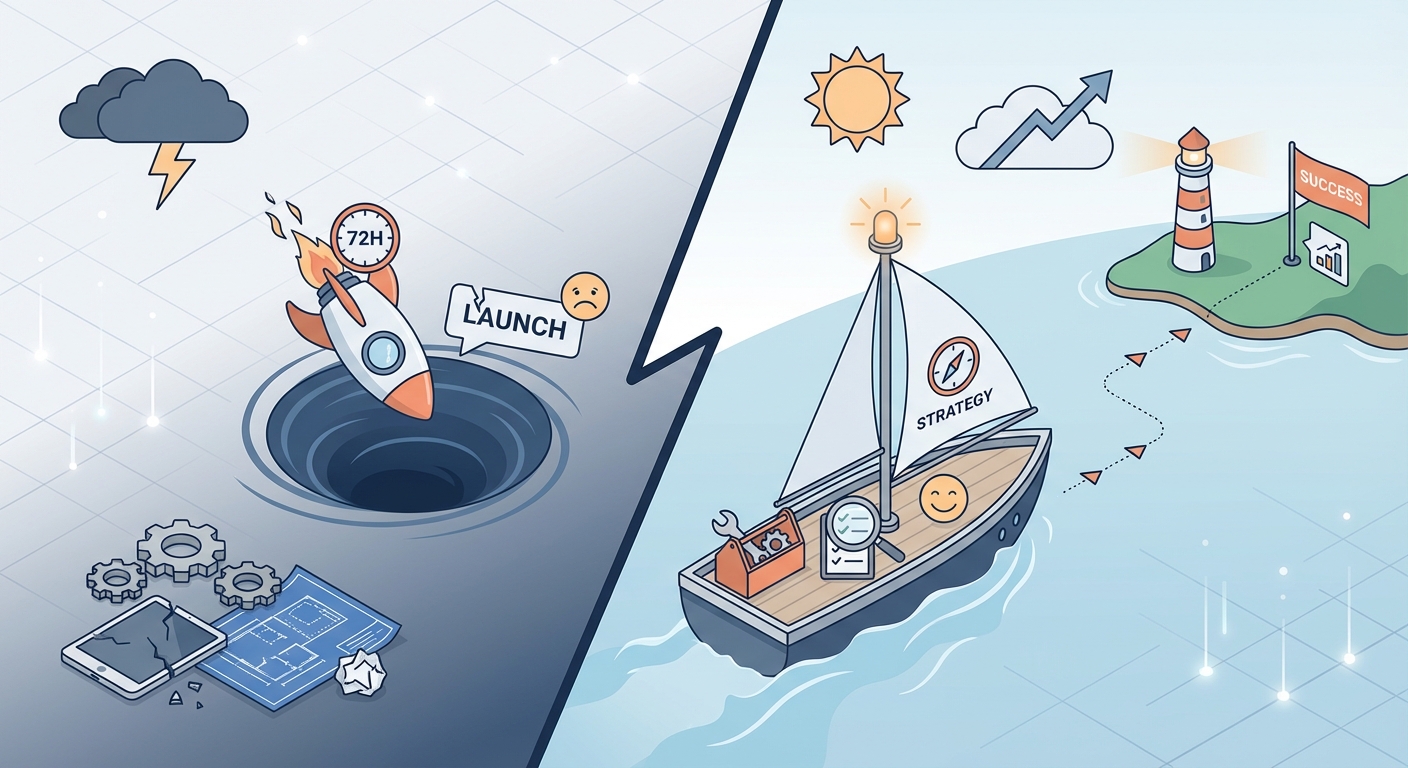
You built your product for six months. You tested every feature. You set a launch date and hit publish. Then nothing happened.
No signups. No feedback. Just silence.
This story plays out thousands of times every year. The brutal truth is that most indie SaaS launches fail not because the product is bad, but because founders misunderstand what a launch actually needs to accomplish.
SaaS launches fail when founders prioritize building over validating, launch without an audience, ignore technical readiness, set unrealistic pricing, and lack clear success metrics. Success comes from pre-launch validation, audience building, infrastructure planning, strategic pricing, and measuring what matters. Avoid these five failure points and your launch has a real chance.
Building Without Validation Kills More Products Than Bad Code
The first reason why SaaS launches fail is simple. Founders build solutions to problems that don’t exist or that nobody will pay to solve.
You might have a problem that bothers you. That doesn’t mean it bothers enough people to sustain a business. You might have talked to three friends who said they’d use your product. That’s not validation.
Real validation means finding people who have the problem right now, who are already trying to solve it, and who would pay money for a better solution. Before you write code, you need to validate your SaaS idea before writing a single line of code.
Here’s what actual validation looks like:
- Identify a specific problem that costs people time or money
- Find at least 20 people who currently experience this problem
- Confirm they’re already paying for an imperfect solution or spending significant time on workarounds
- Get 5 to 10 people to commit to paying before you build anything
Most founders skip straight to step four or ignore validation entirely. They assume that if they build something great, users will come. They won’t.
The market doesn’t care about great products. It cares about products that solve expensive problems for people who know they have those problems.
The biggest mistake I see is founders falling in love with their solution before they understand the problem. You need people begging you to build something, not politely saying it sounds interesting.
Launching to an Empty Room Guarantees Failure
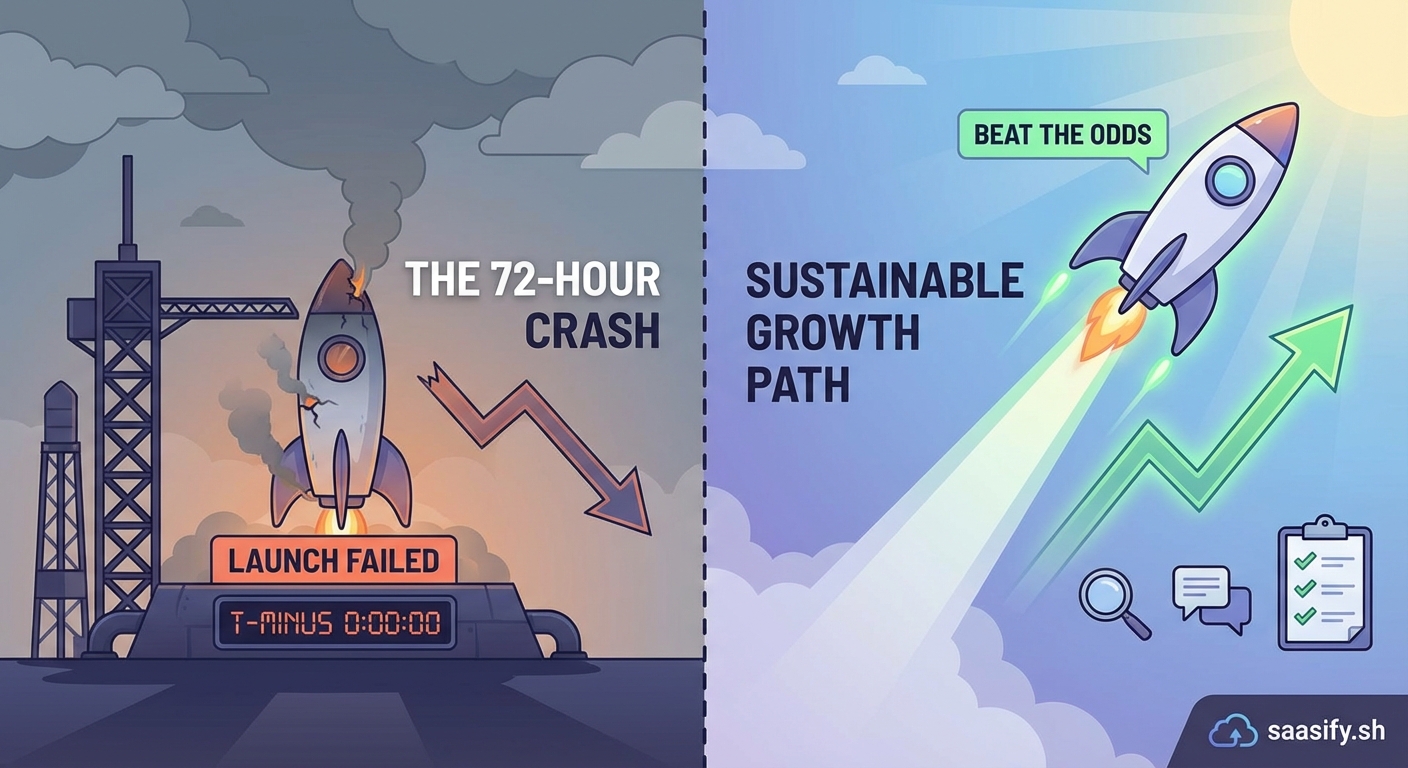
The second failure point happens when founders treat launch day as the start of their marketing. It’s not. It’s the culmination.
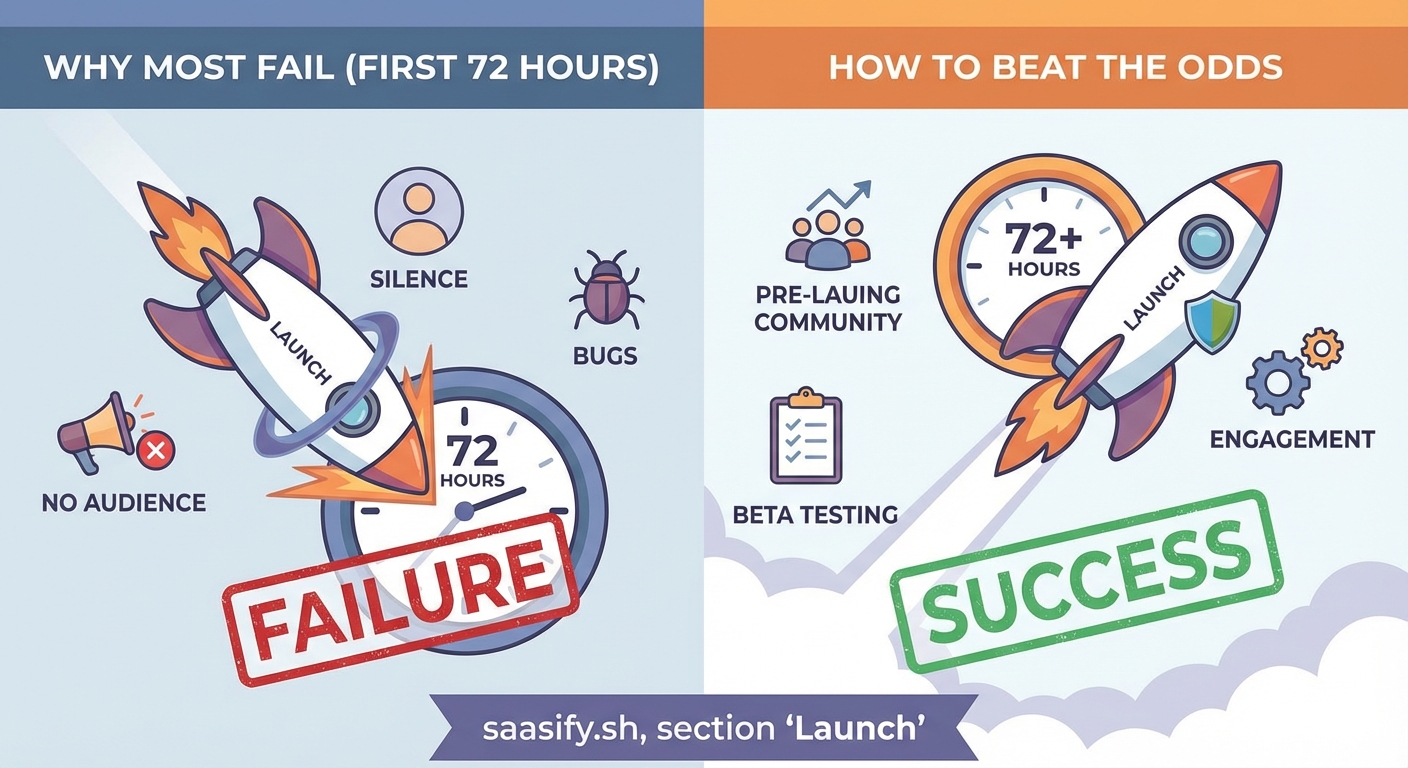
If you have zero audience on launch day, you have zero chance of success. You need people waiting for your product before you release it.
This means building an audience months before launch. It means creating content, starting conversations, and collecting email addresses from people interested in your solution.
Many successful indie founders spend more time on building their first 1,000 email subscribers than they do on their initial MVP. That’s not an accident.
Here’s a comparison of failed versus successful launch preparation:
| Failed Launch Approach | Successful Launch Approach |
|---|---|
| Build in silence for months | Share progress publicly from day one |
| Launch to no audience | Build waitlist of 200+ interested users |
| Hope for viral growth | Plan targeted outreach to 50 ideal customers |
| Generic “we launched” post | Personalized messages to engaged community |
| No follow-up plan | 30-day post-launch content calendar ready |
The pattern is clear. Successful launches happen when founders build relationships before they build products.
You need to know where your customers hang out. You need to be present in those spaces, providing value and building trust. When you finally launch, those people should already know who you are and what problem you solve.
Choosing between a soft launch or going big matters less than having anyone to launch to at all.
Technical Disasters Destroy Trust Instantly
The third reason launches fail is infrastructure. Your product breaks under minimal load, critical features don’t work, or the signup process fails.
Users give you one chance. If your product doesn’t work the first time they try it, they’re gone forever.
This doesn’t mean you need perfect code. It means you need reliable core functionality and a plan for when things break.
Most indie founders underestimate how much infrastructure matters:
- Database queries that work fine with 10 test users collapse with 100 real ones
- Email delivery fails because you didn’t set up proper DNS records
- Payment processing breaks because you tested with Stripe test mode but never verified production
- Your server runs out of memory because you deployed on the cheapest hosting option
These aren’t hypothetical problems. They happen constantly.
Before you launch, test your infrastructure under realistic conditions. Get 20 beta users actually using your product. Monitor your logs. Fix the errors that appear.
The goal isn’t perfection. The goal is knowing what breaks and having a plan to fix it fast.
Consider building your MVP in 30 days, but give yourself another two weeks for infrastructure hardening and real-world testing.
Wrong Pricing Signals Wrong Value
The fourth failure point is pricing. Founders either charge too little, too much, or make pricing so confusing that nobody converts.
Pricing too low signals that your product isn’t valuable. Pricing too high without clear differentiation means nobody takes the risk. Confusing pricing with seven tiers and dozens of features means decision paralysis.
When you price your SaaS product with zero customers, you’re making educated guesses. Those guesses need to be based on real research, not hopes.
Here’s what to consider:
- What are people currently paying for alternative solutions?
- What’s the economic value of solving this problem?
- Can you charge monthly or do you need annual pricing for cash flow?
- Does your target market expect freemium or paid-only?
Many founders launch with free plans that attract tire-kickers who’ll never pay. Others launch at enterprise prices when they’re targeting solo developers.
Your pricing should match your market position. If you’re targeting profitable micro-SaaS niches, your pricing needs to reflect the specific economics of that niche.
Start with simple pricing. One or two tiers maximum. Clear value at each level. Easy to understand in five seconds.
You can always adjust pricing later, but launching with confusing or misaligned pricing kills conversions immediately.
Measuring the Wrong Things Leads to Wrong Decisions
The fifth reason launches fail is that founders don’t know what success looks like. They launch and then panic when they don’t immediately get 1,000 signups.
Most launches don’t produce huge numbers. That’s normal. What matters is whether you’re getting signal that your product solves a real problem.
Here are the metrics that actually matter in your first 30 days:
- How many people sign up?
- How many activate (actually use your core feature)?
- How many come back the next day?
- How many convert to paid?
- What feedback are paying customers giving you?
Notice what’s not on that list. Total traffic. Social media impressions. Vanity metrics that make you feel good but don’t indicate product-market fit.
You need a system to track these numbers. Building a revenue dashboard helps you see patterns and make smart decisions.
If 100 people sign up but zero activate, you have an onboarding problem. If 50 people activate but zero convert, you have a pricing or value problem. If 10 people pay but all churn after one month, you have a retention problem.
Each scenario requires a different response. You can’t fix what you don’t measure.
Set realistic expectations before launch:
- Define what a successful first week looks like (be honest and conservative)
- Decide which three metrics you’ll track daily
- Plan how you’ll collect qualitative feedback from early users
- Schedule a one-week post-launch review to assess what worked
Common Launch Mistakes and How to Avoid Them
Beyond the five major failure points, several smaller mistakes compound to sink launches.
Here’s a breakdown of frequent errors:
- Launching on Friday: Nobody pays attention to launches on Friday afternoon. Launch Tuesday or Wednesday morning.
- No clear call to action: Your launch post should tell people exactly what to do next. Sign up. Try the demo. Join the waitlist.
- Ignoring feedback: Early users will tell you what’s broken. Listen to them. Respond within hours, not days.
- Trying to reach everyone: Target one specific group of users. Expand later.
- No follow-up content: Launch day is just the start. Plan content for the next 30 days to maintain momentum.
Many founders also make the mistake of launching everywhere at once. They post on Product Hunt, Hacker News, Reddit, Twitter, and LinkedIn simultaneously.
This spreads you too thin. You can’t respond to feedback on five platforms. You can’t build relationships in five communities at once.
Pick one or two channels where your target users actually spend time. Focus there. Do it well.
What Successful Launches Actually Look Like
Let’s be clear about what success means for an indie SaaS launch.
It doesn’t mean going viral. It doesn’t mean 10,000 signups. It doesn’t mean quitting your job.
Success means getting your first 10 paying customers who find real value in your product. Success means learning what works and what doesn’t. Success means building momentum you can sustain.
Some solo developers have built and sold multi-million dollar products, but they all started with unglamorous first launches that taught them critical lessons.
Your first launch is a learning experience. Treat it that way. Set realistic goals. Measure what matters. Talk to your users. Fix what’s broken. Build from there.
The founders who succeed aren’t the ones with perfect launches. They’re the ones who survive their imperfect launches and keep improving.
Building a Pre-Launch Foundation That Works
Since most failures stem from launching unprepared, let’s talk about what preparation actually involves.
Three months before your target launch date, you should:
- Have a working prototype that solves the core problem
- Start building your email list through content and outreach
- Identify 10 to 20 potential early adopters and talk to them weekly
- Set up basic analytics and error tracking
- Write your launch announcement and get feedback on it
Two months before launch:
- Get 5 beta users actually using your product
- Fix the critical bugs they discover
- Refine your messaging based on how they describe your product
- Grow your email list to at least 100 people
- Plan your launch day schedule hour by hour
One month before launch:
- Finalize your pricing based on beta user feedback
- Create your pre-launch waitlist landing page
- Prepare support documentation for common questions
- Test your payment flow end to end
- Line up 3 to 5 people who’ll share your launch
One week before launch:
- Do a final technical review of critical paths
- Send a heads-up email to your waitlist
- Prepare response templates for common questions
- Clear your calendar for launch day
- Get sleep (seriously)
This timeline assumes you’re building while working another job or juggling other commitments. Adjust based on your situation, but don’t skip the validation and audience-building steps.
When to Pivot Versus When to Push Through
Not every launch that starts slow is doomed. Some products need time to find their audience. Others need fundamental changes.
How do you know the difference?
If you’re getting signups but no activation, you have a product or onboarding problem. Fix that before doing more marketing.
If you’re getting activation but no conversion, you have a pricing or value proposition problem. Talk to users who activated but didn’t pay.
If you’re getting no signups at all, you either have an audience problem or a messaging problem. Maybe both.
The key signal is engagement. If people are using your product and finding value but not paying, that’s solvable. If nobody even tries your product, you need to rethink your approach.
Give yourself 90 days post-launch before making major pivots. That’s enough time to:
- Try different marketing channels
- Adjust pricing once or twice
- Improve onboarding based on user feedback
- Build some word-of-mouth momentum
But if after 90 days you have fewer than 5 paying customers and no clear path to more, it’s time for honest evaluation.
Making Your Next Launch Different
If you’ve already launched and failed, you’re in good company. Most successful indie founders have multiple failed launches behind them.
The difference between founders who eventually succeed and those who give up is what they learn from failure.
After a failed launch, do this:
- Write down everything that didn’t work
- Talk to the few people who did sign up and ask why they left
- Identify the one biggest mistake you made
- Build your next attempt around avoiding that mistake
Don’t try to fix everything at once. Focus on the one change that would have made the biggest difference.
Maybe that’s building an audience first. Maybe it’s validating the problem better. Maybe it’s choosing a different niche entirely.
Whatever it is, make that your focus for the next attempt.
Turning Launch Lessons Into Long-Term Success
Launch day matters less than what you do in the months after. The real work starts when the initial excitement fades and you’re left with the daily grind of building a business.
Your launch teaches you who your customers are, what they actually need, and how to reach them. Use those lessons to build sustainable growth systems.
Keep talking to users. Keep improving your product. Keep showing up in the communities where your customers spend time.
Success in indie SaaS isn’t about one perfect launch. It’s about consistent progress over months and years. It’s about learning what works for your specific product and market.
Your first launch probably won’t be perfect. That’s fine. Make it good enough to learn from. Then use those lessons to build something that lasts.
The founders who win aren’t the ones who launch perfectly. They’re the ones who launch, learn, and keep building.