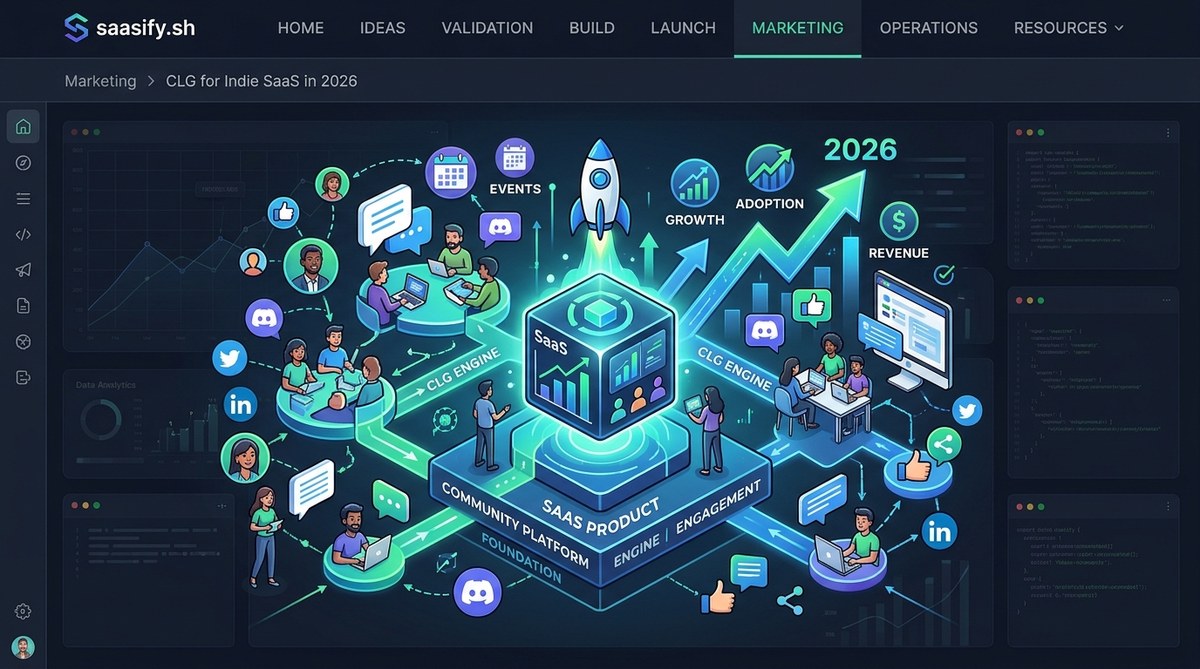
You are building a SaaS product alone or with a very small team. You have maybe 50 users, or you are still pre-revenue. Paid ads are too expensive. Cold outreach feels spammy. You need a growth strategy that does not burn cash and actually builds a loyal user base. Community-led growth SaaS is the answer. It is not about building a Facebook group and hoping for the best. It is a repeatable system where your users become your biggest advocates. In 2026, this is the most sustainable way for an indie founder to grow.
Community-led growth SaaS works because it turns users into advocates. Instead of spending money on ads, you invest time in a space where your target audience already hangs out. You help them for free. You build trust. Then your product becomes the natural next step. This guide gives you a repeatable 4-step engine to build that community from scratch, even if you have zero following today.
Why Paid Ads Feel Like a Trap for Solo Founders
You have probably tried running a Facebook ad or a Google search campaign. You spent $200, got 10 clicks, and zero signups. That is painful. For an indie SaaS founder with a limited budget, paid acquisition is a gamble. You are competing against companies with dedicated ad spend and teams of optimizers. You cannot win that game on dollars alone.
Community-led growth SaaS flips the script. Instead of paying for attention, you earn it. You show up in the places your ideal users already gather. You answer their questions. You share your expertise. Over time, people start to trust you. When they need a solution to the problem your SaaS solves, they think of you first. This is not a theory. It is how Buffer, Mailchimp, and many indie SaaS products grew their early user base.
The Core Loop of Community-Led Growth SaaS
Before we get into tactics, you need to understand the loop. It has four stages:
- Attract — You find where your target users hang out online. This could be a subreddit, a Slack group, a niche forum, or a community on X (formerly Twitter).
- Contribute — You add value without asking for anything in return. You answer questions. You write detailed guides. You share your learnings from building your own product.
- Convert — A small percentage of people who see your contributions want to try your SaaS. They sign up for a free trial or a free plan.
- Amplify — Your happy users tell others about your product. They share it in the same communities where you started. The loop feeds itself.
The beauty of this model is that each stage feeds into the next. You do not need to be a marketing genius. You just need to be consistent.
Where to Find Your First 100 Community Members
You cannot build a community in a vacuum. You need to join an existing one first. Here are three places to start for your community-led growth SaaS:
- Reddit subreddits related to your niche. If you make a project management tool for freelance designers, go to r/freelance and r/design. Do not post your link. Just answer questions. Use the “finding SaaS ideas in Reddit comments” method to understand their pain points.
- Niche Slack or Discord communities. Many professions have dedicated chat rooms. Search for “[your niche] community Slack” on Google. Join and lurk for a few days. Then start helping.
- X (Twitter) hashtags and lists. Follow people who tweet about your space. Reply to their questions. Share useful resources.
The goal is not to promote your SaaS. The goal is to become known as a helpful person. When you do that, people will naturally ask what you are working on.
The 4-Step Engine: How to Operate Your Community Strategy
Here is a numbered list of the practical process you can follow each week. This is the engine that powers community-led growth SaaS.
- Spend 30 minutes each morning scanning your chosen communities. Look for questions that you can answer with authority. Bookmark the ones that relate to your product’s core value.
- Write a thoughtful, detailed response. Do not just say “try my tool.” Write a 200-word answer that genuinely helps. If relevant, link to a blog post on your site that goes deeper. For example, you could link to a post about “building a pre-launch waitlist that actually converts” if someone asks about getting early users.
- Track the people who engage with your answers. Send them a direct message thanking them for the conversation. Ask a follow-up question. Build a relationship.
- Once a week, create a piece of content based on the most common questions you saw. This could be a Twitter thread, a blog post, or a short video. Share it in the community. This content becomes a magnet for new users.
This process takes about one hour per day. It is free. And it compounds over time.
Techniques vs. Mistakes: A Handy Reference
Let us look at a table that compares what works and what does not in community-led growth SaaS.
| Technique | Why It Works | Common Mistake | Why It Fails |
|---|---|---|---|
| Answering questions with deep detail | Builds authority and trust | Dropping a link with no context | Looks like spam, gets ignored |
| Sharing your build-in-public journey | Creates a personal connection | Only talking about your wins | Feels inauthentic and salesy |
| Creating free templates or tools | Provides immediate value | Making the free tool too limited | Users feel tricked, not helped |
| Engaging with competitor’s users | Shows you understand the space | Badmouthing the competitor | Damages your reputation |
| Asking for feedback early | Makes users feel invested | Ignoring the feedback you receive | Breaks trust and kills goodwill |
The Surprising Power of Building in Public
One of the most effective ways to fuel community-led growth SaaS is to build your product in public. Share your progress on X or in your community. Show screenshots of new features. Talk about your pricing decisions. Ask for opinions on your landing page.
When you build in public, your community feels ownership over your success. They want you to win. They will share your product because they feel like they were part of the journey. This is a form of social proof that no ad can replicate.
“Building in public is the best marketing strategy for solo founders. It turns your development process into content, and your users into cheerleaders.” — A lesson learned from many indie founders who grew without ads.
What to Do When You Get Your First 100 Users
Once you have a small but engaged user base, your job changes. You need to turn those users into amplifiers. Here is a bulleted list of actions you can take:
- Create a dedicated space for your users. A simple Discord server or a Circle community works. Invite your most active users there.
- Celebrate user wins publicly. When someone achieves a goal using your SaaS, ask if you can share their story. Tag them. They will share it with their network.
- Give your power users special access. Let them test new features first. Ask for their feedback. Make them feel like insiders.
- Create a referral program that rewards sharing. Offer a month of free service for every paying customer they bring in.
- Ask for testimonials and reviews. A good review on a site like Product Hunt or G2 can bring in a steady stream of new users.
Your community is not just a support channel. It is your growth engine. Treat it that way.
Measuring What Matters in Community-Led Growth
You cannot improve what you do not measure. But do not overcomplicate it. Here are the three metrics that matter most for community-led growth SaaS:
- Number of quality contributions per week. This is your input metric. If you stop showing up, the engine stops.
- Referral signups per month. Track how many new users say they found you through a community or a friend.
- Net Promoter Score (NPS) among your community members. A high NPS means your users are likely to recommend you.
You do not need a fancy dashboard. A simple spreadsheet works. Review these numbers every two weeks. If referrals are low, double down on your contribution quality.
Your 30-Day Launch Plan for Community-Led Growth
If you are starting from zero, here is a plan to get your first 50 users in 30 days using community-led growth SaaS.
- Week 1: Identify three communities where your target audience hangs out. Create accounts if needed. Just observe. Do not post anything.
- Week 2: Start contributing. Answer 5 questions per day in those communities. Do not mention your product. Focus on being helpful.
- Week 3: Share your build-in-public journey. Create a Twitter thread or a blog post about why you are building your SaaS. Share it in the communities. Include a link to your waitlist or free trial.
- Week 4: Reach out to the people who engaged with your content. Offer them a personal demo or a free extended trial. Ask for feedback. Turn them into your first advocates.
This plan requires no ad budget. It only requires your time and genuine willingness to help.
The Long Game: Why Community Beats Ads Every Time
Paid ads give you a spike of traffic that disappears the moment you stop paying. Community-led growth SaaS builds an asset that grows over time. Every answer you write, every relationship you build, and every user you delight is a deposit into your growth bank account.
In 2026, the indie SaaS market is more crowded than ever. But the tools for building community are better and more accessible. You can build a following on X, a presence on Reddit, or a niche Discord server in a weekend. The barrier to entry is not money. It is consistency.
Your First Step Starts Today
Stop reading. Pick one community. Go there right now. Find a question you can answer. Write a helpful response. Do not link to your product. Just help. Do that every day for the next 30 days. At the end of that month, you will have a small group of people who know you, trust you, and are curious about what you are building. That is the foundation of community-led growth SaaS. It is simple. It is free. And it works.