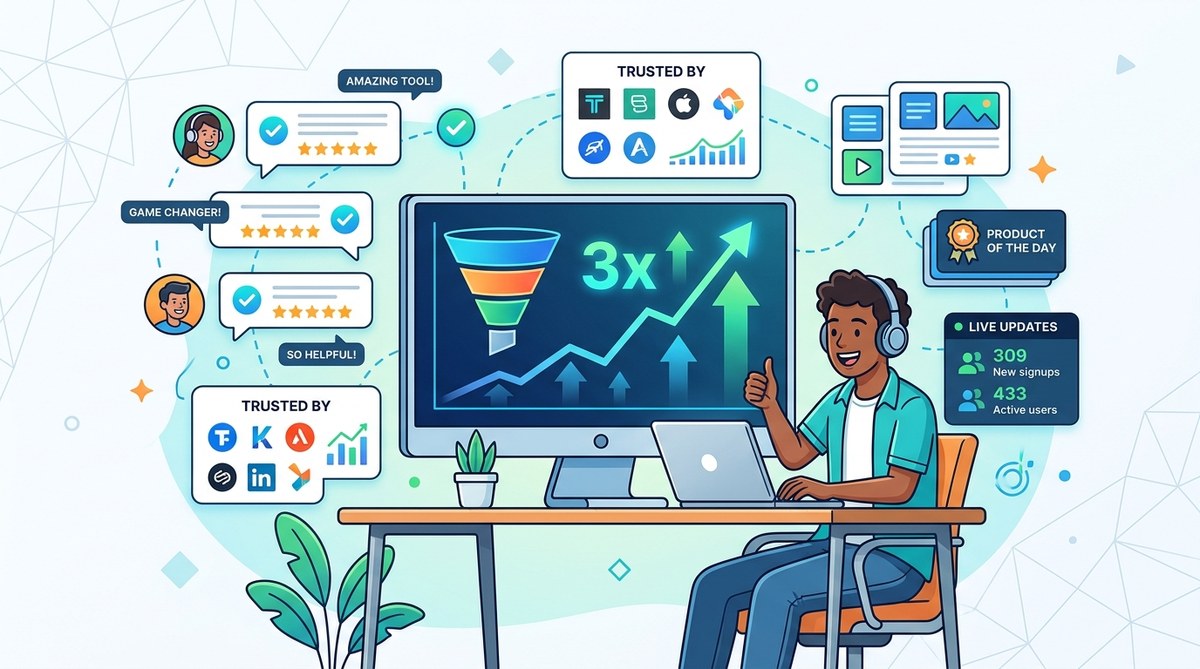
You have a great SaaS product ready to launch. But you have a problem. You need sales to get social proof, and you need social proof to get sales. That catch 22 stops many indie founders. But it does not have to stop you. With the right tactics, you can build trust before you have a single paying customer. This guide shows you exactly how to use social proof during your SaaS launch to triple your conversion rates.
Social proof bridges the trust gap for your SaaS launch. When used correctly, it can triple your conversion rates by reassuring visitors that others trust you. This article covers how to collect proof before you have customers, where to place it for maximum impact, and which mistakes to avoid. Use these strategies to build trust and turn skeptical visitors into paying users.
Why Social Proof Beats Features During a Launch
Many founders lead with features. They list every integration, performance metric, and API route. That matters, but it only goes so far. People buy from people they trust. In a solo founder launch, trust is the scarcest resource you have.
Social proof taps into something primal. Robert Cialdini calls it the principle of social validation. When we see others acting, we assume that action is correct. For a SaaS product, that means a visitor sees 10 beta users loving the tool and thinks, “This must be good.”
“If you can show that other people have already chosen your product, you reduce the perceived risk for new buyers. That risk reduction is what moves someone from ‘maybe later’ to ‘sign up now’.” As an indie founder, every testimonial and usage stat you collect works like a stepping stone for that next visitor.
Features are rational. Social proof is emotional. And emotional reasons drive most purchase decisions. So while you polish your product, polish your proof too.
Types of Social Proof You Can Use from Day One
You do not need thousands of customers to get started. Use these forms of social proof, even with a small base.
- Beta testimonials. Ask your first 5 to 10 testers for a short quote.
- Logos or company names. If you have any recognizable brand or even a real company name, show it.
- Usage stats. “Over 100 tasks processed this week” works even if you have only a handful of users.
- Expert endorsements. A founder tweet or a mention in a niche newsletter counts.
- Social media follower counts. Even a modest but engaged following suggests legitimacy.
- Performance or uptime badges. Show real data from Statuspage or similar.
- Media mentions. Any press or podcast appearance builds authority.
- Community engagement. Show screenshots of active discussions around your product.
Each of these signals to a visitor that real humans trust you. Many of them cost nothing to set up.
How to Build Social Proof Before You Have Customers
You can start building social proof while you are still coding. Here is a numbered process to follow.
- Run a closed beta with active users. Give 10 to 20 people free access in exchange for honest feedback. If they like it, ask for a quote or a video. Record their reactions. Save everything.
- Gather written testimonials during the beta. Use a simple Typeform or email request. Ask what specific problem your tool solved. Specificity makes proof believable.
- Offer a founder guarantee or a certification. If you have domain expertise, write a guest post or record a talk. Show that you know the space. Authority-based social proof is powerful.
- Show real usage metrics from launch week. Display dashboard counts for active users, tasks completed, or files uploaded. Numbers prove traction.
- Leverage existing partnerships. If your SaaS integrates with a known tool, display that integration badge. Association transfers trust.
- Host a pre launch waitlist with visible numbers. A growing count of signups creates its own momentum. You can read more about this in our guide on how to build a pre launch waitlist that actually converts.
- Use social media engagement. Post updates about your build process. Let people see you are a real person solving real problems. A screenshot of a positive exchange counts.
These steps do not require any revenue. They require intention. The earlier you start, the more proof you have when launch day arrives.
High Impact Social Proof Placement for Your Launch Page
Where you place social proof matters just as much as what you show. The following table breaks down placement, reasoning, and a practical example for a SaaS product.
| Social Proof Type | Where to Place It | Why It Works | Example for a SaaS |
|---|---|---|---|
| Customer testimonial | Above the fold, next to the headline | Reduces hesitation at the first moment of interest | “Increased team productivity by 40% in week one” next to the hero text |
| Usage counter | Near the pricing section | Shows that many others are already paying | “Over 1,200 automations run today” under the plan comparison |
| Logo row | Between the hero and the features section | Association with known brands builds instant trust | Show 5 to 10 company logos, even if some are from beta clients |
| Expert endorsement | Next to the call to action button | Overcomes final doubt before conversion | “This tool saved us 10 hours per week, highly recommend” above the signup form |
| Social media proof | In the footer or on the sidebar | Provides a low effort way to verify legitimacy | Embed a tweet praising your product or show follower count |
Your landing page is your salesperson. Give that salesperson the best stories and numbers you have. If you want to improve your overall page performance, check our guide on why your SaaS landing page isnt converting and how to fix it.
A 3 Step Process to Implement Social Proof in Your Launch
Follow this process to go from zero proof to a launch page that converts.
Step 1. Collect raw proof during your MVP phase.
Run a beta with a small group. Ask every tester one question: “What was the biggest problem this solved for you?” Their answer is your testimonial. Record it. Also collect screenshots of their engagement, like active usage graphs or feature requests. This stage is about quantity.
Step 2. Match proof to visitor intent.
A visitor on your pricing page cares about value. Show a testimonial that mentions ROI. A visitor on your feature page cares about usability. Show a quote that says “I set it up in 5 minutes.” Segment your social proof so each page answers the question a visitor is asking at that moment.
Step 3. Test and optimize based on conversion data.
Run A/B tests with and without social proof elements. Try different positions, lengths, and formats. You can get your first paying customers by getting your first 10 customers without spending a dollar on ads. Use their feedback to refine your proof.
This process turns social proof from a lucky accident into a deliberate growth engine.
Common Social Proof Mistakes That Kill Conversions
Using social proof badly can hurt more than using none at all. Here are the most common errors founders make.
| Mistake | Why It Hurts | How to Fix It |
|---|---|---|
| Using fake or generic testimonials | Readers spot vagueness instantly. It erodes all trust. | Use real names, real companies, and specific results. |
| Showing too many logos without context | A wall of logos looks like decoration, not proof. | Add a short caption. “Used by teams at these companies.” |
| Placing social proof below the fold | Visitors make a first impression in seconds. If proof is hidden, they leave. | Move one piece of proof into the hero area. |
| Using only quantitative stats without stories | Numbers are cold. Stories create connection. | Pair a stat like “10X processing time” with a quote from a real user. |
| Ignoring negative feedback | Trying to hide criticism looks dishonest. | Respond to negative comments publicly and show how you improved. |
A single well placed testimonial from a real person can outperform a dozen generic statements. Keep your proof honest and specific.
Your Launch Is About Trust as Much as Features
A SaaS launch is a trust building project as much as a coding project. Social proof does the heavy lifting of making strangers feel safe. Start small. Ask one beta user for a quote. Add a logo row. Show a real usage number. Then do it again. Each piece of proof builds on the last.
When you treat social proof as a core part of your launch strategy, your conversion rates will reflect it. The visitors who land on your page will see that real people trust you. And they will give you the same trust. That is how you turn a launch from a shaky start into a growth story.
Go collect your proof. Your launch depends on it.