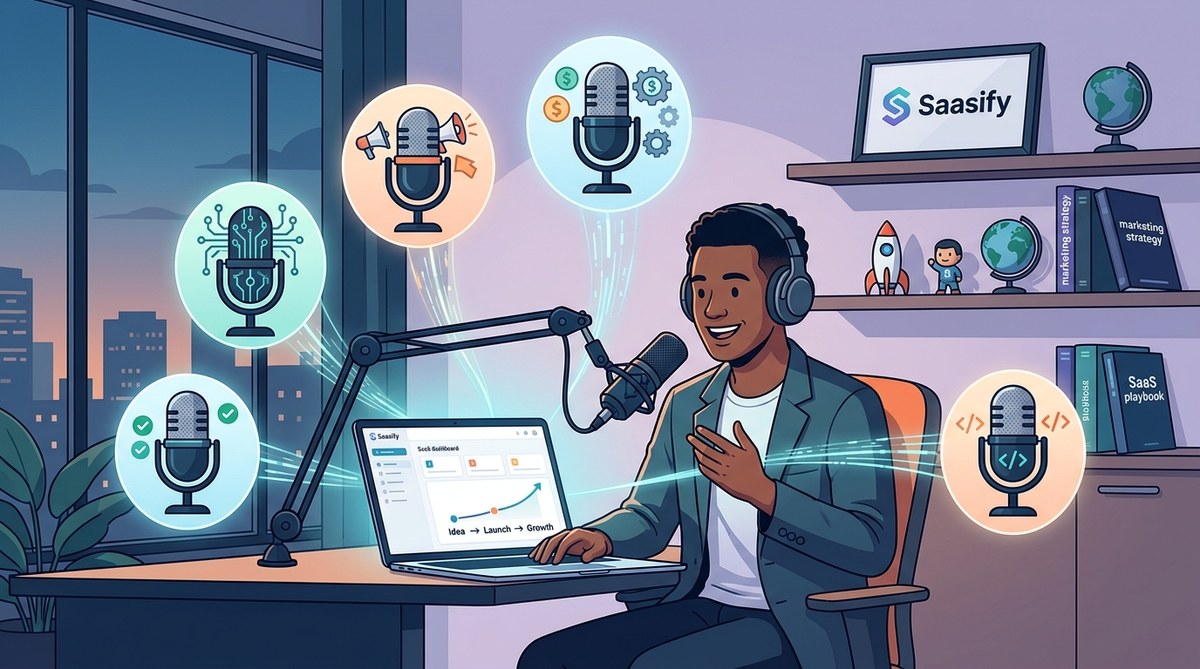
Podcasts are the new cocktail party for B2B. Your ideal customer is stuck in traffic, folding laundry, or jogging with earbuds in, listening to a host they trust. When that host says your name and describes your product, the endorsement carries weight that no ad can buy. But hiring a PR agency to book those appearances can cost $5,000 a month or more. For most indie SaaS founders, that budget doesn’t exist. The good news? You can do it yourself. This guide shows you exactly how to get featured on niche podcasts without an agency.
You don’t need a PR agency to book podcast interviews for your SaaS. By targeting small, hyper-relevant shows, crafting personalized pitches, and preparing a compelling story, any founder can land 5 to 10 guest spots per month. This playbook covers finding the right hosts, writing emails that get opened, and converting listeners into trial users. The only investment is your time and a willingness to share your expertise.
Why Podcast Guesting Works for Indie SaaS
Podcast listeners are a special breed. They have actively chosen to spend 30 to 60 minutes with a host on a specific topic, which means they are already primed to learn. When you appear as a guest, you bypass the noise of social media algorithms and land directly in front of a warm audience.
For a bootstrapped SaaS, this channel is pure gold. You get:
- Authority by association: The host’s trust rubs off on you.
- Long-form content: One episode can be repurposed into blog posts, social clips, and emails.
- Warm leads: Listeners who visit your site after hearing you are more likely to convert.
- Zero ad spend: Your main cost is the time to research and record.
And you can achieve all of this without spending a dime on a PR firm. Let’s get into the mechanics.
How to Find the Right Niche Podcasts (Without a List from an Agency)
The biggest mistake founders make is pitching any podcast with a microphone. Instead, you need shows whose audience overlaps perfectly with your target customer. Here is a three-step research method.
Step 1: Use Podcast Search Engines
Start with tools like Listen Notes, Podchaser, or Apple Podcasts search. Enter keywords related to the problem your SaaS solves, not just your industry.
For example, if you built a tool for freelancers to manage invoices, search for “freelance finance,” “self-employed taxes,” and “solo business operations.” Look for shows with 500 to 5,000 downloads per episode. Those hosts are hungry for guests and their audience is highly engaged.
Step 2: Monitor Guest Appearances of Similar Products
Find a competitor or a complementary tool and see which podcasts they have been on. Use the “mentioned in” filter on Podchaser. If a show invited them, the host is open to talking about tools like yours.
Step 3: Check Listener Demographics
Before pitching, listen to two episodes. Confirm the host interviews people (not just solo rambles) and that the audience matches your ideal customer profile. Do they discuss SaaS tools? Do they ask about workflows and productivity? If yes, add the show to your target list.
Here are some places to find niche podcasts:
- Apple Podcasts categories (drill down to subcategories)
- Spotify playlists curated around topics
- Reddit communities (e.g., r/podcasts, r/Entrepreneur)
- Podcast guest marketplaces like MatchMaker.fm (free tier available)
Build a spreadsheet with 30 to 50 shows. Include columns for the host’s name, email, podcast focus, typical guest topics, and a link to the contact form.
Crafting Your Pitch: The Numbered Process
Once you have a list, it’s time to pitch. This part scares most people, but it is just a structured process.
- Personalize the subject line. Use something like “Episode idea for [Show Name] about [specific topic].” Avoid generic lines like “Podcast guest opportunity.”
- Compliment their work specifically. Mention one recent episode you loved. Explain why it resonated. This shows you actually listen.
- Introduce yourself and your SaaS in one sentence. Example: “I’m Jane, a former CPA who built Invoicelytics, a tool that uses AI to catch billing errors for freelancers.”
- Propose three episode angles. Keep them focused on value for the audience, not on your product.
- Keep the email under 150 words. Hosts are busy. Get to the point.
- Include a link to a past interview (if you have one). This builds credibility. If you don’t, offer to do a short recorded audition.
- Send a follow-up after 7 days. Most hosts are swamped. A polite nudge works wonders.
| Do | Don’t |
|---|---|
| Listen to at least one episode before pitching | Send the same mass email to every podcast |
| Offer to promote the episode to your audience | Lead with a feature list of your product |
| Propose angles that solve a real pain point | Ask “Can I be on your show?” |
| Be specific about what you will discuss | Attach a press kit or media folder |
| Respect their time and format | Pitch a topic that doesn’t match the show’s theme |
“The best podcast pitches I receive are short, specific, and show that the person actually knows my show. If a founder mentions an episode from three months ago, I immediately add them to my shortlist.” — Sarah K., host of The Solopreneur Toolbox
Preparing for the Interview: From Amateur to Pro
You got the booking. Now you have to deliver. Preparation is everything.
First, align with the host on the main talking points. Agree on three key takeaways you want listeners to remember. Then:
- Test your audio setup. A simple USB microphone and a quiet room beat any fancy gear with background noise.
- Have a drink nearby but avoid crunchy snacks.
- Outline your stories before the call. Concrete examples are far more memorable than abstract advice.
- Mention your SaaS naturally, but only when it fits the conversation. Aim to mention it once or twice in a 30-minute episode.
After the interview, ask the host for a link to the episode once it goes live. Then promote it to your email list, social channels, and website. The host will appreciate the cross-promotion and be more likely to invite you back.
Converting Listeners into Users
Getting on a podcast is pointless if you don’t have a plan for the audience. Before the episode airs, set up a dedicated landing page with a lead magnet tied to the topic you discussed.
For example, if you talked about “5 billing mistakes that cost freelancers thousands,” offer a free checklist or a calculator tool on that page. Collect their email in exchange. Then send a sequence that includes the podcast episode and a clear call to action to start a free trial.
You can learn more about building email lists from this guide on how to build your first 1,000 email subscribers. For more low cost channels, check out 7 low-cost marketing channels that actually work for micro-SaaS.
Common Mistakes and How to Avoid Them
| Mistake | Solution |
|---|---|
| Pitching shows that are too big (e.g., 100K downloads) | Start with micro-podcasts (under 1K downloads). They have higher response rates. |
| Focusing only on your product story | Deliver value first. Your product is the example, not the lesson. |
| Ignoring the follow-up | 80% of bookings come after a second email. Send a respectful reminder. |
| Not confirming the recording setup | A pre-call test saves you from a bad audio episode. |
| Forgetting to repurpose the content | Turn the audio into blog posts, tweets, and LinkedIn carousels. |
Your DIY Podcast Tour Starts Now
The barrier to podcast guesting has never been lower. Hosts of niche shows are constantly searching for knowledgeable guests. Your expertise as a SaaS founder is exactly what their audience craves. By following this playbook, you can book a steady stream of appearances without paying a retainer to an agency.
Start today. Pick three podcasts from your research list, write personalized pitches, and send them before the week ends. Do this every week for a month, and you will have a calendar full of interviews that drive real leads to your SaaS. The only thing standing between you and that first booking is this email.
So open your spreadsheet. Hit send. Then get ready to speak directly to your next paying customer.