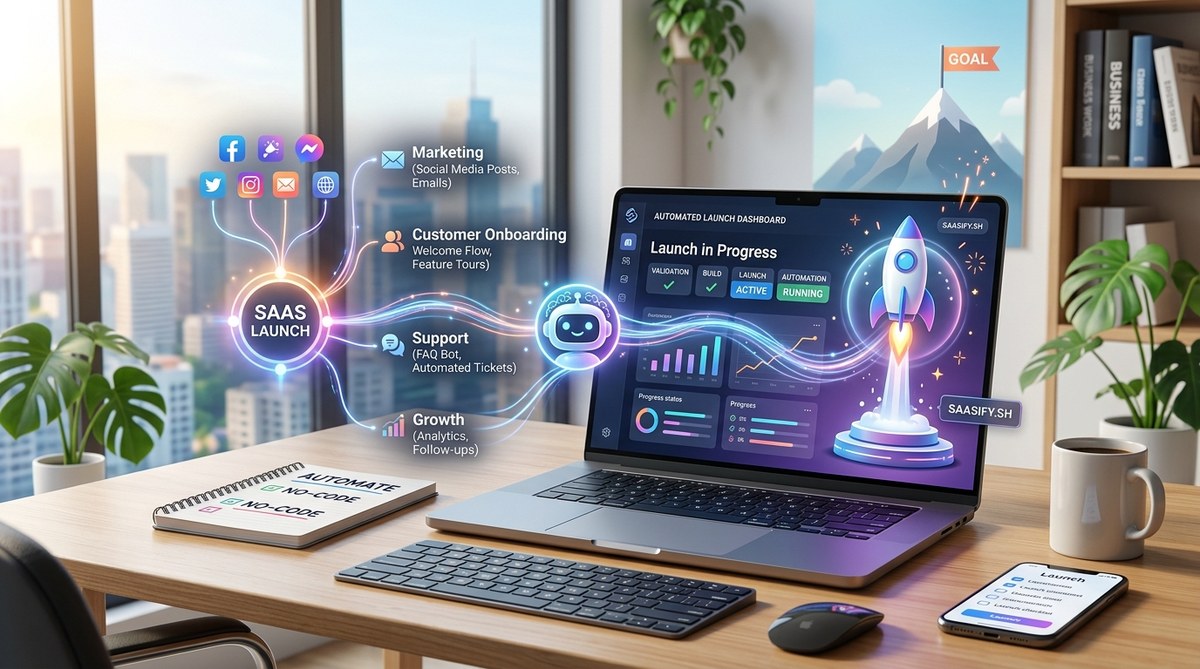
The dream of launching your own SaaS product has never been more accessible. In 2026, you don’t need a computer science degree or a co-founder who sleeps with a terminal open. You just need a clear idea and the right AI tools to turn that idea into a live product. Whether you’re a marketer, a consultant, or someone with zero coding experience, this guide will show you exactly how to use AI to automate your SaaS launch and get your first paying customers.
You can launch a functional SaaS product without writing a single line of code by combining no-code platforms, AI-assisted design, automated marketing, and AI-generated content. This guide walks you through idea validation, building an MVP, creating a landing page, setting up payments, and launching on channels like Product Hunt using only AI tools. Non-technical founders are shipping products faster than ever in 2026.
Your AI SaaS Launch Blueprint for Non-Technical Founders
Everyone thinks building software is the hard part. In reality, the hard part is building something people actually want and then getting it in front of them. AI tools now handle the heavy lifting for both. Let’s break down the process into four repeatable stages.
Stage 1: Validate Your Idea Without Writing Code
Before you spend any time building, you need to know if your idea has legs. AI can help you research your market, analyze competitors, and even simulate customer conversations.
-
Use an AI research tool like ChatGPT or Claude to analyze Reddit threads, Twitter conversations, and review sites in your niche. Ask it: “What are the top 5 recurring complaints about [topic]?” This gives you a problem worth solving.
-
Create a simple landing page with a no-code builder like Carrd or Framer. Let AI write your headline and value proposition. For example, prompt GPT: “Write a compelling headline for a SaaS that helps freelance writers automate their invoicing.”
-
Run a small ad campaign or share the landing page on relevant forums. Measure sign-ups for a waitlist or early access. If fewer than 10 people join your waitlist in a week, your idea probably needs refinement.
If you want a deeper framework for this, check out How to Validate Your SaaS Idea Before Writing a Single Line of Code. It’s exactly what you need before investing time.
Stage 2: Build Your MVP with AI and No-Code Tools
Once you have validation, it’s time to build a minimum viable product. In 2026, the tools are incredibly powerful.
- Use Bubble or Glide to build your backend logic without coding. You can create user authentication, databases, and workflows by dragging and dropping.
- For AI features inside your app, integrate APIs from OpenAI, Claude, or Google’s Gemini. These come with clear documentation and pre-built connectors for no-code platforms.
- Let AI generate your database schema. Describe your app in plain English and ask an LLM to output a Bubble-compatible data structure.
Example: You want to build a tool that generates social media captions. You can create a form where users paste a blog post URL. Your Bubble app sends that text to the OpenAI API, receives a caption, and displays it back. This entire flow takes an afternoon to set up.
For more on choosing the right stack, see How to Choose the Right Tech Stack for Your Indie SaaS Without Analysis Paralysis. It’s written with non-technical founders in mind.
Stage 3: Automate Marketing and Launch Preparation
Marketing is where non-technical founders often get stuck. AI can write your emails, create social posts, and even schedule your entire launch campaign.
-
Email Sequence: Use a tool like ConvertKit or Mailchimp. Have ChatGPT draft your welcome email, your launch day email, and a follow-up sequence. Customize the tone to match your brand.
-
Social Media Content: Use AI to generate 30 days of posts based on your product’s features and customer pain points. Then schedule them with Buffer or Hootsuite.
-
Press and Outreach: Ask AI to write a short pitch for bloggers and newsletter owners in your niche. Personalize each one with a sentence about their recent content.
Expert Tip: The best launch strategy is to start building an audience before your product is ready. Use AI to help you write valuable content about the problem you’re solving. This creates demand before you even launch. A pre-launch waitlist filled with engaged followers is worth more than a perfect product with zero awareness.
Stage 4: Launch Day and Beyond
Your launch day is not the finish line. It’s the start of a conversation with your users. Here’s what automation looks like during the launch itself.
| Task | AI Tool | What It Does |
|---|---|---|
| Write Product Hunt listing | ChatGPT / Claude | Drafts the tagline, description, and first comment |
| Create demo video script | AI video tools (Synthesia) | Generates a script and an AI avatar that walks through your product |
| Respond to early user questions | Chatbot (Zendesk AI / Intercom) | Answers FAQ automatically, escalates complex issues |
| Monitor social mentions | Brandwatch or Mention | Alerts you when people talk about your launch |
Common Mistake: Trying to automate customer support entirely. Use AI for first-level responses, but personally reply to every early user. That personal touch builds loyalty.
If you want a complete timeline, see The 30-Day Pre-Launch Marketing Plan for Solo Developers. It maps out exactly what to do each week.
The Tools You Need to Automate Your SaaS Launch
Here’s a bulleted list of the essential categories of tools every non-technical founder should know about in 2026.
- No-code app builder: Bubble, Glide, or Adalo for the core product.
- AI code assistant: GitHub Copilot or Cursor (if you want to write any custom scripts).
- AI writer: ChatGPT, Claude, or Jasper for copy, emails, and documentation.
- Landing page builder: Carrd, Framer, or Webflow.
- Payment processor: Stripe (integrates with most no-code tools).
- Email marketing: ConvertKit or Mailchimp.
- Waitlist tool: Prefinery or simple Google Forms.
- Analytics: Plausible or Fathom (privacy-friendly and simple).
For a complete setup under $50/month, read The Ultimate No-Code Stack for Building Your First SaaS in 2026.
Three Common Mistakes Non-Technical Founders Make
Even with great AI tools, pitfalls exist. Avoid these.
-
Building too many features upfront. Your MVP should do one thing well. AI can help you prioritize features by asking: “Which feature would deliver the most value to a single user?” Focus on that first.
-
Ignoring the user onboarding experience. AI can generate a quick onboarding tutorial inside your app. Use tools like Appcues or Userpilot to create a walkthrough without coding. Make sure new users see value within 60 seconds.
-
Relying entirely on AI for customer support. Early users need to feel heard. Set up an AI chatbot to handle common questions, but have a personal email where they can reach you. That human touch converts trial users into paying customers.
How to Get Your First 10 Paying Customers Without Ads
Paid advertising is expensive for an unproven product. Here’s a no-budget approach powered by AI.
- Use AI to find 50 relevant people in your target market on LinkedIn or Twitter.
- Have AI draft a personalized message that mentions something specific about their work.
- Don’t pitch your product immediately. Ask for feedback on your MVP idea.
- Offer free access in exchange for honest feedback.
- Once you have a few users, ask them to share with peers.
This method works because it builds relationships, not just transactions. For more strategies, see How to Get Your First 10 Customers Without Spending a Dollar on Ads.
The 48-Hour Pre-Launch Sprint
If you’re short on time, this sprint will get you launch-ready in two days.
Day 1:
– Finalize your MVP using Bubble or Glide.
– Use AI to write your Product Hunt copy and first comment.
– Create a simple landing page with a waitlist.
– Set up your payment processor (Stripe).
Day 2:
– Schedule your email sequence for launch week.
– Generate 7 social media posts using AI.
– Record a 60-second demo video using Loom or an AI avatar tool.
– Submit your product to Product Hunt and 3 niche directories.
For a more detailed checklist, see Launch Week Checklist: 23 Tasks Every Indie Developer Must Complete. It’s designed for solo founders.
What Happens After You Click “Publish”
Your work doesn’t end when the product goes live. Use AI to monitor feedback, iterate on features, and improve your marketing based on real data.
- Set up automated surveys using Typeform with AI-generated questions.
- Use a tool like Hotjar for heatmaps and session recordings to see where users get stuck.
- Ask AI to summarize user feedback emails and suggest the top three improvements.
This continuous loop of build, measure, learn keeps you moving forward without a technical background. And if your launch doesn’t go as planned, read What to Do When Your SaaS Launch Flops (And How to Recover). Every indie founder has faced a setback.
Your Next Step Starts Now
You don’t need permission or a developer to launch a SaaS product in 2026. The tools are ready. The audiences are waiting. Your job is to pick one idea, follow this blueprint, and start building today. Even if your first attempt doesn’t take off, the skills you learn will make your second launch far stronger. Open a no-code builder, start a conversation with an AI assistant, and give yourself permission to ship something imperfect. The market rewards those who ship, not those who wait for perfect.