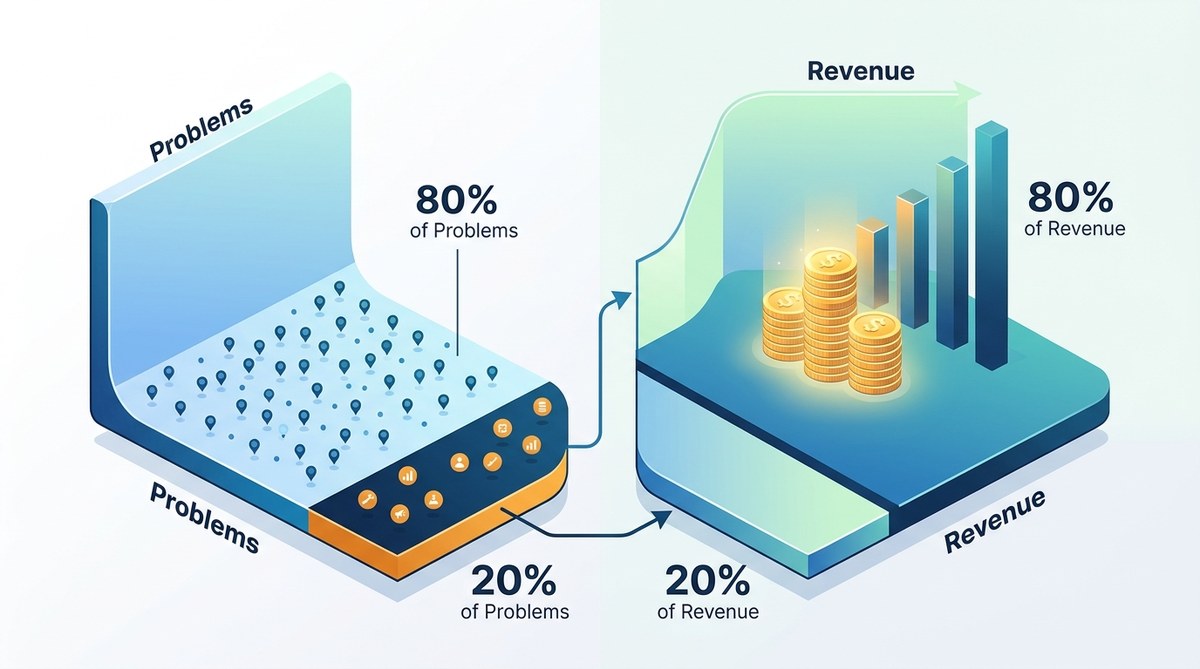
You are staring at your revenue dashboard. The number is fine, but you feel stuck. Your feature backlog has fifty items. Your customer support queue is overflowing. Your to-do list never ends. But deep down you know that most of your effort is going into things that barely move the needle. That gut feeling is real. It is the 80/20 rule at work, and once you understand how to apply it to your SaaS revenue, you will stop trading hours for pennies and start building what actually pays.
The 80/20 rule for SaaS revenue reveals that roughly 80% of your income comes from 20% of your customers, features, or problems solved. By identifying that vital 20%, you can double down on what works, kill distractions, and grow faster without burning out. This guide shows you how to find your 20% and use it to prioritize ideation, development, and marketing.
What the 80/20 Rule Really Means for Your SaaS
The Pareto principle is simple: 80% of consequences come from 20% of causes. For a SaaS business, that translates into a handful of truths:
- Eighty percent of your recurring revenue likely comes from twenty percent of your customers.
- Eighty percent of your churn probably comes from a small handful of missing features or pain points.
- Eighty percent of your support tickets likely stem from twenty percent of the bugs or usability issues.
- Eighty percent of your new signups probably come from twenty percent of your marketing channels.
When most founders hear this, they nod and move on. They do not change how they build. That is a mistake. The real power is not in knowing the theory; it is in using it to decide what to build next and what to ignore.
I once worked with a founder who had spent three months building a fancy reporting module. It took thousands of lines of code and hours of design. After launch, only one enterprise client used it. Meanwhile, a simple CSV export feature that took two days to build was generating praise from dozens of paying customers. That is the 80/20 rule slapping you in the face.
How to Identify the 20% of Problems That Deliver 80% of Revenue
Finding your golden 20% requires a systematic look at your data. You cannot guess. You need to measure. Here is a simple process you can run this week.
Step 1: Pull Your Revenue by Customer Segment
Open your billing system. Export a list of all customers and their monthly recurring revenue. Sort high to low. Calculate the cumulative percentage. The customers at the top that collectively represent roughly 80% of your MRR are your vital 20%. Study them. What industry are they in? What feature do they use most? What problem did they hire you to solve?
Step 2: Map Revenue to Features
Now look at usage data. For each of your top revenue customers, identify which features they use daily, weekly, or never. Use features as the unit of analysis. Which 20% of features are used by the top 20% of revenue customers? Those features are your cash cows.
Step 3: Surface the Pain Points That Shrink Churn
Churn leaks revenue. Export a list of churned customers from the last six months. Read their exit surveys or cancellation reasons. Categorize them. You will likely find that 20% of the reasons cause 80% of the churn. For example, maybe many users leave because they cannot integrate with Slack, or because onboarding takes too long. Those are the problems to solve.
Step 4: Overlap and Prioritize
Overlay your lists. The intersection of (a) features used by revenue heavyweights and (b) problems causing churn is your sweet spot. Build solutions that strengthen the first group and fix the second group. Ignore everything else.
Where Most Founders Go Wrong
Even when founders know about the 80/20 rule, they mess up the application. Here are the most common mistakes.
| Mistake | Why It Hurts Revenue | What to Do Instead |
|---|---|---|
| Building every feature request from your biggest customer | Turns your product into a one-off consultancy | Say no or unbundle high-effort requests into paid tiers |
| Optimizing for the 80% of users who pay little | Drains resources away from your core revenue drivers | Segment support and development by customer value |
| Ignoring the 20% of bugs that cause 80% of complaints | Increases churn and support costs | Triage by frequency and impact, not by noise |
| Spreading marketing across ten channels | Dilutes your message and budget | Double down on the top two channels that convert |
| Launching features without checking usage data | Adds complexity and maintenance debt | Ship only after verifying demand from your high-value segment |
Each of these mistakes is a slow bleed. You might not notice it for a few months, but eventually your revenue growth stalls. Applying the 80/20 rule as a lens helps you catch these errors early.
A Real Example: How One SaaS Doubled MRR by Focusing on 20% of Problems
Take a project management tool I followed in 2025. They had 1,200 paying customers and $40K MRR. The founder pulled revenue data and discovered that 24 customers (exactly 2% of the base) contributed $20K MRR. Those customers were all marketing agencies. They used only three features: task dependencies, time tracking, and client dashboards.
What did the rest of the user base complain about? Mostly about a missing Gantt chart and better mobile app. But the top revenue customers rarely mentioned those. So the founder stopped building the Gantt chart. Instead, they added API webhooks for time tracking and a better client portal. Within six months, the 24 agencies expanded to 38, and MRR grew to $60K. The founder told me later, “I wasted two years building what I thought everyone wanted. Once I listened only to the people who paid me the most, everything changed.”
“Your biggest paying customers are telling you exactly what to build. The challenge is that their requests never shout the loudest. You have to dig into the data and ignore the noise.” – Alex, founder of a $200K MRR SaaS
Putting the 80/20 Rule into Action This Week
Theory is nice. Execution is everything. Here are concrete actions you can take right now to apply the 80/20 rule to your SaaS revenue.
- Run a revenue segmentation report. Use Stripe, Chargebee, or a simple spreadsheet. Find your top 20% of customers by MRR.
- Interview three of them. Ask what they would cry about if you removed your product. That is your feature north star.
- Delete three features. Pick three features that have less than 5% usage and no connection to your top revenue segment. Remove them or hide them. Watch your maintenance time shrink.
- Stop building for the median user. The median user often pays the least and complains the loudest. Build for the power user who pays the most.
- Create a “do not build” list. Every time a feature request comes in, check if it aligns with the 20% of problems that drive revenue. If not, archive it.
If you are still in the ideation phase and have no customers yet, you can still use the 80/20 rule for SaaS revenue. Look at a market you want to serve. Identify the single biggest pain point that generates the most budget. When you talk to potential customers, ask them directly: “If you could only solve one problem with software, which one would save you the most money or time?” That question will reveal your 20%.
For a deeper framework on validating your idea, check out our problem-first framework: how to discover SaaS ideas people actually want to pay for. It pairs perfectly with the 80/20 mindset.
The One Number That Tells You if You Are on Track
After you apply the 80/20 rule, monitor one key metric: revenue concentration. What percentage of your MRR comes from your top 20% of customers? If it is less than 60%, you may have a spread-too-thin problem. If it is more than 90%, you are dangerously dependent on a few accounts. The sweet spot is 70-85%, which indicates a healthy core without excessive risk.
You can also track “feature revenue attribution.” Assign revenue to features based on usage by high-value customers. If a feature you worked on for three months shows zero revenue correlation, you have a candidate for deprecation.
Build What Pays, Not What Everyone Asks For
The 80/20 rule for SaaS revenue is not a one-time exercise. It is a habit you should bake into your product development cycle. Every quarter, rerun the numbers. Markets shift. Customer segments evolve. The 20% that drives your revenue today may shift next year. But as long as you keep measuring and keep focusing on the vital few, you will spend your energy where it counts.
Start this afternoon. Open your billing data. Find the twenty percent of customers who pay the most. Ask them what they need. Build that. Ignore the rest. Your revenue will thank you, and so will your sleep schedule.