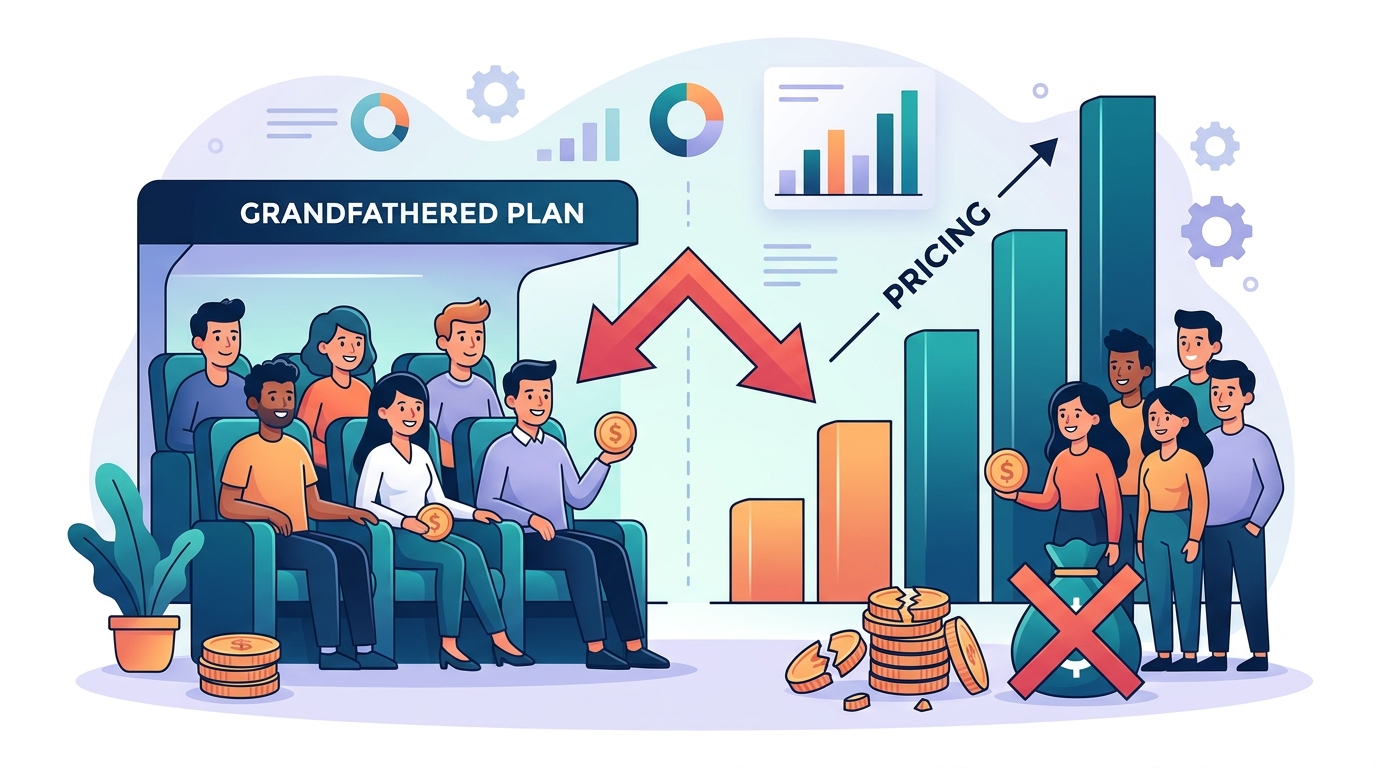
You launched your SaaS at $29/month two years ago. Today, you know it’s worth $79/month. But 300 customers still pay the old rate, costing you $15,000 in monthly revenue. Should you grandfather them indefinitely or force a migration?
Grandfathering early users preserves goodwill but creates revenue gaps that compound over time. The decision depends on your growth stage, churn sensitivity, and whether legacy users still fit your ideal customer profile. Most successful SaaS companies sunset old pricing within 12 to 24 months using phased migrations, value-based upgrades, and transparent communication rather than indefinite grandfathering.
What grandfathering actually means for your business
Grandfathering lets existing customers keep their current pricing when you raise rates or change your plan structure. New customers pay the new price. Old customers stay locked in.
Sounds fair, right?
The reality is more complicated. That $29/month customer from 2023 might use the same resources as someone paying $79 today. They get the same features, support tickets, and server costs. But they contribute 63% less revenue.
Multiply that across hundreds of users and the gap becomes painful.
Some founders treat grandfathering as a loyalty reward. Others see it as a tax on growth. Both perspectives have merit, but neither tells the complete story.
The case for keeping legacy pricing
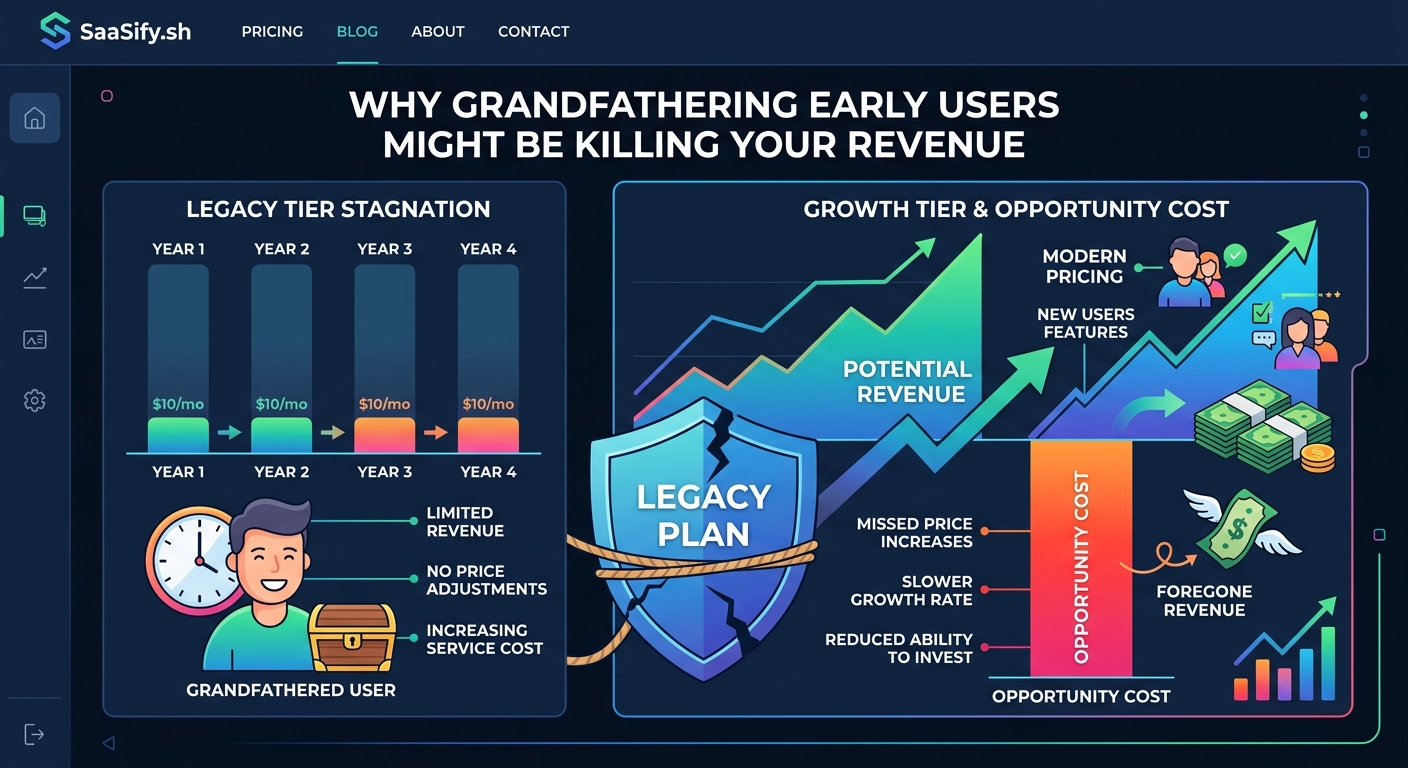
Grandfathering protects your early adopters. These users took a risk on your product when you had no reviews, no case studies, and probably a few critical bugs.
That loyalty deserves recognition.
Customer retention benefits:
- Lower churn among your longest-tenured users
- Positive word of mouth from satisfied early customers
- Reduced support burden from price change complaints
- Protection against competitor poaching during transitions
- Community goodwill that translates to referrals
Early customers often become your best advocates. They write testimonials, participate in case studies, and recommend your product in communities you can’t reach. Forcing them onto new pricing risks losing these relationships.
There’s also a practical angle. Price increases trigger churn. Studies show 10% to 30% of customers leave when forced to pay more, even if the new price remains competitive.
If you’re still finding product-market fit, that churn could hurt more than the revenue gain helps.
The revenue cost of indefinite grandfathering
Now for the hard numbers.
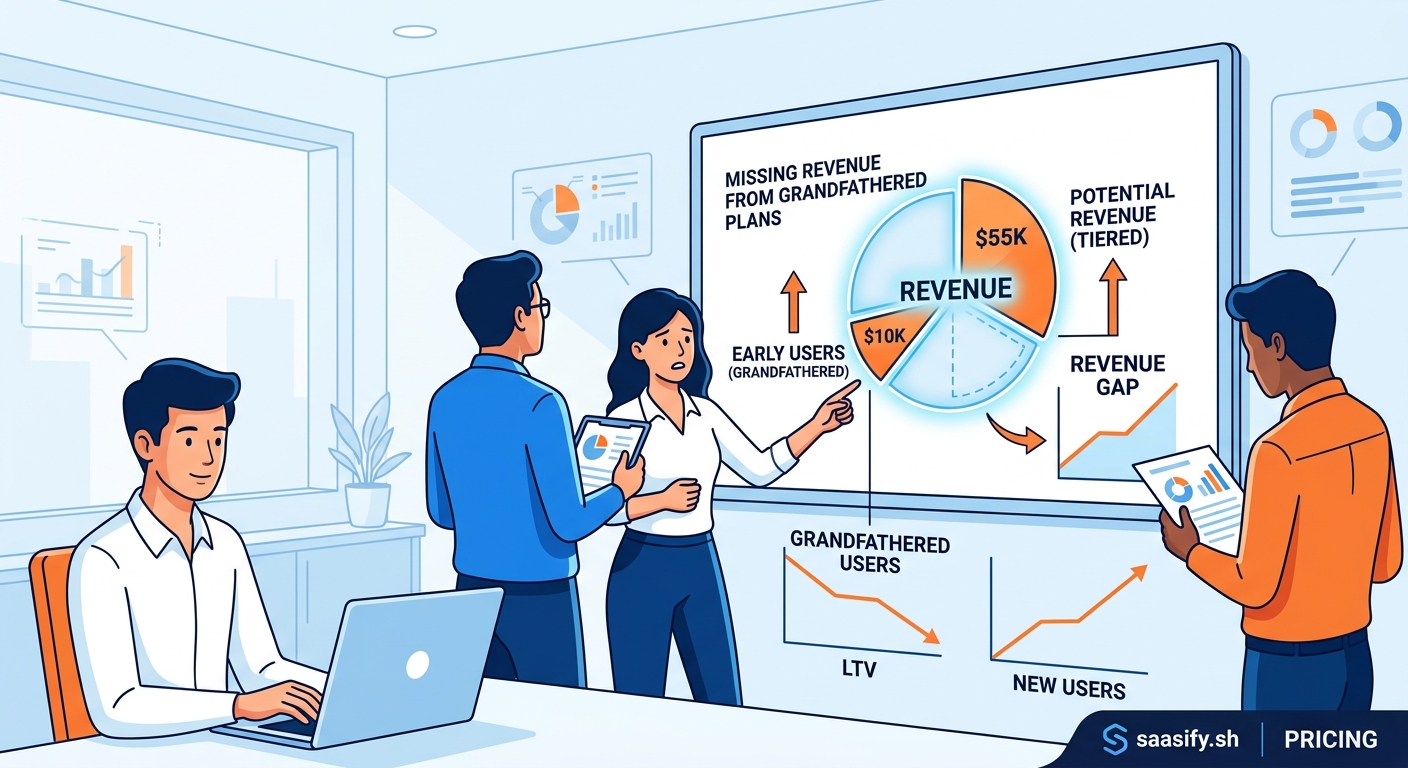
Let’s say you have 500 customers. 200 pay your legacy $29 plan. 300 pay your current $79 plan.
Monthly recurring revenue from legacy users: $5,800
Monthly recurring revenue if they paid current rates: $15,800
Monthly opportunity cost: $10,000
That’s $120,000 annually. Enough to hire a developer or fund serious marketing.
Over three years? $360,000.
The gap widens as your product improves. You add features, improve infrastructure, and hire support staff. Legacy customers benefit from all of it while contributing less to fund it.
Here’s a breakdown of how grandfathering impacts different business metrics:
| Metric | With Grandfathering | Without Grandfathering | Impact |
|---|---|---|---|
| Average revenue per user | $54 | $79 | 32% lower |
| Customer lifetime value | $1,944 | $2,844 | $900 gap |
| Churn during migration | 0% | 15-25% | Higher short-term loss |
| Investor valuation multiple | Lower ARR multiple | Higher ARR multiple | Harder fundraising |
| Support cost per dollar | $0.18 | $0.12 | 50% higher ratio |
Investors notice this too. They calculate valuation based on annual recurring revenue. Legacy pricing suppresses your ARR, which directly impacts your company’s worth.
When grandfathering makes strategic sense
Grandfathering isn’t always wrong. Sometimes it’s the smartest play.
You should consider grandfathering if:
- You’re pre-product-market fit and can’t afford churn
- Legacy users represent less than 15% of your customer base
- Your pricing change is dramatic (3x or more)
- You’re testing new pricing and want a control group
- Early users have long contracts you can’t legally change
Some companies use limited grandfathering with an expiration date. You might let early customers keep their rate for 12 months, then migrate everyone to the new structure.
This gives you time to prove the new pricing works while honoring early commitments.
Others grandfather features instead of price. Old customers keep certain capabilities, but new features require upgrading. This creates a natural migration path without forced changes.
The key is intentionality. Grandfathering by default because you’re afraid of hard conversations will drain your business. Grandfathering as a deliberate strategy with clear boundaries can work.
The hidden costs beyond revenue
Revenue isn’t the only thing grandfathering affects.
Legacy pricing creates operational complexity. You maintain multiple billing systems, support different feature sets, and confuse your team about who gets what.
Your sales team struggles to explain why some customers pay less. New customers feel cheated when they discover the disparity. Support tickets increase as people try to game the system or demand legacy rates.
“We grandfathered our first 100 users indefinitely. Two years later, we had seven different pricing tiers, three billing systems, and our support team spent 40% of their time explaining pricing exceptions. The complexity cost us more than the revenue we protected.” – SaaS founder, $2M ARR
Product development suffers too. You can’t deprecate old features because legacy users depend on them. Technical debt accumulates. Your codebase becomes harder to maintain.
Marketing gets muddied. Your pricing page shows current rates, but prospects hear about cheaper options through the grapevine. Trust erodes.
How to sunset legacy pricing without burning bridges
If you decide to migrate users off old pricing, do it thoughtfully.
A proven migration process:
-
Segment your legacy users by value. Identify which customers you absolutely can’t lose. High-usage accounts, vocal advocates, and enterprise clients deserve white-glove treatment.
-
Create a value-first migration path. Don’t just raise prices. Add features, improve limits, or bundle services that justify the increase. Make the new plan objectively better.
-
Communicate early and often. Give 60 to 90 days notice minimum. Explain why you’re changing, what they get in return, and how much it will cost. Transparency builds trust.
-
Offer transition incentives. Discount the first three months at the new rate. Provide annual billing discounts. Give legacy users first access to new features. Make upgrading feel like a reward, not a punishment.
-
Provide opt-out options. Let users downgrade to a limited free plan or export their data cleanly. Forcing people to pay more with no alternative creates resentment.
-
Handle VIPs personally. Your top 20 legacy customers deserve a call, not an email. Discuss their needs, negotiate custom terms if necessary, and preserve the relationship.
Some companies use a gradual step-up. Instead of jumping from $29 to $79, they might go to $49 for six months, then $79. This softens the shock.
Others grandfather only the base price but charge for usage overages or add-ons. A customer keeps their $29 rate but pays for extra seats, storage, or API calls.
Real examples from successful SaaS companies
Basecamp grandfathered all legacy customers indefinitely. They view it as a core value. Their business model supports this because they have millions of customers and minimal per-user costs.
Most SaaS companies can’t afford that approach.
Intercom sunset legacy pricing in 2018 with a 12-month transition period. They offered enhanced features and granular usage controls. Some customers churned, but revenue per user increased 40%.
ConvertKit (now Kit) maintained legacy pricing for years, then offered a one-time upgrade incentive with three months free at the new rate. Migration rate exceeded 60%.
Buffer used a hybrid model. Legacy users kept their base rate but paid for team members and additional features. This preserved goodwill while capturing expansion revenue.
The pattern? Companies that communicated clearly, added real value, and gave customers time to adjust succeeded. Those that forced sudden changes without justification faced backlash.
Calculating your personal break-even point
Should you grandfather or migrate? The math helps decide.
Calculate your customer lifetime value for both groups. If legacy customers have significantly higher retention and lower acquisition costs, keeping them happy might outweigh the revenue gap.
Compare the revenue opportunity against predicted churn. If migrating 200 users from $29 to $79 generates $10,000 monthly but you lose 30% to churn, you net $7,000 after accounting for lost customers.
Factor in acquisition cost. If replacing those 60 churned customers costs $15,000 in marketing spend, the migration actually loses money in year one.
Consider your growth rate. If you’re adding 100 new customers monthly at $79, legacy users become a smaller percentage of revenue over time. Their impact diminishes naturally.
Look at usage patterns. Legacy customers who barely use your product are safe to migrate. Power users who would be expensive to replace deserve special treatment.
Building pricing changes into your terms from day one
The easiest way to handle this? Plan for it before you have legacy users.
Your terms of service should explicitly state that pricing can change with reasonable notice. Most SaaS companies include language like “We reserve the right to modify pricing with 60 days notice.”
This gives you legal cover and sets expectations early.
Consider including automatic price adjustment clauses tied to inflation or feature additions. Some companies build in annual 5% increases that customers accept upfront.
Avoid promising “lifetime” pricing unless you mean it. That language creates legal and ethical obligations that will haunt you later.
Be specific about what grandfathering means. Does it apply to the current plan only, or all future features? Does it expire after a certain period? Vague promises create messy situations.
Alternative approaches to traditional grandfathering
You don’t have to choose between indefinite grandfathering and forced migration.
Hybrid strategies that work:
- Feature-based grandfathering: Old price, old feature set. New features require upgrading.
- Time-limited grandfathering: Legacy pricing expires after 12 to 24 months with ample warning.
- Usage-based graduation: Customers keep their rate until they exceed certain usage thresholds.
- Cohort pricing: Each signup cohort gets locked pricing for a set period, then migrates together.
- Opt-in upgrades: Offer compelling new features only available at higher tiers. Let value drive migration.
Some companies use grandfathering as a retention tool rather than a permanent state. If a customer threatens to churn, offering to restore their legacy rate for six months can save the relationship while you improve the product.
Others create “founder” or “early supporter” tiers that sit between legacy and current pricing. This acknowledges early users without maintaining the full gap.
The goal is finding a sustainable middle ground that respects early customers without crippling your growth.
Making the decision that fits your stage
There’s no universal answer. The right choice depends on where you are.
Pre-$10k MRR: Grandfather generously. You need every customer and every testimonial. Revenue optimization comes later.
$10k to $100k MRR: Set expiration dates on legacy pricing. Give 12 to 18 months, then migrate everyone. Use this period to prove value.
$100k to $1M MRR: Migrate systematically with value-based upgrades. You have enough customers that losing 15% to 20% won’t kill you, and the revenue gain funds growth.
$1M+ MRR: Segment ruthlessly. Grandfather your top 5% by value, migrate everyone else. Negotiate custom enterprise deals for strategic accounts.
Your investor situation matters too. If you’re bootstrapped, you can prioritize customer relationships over growth metrics. If you’re venture-backed, investors will push you toward revenue optimization.
Your pricing reflects your product’s evolution
Pricing should evolve as your product does.
The $29 tool you launched was different from the $79 platform you run today. Your early users bought a scrappy MVP. Your current customers get a mature product with years of improvements.
Asking everyone to pay the same rate ignores that reality.
Grandfathering made sense when you were proving yourself. But at some point, your product earned the right to charge what it’s worth.
The question isn’t whether to change pricing. It’s how to do it in a way that respects the people who got you here while building the business you need for tomorrow.
Most founders wait too long to address this. They let legacy pricing linger until the revenue gap becomes a crisis. Then they’re forced into rushed migrations that damage relationships.
Start planning your approach now. Set clear policies, communicate them transparently, and build pricing evolution into your customer relationships from the beginning.
Your early users deserve respect and gratitude. But they don’t deserve to subsidize their accounts forever at the expense of your company’s health.
Find the balance that works for your specific situation, document your reasoning, and execute with empathy. That’s how you honor the past while building the future.