
Pricing mistakes killed more startups than bad code ever did. You can build a perfect product, land your first 50 customers, and still watch your business collapse because you charged $29 instead of $99. Or because you gave away too much for free. Or because you changed prices at exactly the wrong moment.
Most SaaS pricing failures stem from underpricing at launch, failing to segment customers properly, or changing prices without data. This post mortem analysis examines real cases where founders reached $100K ARR, made critical pricing errors, and lost significant revenue. You’ll learn the exact mistakes that destroyed growth, the warning signs to watch for, and practical frameworks to price correctly from day one.
The $100K ARR trap that catches everyone
Hitting $100K in annual recurring revenue feels like validation. You finally have proof that people will pay for what you built. But this milestone creates a dangerous blind spot.
Most founders assume their initial pricing was correct because it got them to six figures. They stop experimenting. They avoid raising prices because they fear losing customers. They add features without adjusting tiers.
Then growth stalls. Customer acquisition costs rise. Profit margins shrink. The business that looked healthy at $100K becomes unsustainable at $200K.
The pattern repeats across hundreds of startups. A founder launches at $19/month because it feels safe. They acquire 400 customers. Revenue hits $7,600 monthly. They celebrate crossing $90K ARR.
But those same 400 customers at $49/month would generate $235K ARR. The difference pays for a full-time developer or a marketing budget that actually works.
The real problem isn’t the initial price. It’s the failure to test and adjust once you have data.
Five pricing mistakes that destroy SaaS businesses
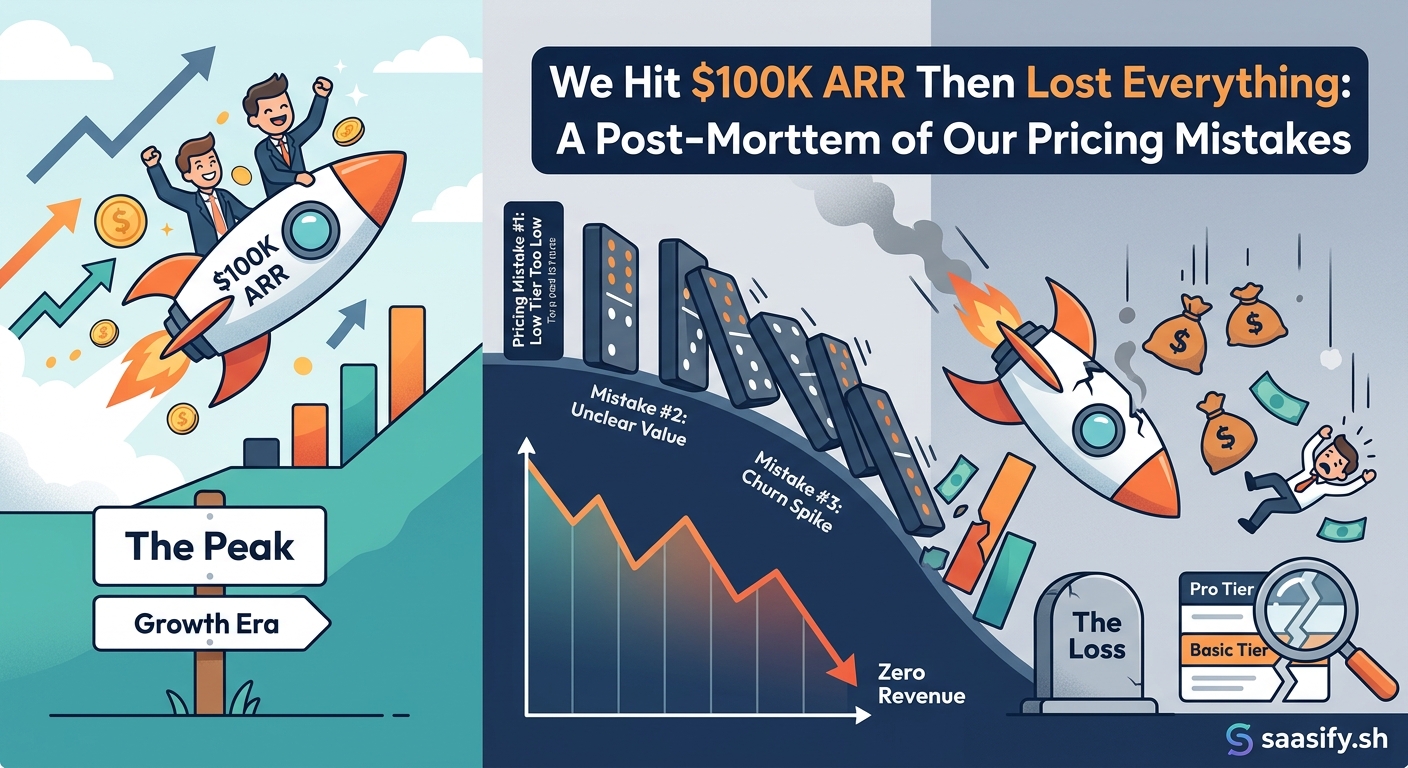
These errors appear in nearly every startup pricing mistakes post mortem. Some founders make one. Others make all five.
Mistake 1: Pricing based on costs instead of value
Building your SaaS cost $40K in development time. Your monthly server costs run $200. You decide to charge $29/month to “cover expenses and make a small profit.”
This logic ignores what customers actually care about. They don’t pay you to cover your AWS bill. They pay for the outcome your product delivers.
A founder built a tool that automated invoice reconciliation for accountants. Development took six months. Hosting cost $150/month. He priced it at $39/month per user.
His customers saved 10 hours of manual work every month. At $75/hour billing rates, that’s $750 in value. He was capturing 5% of the value he created.
When he raised prices to $149/month, he lost three customers out of 67. His MRR jumped from $2,613 to $9,536. Annual recurring revenue went from $31K to $114K with the same product and similar customer count.
Mistake 2: Offering too many features in the cheapest tier
You want to be generous. You want users to experience your full product. You include 80% of your features in the $19 starter plan.
Now you have 200 customers on the starter plan and 12 on the $79 professional plan. Your average revenue per account sits at $24. You can’t afford to hire support. You can’t invest in new features. You’re stuck.
A project management SaaS made this exact mistake. Their $15/month plan included unlimited projects, 10 team members, and most integrations. The $49/month plan added custom fields and priority support.
Only 8% of customers upgraded. The founder realized too late that the starter plan solved 95% of customer needs. There was no reason to pay more.
After restructuring tiers to limit projects and team size on the base plan, upgrade rates jumped to 31%. How to price your SaaS product when you have zero customers becomes much easier when you understand value-based segmentation from the start.
Mistake 3: Grandfathering prices forever
You launched at $29/month. Two years later, you’ve added 47 new features. Your competitors charge $99 for similar tools. But you promised early customers they’d keep their original price forever.
Now you have 180 customers paying $29 and 40 new customers paying $89. Your blended MRR is $5,220 from the old cohort and $3,560 from the new cohort. You’re subsidizing old customers with new revenue.
The math gets worse over time. Those grandfathered customers consume support resources. They request features. They expect the same service as customers paying triple the price.
One founder grandfathered 300 customers at $19/month while charging new customers $59/month. After 18 months, he calculated that supporting the grandfathered cohort cost $4,200/month while they generated $5,700/month in revenue. His actual profit from that segment was $1,500/month, or $5 per customer.
He sent a transparent email explaining the situation and offered grandfathered customers a choice. Stay at $19/month with a feature-limited legacy plan, or upgrade to the current plan at $49/month (still a discount). 73% upgraded. 18% accepted the limited plan. 9% churned.
His MRR from that cohort jumped from $5,700 to $11,470. The customers who stayed were happier because they understood the value exchange.
Mistake 4: Changing prices without communicating the reason
You decide to raise prices. You update your pricing page. You send a brief email saying “Our prices are increasing next month.”
Customers feel ambushed. They don’t understand why. Some assume you’re just greedy. Others think the company is struggling. Trust erodes.
A founder raised prices from $39 to $79 with two weeks notice and minimal explanation. He lost 34% of his customer base in 60 days. His MRR dropped from $18,720 to $14,230 despite the higher price for remaining customers.
The same price increase with a different approach would have worked. Explain what you’ve built since launch. Show the value you’ve added. Give 90 days notice. Offer a discounted annual plan as an alternative.
Transparency matters more than the actual number. Customers accept price increases when they understand the reasoning and feel respected in the process.
Mistake 5: Competing on price instead of value
Your competitor charges $49. You charge $39 because you think being cheaper will win customers. You’re competing in a race to the bottom.
Price-sensitive customers churn faster. They switch to save $10. They complain more. They expect more for less. You end up with the worst possible customer base.
A CRM for real estate agents launched at $29/month to undercut a competitor at $49/month. They acquired 120 customers in six months. Churn ran at 11% monthly. Customers constantly asked for discounts and threatened to leave.
The founder realized he was attracting agents who didn’t value the software. He raised prices to $79/month and repositioned around outcomes instead of features. He lost 40 customers immediately but attracted 65 new customers in the next three months who stayed longer and referred others.
His six-month retention rate jumped from 31% to 78%. Customer lifetime value went from $157 to $1,247. The business became profitable for the first time.
How to diagnose pricing problems before they kill your business
You need a framework to spot pricing mistakes early. These signals tell you something is wrong.
| Warning Sign | What It Means | Action to Take |
|---|---|---|
| Most customers on lowest tier | Tiers not differentiated enough | Reduce features in base plan or add compelling premium features |
| High churn on price increases | Poor communication or wrong positioning | Survey churned customers; improve value messaging |
| Customers asking for discounts constantly | Attracting price-sensitive segment | Raise prices and focus on value buyers |
| Low upgrade rate between tiers | Weak incentive to move up | Redesign tier boundaries around usage or outcomes |
| Negative gross margins on small accounts | Underpriced for cost to serve | Set minimum price or annual commitment |
| Competitors charging 3x your price | Leaving money on table | Test higher prices with new customers |
Run this diagnostic every quarter. Your pricing should evolve as your product and market mature.
A step-by-step process to fix broken pricing
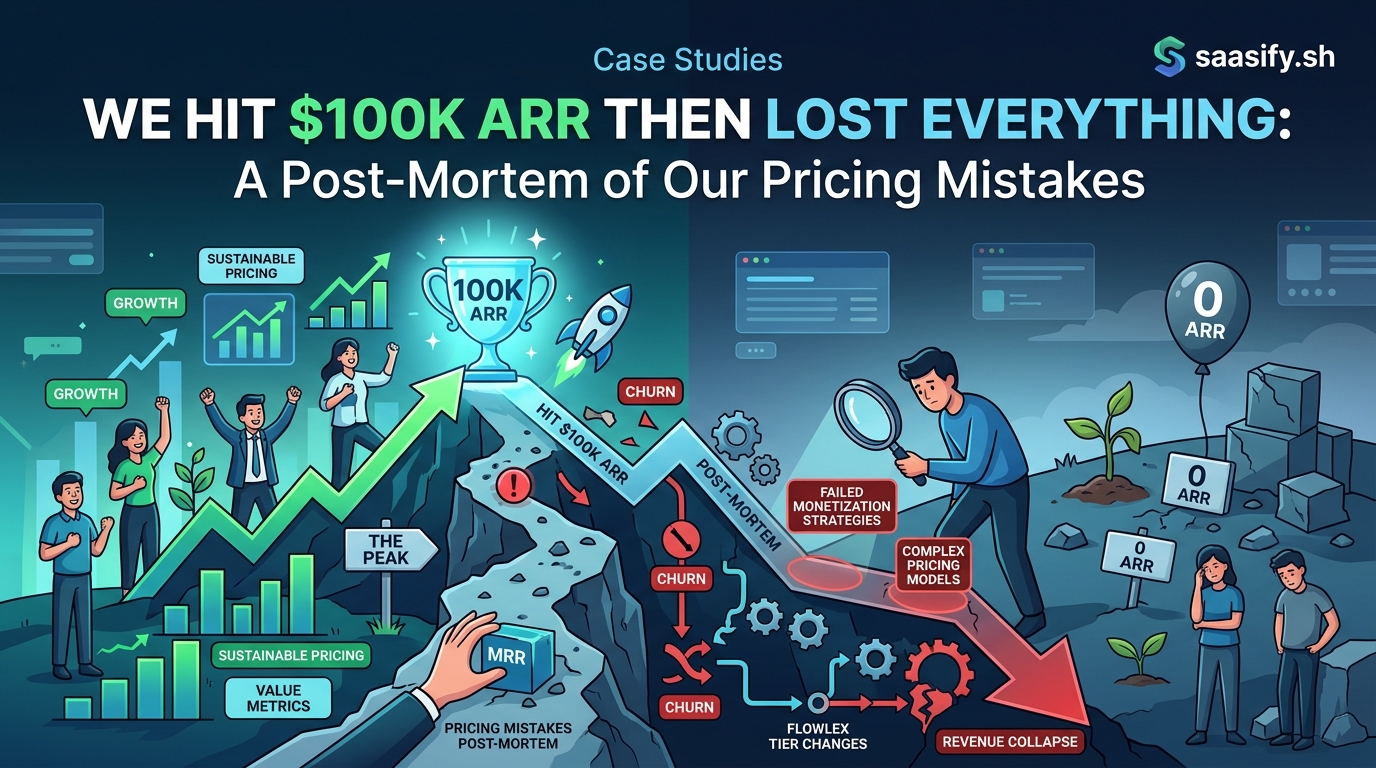
You’ve identified the problem. Now you need to fix it without destroying your business. Follow this sequence.
-
Segment your current customers by value received. Group them into high-value users (power features, frequent usage, getting clear ROI) and low-value users (minimal usage, basic features only). Calculate revenue and support costs for each segment.
-
Interview 10 customers from your high-value segment. Ask what they’d pay if they were buying today. Ask what features matter most. Ask what would make them upgrade to a higher tier. Record exact quotes about value and outcomes.
-
Design new pricing tiers around your findings. Create clear differentiation between tiers based on usage limits, features, or customer size. Make the upgrade path obvious. Ensure each tier targets a specific customer segment with distinct needs.
-
Test new pricing with new customers first. Don’t change anything for existing customers yet. Run the new pricing for 60 days. Track conversion rates, upgrade rates, and feedback. Adjust based on data.
-
Communicate changes to existing customers with 90 days notice. Write a detailed email explaining what you’ve built, why pricing is changing, and what options they have. Offer grandfathered rates for annual commitments or a middle-ground price for loyal customers.
-
Monitor metrics weekly during the transition. Watch churn rates, support ticket volume, upgrade rates, and revenue per customer. Be ready to adjust your approach based on what you see.
This process takes three to four months. Rushing it causes unnecessary churn. Taking too long means leaving revenue on the table.
“The biggest pricing mistake I made was waiting two years to raise prices. I thought I was being customer-friendly. Really, I was undervaluing my work and training customers to expect cheap software. When I finally raised prices, I should have done it 18 months earlier.” – SaaS founder who grew from $80K to $340K ARR after repricing
Real numbers from founders who fixed their pricing
These examples come from actual startups that shared their data publicly or privately.
Case A: Email automation tool
– Original pricing: $29/month for 5,000 contacts
– Problem: 89% of customers stayed on base plan
– Fix: Reduced base plan to 1,000 contacts, kept price at $29
– Result: Upgrade rate jumped to 43%, MRR increased 127% with same customer count
Case B: Analytics dashboard
– Original pricing: $49/month flat rate
– Problem: Enterprise customers getting huge value for tiny price
– Fix: Added usage-based pricing above 100K events/month
– Result: Top 20% of customers now pay $200-$800/month, overall revenue up 89%
Case C: Appointment scheduling
– Original pricing: $15/month per user
– Problem: Competing on price, high churn, low margins
– Fix: Raised to $39/month, added outcome-focused messaging
– Result: Lost 28% of customers, but revenue increased 34% and churn dropped from 9% to 4% monthly
Case D: Team collaboration
– Original pricing: $19/month with most features
– Problem: No reason to upgrade to $49 or $99 tiers
– Fix: Limited base plan to 3 users and 10 projects
– Result: 31% of base plan customers upgraded within 90 days
The pattern across all cases: founders underpriced initially, recognized the problem after hitting $50K-$100K ARR, made data-driven changes, and saw revenue increase even with some customer loss.
The metrics that actually matter for pricing decisions
Stop obsessing over total customer count. Start tracking these numbers instead.
-
Average revenue per account (ARPA): Total MRR divided by total customers. Track this monthly. If it’s not growing, your pricing model is broken.
-
Revenue per tier: How much each pricing tier contributes to total revenue. If your highest tier generates less than 30% of revenue, it’s probably priced wrong or poorly differentiated.
-
Upgrade rate: Percentage of customers who move to higher tiers. Healthy SaaS businesses see 20-40% of customers upgrade within 12 months.
-
Price change churn: Churn rate specifically after price increases. Normal churn is 3-7% monthly for SMB SaaS. Price change churn above 15% suggests poor communication or misaligned value.
-
Customer acquisition cost to lifetime value ratio (CAC:LTV): You need LTV at least 3x your CAC. If pricing is too low, this ratio breaks even when you scale marketing.
-
Gross margin by customer segment: Revenue minus direct costs (hosting, support, payment processing) for each customer group. Negative margins on your smallest customers means your base price is too low.
Build a simple spreadsheet or create a revenue dashboard that actually drives growth decisions to track these metrics. Update it monthly. Share it with your team.
What successful repricing looks like in practice
You can’t just flip a switch and double prices. You need a rollout plan that minimizes damage and maximizes learning.
Start by creating a new “current” pricing tier structure. Keep your existing customers on legacy plans temporarily. All new signups see the new pricing.
Run this split for 60-90 days. Compare conversion rates, upgrade behavior, and customer feedback between legacy and new pricing cohorts.
If new pricing performs better (higher ARPA, similar or better retention, good upgrade rates), you have validation. Now communicate the change to existing customers.
Write an email that covers these points:
- What you’ve built since they joined
- Specific features and improvements they’re now using
- Why pricing is changing (more value, sustainable business, continued innovation)
- Their options (upgrade to new pricing, lock in annual discount, or cancel)
- Exact timeline (90 days notice minimum)
Send this email from the founder, not a generic support address. Make it personal. Show you understand this affects their budget.
Expect 5-12% of customers to churn. That’s normal. The customers who stay are more aligned with your value and more likely to remain long-term.
One founder sent this type of email to 340 customers when raising prices from $39 to $89. He lost 31 customers (9% churn). The remaining 309 customers at the new price generated $27,501 MRR compared to $13,260 before the change. He also offered a $69/month rate for annual commitments, which 89 customers chose.
His total MRR after the transition: $33,742. That’s a 154% increase despite losing customers.
Common questions founders ask about pricing changes
Should I grandfather existing customers forever?
No. Grandfather them for 12-24 months maximum. After that, move everyone to current pricing with discounts for loyalty if needed. Permanent grandfathering creates unsustainable economics as your product improves.
What if competitors are cheaper?
Good. Let them compete on price while you compete on value and outcomes. Price-sensitive customers are expensive to serve and churn faster. You want customers who care about results, not the cheapest option.
How often should I change pricing?
Review pricing every 6-12 months. Make changes every 12-24 months if data supports it. Changing more frequently confuses customers. Changing less frequently leaves money on the table.
Should I offer discounts to prevent churn?
Rarely. Discounts train customers to threaten cancellation to get better deals. Instead, offer annual plans at a discount (15-20% off) or add value through additional features. Save discounts for genuinely struggling customers you want to support.
What if I’m wrong and lose too many customers?
You can always adjust. If churn spikes above 20% after a price change, pause new increases and survey churned customers. Find out if the issue is price level, communication, or value perception. Then fix the real problem.
Moving from pricing mistakes to pricing confidence
Every founder who shared their story for this startup pricing mistakes post mortem said the same thing. They wish they’d raised prices sooner. They wish they’d tested more. They wish they’d trusted the value they created.
Pricing isn’t a one-time decision you make at launch. It’s a continuous process of learning what customers value, how much they’ll pay for it, and how to structure tiers that make sense.
The founders who recovered from pricing mistakes didn’t just change numbers on a page. They changed how they thought about value. They stopped apologizing for charging money. They started having honest conversations with customers about ROI.
Your pricing should make you slightly uncomfortable. If you’re completely confident in your prices, you’re probably leaving money on the table. If customers never push back on price, you’re definitely undercharging.
Start with data. Look at your current metrics. Identify which warning signs apply to your business. Pick one pricing problem to fix in the next 90 days.
Validate your assumptions before making big changes. Test new pricing with a small group. Communicate clearly. Monitor results. Adjust based on what you learn.
The goal isn’t perfect pricing. Perfect doesn’t exist. The goal is pricing that reflects the value you create, attracts the right customers, and makes your business sustainable.
You built something people want to pay for. Now charge what it’s worth.