
Launching your first product alone feels like juggling chainsaws while riding a unicycle. You built something people need, but now you face a dozen platforms, conflicting deadlines, and zero marketing budget. Most indie founders either burn out trying to be everywhere at once or launch quietly to crickets. Neither path works.
This indie founder product launch guide shows solo developers how to coordinate multi-platform launches without a team. You’ll learn a six-step timeline, platform selection criteria, messaging templates, and automation tactics that let you launch strategically instead of frantically. Built for founders who code by day and market by night.
Why Solo Founders Struggle With Multi-Platform Launches
You’re not struggling because you lack talent. You’re struggling because traditional launch advice assumes you have a team.
Corporate playbooks tell you to “coordinate with marketing” and “align stakeholders.” That’s useless when you are the marketing team, the product team, and the support team.
The real challenge is time sequencing. Product Hunt wants you live at midnight Pacific. Hacker News prefers organic discovery. Reddit communities have strict self-promotion rules. Your email list expects a personal note. Each platform has different posting windows, content formats, and audience expectations.
Most founders try to hit everything on the same day. They stay up for 36 hours straight, post frantically, then collapse. Three weeks later, they realize they forgot to set up analytics on half their landing pages.
There’s a better way. Treat your launch like you treat your code: break it into testable modules, automate what you can, and ship iteratively.
The Six-Step Launch Sequence That Works Without a Team
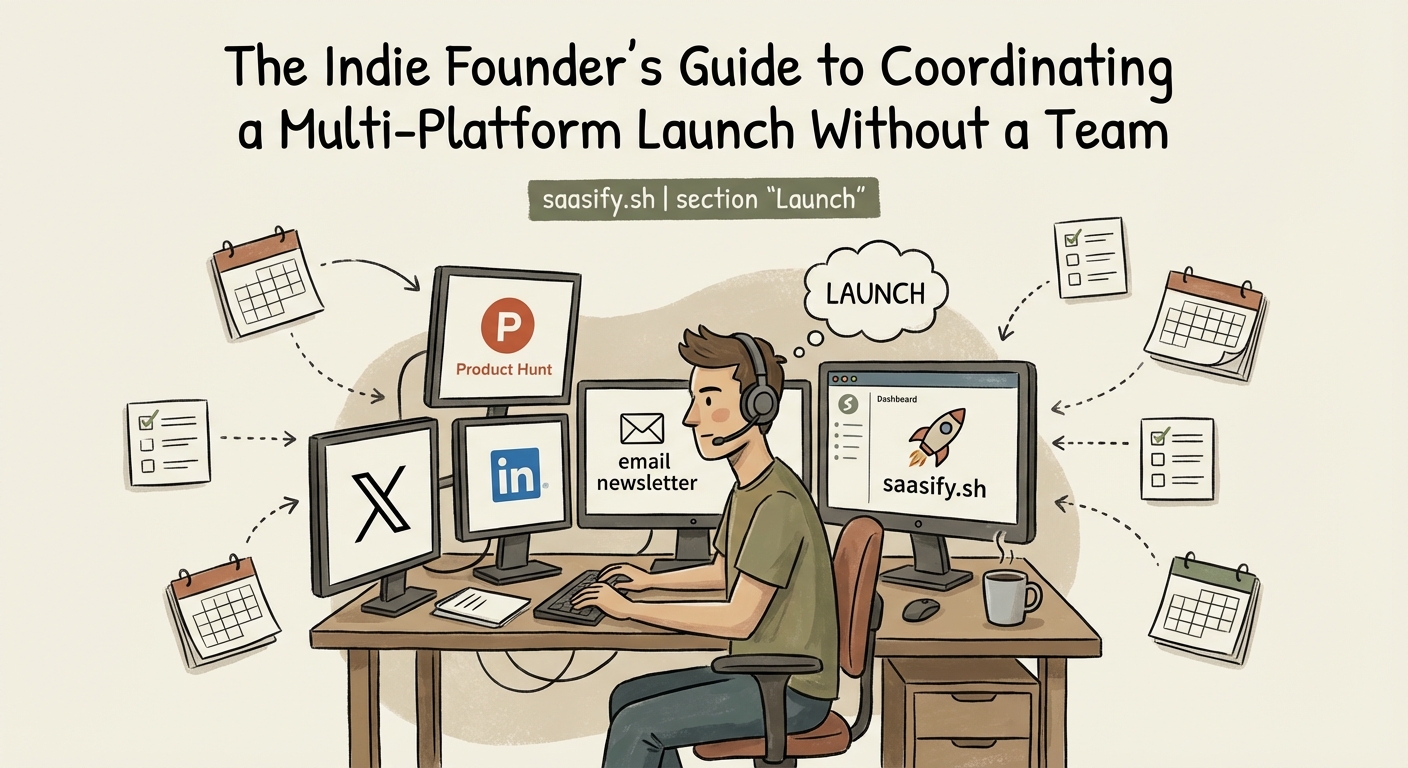
This sequence spreads your launch across two weeks instead of one chaotic day. It gives you time to sleep, respond to feedback, and fix bugs without missing platform windows.
1. Build Your Launch Assets Two Weeks Early
Start with the content that stays consistent across platforms:
- Product screenshots (1200x630px for social sharing)
- 30-second demo video (silent, with captions)
- Three-sentence pitch (problem, solution, proof)
- Founder story (200 words about why you built this)
- Launch day FAQ (10 common questions with answers)
Save these in a shared folder with clear file names. You’ll reuse them everywhere.
Create platform-specific accounts now, not launch morning. Set up analytics tracking on every link. Test your payment flow three times. If you’re building a SaaS MVP in 30 days without burning out, you already know that last-minute technical debt kills momentum.
2. Choose Three Platforms Maximum
You cannot effectively launch on ten platforms alone. Pick three based on where your specific audience lives.
| Platform Type | Best For | Time Investment | Expected Results |
|---|---|---|---|
| Product Hunt | B2B SaaS, dev tools | 8 hours prep + launch day | 200-500 visitors, backlinks |
| Hacker News | Technical products | 2 hours + monitoring | 1000+ visitors if it takes off |
| Niche communities | 4 hours finding right subreddits | 50-200 engaged visitors per post | |
| Twitter/X | Building in public crowd | Ongoing relationship building | Depends on existing followers |
| Email list | Your warmest audience | 1 hour writing | 20-40% open rate |
Your email list always makes the cut. Those people already said yes to hearing from you.
For the other two slots, pick platforms where you’ve been active for at least a month. Cold launching into a community you just joined rarely works. Moderators smell it, and users ignore it.
3. Stagger Your Platform Launches Across Five Days
Launch to different platforms on different days. This spreads your attention and lets you learn from each wave.
Day 1 (Tuesday): Email your pre-launch waitlist that actually converts. These people are warmest. They’ll give you honest feedback and early testimonials.
Day 2 (Wednesday): Post to your most engaged community. For most indie founders, that’s Twitter or a specific subreddit where you’re already known.
Day 3 (Thursday): Launch on Product Hunt at 12:01 AM Pacific. Spend the day responding to every comment and question.
Day 4 (Friday): Submit to Hacker News if your product has a technical angle. Post mid-morning Eastern time.
Day 5 (Saturday): Send a “lessons from launch week” email to your list with updated testimonials and early metrics.
This schedule assumes you have a day job. If you’re full-time on your product, you can compress it. But don’t launch everything on Monday. You need time to incorporate feedback and fix bugs between platforms.
“I launched my first SaaS on eight platforms in one day. Got 2,000 visitors and three paying customers. When I launched my second product on three platforms across a week, I got 800 visitors and twenty customers. Slower launches convert better because you’re present for conversations instead of drowning in notifications.” – Solo founder with two profitable micro-SaaS products
4. Customize Your Message for Each Platform
Never copy-paste the same announcement everywhere. Each platform has its own culture.
For Product Hunt:
– Lead with the problem you solve
– Include a special launch discount
– Respond to every comment within two hours
– Thank people who upvote (in comments, not DMs)
For Hacker News:
– Focus on technical decisions or interesting challenges
– Be honest about limitations
– Engage genuinely in technical discussions
– Don’t ask for upvotes (it’s against the rules)
For Reddit:
– Follow each subreddit’s self-promotion rules
– Provide value first (answer questions, share learnings)
– Frame your post as “I built this to solve X, here’s what I learned”
– Accept criticism gracefully
For your email list:
– Write like you’re talking to a friend
– Share behind-the-scenes struggles
– Offer your list something exclusive
– Ask for specific help (“try the onboarding and tell me where you got confused”)
The launch strategy you choose determines how much you customize. Soft launches need more personal touches. Big splashy launches can be slightly more standardized.
5. Automate Your Response System
You’ll get the same questions dozens of times. Prepare for this.
Create a text file with templated responses for:
– “How is this different from [competitor]?”
– “What’s your pricing?”
– “Do you have [feature X]?”
– “Is there a free trial?”
– “Can I see a demo?”
– “What’s your tech stack?”
Don’t use these templates robotically. Read each question, then customize the relevant template. This saves you from rewriting the same answer forty times while keeping responses personal.
Set up saved replies in your email client. Use TextExpander or similar tools for social media. Create a simple Notion page with your FAQ and link to it when appropriate.
Turn on notifications for the platforms you’re actively launching on, but batch your responses. Check every two hours instead of every two minutes. Constant context switching kills your ability to handle real problems.
6. Track What Actually Matters
Vanity metrics feel good but don’t pay your bills. Track these instead:
- Signups (not just visitors)
- Trial starts (if applicable)
- First meaningful action completed (not just account creation)
- Conversations that revealed product gaps
- People who asked for features you’re planning
- Actual paying customers
Create a simple spreadsheet with one row per platform. Log visitors, signups, and revenue attributed to each source. This tells you where to focus next time.
Many founders obsess over Product Hunt ranking. A #1 product of the day is cool, but twenty paying customers is better. Pricing your SaaS product when you have zero customers matters more than launch day glory.
Common Launch Mistakes Solo Founders Make
These mistakes are so common they’re practically traditions. Avoid them.
Launching before the product is ready. Your launch window is narrow. If half your visitors hit bugs, they won’t come back. Ship a smaller scope that works perfectly over a bigger scope that’s broken.
Ignoring time zones. Product Hunt launches at midnight Pacific. If you live in Europe or Asia, that’s the middle of your night. Either stay up or have a friend cover the first few hours. Launches that go unattended for six hours die.
Forgetting to set up analytics. You can’t improve what you don’t measure. Install Google Analytics, set up goal tracking, and test every conversion funnel before you launch. Fixing tracking after launch means you lost data forever.
Treating launch as a one-time event. Your launch day matters, but your launch week matters more. Keep showing up, keep responding, keep engaging. Most sales happen on days two through five, not day one.
Burning out before launch. If you code until 3 AM every night the week before launch, you’ll be useless on launch day. Sleep matters. Energy matters. Building your first 1,000 email subscribers is a marathon, not a sprint.
Building Your Launch Day Runbook
Create a simple checklist you can follow when you’re tired and stressed. Include:
Pre-launch (Day Before):
– [ ] All landing pages load correctly
– [ ] Payment flow tested with real card
– [ ] Analytics tracking confirmed
– [ ] Social media posts drafted and scheduled
– [ ] Email to list written and scheduled
– [ ] Support email set up and tested
– [ ] Demo video uploaded to YouTube (unlisted)
– [ ] Screenshots uploaded to press kit folder
– [ ] Coffee maker prepped
Launch Morning:
– [ ] Post to primary platform
– [ ] Share on personal social accounts
– [ ] Message 5-10 friends who agreed to support
– [ ] Monitor analytics dashboard
– [ ] Respond to first wave of questions
– [ ] Eat actual food
Launch Day (Every 2 Hours):
– [ ] Check platform for new comments
– [ ] Respond to questions and feedback
– [ ] Monitor error logs
– [ ] Check payment processing
– [ ] Take a 10-minute break
Launch Evening:
– [ ] Write down three things that surprised you
– [ ] Note the most common question you got
– [ ] Back up your analytics data
– [ ] Set alarm for next platform launch
– [ ] Actually sleep
This checklist keeps you from forgetting critical steps when your brain is fried.
What to Do When Your Launch Flops
Most launches underperform expectations. That’s normal.
If you get 50 visitors instead of 500, you didn’t fail. You learned what doesn’t resonate. Read every piece of feedback. Look for patterns. Did people understand what your product does? Did they see the value? Did they hit technical issues?
Small launches often convert better than big ones. Ten genuinely interested people beat a thousand tire kickers.
Take a week to process feedback and fix obvious gaps. Then launch again on a different platform. Treat your first launch as a practice round. Validating your SaaS idea before writing code matters, but validating your messaging matters too.
Some of the most successful indie products launched three or four times before they caught fire. Each launch taught the founder how to talk about their product more clearly.
Tools That Make Solo Launches Manageable
You don’t need expensive tools, but these free or cheap options save hours:
- Buffer or Hypefury for scheduling social posts across time zones
- Notion or Airtable for tracking launch tasks and platform details
- Loom for recording demo videos and bug reports
- Zapier or Make for connecting your signup form to your email tool
- Simple Analytics or Plausible if you want privacy-friendly tracking
- Canny or Upvoty for collecting feature requests in one place
- Calendly for booking demo calls without email tennis
The best tool is the one you’ll actually use. Don’t spend launch week learning new software. Stick with what you know.
After Your Launch Week Ends
Your launch window closes, but your launch isn’t over.
Send a thank-you email to everyone who signed up. Include what you learned, what you’re fixing, and what’s coming next. This turns launch visitors into community members.
Write a public retrospective. Share your numbers, your mistakes, and your wins. This content often performs better than your original launch post. People love transparent founder stories.
Start planning your next launch. Maybe that’s a major feature release. Maybe it’s launching in a new market or language. Maybe it’s just showing up consistently in communities where your customers hang out.
Building a revenue dashboard that drives growth decisions helps you see which launch channels actually generated paying customers versus which just generated noise.
Launch Tactics That Scale as You Grow
These tactics work whether you’re launching your first product or your fifth:
- Keep a swipe file of launch posts that caught your attention
- Build relationships before you need them
- Respond to every piece of feedback in the first week
- Document your process so you can repeat it
- Celebrate small wins (first signup, first dollar, first testimonial)
- Rest between launch pushes
Some founders study how solo developers built and sold successful SaaS products and try to copy their exact launch playbook. That rarely works. Your audience is different. Your product is different. Your strengths are different.
Take principles, not tactics. Test what works for you. Double down on channels that convert. Ignore advice that doesn’t fit your situation.
Your Launch Starts Now, Not on Launch Day
The best launches start months before you post anywhere. You build an audience, solve a real problem, and create something people want to talk about.
If you haven’t launched yet, start small. Share your building process. Ask questions in communities. Help people solve related problems. When launch day arrives, you’ll have people who already care.
If your launch is next week and you’re panicking, breathe. Pick three platforms. Write your core message. Create your checklist. You’ve got this.
Launching alone is hard, but it’s not impossible. Thousands of indie founders do it every month. Most of them feel just as nervous as you do. The difference between founders who succeed and founders who quit is simple: the ones who succeed ship anyway.
Your product deserves to be seen. Your launch doesn’t need to be perfect. It just needs to happen.