You’re building a SaaS product, talking to users, fixing bugs, and trying to grow revenue. The last thing you need is a content strategy that demands 20 hours a week. But ignoring content means staying invisible while competitors flood your niche with blog posts, tutorials, and social updates.
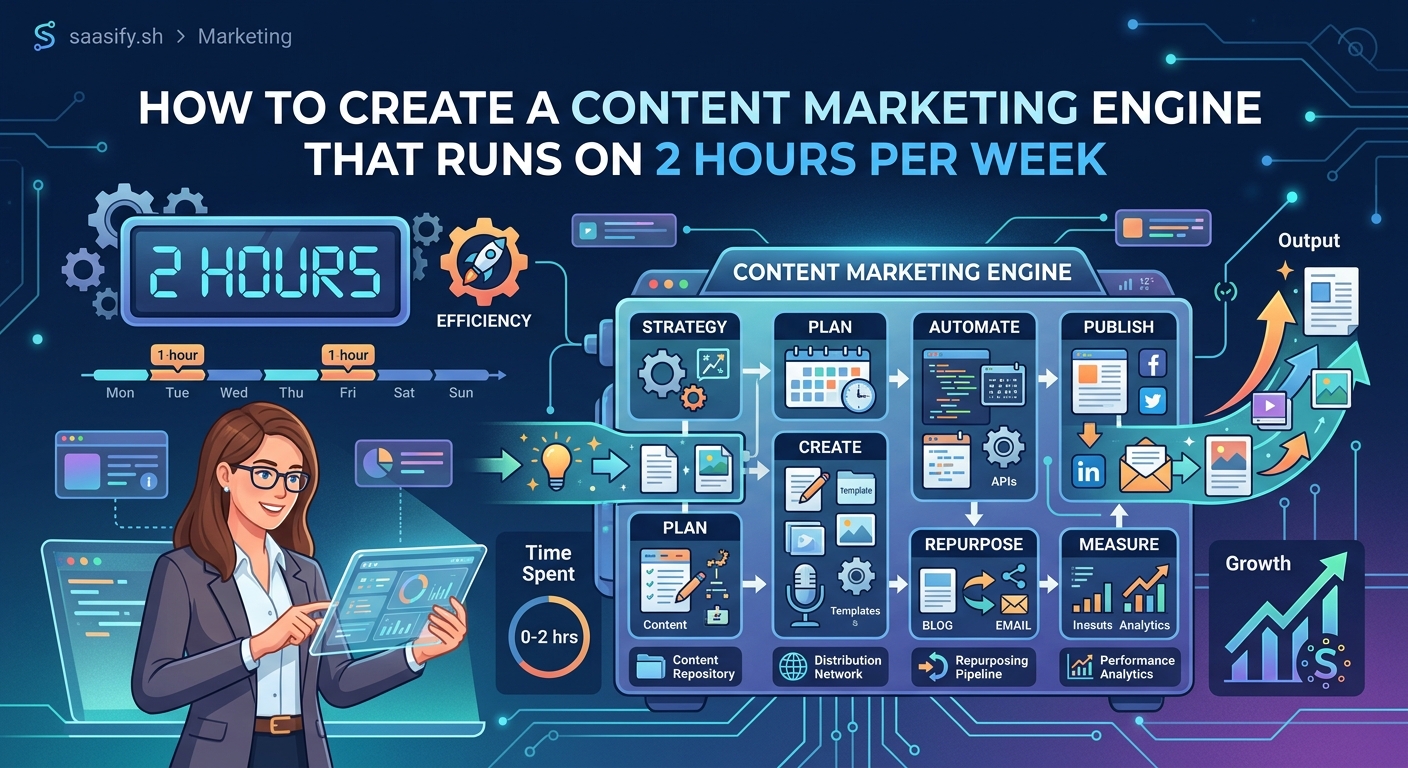
The good news? You can build a content marketing system 2 hours per week that actually works. Not a hustle culture fantasy. Not a content calendar that falls apart by week three. A real system that produces consistent output without burning you out.
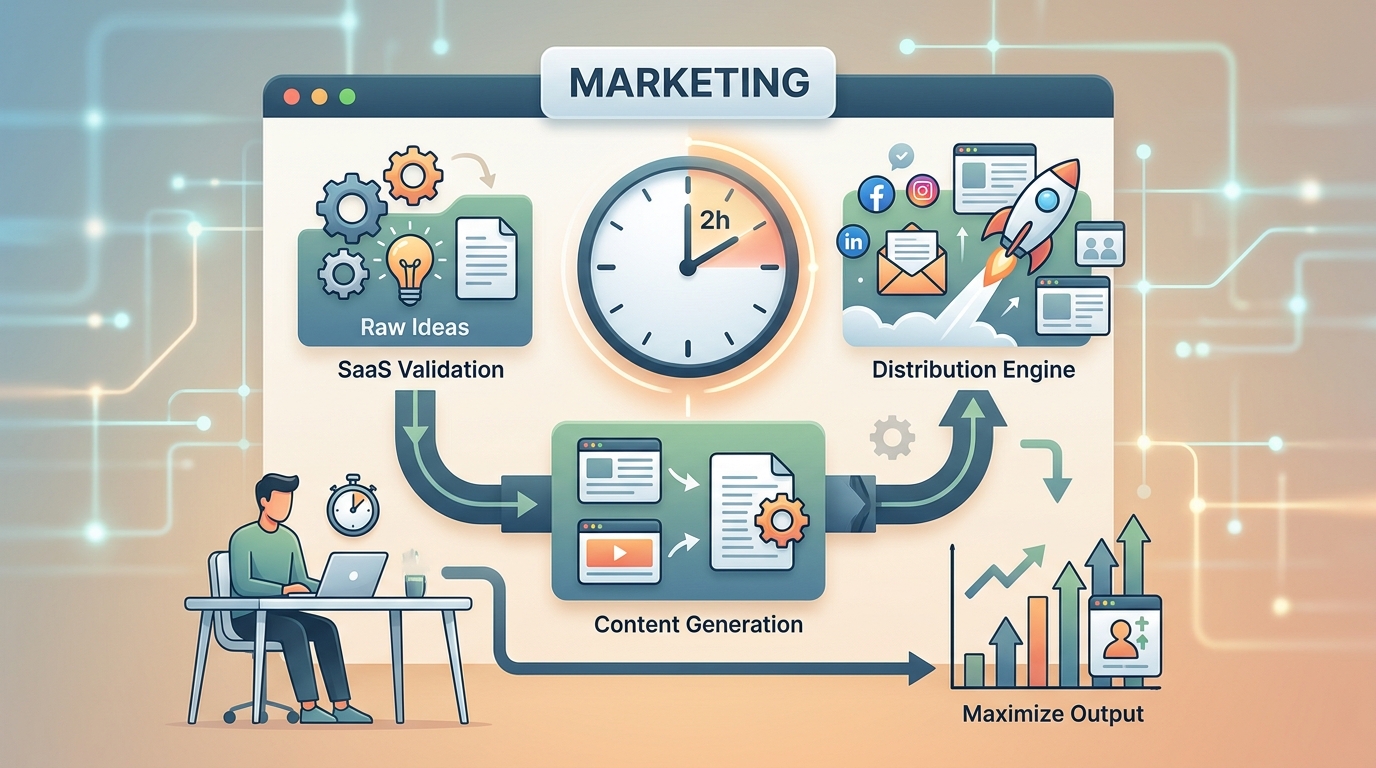
A sustainable content marketing system 2 hours per week relies on batch creation, strategic repurposing, and automation. Focus on one anchor piece weekly, then distribute it across multiple channels. This approach keeps your SaaS visible, builds authority, and generates leads without requiring daily content work or expensive agencies.
Why Most Content Systems Fail for Solo Founders
Most content advice assumes you have a team. Or unlimited time. Or both.
You get told to post daily on Twitter, publish two blog posts per week, record YouTube videos, send newsletters, and engage with every comment. That’s a full-time job disguised as marketing advice.
Solo founders who try this approach burn out in three weeks. They miss deadlines, feel guilty, and eventually abandon content altogether. Then they wonder why their competitor with worse features is getting all the attention.
The problem isn’t your discipline. It’s the system.
A working content marketing system 2 hours per week needs three things: ruthless focus, smart repurposing, and automation that actually saves time instead of creating new tasks.
The One Anchor Piece Framework
Stop trying to create content for every platform from scratch.
Instead, create one substantial piece each week. This is your anchor content. Everything else flows from it.
Your anchor piece should take 60 to 90 minutes to create. It needs to be valuable enough to stand alone but structured so you can break it into smaller pieces later.
Good anchor formats for SaaS founders:
- A tutorial solving one specific problem your users face
- A case study showing real results from your product
- A framework or template your audience can apply immediately
- A behind-the-scenes look at how you built a feature
The anchor piece lives on your blog or as a long-form post on your preferred platform. Once it exists, you repurpose it everywhere else.
This approach works because you’re not creating five different pieces of content. You’re creating one piece five different ways.
The 2-Hour Weekly Content Block
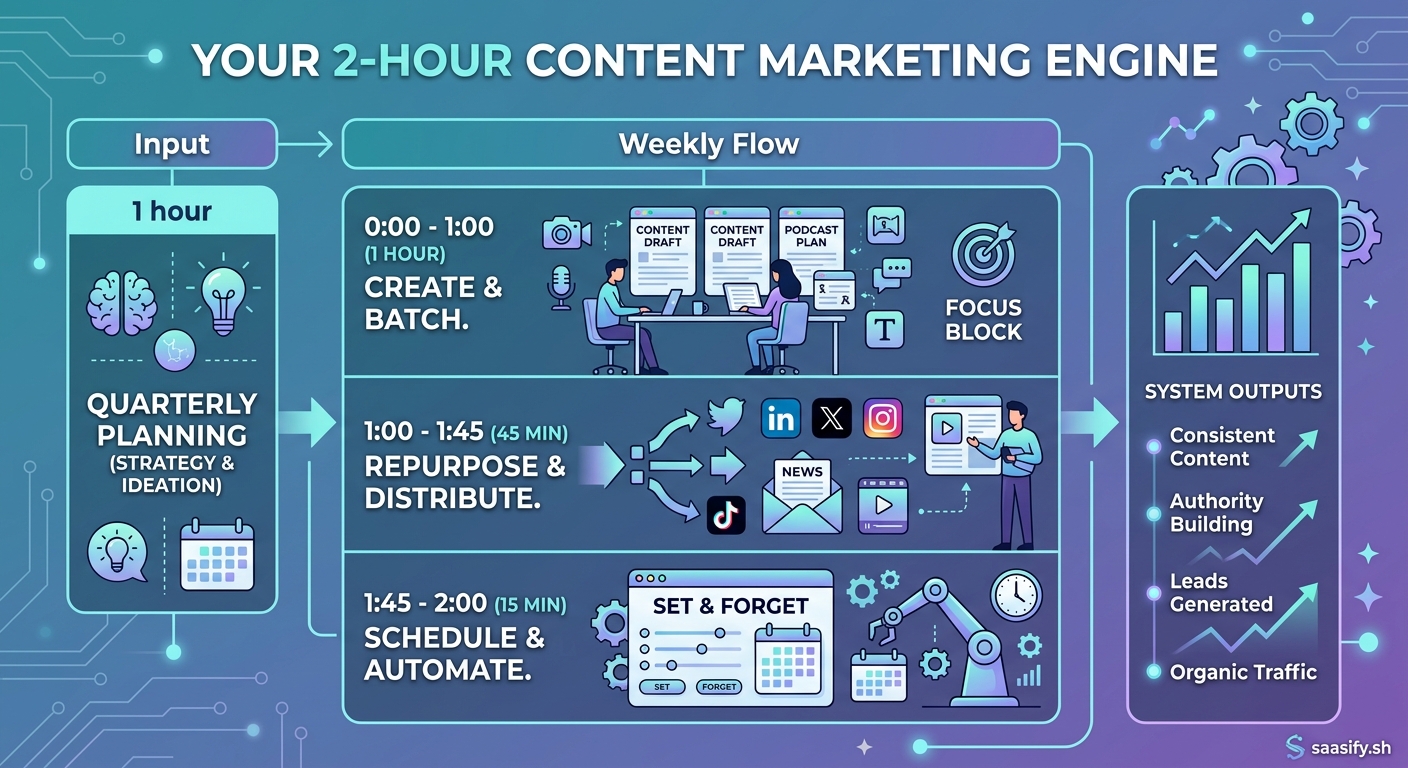
Here’s how the two hours break down:
- 60 minutes: Create your anchor content piece
- 30 minutes: Repurpose it into 3-5 smaller formats
- 20 minutes: Schedule everything across platforms
- 10 minutes: Engage with responses from last week’s content
This schedule assumes you’ve already done the one-time setup work. More on that in a minute.
The key is treating this as a single focused block. Not 20 minutes here and 15 minutes there. One uninterrupted session where you move from creation to distribution without switching contexts.
Most founders waste hours because they create content in fragments. They write a tweet, then check email. They start a blog post, then jump into a customer call. They schedule one post, then get distracted by analytics.
Batch everything. Protect the two hours. Turn off notifications.
The Repurposing Matrix
Your anchor piece becomes multiple content assets through strategic repurposing.
| Anchor Format | Repurposed Assets | Time Required |
|---|---|---|
| Blog post (1000 words) | 5 tweets, 1 LinkedIn post, 1 email, 3 social graphics | 25-30 min |
| Tutorial video (10 min) | Blog transcript, 3 short clips, 5 quote cards, 1 carousel | 30-35 min |
| Case study | Twitter thread, LinkedIn article, email series, infographic | 25-30 min |
| Framework/Template | Tutorial post, demo video, downloadable resource, social tips | 30-40 min |
The repurposing process isn’t about copying and pasting. You’re extracting different angles from the same core idea.
A 1,000-word tutorial about user onboarding becomes:
- A tweet highlighting the biggest mistake people make
- A LinkedIn post with the three-step framework
- An email with the full tutorial and a call to action
- Social graphics showing before and after metrics
- A short video walking through one specific step
Each piece serves a different audience segment and platform algorithm. But you only had to research and write the concept once.
Setting Up Your Content Infrastructure
The two-hour system only works if you’ve built the foundation first. This is a one-time setup that takes 3-4 hours total.
Step 1: Choose your primary platform
Pick one place where your target users actually spend time. For B2B SaaS, that’s usually Twitter or LinkedIn. For developer tools, it might be GitHub discussions or dev.to. For design tools, maybe it’s Dribbble or Twitter.
You’ll repurpose to other platforms, but one needs to be your home base where you engage and build relationships.
Step 2: Create your content bank
Make a simple spreadsheet with three columns: topic, angle, and status.
Spend one hour brainstorming 20-30 topics. These come from:
- Questions users ask in support
- Problems you solved while building your product
- Mistakes you made and learned from
- Features you shipped and why
- Tools or techniques that saved you time
You’re not writing full posts yet. Just capturing ideas so you never face a blank page during your two-hour block.
Step 3: Build your distribution checklist
List every platform where you’ll publish, along with the specific format and any tools you need.
Example checklist:
- [ ] Publish blog post on website
- [ ] Share on Twitter with 3-tweet thread
- [ ] Post full version on LinkedIn
- [ ] Send email to subscribers
- [ ] Create 3 quote graphics in Canva
- [ ] Schedule follow-up engagement time
Turn this into a template you reuse every week. No decisions. Just execute the checklist.
Step 4: Set up scheduling tools
Use Buffer, Hypefury, or similar tools to schedule social posts in advance. Set up email sequences in your ESP. Create Canva templates for graphics so you’re not designing from scratch each time.
The goal is removing friction. When you sit down for your two-hour block, everything should be one click away.
The Content Types That Actually Convert
Not all content formats deliver the same results for SaaS founders.
Some posts get likes but no signups. Others drive traffic but attract the wrong audience. A few formats consistently turn readers into users.
Tutorials that solve one painful problem
Show someone how to do something they’re struggling with right now. Make it specific. “How to build user authentication” is too broad. “How to add Google OAuth to your Next.js app in 15 minutes” is perfect.
These posts rank in search, get shared in communities, and demonstrate your expertise. They also filter for people who might need your product.
Behind-the-scenes building updates
Share what you’re working on, why you made certain decisions, and what you learned. This builds connection and trust. People buy from founders they feel like they know.
Keep it real. Talk about the hard parts. Mention the features that flopped. Show the messy middle, not just the polished wins.
Frameworks and mental models
Give people a new way to think about their problem. The best frameworks are simple enough to remember but powerful enough to change behavior.
If you can name your framework, it becomes shareable. “The 2-Hour Content System” is more memorable than “my content process.”
“The most valuable content doesn’t just inform. It gives readers a framework they can apply immediately and see results. That’s what turns a blog post into a competitive advantage.”
Comparison and alternative posts
Write content comparing your product to competitors or explaining when someone should use your tool versus another solution. This captures high-intent search traffic from people actively evaluating options.
Be honest about trade-offs. If your product isn’t the right fit for enterprise teams, say so. You’ll build more trust than trying to be everything to everyone.
Automation That Actually Helps
Automation should reduce decisions, not create new complexity.
Here’s what to automate:
- Scheduling posts across platforms
- Sending new blog posts to email subscribers
- Collecting content ideas from support conversations
- Tracking which topics drive the most engagement
Here’s what not to automate:
- Writing the actual content (AI-generated posts sound hollow)
- Responding to comments and messages
- Deciding what to create next based solely on metrics
- Engaging with your audience
The human parts matter most. Automation handles distribution so you can focus on creation and connection.
Tools worth using:
- Notion or Airtable: Content calendar and idea bank
- Buffer or Hypefury: Social media scheduling
- Canva: Graphics templates
- ConvertKit or Buttondown: Email automation
- Zapier: Connecting tools without custom code
Don’t add a tool unless it saves more time than it costs to set up and maintain.
Common Mistakes That Kill Consistency
Mistake 1: Starting with too many platforms
You decide to post on Twitter, LinkedIn, Medium, Dev.to, your blog, YouTube, and Instagram. By week two, you’re exhausted and posting nowhere.
Start with two platforms max. Your blog and one social channel. Add more only after the system runs smoothly for a month.
Mistake 2: Creating content without a clear goal
Every piece should move someone closer to trying your product. That doesn’t mean every post needs a hard sell. But it should attract the right people and demonstrate your expertise.
If a post gets 10,000 views but zero signups, it’s entertainment, not marketing.
Mistake 3: Ignoring what already works
You write a tutorial that drives 50 signups. Then you move on to something completely different instead of creating more content like that.
Double down on winners. If case studies convert, write more case studies. If Twitter threads about your building process resonate, keep sharing updates.
Mistake 4: Perfectionism over consistency
You spend six hours polishing a blog post that could have been great at three hours. Then you have no time to create next week’s content.
Done beats perfect. Publish the 80% version and improve based on feedback.
Measuring What Matters
Track three metrics:
- Traffic to your site: Are people finding your content?
- Email signups: Are readers interested enough to subscribe?
- Product signups or demos: Is content driving business results?
Ignore vanity metrics like total followers or post likes unless they correlate with the three metrics above.
Check analytics once a week during your content block. Look for patterns. Which topics drive signups? Which formats get shared most? Which posts rank in search?
Use those insights to guide your next month of content. But don’t obsess over daily fluctuations.
If you’re just starting out, focus on consistency first. Create and publish every week for three months before worrying about optimization. You need enough data to spot real patterns.
Scaling Without Breaking the System
After three months of consistent output, you might want to increase volume. But don’t jump straight to daily posting.
Instead, improve efficiency within your two-hour block:
- Create better templates so repurposing takes 20 minutes instead of 30
- Build a library of graphics you can reuse with new text
- Develop a stronger content bank so choosing topics is instant
- Get faster at writing by following a consistent structure
If you want to publish more frequently, consider adding a second two-hour block rather than cramming more into your existing time. One block for long-form content, another for social engagement and community building.
Or hire help. A VA can handle scheduling and graphics. A freelance writer can turn your outlines into full posts. But keep the strategy and voice in-house. Those are your competitive advantages.
The system should grow with your business, not ahead of it. If you’re pre-revenue, two hours is plenty. If you’re at $10K MRR, maybe you invest four hours. If you’re at $50K MRR, you might hire someone to run the system while you focus on strategy.
Connecting Content to Product Growth
Content marketing isn’t separate from building your SaaS. It’s part of the same loop.
User asks a question in support. You realize ten other people probably have the same question. You write a tutorial answering it. The tutorial ranks in search. New users find it, solve their problem, and discover your product. Some of them sign up.
This is how content compounds. Each piece becomes a permanent asset that works for you while you sleep.
The best content ideas come from building your product and talking to users. If you’re spending time on content but not on validating your SaaS idea, you’re optimizing the wrong thing.
Content amplifies a good product. It can’t fix a product nobody wants.
Start with something worth talking about. Then use your two-hour system to make sure the right people hear about it.
Making the System Stick
The hardest part isn’t creating the system. It’s maintaining it when life gets chaotic.
You’ll have weeks where two hours feels impossible. A customer emergency. A product launch. A personal crisis. The system needs to survive those weeks.
Build in flexibility:
- Keep a buffer of 2-3 pre-written posts you can publish if you miss a week
- Have a “minimal viable content” version that takes 45 minutes instead of two hours
- Give yourself permission to skip a week without guilt, then restart the next week
Consistency matters more than perfection. Publishing 40 weeks out of 52 beats publishing 12 weeks, burning out, and quitting.
Treat your content block like a meeting with your most important customer. You wouldn’t cancel that for every small distraction. Don’t cancel your content time either.
The founders who win at content aren’t the ones with the most time or the biggest team. They’re the ones who show up every week, publish something valuable, and keep going when it feels like nobody’s watching.
Eventually, people start watching. Your archive grows. Your search rankings improve. Your email list expands. Opportunities appear that wouldn’t have existed without consistent visibility.
That’s the power of a content marketing system 2 hours per week. Not because two hours is magic, but because it’s sustainable. And sustainable systems compound over time into unfair advantages.