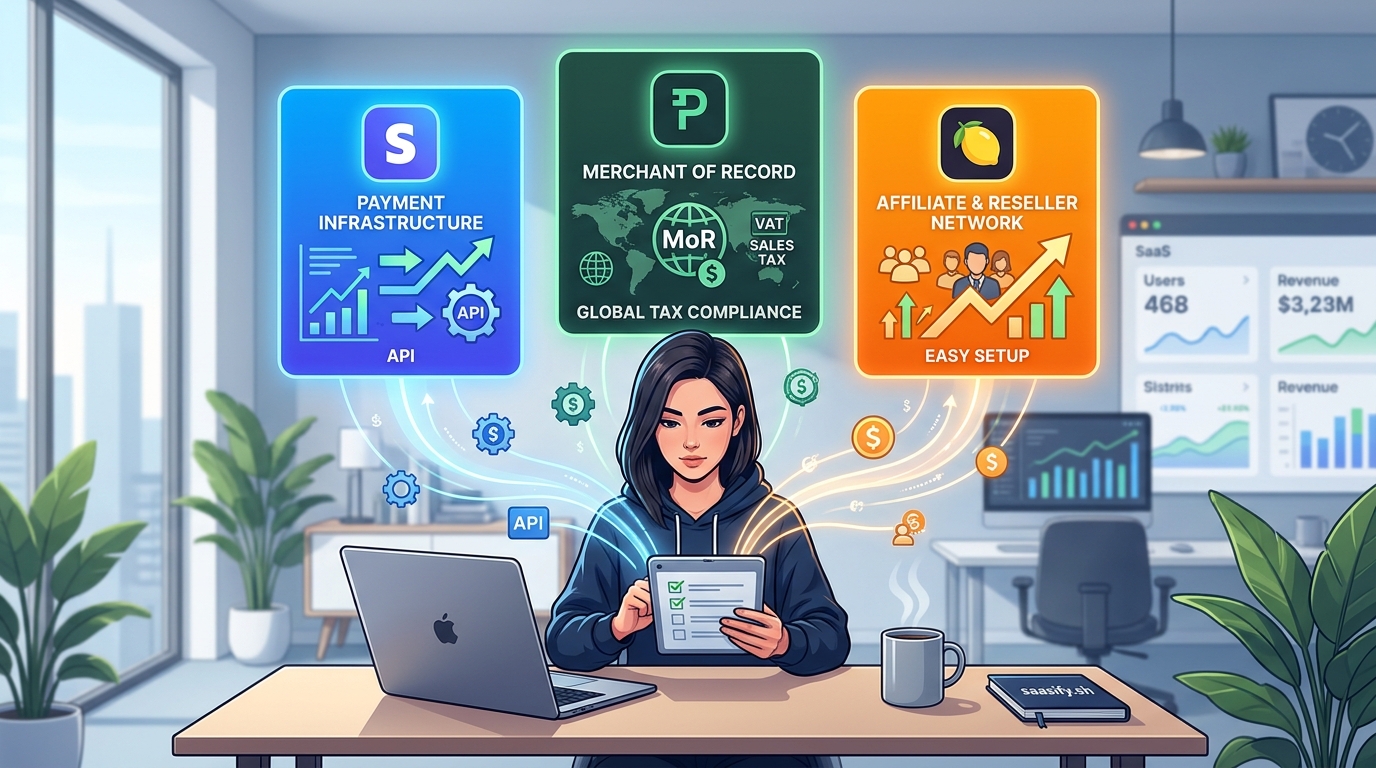
You’ve built your SaaS. You’ve validated the idea. Now you need to collect money. The payment processor you choose will affect your revenue, your taxes, your development time, and your sanity for years to come. Three platforms dominate the conversation among indie founders: Stripe, Paddle, and Lemon Squeezy. Each takes a fundamentally different approach to handling payments, and picking the wrong one can cost you thousands in fees or hundreds of hours in tax paperwork.
Stripe offers maximum flexibility but requires you to handle taxes and compliance yourself. Paddle and Lemon Squeezy act as merchants of record, managing taxes globally but taking higher fees. Choose Stripe if you want control and plan to scale big. Choose Lemon Squeezy if you want simplicity and are starting small. Choose Paddle if you need enterprise features and global reach from day one.
Understanding the fundamental difference
The biggest distinction between these platforms isn’t features or pricing. It’s who becomes the legal seller of your product.
Stripe is a payment processor. You remain the merchant of record. That means you’re responsible for collecting sales tax, VAT, and GST in every jurisdiction where you have customers. You file the returns. You handle compliance. You take on the legal burden.
Paddle and Lemon Squeezy are merchants of record. They become the legal seller. They collect the payment from your customer, handle all tax collection and remittance, then pay you the net amount. You get a single payment from them, not hundreds of individual customer payments.
This architectural difference ripples through every aspect of how you’ll run your business.
Breaking down Stripe
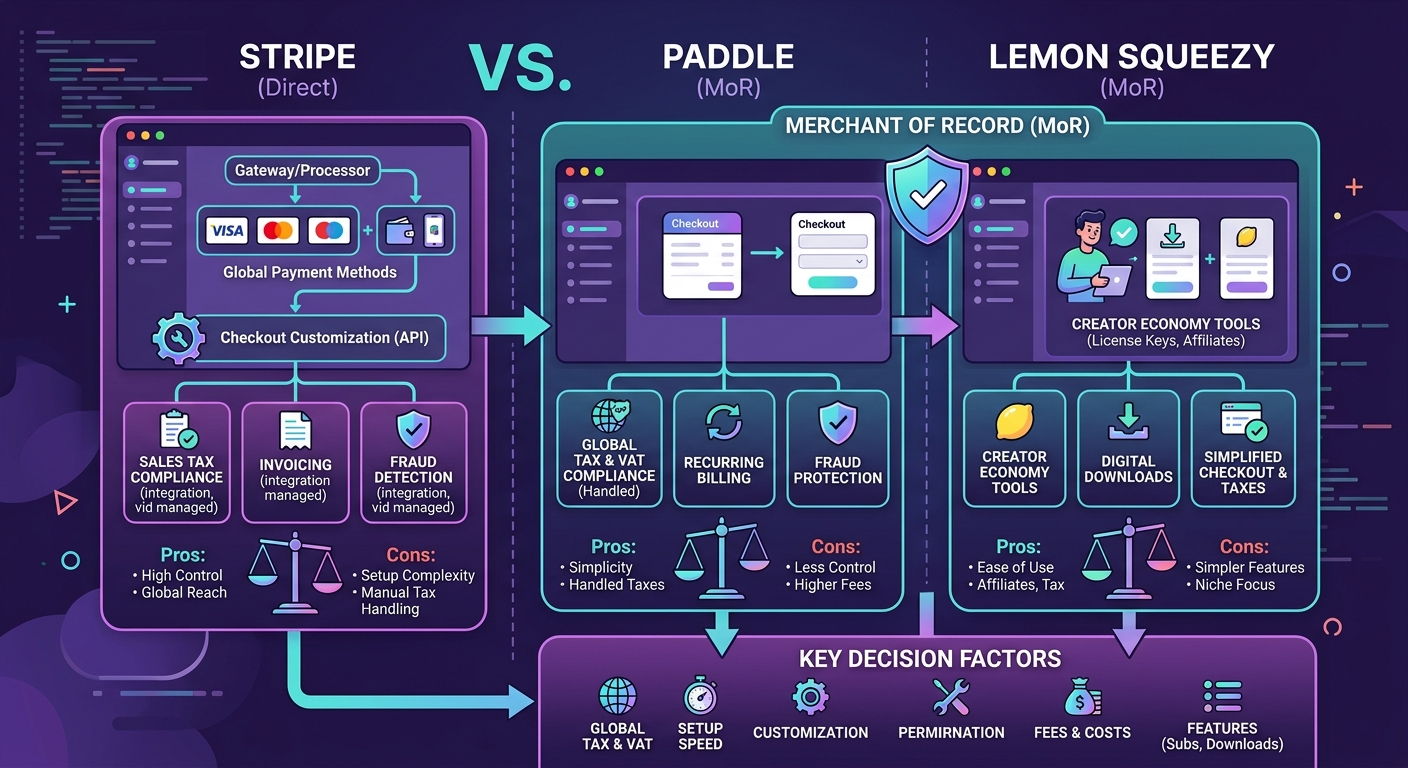
Stripe has become the default choice for SaaS developers. The API is excellent. The documentation is thorough. The ecosystem is massive.
You’ll pay 2.9% plus $0.30 per transaction in the US. International cards cost 3.9% plus $0.30. If you use Stripe Billing for subscriptions, add another 0.5%. Those fees are lower than the alternatives, but they don’t tell the whole story.
The real cost of Stripe comes from tax compliance. Once you hit economic nexus thresholds in various states or countries, you need to register for tax collection, file returns, and remit payments. Some founders handle this themselves. Most hire accountants or use services like Quaderno or Taxjar, which cost $50 to $200 per month.
Stripe recently launched Stripe Tax, which calculates tax rates automatically for $0.50 per transaction. It doesn’t file returns for you. You still need to register in each jurisdiction and submit the data Stripe collects.
The developer experience is where Stripe shines. The API is clean and predictable. Webhooks are reliable. Testing is straightforward. You can build exactly the payment flow you want. Custom pricing models, usage-based billing, complex subscription logic, all possible.
Stripe supports dozens of payment methods globally. Credit cards, Apple Pay, Google Pay, ACH transfers, SEPA debits, Alipay, and more. If you need to accept payments in a specific country or method, Stripe probably supports it.
Breaking down Paddle
Paddle positions itself as the merchant of record for software companies. They handle payments, taxes, and compliance globally. You get a single payout from Paddle, typically monthly.
Fees are higher than Stripe. Paddle charges 5% plus $0.50 per transaction on their standard plan. For higher volume businesses, they offer custom pricing that can drop to around 3% to 4%.
That 5% includes tax handling, fraud protection, and compliance management. You don’t register for taxes anywhere. You don’t file returns. Paddle does it all. For many founders, especially those selling globally from day one, this is worth the premium.
Paddle’s checkout experience is hosted. You redirect customers to a Paddle-branded page. You can customize colors and logos, but you don’t control the entire experience. This matters less than you might think. Conversion rates on Paddle’s checkout are often higher than custom implementations because they’ve optimized it extensively.
The platform includes built-in analytics, dunning management for failed payments, and automated email receipts. The feature set is comprehensive for standard SaaS billing models.
The API is functional but less elegant than Stripe’s. Documentation is good but not exceptional. The developer experience is solid without being remarkable.
Paddle works best for B2C SaaS or small B2B products selling internationally. If you’re targeting enterprise customers who need custom invoicing or purchase orders, Paddle becomes more complicated.
Breaking down Lemon Squeezy
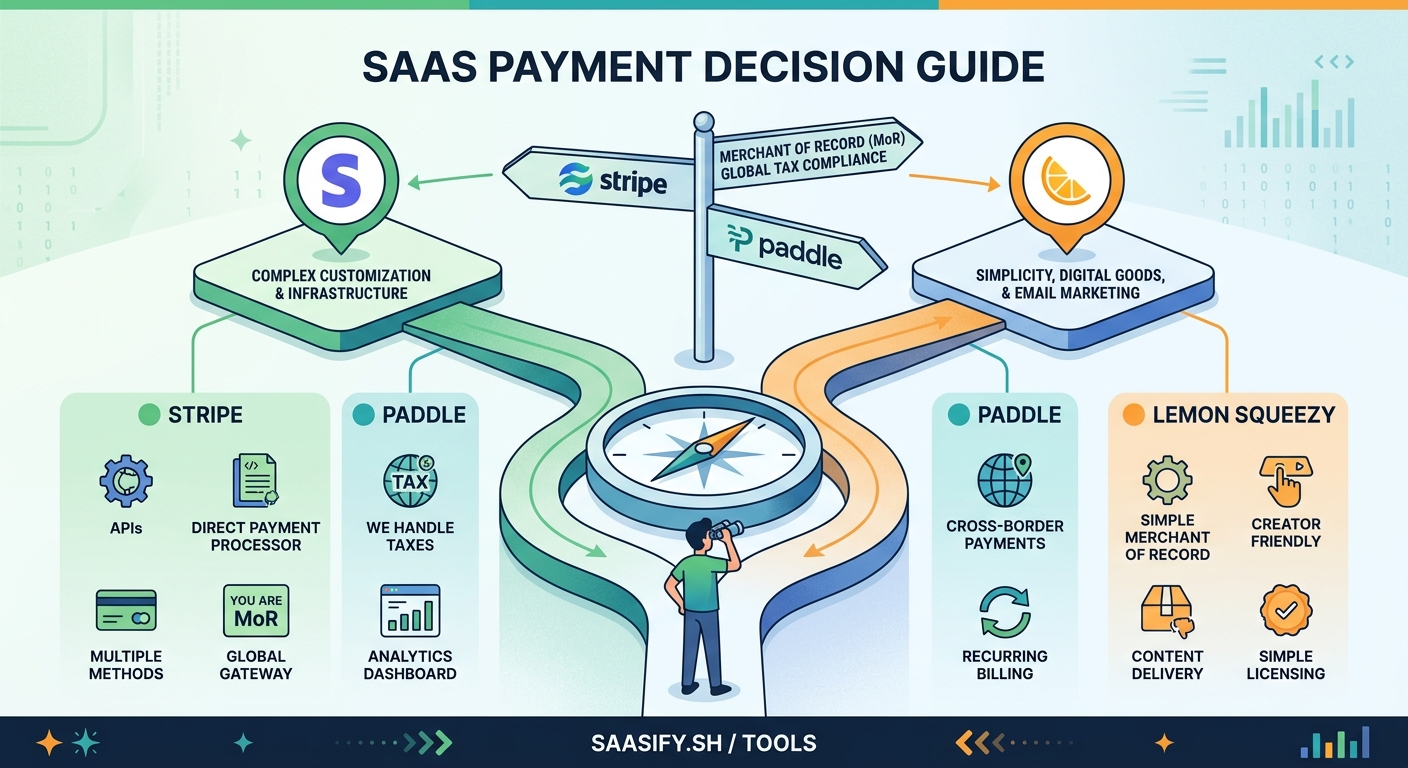
Lemon Squeezy launched in 2021 as a merchant of record specifically for indie makers and small SaaS products. The positioning is clear: Stripe’s power with Paddle’s simplicity, at a price point that makes sense for solo founders.
Fees are 5% plus $0.50 per transaction, identical to Paddle’s standard pricing. Unlike Paddle, Lemon Squeezy has no minimum volume requirements and no application process. You sign up and start selling immediately.
Lemon Squeezy acts as your merchant of record, handling all global tax compliance. You receive a single payout, typically twice monthly. The platform is US-based, which simplifies things for American founders but matters less for international sellers.
The checkout experience is hosted, similar to Paddle. The design is clean and modern. Customization options are decent. You can embed the checkout in an overlay on your site rather than redirecting.
The dashboard is notably simpler than Paddle or Stripe. Everything you need is visible without digging through menus. Analytics are basic but sufficient for most indie products. You can see MRR, churn, and customer lifetime value at a glance.
The API is newer and less mature than Stripe or Paddle. Documentation is improving but still has gaps. The webhook system works reliably for standard use cases. Complex integrations might require more trial and error.
Lemon Squeezy shines for digital products and small SaaS tools. If you’re a solo founder building a SaaS MVP in 30 days, Lemon Squeezy removes payment complexity so you can focus on building.
Comparing fees across realistic scenarios
Looking at percentage fees alone is misleading. Let’s examine what you actually pay in three common situations.
| Scenario | Stripe Total Cost | Paddle Cost | Lemon Squeezy Cost |
|---|---|---|---|
| $10/month plan, 100 customers in US only | $319/month ($29 Stripe fees + $290 in estimated tax compliance time/cost) | $550/month (5% + $0.50 per transaction) | $550/month (5% + $0.50 per transaction) |
| $50/month plan, 200 customers globally | $1,390/month ($290 Stripe fees + $1,100 tax compliance) | $2,100/month | $2,100/month |
| $100/month plan, 500 customers, 50% international | $6,950/month ($1,450 Stripe fees + $5,500 tax compliance at scale) | $10,250/month | $10,250/month |
These numbers assume you value your time or pay someone to handle tax compliance with Stripe. If you’re in a single jurisdiction with simple tax rules and do it yourself, Stripe’s cost drops significantly.
At very high volumes, Stripe becomes cheaper even with tax overhead because you can negotiate lower processing fees and spread compliance costs across more revenue.
Tax compliance reality check
Tax compliance sounds abstract until you deal with it. Here’s what it actually means.
With Stripe, you need to monitor economic nexus thresholds. In the US, that’s typically $100,000 in sales or 200 transactions per state per year. Hit that threshold in Texas? You register for a sales tax permit in Texas. You collect the correct rate for every city and county. You file monthly or quarterly returns. You remit the money you collected.
Now multiply that across all 50 states. Then add the EU, UK, Canada, Australia, and any other countries where you have customers. Each has different thresholds, rates, and filing requirements.
VAT in the EU is particularly complex. The threshold is €10,000 across all EU countries combined. Once you cross it, you register for VAT MOSS or register in each country individually. Rates vary from 17% to 27% depending on the country.
This isn’t theoretical. Founders have received tax bills with penalties for years of unfiled returns because they didn’t realize they had nexus in a jurisdiction.
With Paddle or Lemon Squeezy, none of this is your problem. They’re the seller. They handle it. You receive clean money.
The mental overhead of tax compliance is worse than the actual cost. You’re constantly wondering if you’re doing it right, if you’re missing a jurisdiction, if you’ll get audited. That anxiety tax is real. For many founders, paying an extra 2% to make it disappear is the best money they spend.
Developer experience and integration effort
If you’re technical, Stripe feels like home. The API design is intuitive. Error messages are helpful. The testing environment mirrors production perfectly. You can build your entire payment flow in a weekend.
Stripe’s ecosystem is massive. Every framework has well-maintained libraries. Every common integration exists. Need to connect payments to your CRM? There’s a pre-built solution.
The downside is you’re building and maintaining more code. Subscription management, webhook handling, customer portal, all require development time. Open source tools like Bullet Train or Shipixen provide starter templates, but you’re still responsible for the code.
Paddle’s integration is simpler because they handle more. You implement their checkout overlay, set up a few webhooks, and you’re done. Less code means less maintenance. The tradeoff is less control over the user experience.
Lemon Squeezy falls between the two. The integration is straightforward for standard use cases. The documentation could be better for edge cases. The community is smaller, so you’ll find fewer Stack Overflow answers and blog posts.
For no-code founders or those using no-code stacks, both Paddle and Lemon Squeezy offer Zapier integrations that work well enough for basic flows.
Making your decision
Start by answering these questions:
- Are you selling primarily in one country or globally from day one?
- Do you have strong technical skills and time to build custom integrations?
- What’s your expected monthly revenue in the first year?
- Do you need enterprise features like custom invoicing or purchase orders?
- How much is your time worth for handling administrative tasks?
Choose Stripe if you’re technical, selling primarily in one or two jurisdictions, planning to scale to millions in revenue, or need complete control over the payment experience. The lower processing fees compound significantly at scale. The flexibility is unmatched.
Choose Paddle if you’re selling globally from day one, targeting B2C or small B2B customers, want enterprise features like multi-currency pricing and localized checkouts, or plan to raise venture capital. Investors like seeing clean revenue without tax liabilities.
Choose Lemon Squeezy if you’re a solo founder or small team, selling a micro-SaaS in a profitable niche, want to launch fast without payment complexity, or testing pricing before committing to infrastructure. The simplicity lets you focus on product and marketing.
Common mistakes to avoid
Founders often choose based on the wrong criteria. Here are patterns to avoid.
Don’t choose Stripe just because everyone else uses it. The popularity creates echo chambers. What works for a funded startup with a finance team might be wrong for a solo founder.
Don’t choose a merchant of record solely to avoid learning about taxes. If you’re building a serious business, you’ll need to understand your financials eventually. Tax compliance is part of running a company.
Don’t underestimate switching costs. Moving payment processors is painful. You’ll need to migrate customer data, update billing, handle prorated subscriptions, and communicate changes. Choose carefully the first time.
Don’t ignore currency and payout timing. Stripe pays out in two days. Paddle and Lemon Squeezy pay monthly or twice monthly. If you need immediate cash flow, that matters.
Don’t forget to consider where you want to be in three years. A platform that’s perfect at $5,000 MRR might be expensive or limiting at $100,000 MRR.
Hybrid approaches that actually work
Some founders use multiple platforms strategically. This adds complexity but can optimize for different customer segments.
Use Stripe for annual plans and Lemon Squeezy for monthly plans. Annual plans have lower transaction counts, making Stripe’s per-transaction costs more attractive. Monthly plans benefit from automated tax handling.
Use Paddle for B2C customers and Stripe for B2B enterprise deals. Enterprise customers often need custom invoicing and payment terms that merchants of record don’t handle well.
Use Lemon Squeezy to validate pricing and market fit, then migrate to Stripe once you hit consistent revenue. This lets you launch fast and optimize later.
The key is keeping the setup simple enough that you can actually manage it. Two payment systems is manageable. Three or more becomes a maintenance nightmare.
What about the actual checkout experience
Conversion rate matters more than you think. A 1% improvement in checkout conversion is worth more than saving 1% on fees for most SaaS products.
Stripe’s custom checkout lets you optimize every element. You can A/B test layouts, copy, and flows. You control the entire experience. This flexibility can drive higher conversions if you use it well. It can also drive lower conversions if you build a mediocre checkout.
Paddle and Lemon Squeezy use hosted checkouts that are pre-optimized. They’ve run thousands of A/B tests across millions of transactions. Their default experience often converts better than custom implementations. You sacrifice control for proven performance.
Both hosted platforms support embedding the checkout in an overlay on your site. Customers never feel like they’re leaving. The experience is smooth enough that most users don’t notice it’s hosted.
For pricing your SaaS product, all three platforms handle standard models well. Monthly and annual subscriptions, multiple tiers, add-ons, all work fine. Usage-based billing is easier with Stripe but possible with all three.
Support and reliability matter more than features
When payments break, you need help immediately. Every minute of downtime is lost revenue.
Stripe’s support is email-based for most accounts. Response times vary from hours to days. Once you’re processing significant volume, you can get phone support. The documentation is so thorough that you often don’t need support.
Paddle offers email support with generally faster response times than Stripe. They also provide a dedicated account manager for higher volume customers. The support team understands SaaS business models well.
Lemon Squeezy’s support is responsive and personal. As a smaller company, they’re more accessible. The founder is active in their Discord community. You can often get answers in minutes.
All three platforms are reliable. Downtime is rare. When it happens, Stripe’s scale means they recover fastest. Paddle and Lemon Squeezy have had occasional issues but nothing that should disqualify them.
The path forward for your SaaS
Payment infrastructure is important but it’s not your product. Don’t spend three months researching the perfect solution. Pick one that fits your current situation and move forward.
Start with Lemon Squeezy if you’re pre-revenue or just launching. The simplicity removes friction. You can always migrate later if needed.
Start with Stripe if you’re technical and selling in a single market. The lower fees and flexibility give you room to grow.
Start with Paddle if you’re selling globally and want to focus entirely on product and marketing.
All three platforms power successful SaaS businesses. The difference between them is smaller than the difference between launching this month and launching next month. Make a decision and ship your product.
Your payment processor should fade into the background while you focus on building your revenue dashboard and growing your customer base. Choose the platform that lets you do that, then get back to building something people want to pay for.