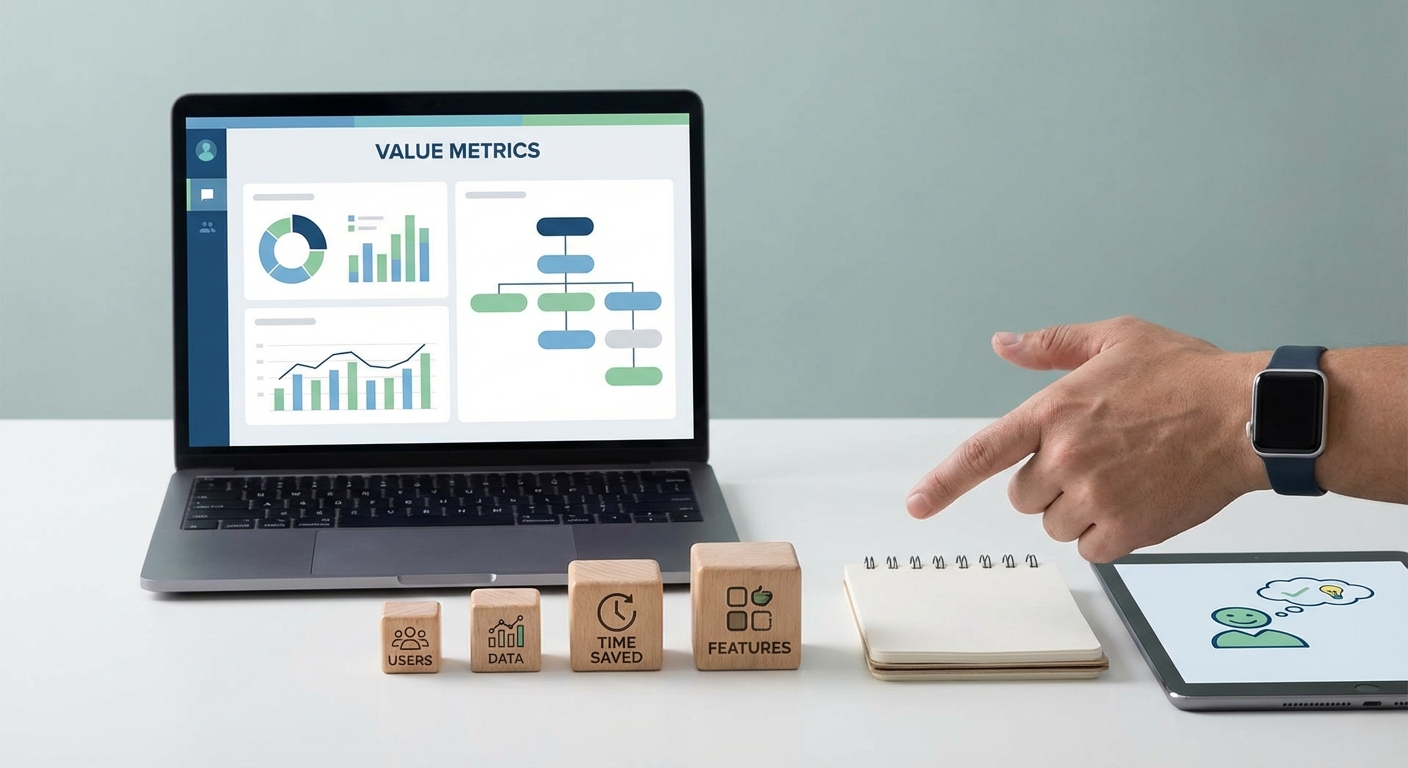
Most SaaS founders can tell you how many users they have. Far fewer can tell you how much value those users actually get from their product.
That gap is expensive. It leads to pricing that feels arbitrary, features nobody uses, and churn you can’t explain. Measuring customer value isn’t about vanity metrics or feel-good surveys. It’s about understanding the specific outcomes your product delivers and quantifying them in ways that inform every decision you make.
Measuring customer value requires identifying the benefits your product delivers, quantifying the costs customers incur, and calculating the net difference. This involves tracking both tangible outcomes like time saved or revenue generated and intangible factors like reduced stress or improved confidence. The right measurement framework connects directly to pricing decisions and product roadmaps.
What customer value actually means
Customer value is the difference between what someone gains from your product and what they give up to use it.
The gains include obvious things like time saved, revenue generated, or costs reduced. They also include less tangible benefits like peace of mind, status, or reduced complexity.
The costs aren’t just your subscription price. They include implementation time, learning curve, switching costs from their old solution, and ongoing maintenance effort.
When gains significantly exceed costs, you have strong customer value. When the gap is narrow, you’re vulnerable to churn.
The challenge is that most of these factors are invisible unless you deliberately measure them.
Why most teams get measurement wrong
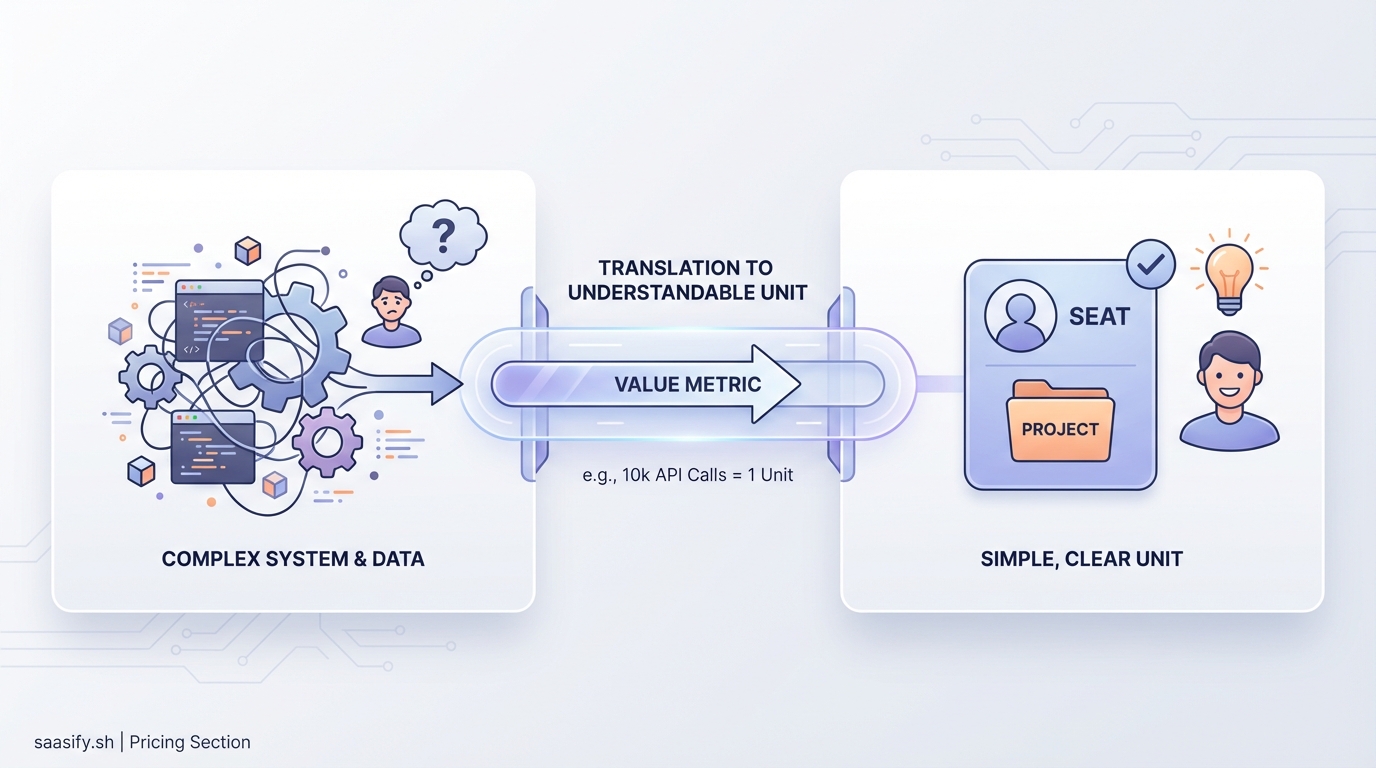
Many teams track metrics that feel important but don’t actually reflect value.
They measure feature usage without knowing if those features create outcomes. They track engagement without understanding if that engagement leads to results. They collect NPS scores without connecting them to specific product experiences.
The result is a dashboard full of numbers that don’t inform decisions.
Another common mistake is measuring only what’s easy to measure. If your product saves customers time but you only track logins, you’re missing the actual value story.
The best measurement systems capture both the tangible and intangible, even when that requires more effort.
The three components of a value measurement system
Every effective value measurement system has three parts: benefit quantification, cost assessment, and net value calculation.
Benefit quantification means identifying specific outcomes and measuring them. If your product helps users schedule meetings faster, you need to know how much faster. If it reduces errors, you need to know by what percentage.
Cost assessment includes monetary costs, time costs, and psychological costs. How much do customers pay? How long does setup take? How steep is the learning curve?
Net value calculation combines these inputs into a single framework that shows whether value is increasing or decreasing over time.
How to identify what creates value for your customers
Start with qualitative research before you build any measurement system.
Interview 10 to 15 customers who get the most value from your product. Ask them what specific problems they solve with your tool. Ask what they did before they found you. Ask what would happen if your product disappeared tomorrow.
Listen for outcome language, not feature language. When someone says “I love your dashboard,” ask what the dashboard helps them accomplish. When they mention a specific feature, ask what result that feature produces.
Look for patterns across interviews. If seven out of ten customers mention faster reporting, that’s a value driver worth measuring.
Document these value drivers in plain language. “Reduces monthly reporting time by 60%” is better than “improves efficiency.”
The best value metrics come from listening to customers describe outcomes in their own words, then translating those descriptions into measurable indicators.
Building your measurement framework
Once you know what creates value, you need a system to measure it consistently.
-
Choose one primary value metric that represents the core outcome your product delivers. For a scheduling tool, this might be “hours saved per week.” For an analytics platform, it might be “decisions made with data per month.”
-
Select three to five secondary metrics that capture supporting value drivers. These might include error reduction, cost savings, team collaboration improvement, or customer satisfaction increases.
-
Create a baseline measurement process. Survey new customers during onboarding to establish their starting point. Ask them to estimate their current state before using your product.
-
Build regular check-ins to track progress. Monthly or quarterly surveys work well for most SaaS products. Keep surveys short and focused on specific outcomes.
-
Connect value metrics to customer cohorts. Track how value changes based on customer size, industry, use case, or plan level.
This framework should live in a dashboard that product, pricing, and customer success teams all reference.
Formulas that make value concrete
Several standard formulas help translate fuzzy concepts into numbers.
The basic customer value formula is: Perceived Benefits – Total Costs = Customer Value
For SaaS products, you can make this more specific:
Customer Value = (Time Saved × Hourly Rate) + (Revenue Generated) + (Costs Avoided) – (Subscription Cost + Implementation Cost + Ongoing Effort Cost)
Customer lifetime value (CLV) measures the total value a customer provides to your business:
CLV = (Average Revenue Per User × Gross Margin) ÷ Churn Rate
But you also need to measure the value you provide to customers, which is different. That’s where outcome-based metrics come in.
If your product saves time, calculate: Hours Saved Per Month × Number of Users × Hourly Rate = Monthly Value Delivered
If it generates revenue, track: Additional Revenue Attributed to Product ÷ Subscription Cost = ROI Multiple
These formulas give you concrete numbers to reference in pricing discussions, sales conversations, and product planning meetings.
Common measurement approaches and their tradeoffs
Different measurement methods work better for different types of value.
| Measurement Method | Best For | Limitations |
|---|---|---|
| Time tracking integration | Products that save time on specific tasks | Requires technical integration, may feel invasive |
| Before/after surveys | Broad outcome measurement across use cases | Relies on customer memory and honesty |
| Usage analytics | Feature adoption and engagement patterns | Shows behavior, not outcomes |
| Customer interviews | Understanding context and qualitative value | Time intensive, hard to scale |
| ROI calculators | Quantifying financial impact | Requires customer to input accurate data |
| Cohort analysis | Tracking value changes over customer lifecycle | Needs significant data history |
Most effective systems combine multiple approaches. Use analytics for behavioral signals, surveys for outcome measurement, and interviews for deeper context.
The key is matching your measurement method to the type of value you’re tracking.
Measuring intangible value
Not all value shows up in time saved or revenue generated.
Reduced stress, improved confidence, better team morale, and peace of mind are real value drivers. They’re just harder to measure.
For intangible value, use proxy metrics and comparative scales.
Ask customers to rate their confidence level before and after using your product on a scale of 1 to 10. Ask how often they worry about the problem your product solves. Ask how their team’s morale has changed.
You can also measure behavioral proxies for intangible value. If your product reduces stress, look for decreased support tickets, fewer escalations, or improved retention.
Another approach is comparative measurement. Ask customers whether they feel more or less confident compared to three months ago. Ask if problem-solving feels easier or harder.
These methods won’t give you precise numbers, but they’ll show directional trends that matter.
Connecting measurement to pricing decisions
Value measurement becomes powerful when it informs how you price your product.
If you know your product saves customers an average of 10 hours per week, and their average hourly rate is $50, that’s $2,000 in monthly value. You can confidently price at $200 to $400 per month and still deliver 5x to 10x ROI.
If you discover that customers in one segment get 3x more value than another segment, that suggests tier-based pricing or segment-specific plans.
When you measure value by use case, you can build packaging that aligns with how customers actually extract value. This is how you develop pricing models that customers understand and accept.
How to price your SaaS product when you have zero customers becomes much easier when you have a value measurement system in place.
Tracking value across the customer lifecycle
Value isn’t static. It changes as customers adopt more features, expand usage, or encounter limitations.
Measure value at key lifecycle stages:
- Onboarding: Are customers achieving initial value within the first week?
- Adoption: Are they expanding usage to capture more value over time?
- Renewal: Is perceived value high enough to justify continued subscription?
- Expansion: Are they hitting value ceilings that suggest they need a higher tier?
Track how long it takes customers to reach their first meaningful outcome. This “time to value” metric tells you whether your onboarding is effective.
Monitor value trends over time. If value increases month over month, that’s a retention signal. If it plateaus or declines, that’s a churn warning.
Build alerts for value drops. When a previously high-value customer shows declining outcome metrics, that’s a trigger for customer success outreach.
Using value data to guide product decisions
Your value measurement system should directly inform your product roadmap.
When you know which features drive the most outcome value, you know where to invest development resources. When you see customers struggling to extract value from a specific workflow, you know where to improve UX.
Create a simple framework:
- High value, high usage: Protect and enhance these features
- High value, low usage: Improve discoverability and onboarding
- Low value, high usage: Investigate why usage doesn’t translate to outcomes
- Low value, low usage: Consider deprecation
This approach keeps your product focused on what actually matters to customers.
If you’re building a SaaS MVP in 30 days without burning out, start with measurement from day one. Even simple surveys during beta testing will tell you if you’re building something valuable.
Benchmarking your value delivery
Once you have internal metrics, compare them to alternatives your customers might use.
If your product saves 10 hours per week, find out how much time customers spent on the same task with their previous solution. If you reduce errors by 40%, learn what error rate they tolerated before.
This competitive value gap shows you where you’re strong and where you’re vulnerable.
Survey churned customers to understand value gaps. Ask what they’re using now and whether it delivers more value. These insights often reveal blind spots in your measurement system.
Track industry benchmarks when available. If similar products typically deliver 5x ROI and you’re delivering 3x, you have room to improve or you’re targeting the wrong segment.
Building a value dashboard
All this measurement means nothing if it’s buried in spreadsheets nobody checks.
Build a value dashboard that shows:
- Primary value metric trend over time
- Value by customer segment
- Time to first value for new customers
- Value correlation with retention
- Feature usage mapped to outcome value
- Competitive value gaps
Update this dashboard monthly at minimum. Review it in product planning meetings, pricing reviews, and customer success check-ins.
Make the dashboard accessible to your entire team. When everyone understands what drives value, everyone makes better decisions.
Building a revenue dashboard that actually drives growth decisions works best when it includes customer value metrics alongside financial metrics.
Common pitfalls to avoid
Several traps catch teams building value measurement systems.
Don’t measure only what’s easy. If the real value is qualitative, find ways to capture it even if it’s harder.
Don’t confuse activity with outcomes. Logins, clicks, and feature usage are activities. Time saved, revenue generated, and problems solved are outcomes.
Don’t ignore segment differences. A metric that works for enterprise customers might be meaningless for small businesses.
Don’t set it and forget it. Value drivers change as your product evolves and as market conditions shift. Review and update your measurement framework quarterly.
Don’t make measurement burdensome for customers. Long surveys kill response rates. Keep measurement lightweight and integrated into natural product workflows when possible.
Turning measurement into action
The point of measuring value isn’t to have impressive charts. It’s to make better decisions.
Use value data to:
- Adjust pricing to better capture the value you deliver
- Prioritize features that increase measurable outcomes
- Identify at-risk customers before they churn
- Improve onboarding to accelerate time to value
- Create case studies with concrete outcome numbers
- Train sales teams on value-based selling
- Guide marketing messaging toward proven outcomes
When measurement connects directly to action, it justifies the effort required to maintain the system.
Starting simple and scaling up
You don’t need a perfect system on day one.
Start with one primary value metric and a simple monthly survey. Ask three questions: What outcome did you achieve this month? How much time/money did you save? How satisfied are you with the value you’re getting?
Track responses in a spreadsheet. Look for patterns. Calculate averages by segment.
After three months, you’ll have enough data to spot trends and identify your highest-value customers.
Then add one more measurement method. Maybe that’s usage analytics, maybe it’s customer interviews, maybe it’s an ROI calculator.
Build the system iteratively. Each addition should make your understanding clearer and your decisions better.
If you’re validating your SaaS idea before writing a single line of code, include value measurement questions in your validation interviews. This gives you baseline data before you even launch.
Making value measurement a team habit
The best measurement systems become part of how your team works.
Include value metrics in weekly standups. When discussing a new feature, ask how it will impact your primary value metric. When reviewing a support ticket, ask whether it reveals a value delivery gap.
Train customer success teams to speak in outcome language. Instead of “Are you using the reporting feature?” ask “How has reporting time changed since you started using this feature?”
Make value stories visible. When a customer achieves a great outcome, share it with the whole team. When value metrics improve, celebrate it.
Over time, thinking about customer value becomes automatic. Decisions naturally align with what actually matters.
Why this matters for indie SaaS founders
For solo founders and small teams, measuring customer value isn’t just nice to have. It’s survival.
You don’t have the resources to guess at pricing or build features nobody values. You need to know exactly what creates outcomes for customers so you can focus your limited time on what matters most.
Value measurement also makes selling easier. When you can tell prospects “Our average customer saves 12 hours per month,” that’s more compelling than any feature list.
It makes retention easier too. When you track value delivery, you spot problems before customers churn.
And it makes growth easier. Understanding what creates value helps you find more customers who need exactly what you deliver.
The measurement system you build today becomes the foundation for every strategic decision you make tomorrow. Start simple, stay consistent, and let the data guide you toward a product that customers can’t imagine living without.