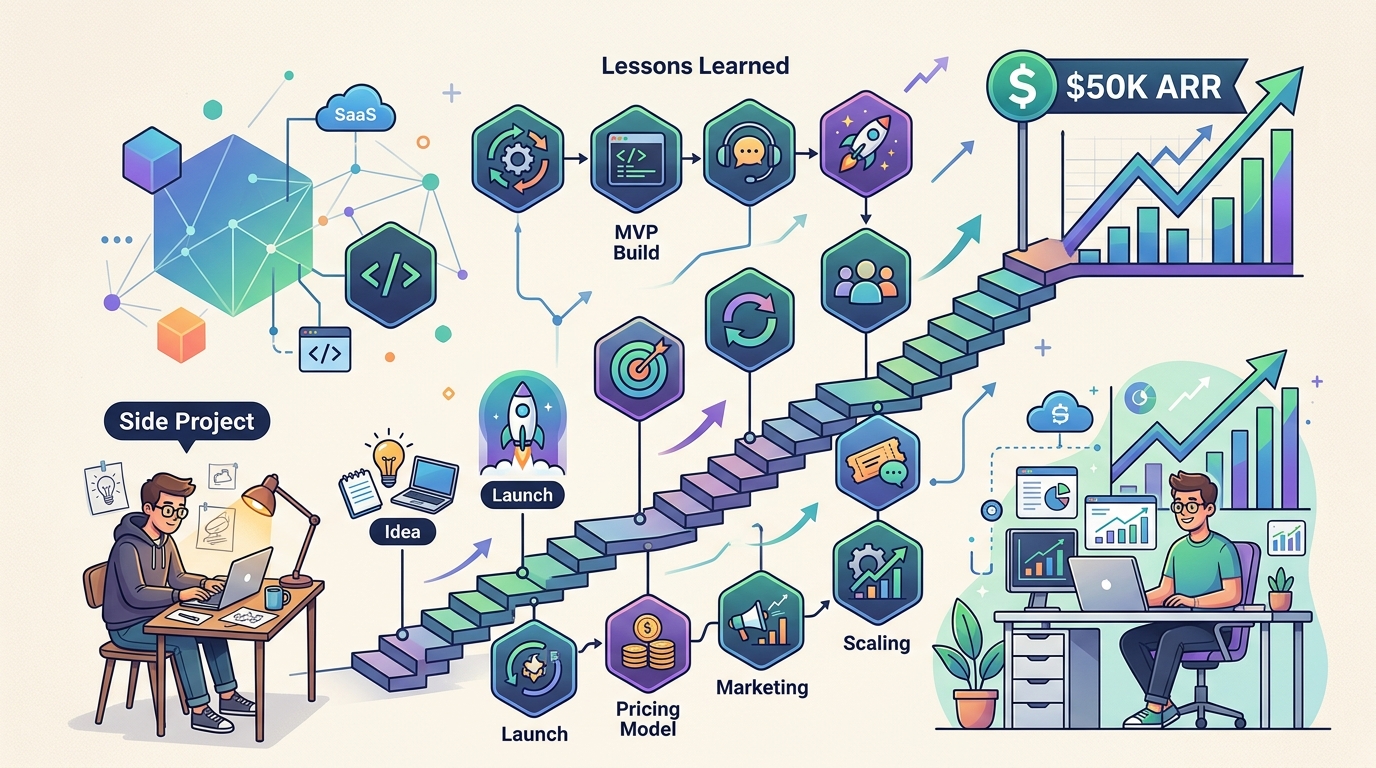
You built something on nights and weekends. Maybe it started as a solution to your own problem, or just a fun experiment. Now you’re wondering if it could actually make money. Thousands of developers face this exact moment, and most never cross the line from hobby to revenue. The gap between a working prototype and a business that pays your bills feels massive, but it’s more about process than luck.
Turning a side project into a profitable business requires validation before scaling, clear pricing from day one, and ruthless focus on solving one problem well. Most founders fail by building features instead of finding customers. Success comes from treating revenue as the primary metric, not user counts or feature completeness. This guide shows you the exact steps to make that transition without quitting your job.
Why Most Side Projects Never Make Money
The brutal truth is that most side projects die in the “almost ready” phase. Developers add one more feature, redesign the landing page again, or wait for the perfect launch moment. None of that matters if nobody wants to pay for what you built.
The problem isn’t technical. It’s psychological. Building feels productive. Talking to potential customers feels uncomfortable. So you keep building, convincing yourself that the next feature will be the one that makes people want to buy.
Here’s what actually separates profitable projects from abandoned repos:
- Revenue comes first. Not after you hit 1,000 users. Not after the mobile app launches. From the first person who sees value.
- One clear problem. If you can’t explain what pain you solve in one sentence, customers definitely can’t.
- Price before product. Knowing what people will pay shapes what you build, not the other way around.
- Real conversations. Five calls with potential customers teach you more than 500 Reddit upvotes.
The Validation Step You Can’t Skip
Before you write another line of code, you need to know if anyone will actually pay for this. Not “like it” or “find it interesting.” Pay money.
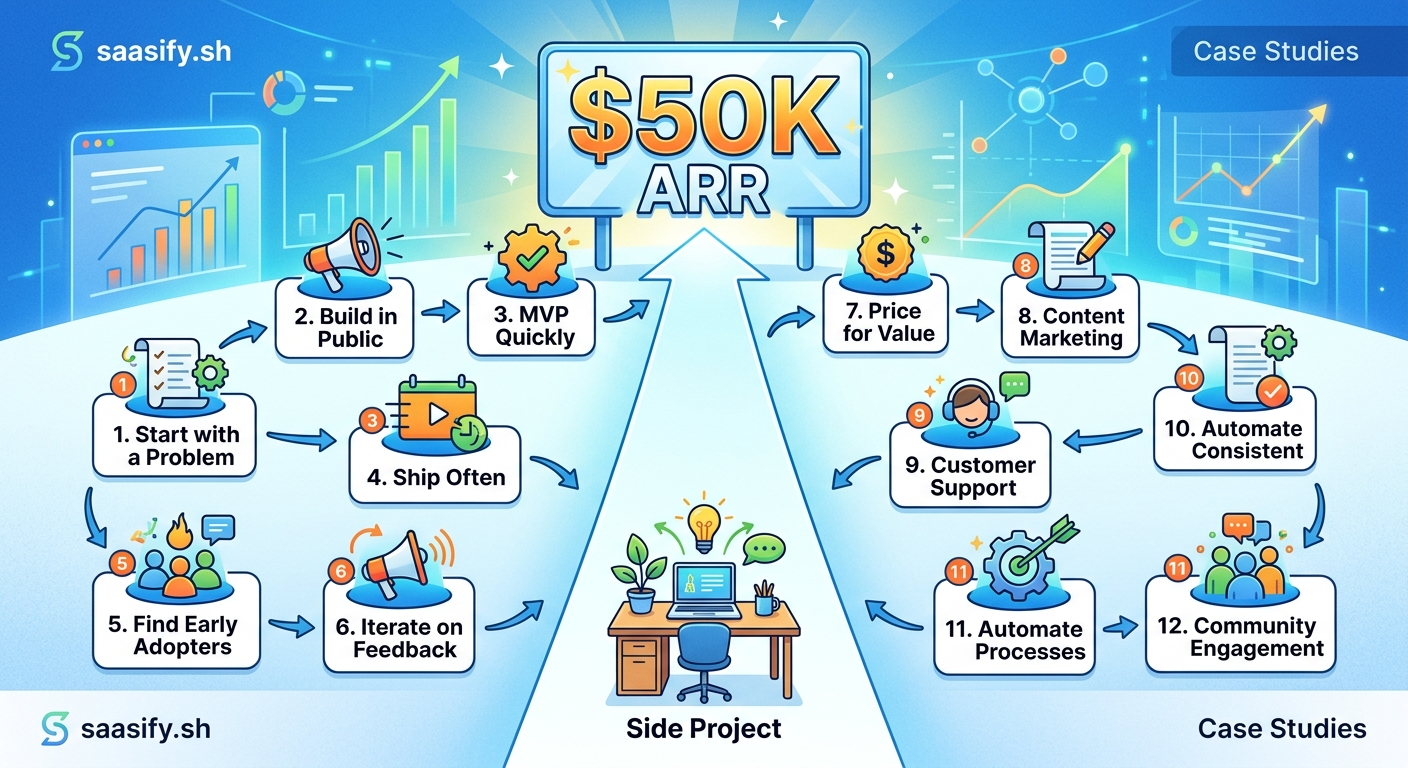
Validating your idea doesn’t require a finished product. It requires conversations and a willingness to hear “no.” Here’s the process that works:
- Find 10 people with the problem. Not friends. Not other developers. People who currently deal with the pain point your project solves.
- Ask about their current solution. What do they use now? How much does it cost? What frustrates them about it?
- Describe your solution without showing it. If they lean forward and ask questions, you’re onto something. If they nod politely and change the subject, you’re not.
- Name a price. Say “I’m thinking $X per month.” Watch their reaction. If they don’t flinch, your price is probably too low.
- Ask for a commitment. “Would you pay that if I had this ready in 30 days?” Get email addresses. Real interest shows up in inboxes.
This process takes a week. Maybe two if you’re starting from zero contacts. It’s uncomfortable. It’s also the difference between building something people want and building something that sits unused.
Building the Minimum Profitable Product
You’ve heard of MVP. This is different. A Minimum Profitable Product has exactly enough features to charge money and deliver value. Nothing more.
Most side projects suffer from feature creep before they even launch. You think about enterprise customers who might need SSO. You plan integrations with tools you don’t use. You design a mobile app even though your target users work on desktops.
Stop. Here’s what your first version actually needs:
| Must Have | Can Wait | Never Build (Yet) |
|---|---|---|
| Core problem solution | User profiles | Admin dashboard |
| Basic authentication | Email notifications | Analytics suite |
| Payment processing | Team features | API access |
| One pricing tier | Multiple integrations | Mobile apps |
The goal is to get to revenue as fast as possible. Every feature you add delays that moment. Building an MVP in 30 days is realistic when you cut ruthlessly.
Your first ten customers will tell you what to build next. They’ll pay you while you build it. That’s infinitely better than guessing in isolation.
Pricing Like You Mean Business
This is where most technical founders freeze. Pricing feels arbitrary. You worry about being too expensive. You see competitors charging less. So you pick a number that feels “safe.”
That’s how you stay a side project forever.
Your price signals value. If you charge $9/month, customers assume you’re worth $9/month. If you charge $49/month, they expect professional software that solves a real problem.
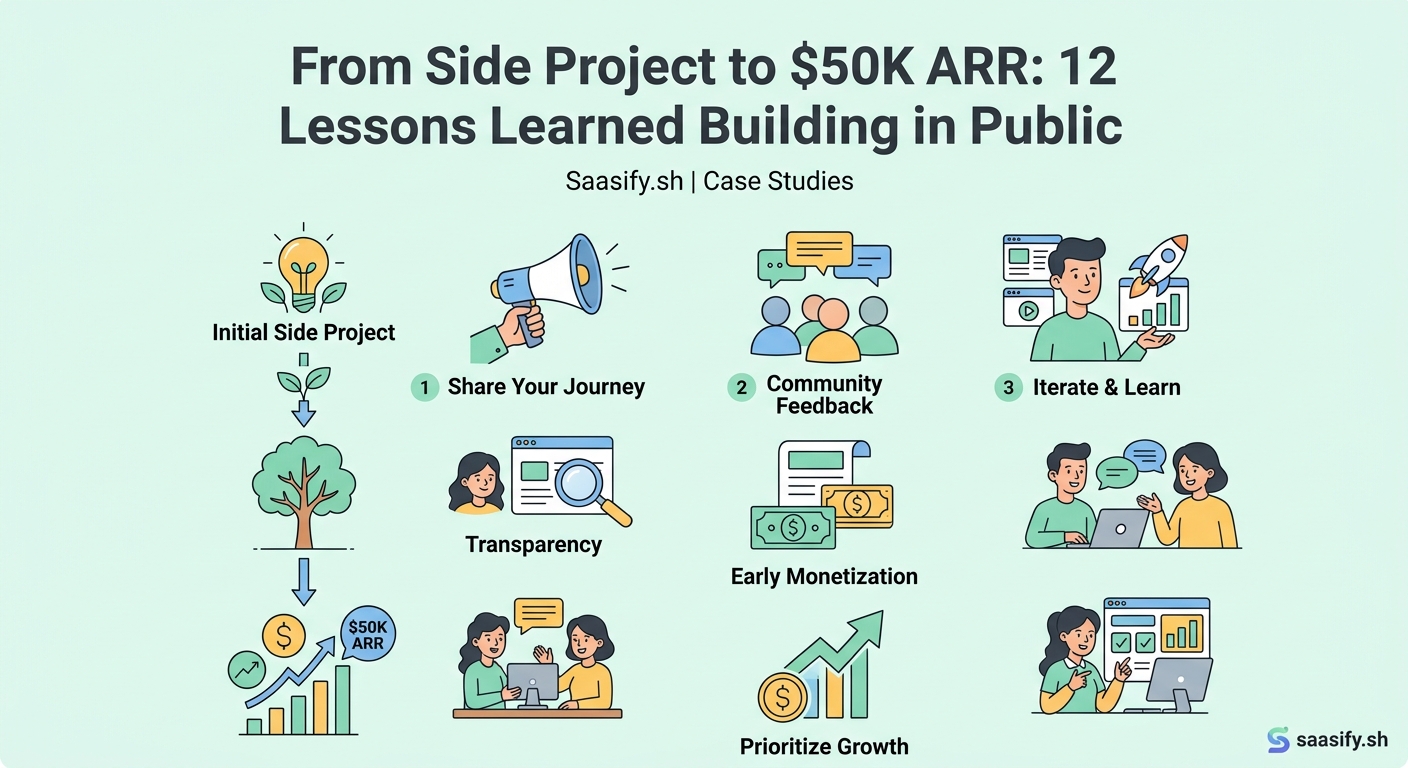
Here’s the framework that works for early-stage products:
- Calculate your costs. Hosting, payment processing, tools. Add 50% buffer.
- Estimate time per customer. Support, onboarding, maintenance. Multiply by your hourly rate.
- Add value markup. If you save someone 5 hours per month, you’re worth at least half of what those hours cost them.
- Round up. Always. $47 becomes $49. $89 becomes $99.
For most B2B SaaS side projects, the sweet spot is $29 to $99 per month. That’s enough to matter, low enough to avoid procurement processes, and high enough to signal quality.
Don’t offer a free tier at first. Free users cost time and money without validation. Offer a 14-day trial instead. People who won’t risk $49 for two weeks won’t become good customers anyway.
Pricing when you have zero customers requires confidence, not data. You can adjust later. You can’t get time back spent supporting free users.
Getting Your First Ten Paying Customers
This is the hardest part. Not because it’s complicated, but because it requires doing things that don’t scale and feel inefficient.
You’re not ready for ads. You’re not ready for content marketing. You’re definitely not ready for a sales team. You’re ready for manual, direct, personal outreach.
Here’s the playbook:
- List 50 potential customers. Names, not companies. Actual people who have the problem.
- Write a personal email to each one. Three sentences: what you built, what problem it solves, asking for 15 minutes.
- Send five per day. Not 50 at once. Five. Then adjust based on responses.
- Show the product live. Screen share. Walk them through. Answer questions in real time.
- Ask for the sale. “Want to start a trial today?” Not “let me know if you’re interested.”
This feels slow. It is slow. It’s also how you get customers who actually pay and stick around.
Building a pre-launch waitlist helps, but nothing replaces direct conversations. Your first ten customers should all know your name. You should know theirs.
Common Mistakes That Kill Momentum
You’ll make mistakes. Everyone does. But some mistakes kill projects that could have succeeded. Here are the big ones:
Building in isolation. You spend six months perfecting the product before showing anyone. By the time you launch, the market has moved or you’ve built the wrong thing.
Waiting for perfection. Your landing page isn’t great. Your onboarding has rough edges. You launch anyway, or you don’t launch at all. Guess which one makes money?
Ignoring feedback. Your first users tell you what’s confusing. You explain how it actually works instead of fixing it. They churn. You blame them for not understanding.
Underpricing to compete. You see someone charging $19 and price at $15. Now you need twice as many customers to hit the same revenue. And you’ve signaled that you’re worth less.
Chasing features over revenue. You have five paying customers asking for better export options. You build a mobile app instead because it sounds more impressive.
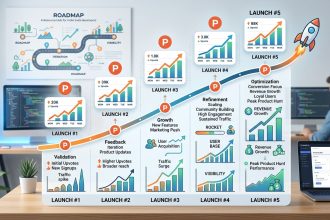
The First 90 Days Roadmap
Here’s what the transition from side project to profitable business actually looks like:
Days 1-30: Validation and MVP
– Talk to 20 potential customers
– Build the absolute minimum that solves the core problem
– Set up payment processing
– Create a simple landing page
– Price your product
Days 31-60: First Customers
– Send 150 personal outreach emails (5 per day)
– Do 20-30 product demos
– Sign your first 5 paying customers
– Fix the most critical bugs they find
– Ask for testimonials
Days 61-90: Initial Growth
– Get to 10 paying customers
– Build the one feature all of them request
– Set up basic analytics to track usage
– Document your support processes
– Start thinking about your next growth channel
This timeline assumes you’re working nights and weekends. If you can dedicate full time, cut it in half. If you have less time, stretch it out. The sequence matters more than the speed.
When to Quit Your Day Job
Don’t quit until the numbers make sense. That’s not being conservative. That’s being smart.
Here’s the math: You need 6 months of living expenses saved, plus enough monthly recurring revenue to cover your basic costs. For most people, that’s $3,000 to $5,000 in MRR.
At $49/month average, that’s 60 to 100 customers. That’s not a huge number, but it’s also not trivial. And you need confidence that you can keep growing.
Red flags that you’re not ready:
– High churn (more than 10% per month)
– All revenue from one or two customers
– You’re still figuring out the core product
– Growth has stalled for three months
Green lights that you’re ready:
– Consistent month-over-month growth
– Churn under 5%
– You’re turning down customers because you can’t keep up
– The day job is actively slowing down your business
The middle ground is going part-time at your job while scaling the business. Not every employer allows this, but it’s worth asking. Four days of employment plus one day on your business can work for 6-12 months.
Building Systems That Scale Without You
The goal isn’t to work more hours. The goal is to build something that generates revenue while you sleep. That requires systems.
Start with these three:
Automated onboarding. New customers should be able to sign up, get access, and start using your product without you. That means clear documentation, in-app guidance, and automated welcome emails.
Self-service support. FAQs, video tutorials, and a searchable help center handle 80% of questions. The other 20% need your time, but only 20%.
Predictable growth. Whether it’s content marketing, paid ads, or partnerships, you need at least one channel that brings in new customers consistently. Low-cost growth experiments help you find what works.
You won’t have all of this on day one. That’s fine. But by month six, you should be able to take a week off without the business falling apart.
The Metrics That Actually Matter
Stop tracking vanity metrics. Website visits don’t pay your bills. Email subscribers might eventually, but not directly.
Here’s what you should check every week:
| Metric | What It Tells You | Target (First Year) |
|---|---|---|
| MRR | Total monthly revenue | Growing 10-20% monthly |
| Churn | % customers who cancel | Under 5% |
| CAC | Cost to acquire a customer | Under 3 months of revenue |
| Trial conversion | % trials that become paid | Above 20% |
That’s it. Four numbers. You can track more later. For now, these tell you if you’re building a business or an expensive hobby.
The metrics that matter for early-stage SaaS change as you grow, but revenue and churn stay critical forever.
Finding Your Niche in a Crowded Market
You’re probably not building something completely new. That’s good. Existing markets have existing customers with existing budgets.
The mistake is trying to compete directly with established players. You can’t out-feature them. You can’t out-spend them on marketing. You can compete on focus.
Profitable micro-SaaS niches exist because big companies ignore them. Find a specific audience with a specific problem. Serve them better than the generic solution.
Examples of good niches:
– Project management for wedding photographers
– Time tracking for lawyers who bill by the minute
– Invoicing for freelance translators
– Scheduling for mobile dog groomers
Examples of bad niches:
– Project management for everyone
– Time tracking for all businesses
– Invoicing software
– Scheduling tool
The more specific you are, the easier it is to find customers. You know where they hang out. You know what they search for. You know what problems keep them up at night.
Making the Mental Shift From Builder to Founder
This is the hardest part, and nobody talks about it enough. Building software is comfortable. Running a business is not.
As a founder, you’ll spend less time coding than you expect. More time on:
– Customer support
– Marketing
– Sales conversations
– Financial planning
– Hiring decisions (eventually)
That doesn’t mean you stop building. It means building becomes one part of your role, not the whole thing.
The shift happens gradually. Your first customer support email feels like an interruption. Your tenth feels like feedback. Your hundredth feels like research.
Your first sales call feels awkward. Your twentieth feels like a conversation. Your fiftieth feels like teaching.
You don’t have to love all of it. But you have to do all of it, at least at first. Bootstrapping to $30K MRR is possible, but rare. Most successful founders do the uncomfortable work.
What Success Actually Looks Like
Forget the overnight success stories. Real progress is boring.
Month 1: 2 customers, $98 MRR
Month 3: 8 customers, $392 MRR
Month 6: 25 customers, $1,225 MRR
Month 12: 65 customers, $3,185 MRR
That’s not going to make headlines. It’s also life-changing money if you’re still working a day job. And it’s the foundation for something bigger.
By month 24, you could be at $10K MRR. By month 36, $25K. Those numbers support a comfortable life in most places. They give you options. They prove the model works.
The founders who succeed don’t have special advantages. They have consistency. They show up every day. They talk to customers. They fix bugs. They ship features. They don’t quit when growth slows down.
Your Side Project Deserves to Be a Business
You already did the hard part. You built something that works. You solved a problem. Now you need to find the people who will pay you to solve it for them.
The gap between side project and profitable business isn’t technical skill. It’s not luck. It’s not timing. It’s the willingness to do uncomfortable work, charge what you’re worth, and keep going when it feels slow.
Start with ten conversations this week. Build the minimum version that solves the problem. Set a price that reflects the value you create. Send personal emails to potential customers. Get comfortable asking for money.
Your side project won’t turn into a business by accident. It happens when you decide to treat it like one. That decision starts today.