Most SaaS founders burn cash on ads that stop working the moment they pause the campaign. They chase new users while existing customers quietly churn. They mistake temporary spikes for sustainable growth.
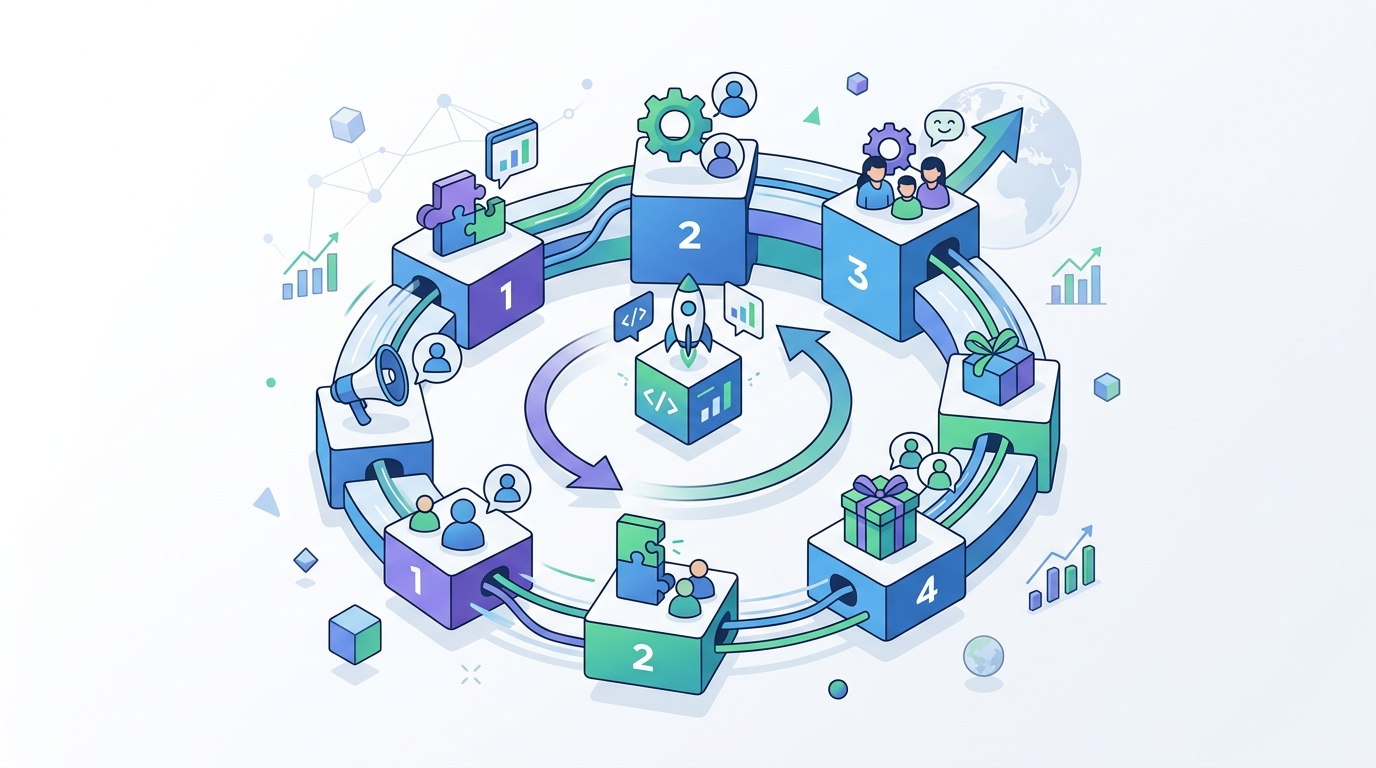
A growth loop changes everything. It turns your users into your acquisition engine. Each new customer creates conditions that bring in more customers, without you spending more money or time. The loop feeds itself.
A growth loop is a self-reinforcing system where user actions create inputs for more user acquisition. Unlike linear funnels that require constant fuel, loops compound over time. Building one requires identifying your natural loop type, mapping mechanics, measuring key metrics, and optimizing bottlenecks. Most indie SaaS products can start with content, viral, or paid loops depending on their business model and customer behavior patterns.
Understanding What Makes a Real Growth Loop
A growth loop is not a funnel.
Funnels are linear. You put users in at the top, some fall out, and a percentage converts at the bottom. Then you start over. Funnels need constant feeding.
Loops are circular. The output becomes the input. Each cycle generates momentum for the next cycle. Growth compounds.
The anatomy of a loop has four parts:
- Input: New users, content, or capital entering the system
- Action: What users do inside your product
- Output: What that action creates (content, invites, value, revenue)
- Feedback: How the output creates new inputs
Here’s the critical part. The output must naturally generate new inputs without manual intervention. If you need to manually push every cycle, it’s not a loop. It’s just a process you repeat.
Real loops run while you sleep.
The Four Types of SaaS Growth Loops You Can Build
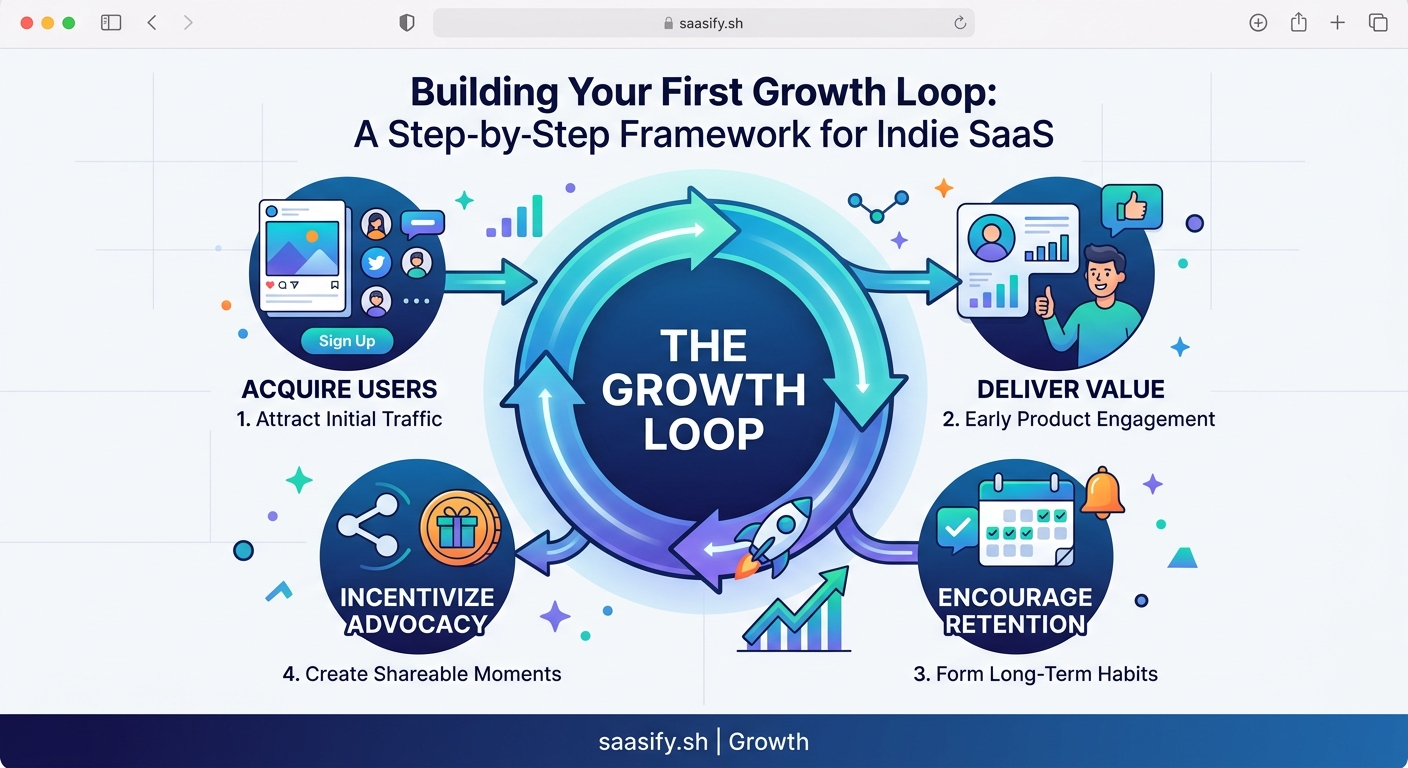
Not every loop fits every product. Your business model, customer behavior, and product mechanics determine which loop type will work.
Content Loops
Users create content. That content ranks in search or gets shared. New users find it. Those new users create more content.
This works for tools where the output is naturally shareable or searchable. Think design tools where users publish portfolios, or form builders where forms live on public pages.
The loop looks like this: User creates content > Content gets indexed or shared > New users discover content > New users sign up > New users create content.
Content loops take time to spin up. You need enough users creating enough content to reach critical mass. But once they work, they’re incredibly durable. How to validate your SaaS idea before writing a single line of code can help you determine if your product naturally supports content creation.
Viral Loops
Users invite other users because the product works better with more people. Each new user has a chance to invite more users.
This only works if your product has built-in network effects. Collaboration tools, communication platforms, and multiplayer experiences fit here.
The math matters. If your viral coefficient (k) is above 1.0, you have exponential growth. If it’s below 1.0, the loop still helps but won’t sustain growth alone.
Viral coefficient = (invites per user) × (conversion rate of invites)
If each user invites 5 people and 25% sign up, your k is 1.25. That’s exponential. If each user invites 3 people and 20% sign up, your k is 0.6. That helps but doesn’t compound.
Paid Loops
Revenue from customers funds ads. Ads bring new customers. New customers generate more revenue. More revenue funds more ads.
This is the most accessible loop for early-stage founders. You don’t need network effects or user-generated content. You just need positive unit economics.
The loop works when your customer lifetime value (LTV) exceeds your customer acquisition cost (CAC) by at least 3x. That margin funds growth and keeps you profitable.
If your LTV is $900 and your CAC is $200, you have $700 per customer to reinvest. That ratio lets you scale ads profitably. How to price your SaaS product when you have zero customers helps you set pricing that supports this loop.
Sales Loops
Happy customers refer new customers. Those referrals convert at higher rates and lower costs. More happy customers create more referrals.
This works best for products with high touch points, strong results, or tight communities. B2B tools, vertical SaaS, and products solving painful problems fit here.
The loop requires exceptional product experience. Mediocre products don’t get referrals. You need customers who actively want to tell others.
How to Build Your First Growth Loop in Seven Steps
Building a loop is not theoretical. It’s a series of concrete decisions and tests.
1. Identify Your Natural Loop Type
Look at your product mechanics and business model. Which loop type fits naturally?
If users create content that could rank or spread, consider a content loop. If your product needs multiple users to work well, consider a viral loop. If you have strong unit economics, consider a paid loop. If you serve a tight community with painful problems, consider a sales loop.
Don’t force a loop that doesn’t fit. A project management tool without collaboration features can’t run a viral loop. A low-margin product can’t sustain a paid loop.
Pick the loop that matches what your product already does.
2. Map the Loop Mechanics
Draw out the exact steps of your loop.
Start with the input. What brings users in? Then map each action they take. What do they do inside your product? What does that action create? How does that output generate new inputs?
Be specific. “Users share” is too vague. “Users publish project pages with backlinks that rank in Google” is specific.
Here’s an example for a content loop:
- User signs up and creates a landing page
- Landing page goes live with a branded footer link
- Page ranks for long-tail keywords
- New users find the page in search
- Some click the footer link and sign up
- New users create their own pages
Each step needs to actually happen. If users create pages but never publish them, the loop breaks. If pages publish but don’t rank, the loop breaks. If pages rank but have no attribution, the loop breaks.
3. Build the Minimum Viable Loop
Ship the simplest version that could work.
Don’t optimize before you validate. Don’t add fancy features before you prove the basic mechanics function.
For a content loop, that might mean just adding a small attribution link to user-generated pages. For a viral loop, that might mean a basic invite system. For a paid loop, that might mean one ad channel with manual tracking.
Get the loop running, even slowly. How to build a SaaS MVP in 30 days without burning out applies the same principle to your loop MVP.
4. Measure Loop Metrics
You need numbers to know if your loop works.
Different loop types need different metrics:
| Loop Type | Key Metrics | Target Benchmarks |
|---|---|---|
| Content | Pages published per user, organic traffic per page, signup rate from content | 60%+ users publish, 100+ monthly visits per page, 2%+ conversion |
| Viral | Invites sent per user, invite acceptance rate, viral coefficient (k) | 3+ invites per user, 20%+ acceptance, k > 1.0 for exponential |
| Paid | LTV, CAC, LTV:CAC ratio, payback period | LTV:CAC > 3:1, payback < 12 months |
| Sales | Referral rate, referral conversion rate, referral LTV vs. non-referral | 20%+ customers refer, 30%+ referral conversion, 1.5x+ LTV |
Track these weekly. Loops take time to show results, but you need to spot problems early.
5. Optimize Bottlenecks
Most loops have one step that limits the entire system.
Maybe users sign up but don’t create content. Maybe they create content but it doesn’t rank. Maybe they invite people but invites don’t convert.
Find the weakest link. Fix that before anything else.
Use this process:
- Calculate conversion rate at each step
- Identify the step with the lowest conversion
- Run experiments to improve that step
- Measure results
- Repeat
If 80% of users sign up but only 10% publish content, that’s your bottleneck. Improving ad targeting won’t help. You need to get more users to publish.
6. Scale What Works
Once your loop shows positive unit economics and healthy conversion rates, add fuel.
For content loops, that means getting more users to create more content. For viral loops, that means improving the invite experience. For paid loops, that means increasing ad spend. For sales loops, that means systematizing referral requests.
But scale gradually. Loops can break under sudden load. Infrastructure that worked for 100 users per month might fail at 1,000 users per month.
Double your input every month until you hit a new bottleneck. Then optimize that bottleneck before scaling further.
7. Build Secondary Loops
The best SaaS products run multiple loops simultaneously.
Your primary loop gets you to initial traction. Secondary loops compound on top of that foundation.
A paid loop can fund content creation. A content loop can generate leads for sales. A viral loop can amplify paid acquisition.
But don’t build a second loop until your first loop runs smoothly. Multiple broken loops are worse than one working loop.
“Most founders try to run five growth tactics at 20% capacity. Winners run one loop at 100% capacity until it works, then add a second loop.” – Founder who scaled to $5M ARR with two loops
Common Mistakes That Break Growth Loops
Even well-designed loops fail if you make these errors.
Optimizing for vanity metrics. Signups don’t matter if users don’t take the action that feeds your loop. Track the metrics that actually move the loop forward.
Ignoring time delays. Content loops take months to show results. Viral loops need time to compound. Paid loops require multiple customer lifecycles. Give your loop time to work before declaring it broken.
Breaking attribution. If you can’t track where users come from, you can’t measure your loop. Build tracking into every step from day one.
Skipping the math. Loops are systems with measurable inputs and outputs. If you don’t know your numbers, you’re guessing. Calculate conversion rates, coefficients, and ratios weekly.
Forcing loops that don’t fit. Not every product supports every loop type. A low-margin product can’t run a paid loop profitably. A single-player tool can’t run a viral loop. Build the loop your product naturally supports.
Here’s a comparison of what works versus what breaks loops:
| What Works | What Breaks Loops |
|---|---|
| Simple mechanics with clear cause and effect | Complex systems with too many steps |
| Metrics tracked at every step | Tracking only top-level vanity metrics |
| One loop optimized fully before adding more | Multiple half-built loops running simultaneously |
| Natural user behavior driving the loop | Forced actions users don’t want to take |
| Patience through the initial slow period | Giving up before the loop compounds |
Real Examples of Working Growth Loops
Seeing loops in action makes the concept concrete.
Notion runs a content loop. Users create public pages and wikis. Those pages rank in search. New users discover Notion through those pages. Some sign up. New users create more public pages. The loop compounds.
Their attribution is subtle but effective. Every public Notion page includes branding and a signup prompt. The content itself demonstrates the product’s value.
Loom ran a viral loop. Users record videos and share them. Recipients watch videos and see Loom branding. Some recipients sign up to create their own videos. Those new users share videos with their own networks. The loop spreads.
Their key insight was making the output inherently shareable. The video itself was the distribution mechanism.
Calendly combines viral and sales loops. Users send booking links to schedule meetings. Recipients interact with Calendly’s interface. Some recipients sign up for their own accounts. Happy users refer colleagues. Both loops feed growth.
Their genius was making the product visible to non-users during normal use. Every meeting scheduled is a potential acquisition event.
These examples share common traits. The loop fits the product naturally. The mechanics are simple. Attribution is built in. User behavior drives growth without forced actions.
Measuring Whether Your Loop Actually Works
Numbers tell you if your loop is real or imaginary.
Calculate your loop cycle time first. How long does it take for one user to generate one new user? For content loops, this might be 30-90 days as content ranks. For viral loops, this might be days or weeks. For paid loops, this depends on your sales cycle.
Then calculate your loop gain. On average, how many new users does each existing user generate? If the answer is greater than one, you have exponential growth. If it’s less than one, you have linear growth with loop assistance.
Loop gain = (new users from loop) / (existing users in period)
Track these metrics in a dashboard. How to build a revenue dashboard that actually drives growth decisions shows you how to set up tracking that matters.
Watch for these warning signs:
- Loop cycle time increasing over time (loop is slowing down)
- Loop gain decreasing (loop is weakening)
- High variance in loop performance (loop is unstable)
- Conversion rates dropping at key steps (bottleneck emerging)
Healthy loops show consistent or improving metrics over time. The cycle time stays stable or decreases. The loop gain stays above one. Conversion rates at each step remain steady or improve.
Starting Your Loop Without Existing Users
The cold start problem is real. Loops need users to generate more users. But what if you have no users yet?
You need to manually prime the pump.
For content loops, create the first batch of content yourself. Seed your platform with examples that rank and convert. Once users see what’s possible, they’ll create their own content.
For viral loops, target user groups where network effects matter immediately. Don’t try to get random individuals. Get small teams or communities who will invite each other naturally.
For paid loops, start with organic channels to get your first customers. Use those customers to calculate your unit economics. Once you know your LTV and CAC, you can confidently invest in paid acquisition.
For sales loops, manually ask your first happy customers for referrals. Make it easy. Provide templates, incentives, or simple referral links. How to build a pre-launch waitlist that actually converts helps you gather those first users who can feed your loop.
The goal is to reach minimum viable loop velocity. That’s the point where the loop generates enough new users to sustain itself without constant manual intervention.
For most loops, that happens somewhere between 100 and 1,000 active users. Below that threshold, you’re still priming. Above it, the loop starts to run itself.
Why Most Loops Fail in the First 90 Days
Loops take longer to work than founders expect.
Content loops need time for content to rank. Search engines don’t index and rank pages overnight. It takes weeks or months for content to accumulate authority and traffic.
Viral loops need time to compound. If your viral coefficient is 1.2, you don’t see exponential growth immediately. The first cycle might bring 20% more users. The second cycle brings 20% more than that. The curve looks flat for weeks before it bends upward.
Paid loops need time to optimize. Your first ad campaigns won’t be profitable. You need data to find the right channels, audiences, and creatives. That takes cycles of testing and iteration.
Sales loops need time to build trust. Referrals come from happy customers who have used your product long enough to see results. If your product takes 60 days to deliver value, your sales loop won’t produce referrals for at least 60 days.
Founders give up too early. They build a loop, run it for three weeks, see no results, and declare it broken. Then they switch to a different growth tactic and repeat the cycle.
Patience is a competitive advantage. Give your loop at least 90 days before you evaluate it. Track the metrics. Watch for positive trends. Optimize bottlenecks. But don’t abandon a loop just because it’s slow at first.
Combining Loops for Compounding Growth
Single loops are powerful. Multiple loops are unstoppable.
Once your primary loop runs consistently, layer a secondary loop on top. The two loops feed each other and create compounding effects.
Common combinations:
- Paid + Content: Use paid ads to acquire users who create content. Content brings organic traffic. Organic users create more content and can convert to paid customers. Revenue funds more ads.
- Viral + Sales: Users invite colleagues (viral). Happy users refer other companies (sales). Both loops grow your user base and create network effects.
- Content + Sales: Users create searchable content. Content attracts organic visitors. Visitors sign up. Happy users refer others. Content and referrals both feed growth.
The key is timing. Don’t build your second loop until your first loop shows these signs:
- Consistent positive unit economics
- Stable or improving conversion rates
- Predictable cycle time
- Minimal manual intervention required
Then add one loop at a time. Test it. Optimize it. Get it running smoothly. Then consider a third loop.
How to build your first 1,000 email subscribers as a solo SaaS founder can serve as an input for multiple loop types, giving you flexibility as you scale.
Tools and Systems for Running Your Loop
You don’t need expensive software to build a growth loop. You need the right data and simple systems.
Start with these basics:
Analytics: Track user actions at each step of your loop. Google Analytics or Mixpanel work fine. Tag every key action. Set up funnels that show conversion at each step.
Attribution: Know where every user comes from. Use UTM parameters for all links. Track referral sources. Build attribution into your product’s DNA.
Dashboards: Create a simple dashboard that shows your loop metrics. Update it weekly. Share it with your team if you have one. Make the numbers visible.
Automation: Automate the repetitive parts of your loop. If users need to share content, make sharing one click. If you need to track conversions, automate the tracking. Remove friction from every step.
You don’t need a fancy growth stack. You need clear visibility into your loop mechanics and the ability to test changes systematically.
When to Pivot Your Loop Strategy
Sometimes the loop you built isn’t the loop that works.
You’ll know it’s time to pivot when:
- Loop metrics stay flat or decline for 90+ days despite optimization
- User behavior doesn’t match your loop design (users don’t take the actions your loop requires)
- Unit economics never reach profitability (paid loops)
- Key steps in your loop have conversion rates below 5%
Don’t pivot immediately. First, try aggressive optimization. Change your onboarding. Improve your core product. Test different incentives. Run experiments on the weakest step.
But if nothing moves the metrics after serious effort, consider a different loop type. Your product might support a loop, just not the one you built first.
A tool that failed at viral loops might succeed with content loops. A product that can’t run paid loops profitably might thrive with sales loops.
The loop must fit your product and your users. If it doesn’t, no amount of optimization will fix the fundamental mismatch.
Making Your Loop Work With Limited Resources
Indie founders worry they can’t compete with funded companies running expensive growth loops.
That’s backwards. Loops are perfect for bootstrapped founders precisely because they don’t require constant capital injection.
Focus on loops that match your constraints:
If you have time but no money: Build content loops. Create the initial content yourself. Optimize for SEO. Let organic traffic feed your growth over months.
If you have a great product but no audience: Build sales loops. Deliver exceptional value. Make asking for referrals part of your customer success process. Let happy users bring friends.
If you have some revenue: Build paid loops. Start small. Test one channel. Calculate your unit economics. Scale gradually as revenue allows.
If you have network effects: Build viral loops. Make sharing core to the product experience. Let the product spread itself.
The constraint is actually an advantage. You’re forced to build loops that work efficiently. You can’t waste money on broken mechanics. You optimize by necessity.
Should you soft launch or go big? Choosing the right strategy for your micro-SaaS helps you match your launch strategy to your loop type and resources.
Turning Your Loop Into Sustainable Growth
A working loop changes everything about how you build your SaaS.
You stop chasing tactics. You stop jumping between growth channels every month. You stop feeling like you’re pushing a boulder uphill.
Instead, you build systems. You optimize mechanics. You watch metrics improve week by week. You let compound growth do the heavy lifting.
The loop becomes your growth engine. Everything else supports it.
Your product roadmap prioritizes features that strengthen the loop. Your content strategy feeds the loop. Your customer success process optimizes for loop velocity.
Growth becomes predictable. You know how many users this month will generate how many users next month. You can forecast. You can plan. You can scale confidently.
That’s the power of building a real growth loop. It transforms your SaaS from a project you push to a system that pulls itself forward.
Start with one loop. Map it. Build it. Measure it. Optimize it. Give it time. Then watch it compound.