
Most founders wait too long to test pricing. They believe they need thousands of users before changing a single number on their pricing page. That mindset costs them months of potential revenue and real customer feedback.
You can run meaningful pricing experiments right now, even with a small user base. The key is choosing tests that produce clear signals without requiring statistical significance or enterprise-grade analytics tools.
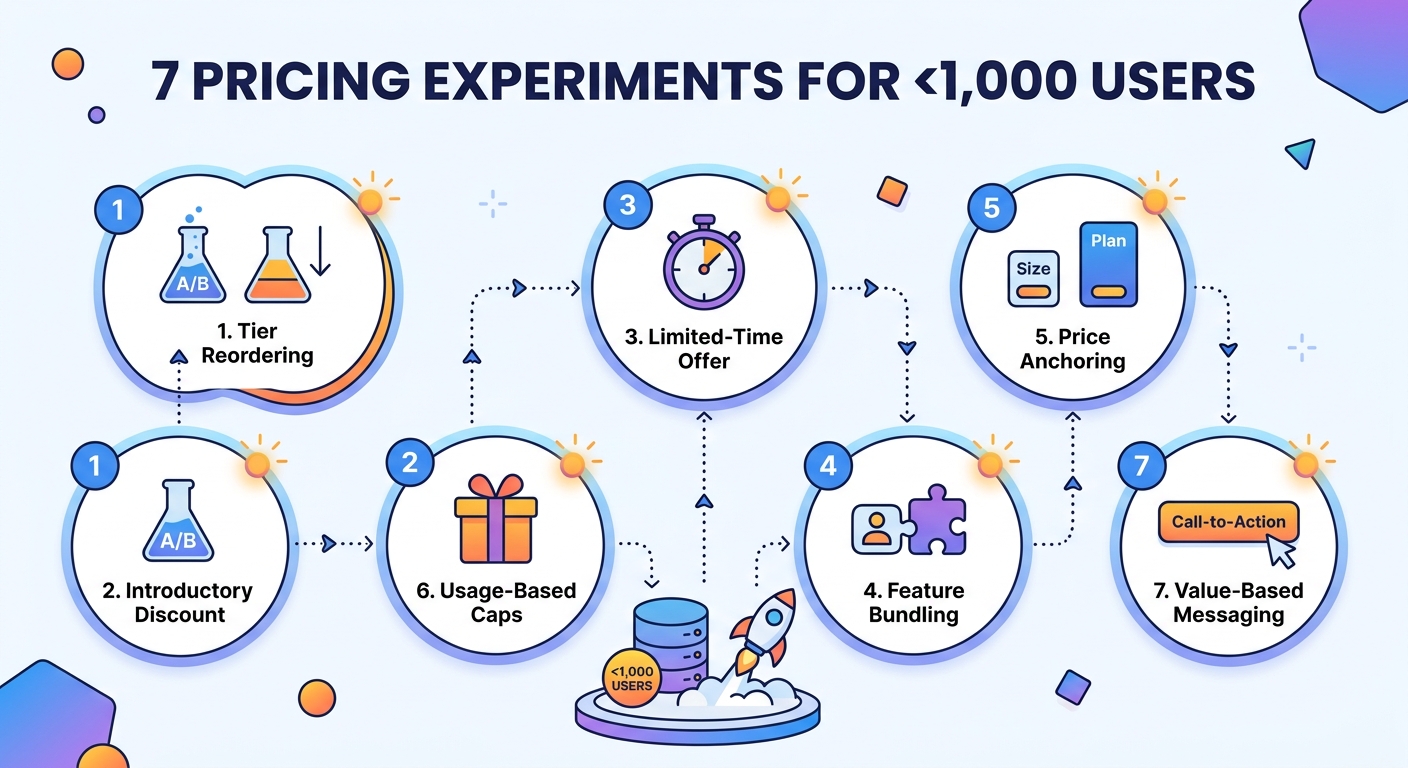
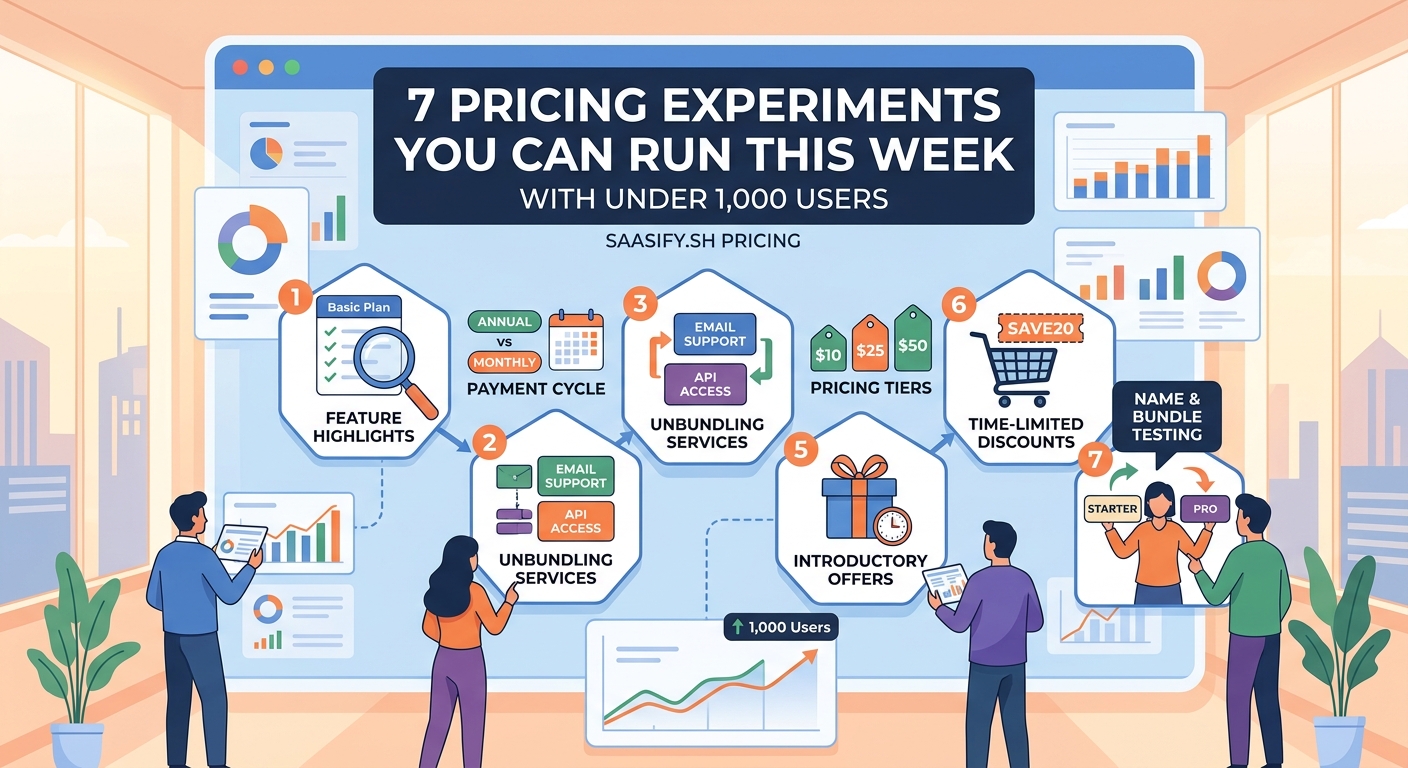
Pricing experiments with under 1,000 users focus on qualitative signals rather than statistical confidence. Test willingness to pay through landing page variants, email surveys, grandfather clause removals, add-on features, trial length adjustments, annual plan incentives, and transparent price increase communications. Each experiment takes less than a week to implement and reveals actionable insights about customer value perception.
Why small user bases are perfect for pricing tests
Working with fewer than 1,000 users gives you advantages that larger companies lose. You can talk directly to every customer. You can roll back changes without triggering mass confusion. You can move fast without coordinating across multiple teams.
The goal at this stage is not statistical perfection. You want directional insight. You want to understand what customers value and how they talk about money.
Small sample sizes force you to combine quantitative data with qualitative feedback. That combination produces better decisions than either approach alone.
Setting up your pricing experiment framework
Before running any test, document your current baseline metrics. You need reference points to measure against.
Track these numbers weekly:
- Trial-to-paid conversion rate
- Average revenue per user
- Churn rate by plan tier
- Support tickets mentioning pricing
- Time from signup to first payment
Create a simple spreadsheet. Update it every Monday morning. This habit takes 10 minutes and prevents you from misremembering your starting point.
Choose one metric as your primary success indicator for each experiment. Secondary metrics provide context, but focusing on a single number keeps your decision-making clear.
The best pricing experiments at early stage are the ones you can explain to a customer in a single sentence without making them feel manipulated.
Test 1: landing page price display variants
Your pricing page is a conversation starter, not a contract. Test different ways of presenting the same prices to see what generates more trial signups and better-qualified leads.
Create two versions of your pricing page:
- Show monthly prices prominently with annual savings mentioned below
- Show annual prices prominently with monthly option mentioned below
Split traffic 50/50 for one week. Use a simple tool or even manual URL parameters if you are working solo.
Measure signup rate and the percentage of people who choose annual plans. Also track the quality signal by looking at activation rates for each group.
This test works because it reveals whether your audience thinks in monthly budgets or prefers to commit annually. The answer changes how you structure future offers.
Test 2: direct willingness to pay surveys
Email 50 of your most engaged users with a simple question. Keep it conversational and specific.
Ask: “If we added [specific feature] to your plan, what’s the most you would pay per month for it?”
Provide four options:
– I would not pay extra for this
– $10 to $20 more per month
– $20 to $50 more per month
– Over $50 per month
Include a text box for explanation. The written responses matter more than the numbers.
Send this survey on a Tuesday morning. Follow up personally with anyone who responds. These conversations teach you how customers calculate value.
You will learn which features customers consider essential versus nice-to-have. You will also discover whether your current pricing leaves money on the table.
Test 3: removing grandfather pricing for new features
If you have been protecting early users with locked-in pricing, test whether new features can exist outside that protection. This approach respects the original deal while creating room for growth.
When you launch a new capability, offer it as an add-on to grandfathered accounts. Current pricing stays the same, but the new feature costs extra.
Announce this clearly: “Your base plan pricing never changes. This new feature is available for $X per month if you want it.”
Track two things:
– How many grandfathered users add the feature
– How many complain about the approach
Most early users understand that new capabilities built after their signup can cost extra. The ones who complain often reveal deeper dissatisfaction that pricing cannot fix.
This test helps you understand whether grandfathering early users might be killing your revenue or if your early supporters genuinely need protection.
Test 4: trial length adjustments
Your trial length affects both conversion rate and customer quality. Testing different durations reveals how long people need to experience value.
Split new signups into two groups:
– Group A gets a 7-day trial
– Group B gets a 14-day trial
Run this for two weeks minimum. Track conversion rate, time to first meaningful action, and support ticket volume per group.
Shorter trials create urgency. Longer trials give complex products time to demonstrate value. The right answer depends on your product’s aha moment timing.
Also measure 30-day retention for each group. Sometimes longer trials convert worse initially but produce better long-term customers.
| Trial Length | Best For | Risk |
|---|---|---|
| 7 days | Simple tools with immediate value | May rush complex workflows |
| 14 days | Products needing integration time | Lower urgency to convert |
| 30 days | Enterprise features or seasonal use | Forgotten trials, low conversion |
Test 5: annual plan incentive levels
Annual plans improve cash flow and reduce churn. But the discount size dramatically affects uptake.
Test three discount levels with new customers:
– 10% off (two months free)
– 16% off (two months free)
– 20% off (2.4 months free)
Present these as “pay for 10 months, get 12” style messaging. Customers understand months better than percentages.
Track not just conversion rate but also the absolute revenue per customer. A 10% discount that doubles annual plan adoption might generate more cash than a 20% discount with slightly higher adoption.
Survey customers who choose monthly plans. Ask what would make annual plans attractive. Their answers often reveal concerns about commitment, not price.
Test 6: transparent price increase communication
If you launched with unsustainably low pricing, test whether honest communication about increases preserves your customer base.
Email your users two weeks before a price increase. Explain why in plain language:
“When we started, we priced low to learn what customers valued. Now we know. We are raising prices to match the value we deliver and fund the features you have requested. Your current rate stays locked for 60 days.”
Offer three options:
– Lock in current pricing by switching to annual
– Accept the new monthly rate
– Downgrade to a lower tier
Track the percentage who churn versus those who upgrade to annual. Most founders are surprised how many customers accept reasonable increases when explained well.
This test teaches you whether your pricing was dramatically wrong or just slightly low. It also identifies your most price-sensitive segment.
Test 7: feature-gated pricing tiers
If you currently offer a single plan, test whether splitting into two tiers increases total revenue.
Create a basic tier at your current price with core features. Add a professional tier at 2x the price with advanced capabilities.
Grandfather existing customers into the professional tier. New signups choose between the two.
Measure the mix of signups across tiers and the total revenue per 100 signups. Also track whether the basic tier attracts different customer profiles than before.
This experiment works because it reveals whether a segment of your market would pay more for additional value. It also shows whether a cheaper entry point increases overall adoption.
Some founders worry about cannibalizing their existing tier. In practice, customers who want basic features were never going to use advanced ones anyway. Tiering captures both segments.
Measuring experiments without statistical significance
With under 1,000 users, you cannot achieve statistical significance on most tests. That limitation is fine. You are looking for strong signals, not academic certainty.
Consider a result meaningful if:
– The difference exceeds 20% in your target metric
– The pattern holds for two consecutive weeks
– Qualitative feedback aligns with the quantitative trend
– The result makes logical sense given your product
If a test shows a 5% difference, ignore it. If it shows a 40% difference, pay attention even with a small sample.
Combine your numbers with customer conversations. If your data suggests people prefer annual plans but conversations reveal they worry about commitment, you have learned something important regardless of sample size.
Common mistakes that invalidate results
Running too many tests simultaneously confuses your signal. Pick one experiment per two-week period.
Changing your product significantly mid-test ruins comparisons. If you ship a major feature during a pricing test, restart the experiment.
Ignoring customer complaints because “it’s just a test” damages trust. If an experiment generates negative feedback, acknowledge it publicly and explain your reasoning.
Testing pricing without improving your product creates a ceiling. Customers will only pay more if you deliver more value. Price experiments reveal what customers think you are worth today, not what they might pay tomorrow.
When to stop testing and commit
You have enough data to make a pricing decision when:
- Three experiments point in the same direction
- Customer conversations confirm what your data suggests
- You can articulate why the new pricing makes sense
- The change aligns with your revenue dashboard projections
Commit to your new pricing for at least 90 days. Constant changes confuse customers and prevent you from measuring real impact.
Document what you learned. Write down the experiments you ran, the results, and your reasoning. This record becomes valuable when you hire your first growth person or raise funding.
Building pricing experiments into your routine
Treat pricing optimization like feature development. Schedule it. Budget time for it. Review results in your weekly metrics meeting.
Create a simple testing calendar:
– Week 1-2: Run experiment
– Week 3: Analyze results and gather feedback
– Week 4: Implement changes or plan next test
This rhythm prevents pricing from becoming an emergency decision made under revenue pressure. It also builds institutional knowledge about what your customers value.
As you grow past 1,000 users, your experimentation approach will evolve. You will gain access to better tools and larger sample sizes. But the discipline you build now by running small, focused tests creates habits that scale.
Making pricing experiments part of your growth strategy
Pricing is not a one-time decision. It is an ongoing conversation with your market about value.
The experiments outlined here take minimal time to implement. Most require no special tools beyond email and a spreadsheet. All of them produce insights that improve your business even if you decide not to change prices.
Start with the test that addresses your biggest current question. If you are unsure whether customers would pay more, run the willingness to pay survey. If you suspect your trial is too long or too short, test different durations.
The act of experimenting signals to your team and customers that you are serious about building a sustainable business. It also protects you from the most common early-stage mistake: leaving your pricing unchanged for years because you are afraid to ask customers for more money.
Your pricing should evolve as your product improves and your understanding of customer value deepens. These seven experiments give you a framework for that evolution, even when your user base is still small.