
Choosing between vertical and horizontal SaaS isn’t just a strategic decision. It shapes every part of your business, from how you build features to who you hire and how fast you can grow.
Most founders pick their model by accident, then spend years fighting uphill battles they never needed to face.
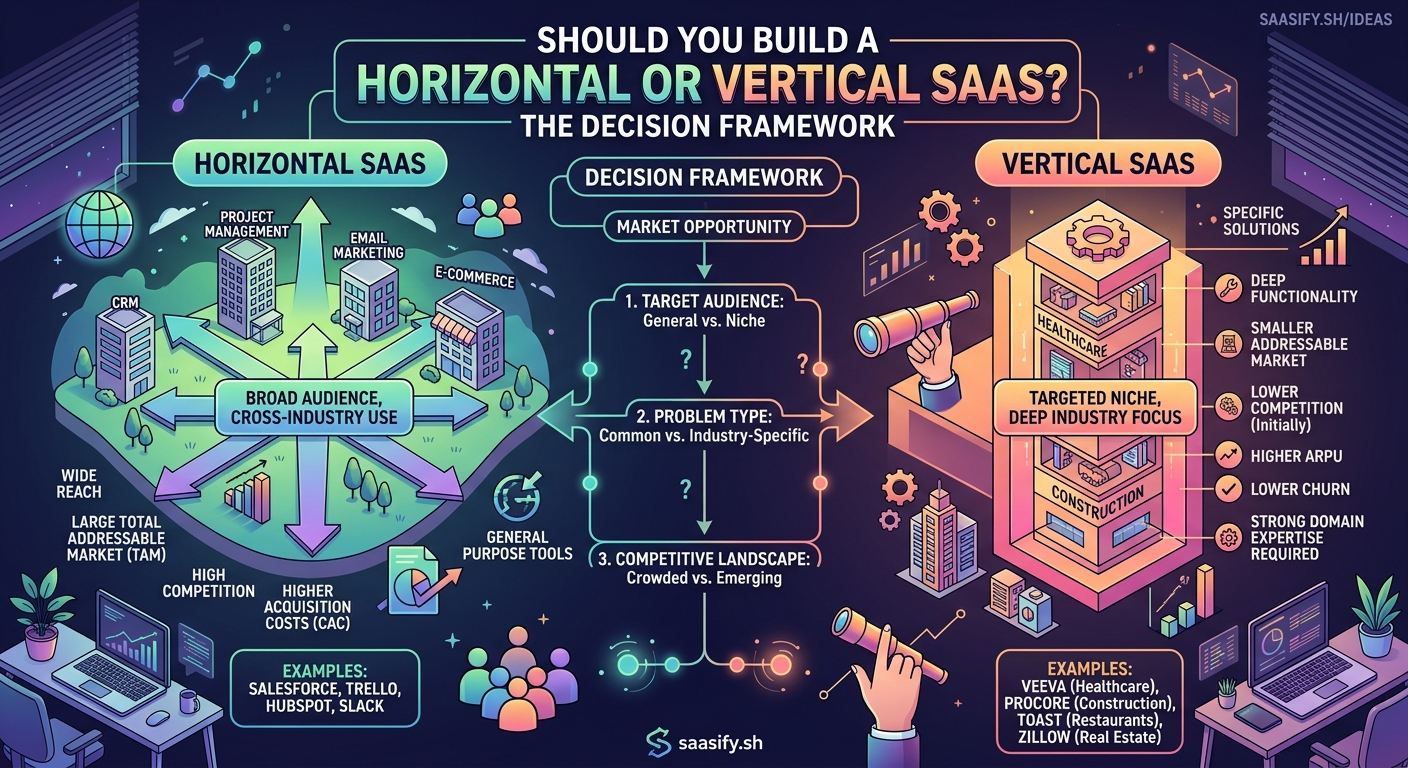
Vertical SaaS targets one specific industry with deep, specialized features. Horizontal SaaS serves multiple industries with broad, general-purpose tools. Your choice determines your go-to-market strategy, pricing power, competition level, and long-term defensibility. Neither is inherently better, but one will match your strengths, resources, and market opportunity far better than the other.
Understanding the core difference
Horizontal SaaS builds tools anyone can use.
Think Slack, Notion, or Mailchimp. These products solve common problems across every industry. A dentist and a software agency both need project management. A bakery and a law firm both send emails.
Vertical SaaS goes deep into one industry.
Vetstoria serves veterinary clinics. Toast focuses on restaurants. Procore targets construction companies. These tools speak the language of their industry, handle niche workflows, and integrate with sector-specific systems.
The difference isn’t just about target audience. It fundamentally changes how you build, sell, and scale.
Why horizontal SaaS attracts most first-time founders
Horizontal products feel safer.
Your total addressable market looks massive on paper. Every business needs email, invoicing, or time tracking. You’re not betting everything on one industry staying healthy.
Distribution seems simpler too.
You can write content that appeals to generic business problems. Your SEO keywords have high search volume. Product Hunt and Twitter give you access to diverse audiences.
The problem? Everyone else sees the same opportunity.
You’re competing against established players with decade-long head starts, massive budgets, and brand recognition. Differentiation becomes nearly impossible when you’re solving the same problems as 50 other tools.
Here’s what most founders miss about horizontal SaaS:
- You need significant capital to compete on features and marketing
- Customer acquisition costs stay high because you lack targeting precision
- Retention suffers when customers can easily switch to similar alternatives
- Your product roadmap pulls in every direction as different industries request conflicting features
The hidden advantages of vertical SaaS
Vertical SaaS feels risky because you’re putting all your eggs in one basket.
But that focus creates compounding advantages.
You become the obvious choice for your industry. When a restaurant owner asks peers what POS system to use, Toast comes up repeatedly. That word-of-mouth marketing costs you nothing and converts at rates horizontal products never achieve.
Your features create real moats.
A generic CRM can’t compete with a tool that automatically handles HIPAA compliance for medical practices or tracks job costing for contractors. These specialized capabilities take years to build and deeply understand.
Pricing power increases dramatically.
Businesses pay premium prices for tools that solve their specific problems completely. A $49/month horizontal tool competes on price. A $299/month vertical tool competes on necessity.
Validating your SaaS idea becomes more straightforward in vertical markets because you can find and interview your exact target customers.
The decision framework that actually works
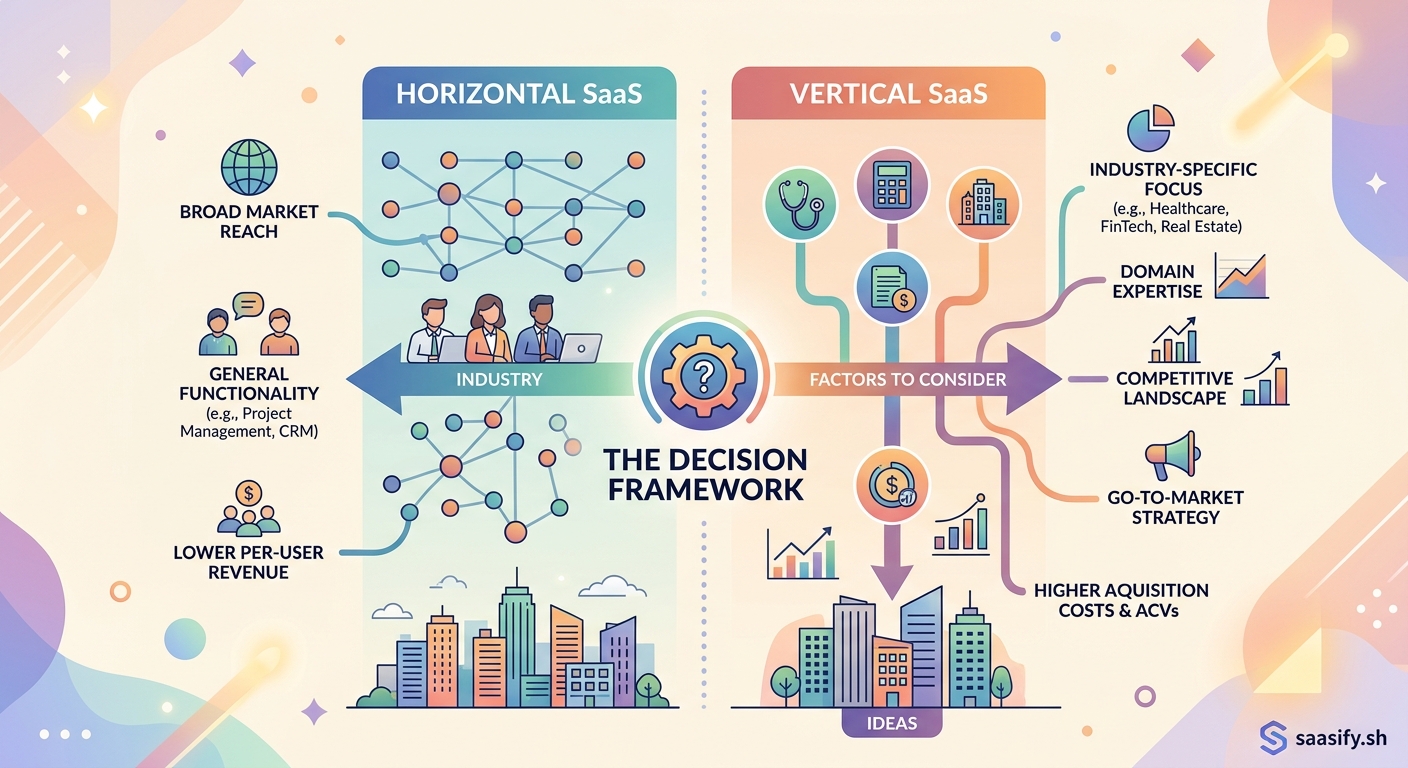
Stop asking which model is better. Start asking which model matches your situation.
Use this framework to evaluate your fit:
-
Assess your industry expertise. Do you have 5+ years working in a specific industry? Can you name the top 3 pain points without research? Do you know the compliance requirements, seasonal patterns, and vendor ecosystem? If yes, vertical makes sense. If no, you’ll spend years learning what insiders already know.
-
Evaluate your funding situation. Bootstrapping or raising less than $500K? Vertical SaaS lets you dominate a niche with limited resources. Planning to raise $2M+? Horizontal SaaS needs that capital to compete effectively.
-
Examine your distribution advantages. Do you have an audience, network, or platform in a specific industry? That’s a massive edge for vertical. Are you a generalist with broad reach? Horizontal might work better.
-
Check market timing. Is your target industry undergoing regulatory changes, technology shifts, or growth spurts? Vertical SaaS thrives during industry transitions. Stable, mature industries make vertical harder.
-
Test your competitive landscape. Count the number of established players. Horizontal markets with 10+ strong competitors require differentiation through brand, not features. Vertical markets with weak incumbents or manual processes create opportunities.
Common mistakes founders make with each model
Horizontal SaaS founders often try to be everything to everyone immediately.
They build feature bloat instead of depth. A project management tool adds time tracking, then invoicing, then CRM, then chat. Each feature is mediocre because resources spread too thin.
The better approach? Start horizontal but go deep on one use case. Notion began as a note-taking tool for individuals. Slack focused on team chat before adding workflows and apps.
Vertical SaaS founders make the opposite mistake.
They pick industries they don’t understand, then wonder why sales stall. Building accounting software for law firms sounds profitable until you realize lawyers hate changing their systems and buying decisions take 9 months.
Another trap: choosing industries that are too small.
Your niche needs enough customers to support a real business. Pet groomers might love specialized software, but if there are only 50,000 shops nationwide and half use pen and paper, your ceiling is painfully low.
Real revenue models for each approach
Horizontal SaaS typically follows freemium or low-touch sales models.
You need volume to win. Monthly prices range from $10 to $100 per user. Annual contracts help, but month-to-month is common. Customer lifetime value stays modest, so you optimize for low acquisition costs and viral growth.
Vertical SaaS supports higher prices and longer sales cycles.
Annual contracts become standard. Prices range from $200 to $2,000+ monthly depending on business size. Implementation fees, training, and support create additional revenue streams.
Here’s a comparison of typical metrics:
| Metric | Horizontal SaaS | Vertical SaaS |
|---|---|---|
| Average deal size | $500 to $2,000 annually | $3,000 to $25,000 annually |
| Sales cycle length | 1 to 14 days | 30 to 90 days |
| Customer acquisition cost | $200 to $800 | $1,000 to $5,000 |
| Gross churn (annual) | 15% to 40% | 5% to 15% |
| Time to product-market fit | 12 to 24 months | 6 to 18 months |
Pricing your SaaS product requires different strategies depending on your model.
Building your MVP for each model
Horizontal SaaS MVPs need polish.
You’re competing against established tools from day one. Users expect smooth onboarding, responsive design, and reliable performance. They’re comparing you to products that have been refined for years.
Your MVP should do one thing exceptionally well. Not ten things adequately.
Vertical SaaS MVPs can be rougher around the edges.
Industry insiders tolerate clunky interfaces if you solve their specific problem better than anyone else. A contractor who currently uses spreadsheets and paper will happily use your basic job tracking tool if it handles change orders correctly.
Focus your MVP on the workflow that causes the most pain. For restaurants, that might be table management during dinner rush. For dental offices, it could be insurance verification.
Building a SaaS MVP in 30 days is more realistic with vertical products because you can cut scope aggressively.
Marketing and customer acquisition differences
Horizontal SaaS demands content volume.
You’re fighting for attention in crowded categories. SEO requires hundreds of articles targeting every variation of your core keywords. Paid ads get expensive fast because you’re bidding against competitors with deep pockets.
Social media and community building become critical. You need constant visibility because customers have endless alternatives.
Vertical SaaS wins through targeted presence.
You can dominate your niche with 30 well-crafted articles about industry-specific problems. Attend the three conferences your customers actually go to. Sponsor the podcast they all listen to. Join the Facebook groups where they ask questions.
Your marketing becomes a rifle, not a shotgun.
“The best vertical SaaS companies don’t just understand their industry. They become part of its fabric. They hire from within it, speak at its events, and shape its conversations. That insider status is impossible to replicate and incredibly valuable.” — Former VP of Sales at a $100M vertical SaaS company
Technical architecture considerations
Horizontal SaaS needs flexible data models.
You’re serving diverse use cases, so your database schema must accommodate different workflows without breaking. Multi-tenancy becomes complex when customers want wildly different configurations.
API-first architecture matters more because integrations span hundreds of potential tools. Your product becomes a platform that connects to everything.
Vertical SaaS benefits from opinionated architecture.
You can hard-code industry assumptions. A restaurant POS knows tables have numbers, orders have courses, and shifts have specific times. This rigidity actually speeds development because you’re not building for infinite flexibility.
Your integrations focus on 5 to 10 critical tools everyone in the industry uses. Go deep on those rather than shallow on hundreds.
Choosing the right tech stack depends heavily on whether you’re building horizontal or vertical.
The talent and team implications
Horizontal SaaS teams need product generalists.
Your product managers should understand broad business problems. Designers focus on universal usability principles. Engineers build flexible systems that adapt to different use cases.
Sales and support teams handle diverse customer types daily. Training becomes harder because every customer has unique needs.
Vertical SaaS teams benefit from industry specialists.
Hire people who worked in your target industry. A former restaurant manager makes a better product manager for restaurant software than someone with a generic PM background. They intuitively understand the problems and can validate solutions faster.
Your support team becomes consultants who speak the industry’s language. Customers trust them more and churn less.
Growth trajectory and exit potential
Horizontal SaaS grows faster early but plateaus harder.
You can acquire customers from any industry, so initial growth feels explosive. But you hit ceilings when marketing efficiency drops and competition intensifies. Scaling past $10M ARR requires significant capital and team expansion.
Exit multiples vary widely. Generic tools in crowded categories sell for 3x to 6x revenue. Differentiated horizontal platforms with strong network effects can reach 10x to 15x.
Vertical SaaS grows steadily and compounds longer.
Your first customers come slowly. You’re learning the industry and building credibility. But once you establish product-market fit, growth becomes predictable. You can model exactly how many target customers exist and what percentage you can capture.
Exit multiples for vertical SaaS often exceed horizontal because:
- Strategic buyers (industry incumbents) pay premiums to acquire technology and customer bases
- Private equity firms love the predictable revenue and low churn
- Consolidation plays make sense when you dominate a niche
Making the final call
Your decision comes down to honest self-assessment.
Choose horizontal SaaS if you:
- Have significant funding or can raise it easily
- Excel at broad marketing and brand building
- Enjoy rapid iteration and constant pivoting
- Can compete on design and user experience
- Want to build a large team quickly
Choose vertical SaaS if you:
- Have deep expertise in a specific industry
- Prefer focused, efficient operations
- Value pricing power over market size
- Can access industry networks and distribution
- Want to bootstrap or raise minimal capital
Neither path is easier. Both can build massive businesses.
The founders who succeed are the ones who pick the model that matches their strengths, then commit fully to its requirements.
Finding profitable micro-SaaS niches often reveals vertical opportunities that horizontal players ignore.
Your next 30 days
Stop debating the decision in your head.
Spend the next month testing your assumptions:
- Interview 20 potential customers in your target market
- Map out the three biggest competitors and their weaknesses
- Calculate realistic customer acquisition costs for your channels
- Estimate how long it takes to build your core features
- Project your first year revenue based on conservative conversion rates
The data will tell you which model fits your reality.
Then commit. Build something people need. Charge what it’s worth. Grow sustainably.
The vertical vs horizontal SaaS debate matters less than building something that solves real problems for real people. Pick your path, validate it thoroughly, and execute relentlessly.