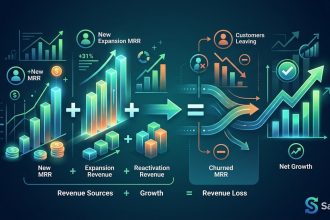
Building a SaaS product that people love is one thing. Getting it in front of the right people and turning them into paying customers is a completely different game. In 2026, the market is more crowded than ever, and the old playbook of buying ads and hoping for the best just does not cut it. You need a system. You need a curated set of tools that work together to drive what matters most: product-led growth. This is your SaaS growth stack for 2026.
A modern SaaS growth stack is not just a list of tools. It is a strategic framework that connects product analytics, user onboarding, engagement messaging, and pricing experiments into one loop. The goal is to turn every free user into a revenue source without relying on a big sales team. Focus on the four core layers: data, activation, conversion, and retention.
The Four Layers of a Growth Stack That Actually Works
Think of your growth stack as a funnel with four distinct layers. Each layer has a specific job, and the tools you choose for each layer must talk to each other. If they do not, you will have data silos and missed opportunities.
Layer 1: Product Analytics and User Behavior
You cannot improve what you do not measure. Your analytics layer is the foundation. It tells you where users drop off, which features they use, and what paths lead to a subscription.
Layer 2: Onboarding and Activation
This layer is about getting users to that “aha” moment as fast as possible. It includes in-app guides, checklists, and tooltips. If a user does not experience the core value of your product within the first session, they likely never will.
Layer 3: Engagement and Messaging
Once a user is activated, you need to keep them engaged. This layer handles email campaigns, in-app messages, push notifications, and even SMS. The key here is personalization, not spam.
Layer 4: Conversion and Revenue Orchestration
This is where the magic happens. This layer includes pricing page optimization, trial-to-paid conversion flows, and usage-based billing logic. It also includes tools for handling payments and subscriptions.
How to Choose Your Tools Without Analysis Paralysis
There are thousands of tools on the market. The trick is to start with one tool per layer and integrate them. Here is a simple process to follow:
- Map your user journey. Write down every step a user takes from landing on your site to becoming a paid customer. Identify the critical moments where they decide to stay or leave.
- Pick one tool for your weakest layer. If your trial conversion rate is low, start with the conversion layer. Do not buy an expensive analytics suite if you do not even know your basic activation rate.
- Integrate before you add. Make sure your new tool sends data back to your analytics layer. For example, your onboarding tool should report completion rates to your product analytics dashboard.
- Run a two-week experiment. Set a specific goal, like increasing activation by 15%. Use the tool to run the experiment, measure the result, and decide if the tool stays.
- Iterate and stack. Once one layer is stable, move to the next. Over time, you will build a complete stack that is custom fit for your product.
The Tools You Need in Your Stack
Below is a breakdown of the categories and some considerations for each. This is not an exhaustive list, but it covers the essentials for a product-led growth motion in 2026.
| Category | Primary Function | Common Mistakes |
|---|---|---|
| Product Analytics | Track user behavior, feature usage, and drop-off points. | Installing tracking but never looking at the data. |
| Onboarding & Adoption | Guide users to the “aha” moment with checklists and tours. | Making the onboarding too long or skipping mobile users. |
| Engagement & Messaging | Send targeted emails, in-app messages, and push notifications. | Sending the same message to every user. |
| Conversion & Pricing | Handle payments, trials, and pricing page experiments. | Changing pricing without testing it on a segment first. |
“The best growth tool in the world will not save a product that is confusing. Before you buy anything, spend a week watching user recordings. The insights are free and they are often more valuable than any dashboard.” – Advice from a bootstrapped founder who grew to $30K MRR without a sales team.
The 3-Step Framework to Build Your Own Stack
You do not need to copy someone else’s stack. Your product, audience, and business model are unique. Use this framework to build your own.
-
Start with the data layer. Choose a product analytics tool that lets you create cohorts and funnels. This is non-negotiable. Without it, you are flying blind. If you are just starting out, consider free tiers of tools like PostHog or a simple setup with Plausible. For a deeper look at what metrics matter, check out our guide on the 5-metric framework for early-stage SaaS.
-
Add an activation layer. Pick a tool that can create in-app experiences without requiring a full engineering sprint. Look for something that integrates with your analytics tool so you can see which onboarding flows lead to higher retention. You can learn more about building features that users actually want in our validation framework guide.
-
Layer on engagement and conversion. Finally, add a tool for email and in-app messaging, and a separate tool for payments and subscription management. Make sure your messaging tool can pull data from your analytics tool to send behavior-based emails. For payments, compare options like Stripe, Paddle, and Lemon Squeezy in our complete payment guide.
Common Mistakes That Stall Your Growth Stack
Even with the right tools, things can go wrong. Here are the most common pitfalls and how to avoid them.
- Buying too many tools at once. You end up with a mess of integrations and no clear data. Start with one tool per layer.
- Ignoring the free tier. Many tools have generous free plans for small teams. Use them. Do not pay for enterprise features you do not need yet.
- Forgetting about mobile. A huge portion of SaaS signups now happen on mobile. Make sure your onboarding and messaging tools work perfectly on a phone screen.
- Setting and forgetting. A growth stack is not a set-it-and-forget-it thing. You need to review your funnels monthly and adjust your tools and flows based on the data.
Putting It All Together for 2026
The SaaS growth stack for 2026 is not about having the most expensive tools. It is about having the right tools that work together to create a smooth, data-driven user experience. Start with the data layer, add activation, then build out your engagement and conversion layers. Run experiments, measure results, and iterate.
Your goal is to build a system where the product itself does the selling. When your stack is aligned, every new user has a clear path to value, and every paying customer feels like the product was built just for them. That is the power of a well-built growth stack. Now go pick your first tool and start building.