You’ve built something. It works. Now you need people to pay for it.
But you’re staring at a $0 marketing budget, wondering how anyone finds their first customers without throwing money at Facebook or Google. The good news? Some of the most successful SaaS products got their first 10 customers through free channels that required time and creativity instead of cash.
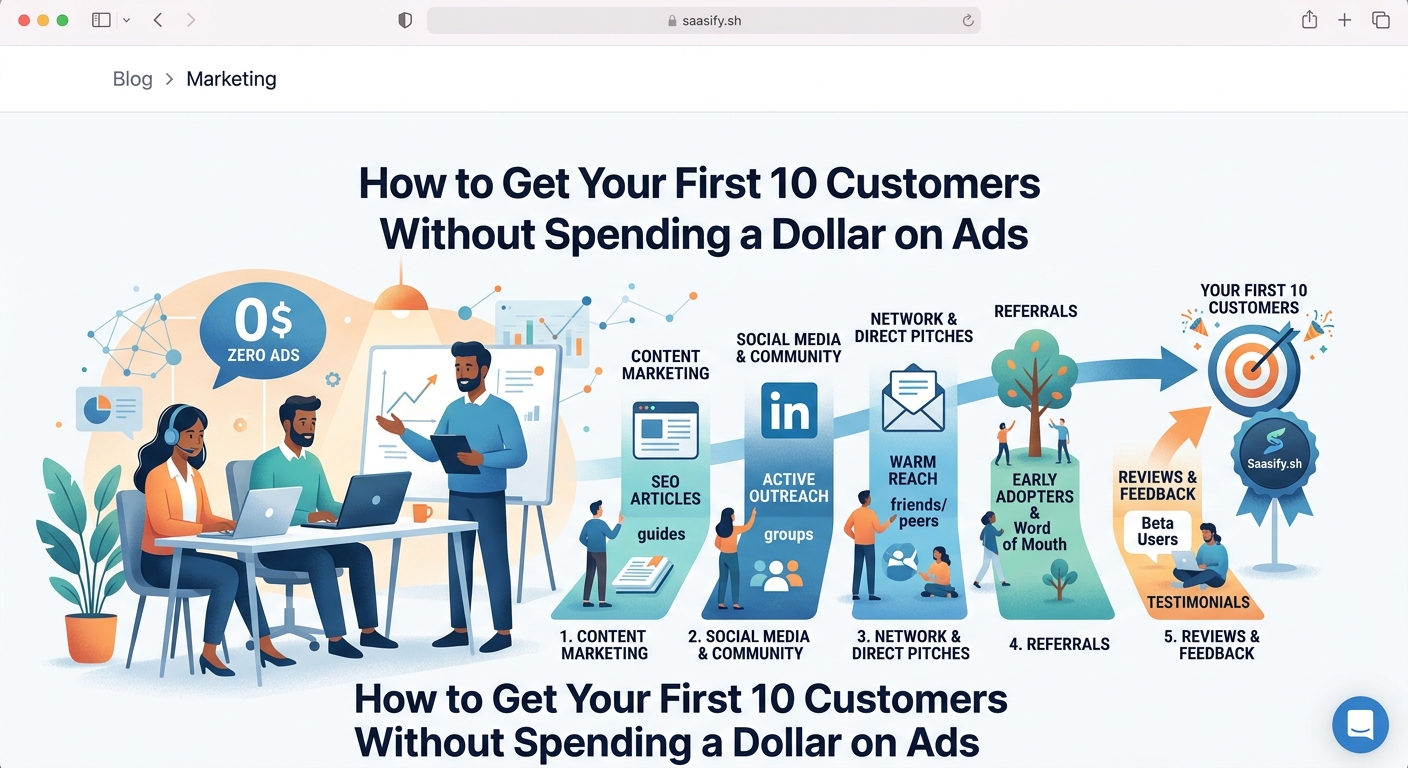
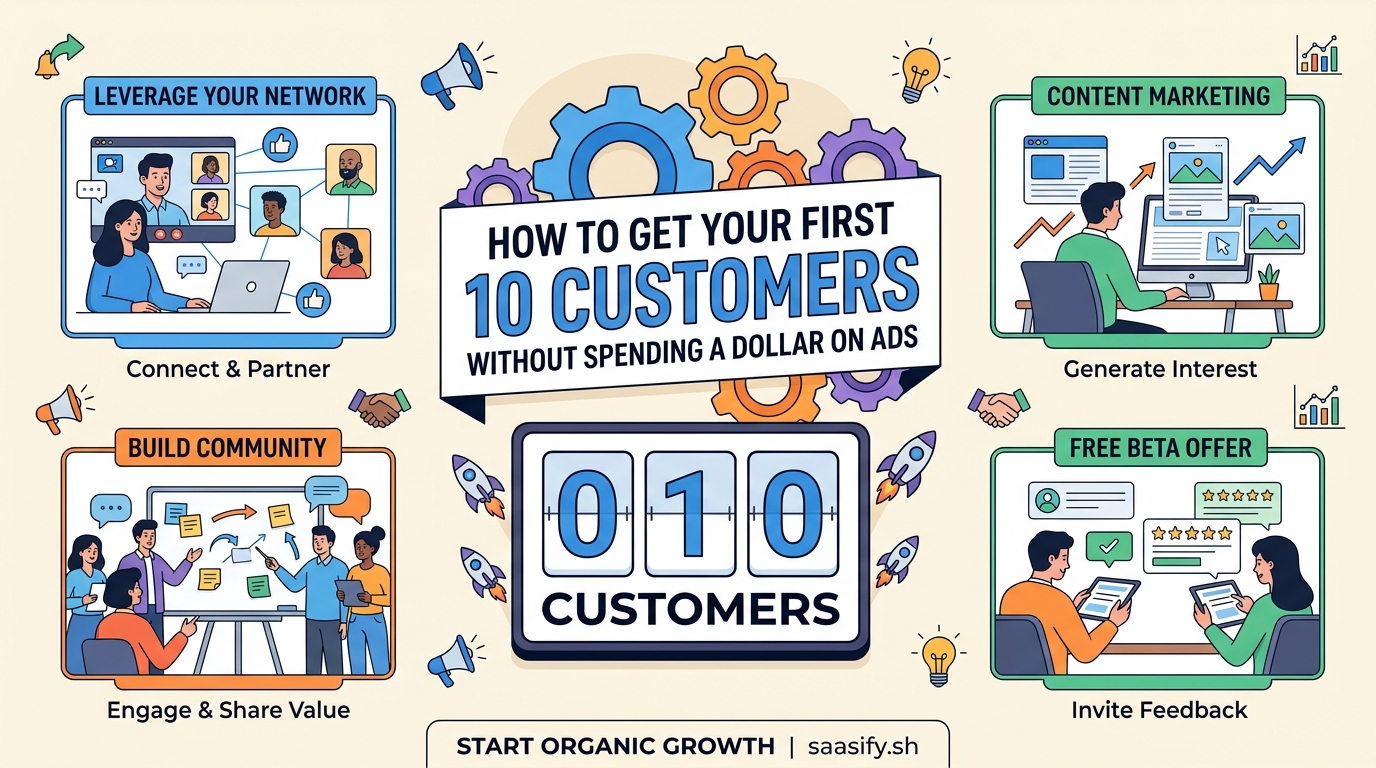
Getting your first 10 customers without ads requires strategic effort in communities where your target users already gather. Focus on solving specific problems through direct outreach, valuable content, and genuine relationship building. These early customers validate your product and provide feedback that shapes your roadmap. The methods that work at this stage are manual, personal, and don’t scale, but that’s exactly what makes them effective for finding product-market fit.
Why your first 10 customers matter more than you think
Your first 10 customers are not just revenue.
They’re your validation signal. They tell you if people will actually pay for what you built. They become your feedback loop, your case studies, and often your best advocates.
Most founders treat customer acquisition like a numbers game from day one. They want scale before they have substance. But at zero customers, you don’t need a funnel. You need conversations.
The strategies that get you to 10 customers look nothing like the strategies that get you to 100. They’re manual. They’re personal. They don’t scale. And that’s the point.
The foundation you need before reaching out
Before you start looking for customers, make sure you can answer these questions clearly:
- Who specifically has the problem you solve?
- Where do they spend time online?
- What words do they use to describe their pain?
- What’s the smallest valuable outcome you can deliver?
If you’re fuzzy on any of these, you’ll waste weeks talking to the wrong people. Building features users actually want starts with knowing exactly who you’re building for.
Your landing page should explain what you do in one sentence. Not what you think is clever. What makes sense to someone who landed there by accident.
Test this by showing it to someone outside your industry. If they can’t repeat back what you do, rewrite it.
Finding your first customers in online communities
Reddit, niche forums, Slack groups, Discord servers, and Facebook groups are where your early customers are talking about their problems right now.
Here’s how to find them without getting banned:
- Search for communities where your target users gather
- Spend one week just reading and commenting helpfully
- Answer questions related to your domain without mentioning your product
- Build credibility by being genuinely useful
- Only mention your solution when someone asks a question it directly solves
The ratio matters. For every one self-promotional comment, you should have at least 10 helpful ones.
Marketing on Reddit without getting banned requires patience and authenticity. Communities can smell a sales pitch from a mile away.
Look for these high-value community types:
- Industry-specific Slack workspaces
- Subreddits with 5,000 to 50,000 members (big enough to be active, small enough to notice you)
- Facebook groups for specific professions
- Discord servers for niche hobbies or tools
- Forums that Google still indexes well
Document where you find the best conversations. You’ll return to these channels repeatedly.
Cold outreach that doesn’t feel gross
Cold email gets a bad reputation because most people do it wrong.
Here’s what doesn’t work: “Hi [FIRST_NAME], I noticed your company and thought you might be interested in our revolutionary solution…”
Here’s what does work: specific, personalized messages to people who clearly have the problem you solve.
Your cold outreach process should look like this:
- Identify 10 people who match your ideal customer profile exactly
- Research each person for 5 minutes (LinkedIn, their website, recent posts)
- Find a specific problem they mentioned or a relevant context
- Write a short email that references that context and offers a specific solution
- Include one clear call to action
Keep it under 75 words. Make it about them, not you.
Writing cold emails that get demo bookings comes down to relevance and timing. If you can’t explain why you’re reaching out to this specific person right now, don’t send it.
Subject lines that work:
- “[Specific problem] solution for [their company]”
- “Saw your post about [specific thing]”
- “Fellow [shared identity] built something for you”
Avoid anything that sounds like a template. People delete templates.
Creating content that attracts your first users
Content marketing sounds slow, but it can generate customers within days if you target the right keywords.
Focus on bottom-of-funnel content. These are searches people make when they’re ready to buy or try something:
- “Best [tool type] for [specific use case]”
- “How to [solve problem] without [expensive solution]”
- “[Tool name] alternative for [specific need]”
- “[Problem] solution for [specific industry]”
Write one piece of content per week. Publish it on your blog, then share it in relevant communities where people are asking that exact question.
Building a content engine on 2 hours per week is possible when you focus on search intent instead of vanity metrics.
Your content should:
- Answer one specific question completely
- Include real examples and screenshots
- End with a natural mention of how your product helps
- Link to your signup or demo page
Don’t write about your product features. Write about the problems those features solve.
Leveraging your network without being annoying
Your existing network is your fastest path to your first few customers.
But there’s a right way and a wrong way to ask for help.
Wrong way: “Hey everyone, I just launched a new product! Check it out and let me know what you think!”
Right way: Direct messages to specific people who have the problem you solve, asking if they’d be willing to try it and give feedback.
Make a list of:
- Former colleagues who work in your target industry
- Friends who have mentioned related problems
- People you’ve helped in the past
- Professional contacts from conferences or meetups
Reach out to them individually. Explain what you built and why you thought of them specifically. Offer it for free or heavily discounted in exchange for honest feedback.
Most people want to support someone they know. But they need to understand how it helps them, not just that you need customers.
Building in public to attract early adopters
Sharing your journey publicly creates multiple customer acquisition paths.
Tweet about what you’re building. Share screenshots. Post metrics. Talk about problems you’re solving.
This works because:
- It builds an audience before you launch
- It creates accountability and momentum
- It attracts people who want to support indie builders
- It generates organic conversations about your product
The real pros and cons of building in public depend on your personality and target market. Not everyone needs to see your entire process.
But even a modest building-in-public approach can generate your first customers through:
- Twitter/X threads about your progress
- LinkedIn posts sharing lessons learned
- Dev.to or Hashnode articles about technical decisions
- YouTube videos showing your process
- Indie Hackers updates on your milestones
The key is consistency. Post at least three times per week. Engage with people who comment. Answer questions. Be helpful.
Product launches that generate immediate traction
A coordinated launch can bring your first 10 customers in a single day.
Focus on platforms where early adopters gather:
- Product Hunt
- Hacker News
- BetaList
- Indie Hackers
- Niche communities specific to your industry
The 48-hour Product Hunt playbook breaks down exactly how to prepare for launch day. Most successful launches start with preparation two weeks before.
Your launch checklist:
- Build a small group of supporters before launch day
- Prepare all assets (screenshots, videos, descriptions)
- Write a compelling tagline that explains your value in 10 words
- Schedule your launch for Tuesday, Wednesday, or Thursday
- Engage with every comment and question personally
- Share your launch across all your channels
Don’t expect a Product Hunt launch to solve all your problems. But it can generate initial visibility and your first paying customers if your product solves a real problem.
Offering early access and founder deals
People love being first. They love getting deals that won’t be available later.
Use this to your advantage.
Create a founder’s tier:
- Lifetime access at a heavily discounted rate
- Or first-year pricing that’s 50-70% off
- Or free access in exchange for detailed feedback
Make it clear this is a limited-time offer for your first customers only. Create urgency without being pushy.
How to price your SaaS with zero customers is tricky, but early-stage pricing should prioritize learning over revenue.
Your early customers are paying for:
- The chance to shape the product
- Direct access to the founder
- Better pricing than anyone will get later
- The satisfaction of supporting something new
Make them feel like partners, not just users.
Turning free users into paying customers
You might need to give away free access to get your first users in the door.
That’s fine. But have a conversion plan.
Set clear expectations:
- This is a free trial for [specific duration]
- You’re looking for feedback in exchange for access
- You’ll reach out at [specific milestone] to discuss pricing
After they’ve used your product for a week or two, schedule a call. Ask:
- What problem were you trying to solve?
- How well did the product solve it?
- What would make it worth paying for?
- What’s a fair price for the value you’re getting?
These conversations give you pricing insights and often convert directly to paid customers. People who get value from your product want to support it, especially if they’ve talked to you personally.
Common mistakes that waste time
Here’s what doesn’t work when trying to get your first 10 customers:
| Mistake | Why it fails | What to do instead |
|---|---|---|
| Posting “I built a thing” with no context | People don’t care about your product, they care about their problems | Lead with the problem you solve |
| Mass emailing everyone you know | Generic messages get ignored | Personalize outreach to people who clearly need your solution |
| Building more features before getting users | You’re guessing at what people want | Get users first, then build what they ask for |
| Waiting for the perfect moment to launch | Perfect never comes | Launch when it works, even if it’s rough |
| Trying every channel at once | You spread yourself too thin | Pick two channels and do them well |
| Giving up after one week | Traction takes time | Commit to 30 days of consistent effort |
The biggest mistake is treating customer acquisition like a passive process. Nobody will find your product by accident. You have to put it in front of people.
Your 30-day customer acquisition plan
Here’s a realistic plan for getting your first 10 customers in one month:
Week 1: Foundation
– Finalize your landing page and signup flow
– Identify three communities where your customers gather
– Write down 20 people who might be good early customers
– Create a list of 10 keywords you want to rank for
Week 2: Outreach
– Join the communities and start contributing
– Send personalized emails to 10 potential customers
– Publish one piece of content targeting a specific keyword
– Share your progress on social media three times
Week 3: Launch
– Prepare your Product Hunt or Hacker News launch
– Line up supporters who will engage on launch day
– Create launch-specific content and assets
– Reach out to your network about your upcoming launch
Week 4: Convert
– Execute your launch
– Follow up with everyone who showed interest
– Have pricing conversations with free users
– Double down on the channel that’s working best
This plan assumes you’re spending 2-3 hours per day on customer acquisition. If you can spend more, you’ll see results faster.
The 30-day pre-launch marketing plan goes deeper on preparing before your product is ready.
Measuring what actually matters
At this stage, vanity metrics don’t help you.
Track these instead:
- Number of conversations with potential customers
- Number of people who signed up or requested access
- Number of people who completed your onboarding
- Number of people who are actively using your product
- Number of people who paid
Your goal is 10 paying customers. Everything else is a leading indicator.
Keep a simple spreadsheet:
- Name
- How they found you
- Date they signed up
- Date they started using the product
- Date they became a paying customer
- Feedback or notes
This becomes your customer research database. You’ll reference it constantly as you grow.
What to do after you hit 10 customers
Getting to 10 customers proves you can get customers.
Now you need to figure out which acquisition channel is most efficient for you.
Look at your spreadsheet. Where did most of your customers come from? That’s your signal.
If five came from Reddit, double down on Reddit. If four came from cold email, send more cold emails. If six came from content, write more content.
Distribution channels solo founders use become clearer after you have data on what’s working.
Your next milestone is 50 customers. The strategies that got you to 10 will get you there, but you’ll need to systematize them.
“The work that gets you from 0 to 10 customers is completely different from 10 to 100. Don’t try to scale what doesn’t work yet. First, prove that people will pay. Then, figure out how to reach more of them.” – Indie SaaS founder who bootstrapped to $500K ARR
The real work starts now
Getting your first 10 customers without ads isn’t about finding a hack or a secret channel.
It’s about putting your product in front of people who have the problem you solve, having real conversations, and delivering value.
The channels are free. The work is not.
You’ll send emails that get ignored. You’ll post in communities and get no response. You’ll launch and hear crickets. That’s normal.
The difference between founders who get their first 10 customers and those who don’t is simple: the ones who succeed keep going.
Pick two channels from this guide. Commit to working them consistently for 30 days. Track what happens. Adjust based on what you learn.
Your first 10 customers are out there. They just don’t know you exist yet.