You just launched your micro-SaaS. You’ve got a working product and exactly zero customers. Your budget is tight, maybe nonexistent. You need marketing channels that actually work without draining your bank account.
Most marketing advice assumes you have money to spend. But bootstrapped founders need different tactics. The good news? Some of the most effective marketing channels for small businesses cost almost nothing except your time.
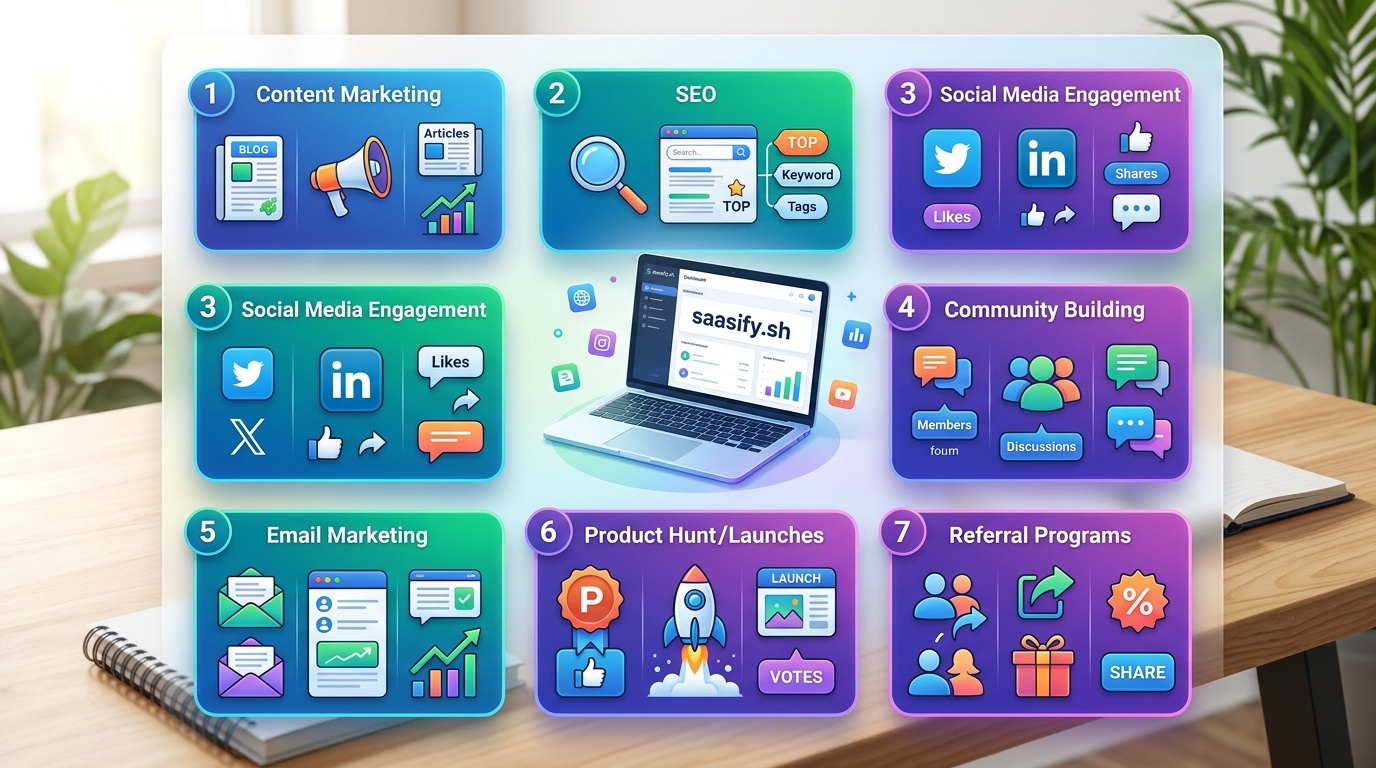
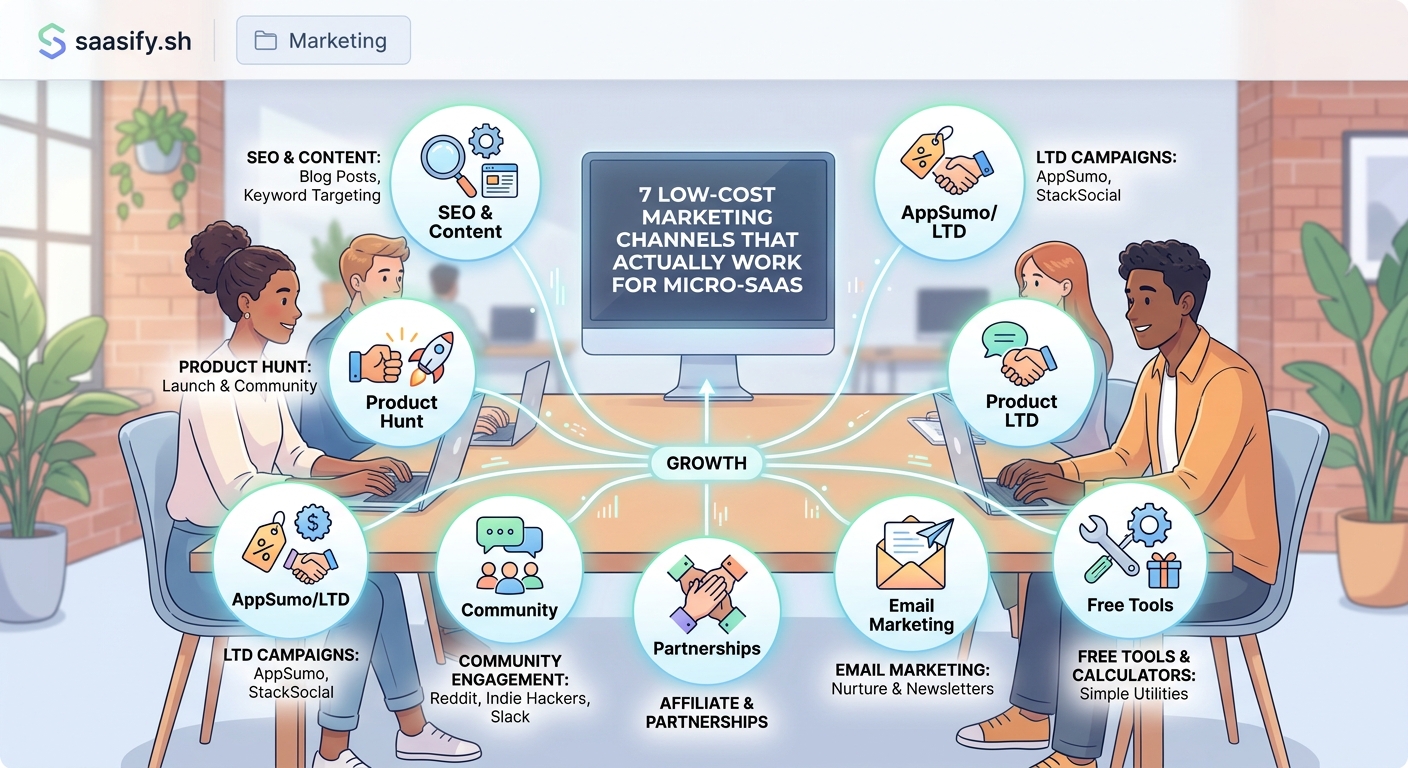
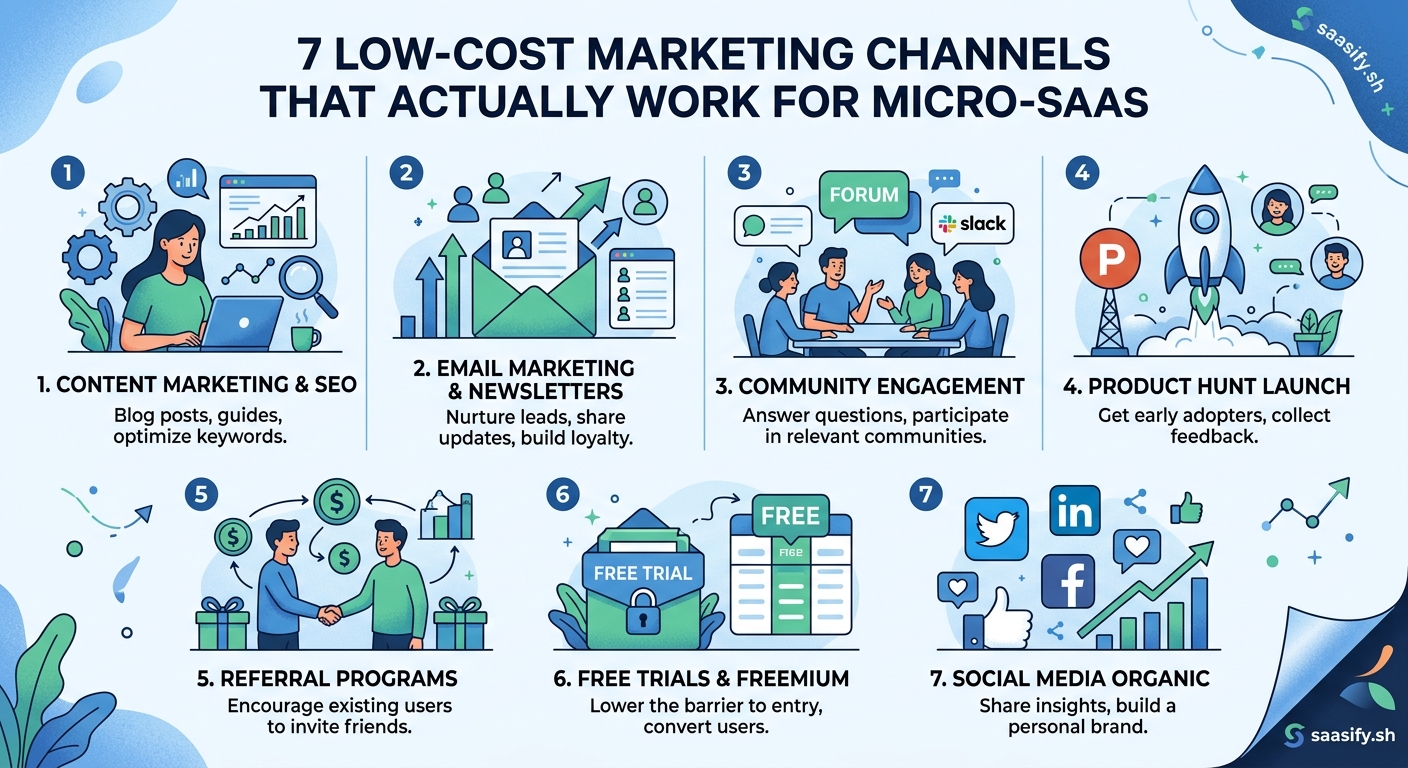
Small businesses can acquire customers through seven proven channels that require minimal budget: content marketing, community engagement, email outreach, product launches, organic social, strategic partnerships, and customer referrals. Success comes from choosing one or two channels, executing consistently, and measuring results before scaling. Most founders waste time spreading effort across too many channels instead of mastering the ones that match their audience and skillset.
Content Marketing That Actually Drives Signups
Content marketing sounds boring. It is boring. But it works.
You’re not writing to entertain. You’re writing to solve problems your potential customers are searching for right now.
Start with keyword research using free tools like Google’s autocomplete or AnswerThePublic. Find questions your target audience is asking. Then answer them better than anyone else.
Here’s what works:
- Write tutorials that solve specific problems
- Create comparison posts between tools in your space
- Build calculators or templates people can use immediately
- Document your process publicly
The trick is publishing consistently. One post per week beats ten posts in one month followed by silence.
You need at least 20 solid articles before you’ll see meaningful traffic. That’s five months of weekly publishing. Most founders quit after three posts because they don’t see instant results.
Building your first email list gives you a way to capture readers who aren’t ready to buy yet.
Start with content that targets people ready to buy, not just browsing. “How to choose” and “best alternatives to” posts convert better than educational content for beginners.
Community Engagement Without Being Spammy
Communities hate self-promotion. But they love people who genuinely help.
Find where your target customers hang out. Reddit, niche forums, Slack groups, Discord servers, Facebook groups. Join them. Then spend two weeks just reading and learning the culture.
After you understand the community norms, start helping. Answer questions. Share insights. Provide value without mentioning your product.
Only after you’ve built credibility can you mention your tool when it’s genuinely relevant. Even then, frame it as “I built this to solve exactly this problem” rather than “check out my product.”
The ratio matters. For every one mention of your product, you should have 20 helpful comments that don’t mention it at all.
Reddit marketing requires specific tactics to avoid getting banned while still driving signups.
Email Outreach That Gets Responses
Cold email works if you do it right. Most people do it wrong.
The difference between spam and effective outreach is personalization. Not just inserting someone’s name. Real personalization means understanding their specific situation and offering something valuable.
Here’s a simple framework:
- Research 10 potential customers thoroughly
- Find a specific problem they’re facing
- Offer genuine help or insight
- Mention your product only if it’s directly relevant
- Keep the entire email under 75 words
Send these manually. No bulk tools. No templates. Each email should feel like you wrote it specifically for that person.
Your response rate should be above 20%. If it’s lower, your targeting or messaging needs work.
Cold email templates can help structure your outreach without sounding robotic.
Product Launches on the Right Platforms
Launching on Product Hunt, Hacker News, or similar platforms can drive hundreds of visitors in a single day. But timing and preparation matter more than the product itself.
Product Hunt launches work best on Tuesday, Wednesday, or Thursday. Avoid Mondays and Fridays. You need to rally support before launch day, not during it.
Build a list of people who will upvote and comment in the first hour. The algorithm rewards early engagement. Ten upvotes in the first hour beats 100 upvotes spread across the day.
Hacker News is different. The community values technical depth and honesty. Show your work. Explain your decisions. Be ready to engage in the comments for hours.
Here’s what to prepare:
- A compelling tagline under 60 characters
- Screenshots that show value immediately
- A launch video under two minutes
- Responses to common objections
- A special launch offer
Pre-launch waitlists help you build momentum before your official launch day.
Most launches fail because founders treat them as one-time events. Your launch is just the beginning of ongoing promotion.
Organic Social Media Done Right
Social media doesn’t require posting three times per day. It requires posting valuable content consistently on the right platform.
Pick one platform where your customers actually spend time. For B2B SaaS, that’s usually Twitter or LinkedIn. For consumer products, maybe Instagram or TikTok.
Your content should follow the 80/20 rule. Eighty percent helpful, educational, or entertaining content. Twenty percent promotion.
Share your journey. Post screenshots of your progress. Document what you’re learning. People connect with humans, not faceless companies.
The algorithm rewards engagement. Ask questions. Run polls. Respond to every comment in the first hour.
Here’s a simple posting schedule:
- Monday: Share a lesson learned
- Wednesday: Post a tip or tutorial
- Friday: Show progress or behind-the-scenes
You don’t need thousands of followers. You need the right followers. A hundred engaged people in your target market beats ten thousand random followers.
Building in public works because it creates accountability and attracts people who want to follow your journey. Some will become customers.
Strategic Partnerships That Actually Work
Partnerships sound corporate. But for small businesses, they’re just mutually beneficial relationships.
Find products or services that serve the same audience but aren’t direct competitors. Reach out with a specific collaboration idea.
The key is making it easy for them. Don’t ask “want to partner?” Ask “can I write a guest post for your audience about X?”
Types of partnerships that work:
- Guest posting on complementary blogs
- Co-hosting webinars or workshops
- Integration partnerships
- Affiliate or referral arrangements
- Bundle deals
Start small. A single guest post can drive more qualified traffic than months of social media posting.
The best partnerships come from genuine relationships. Engage with potential partners on social media. Comment on their content. Share their work. Build the relationship before asking for anything.
Customer Referrals From Day One
Your best marketing channel is your existing customers. Even if you only have five.
Build referral mechanics into your product from the start. Not a complex referral program. Just make it easy for happy customers to tell others.
Simple tactics that work:
- Add “Powered by [Your Product]” to free accounts
- Include social sharing in key workflows
- Send a “how’s it going?” email after two weeks
- Ask for testimonials after wins
- Offer incentives for referrals
The timing matters. Ask for referrals right after someone experiences value. Not during onboarding. Not randomly. Right after they accomplish something meaningful with your product.
Make the ask specific. “Know anyone else struggling with X?” works better than “tell your friends.”
Track where signups come from. If customers are already referring others organically, double down on making that easier.
Measuring What Actually Matters
You can’t optimize what you don’t measure. But don’t measure everything. Focus on metrics that drive decisions.
For each marketing channel, track:
- Time invested per week
- Visitors generated
- Signups created
- Conversion rate to paid
- Customer acquisition cost
| Channel | Time Investment | Best For | Avoid If |
|---|---|---|---|
| Content Marketing | 5-10 hours/week | Long-term growth | You need customers now |
| Community Engagement | 3-7 hours/week | Building trust | Your audience isn’t there |
| Email Outreach | 2-5 hours/week | B2B products | Consumer products |
| Product Launches | 20 hours once | Immediate traffic | Poor product-market fit |
| Organic Social | 3-5 hours/week | Building audience | You hate social media |
| Partnerships | 5 hours/week | Established products | Brand new launches |
| Customer Referrals | 2 hours setup | Happy customers | No customers yet |
Calculate your customer acquisition cost for each channel. Divide time invested by customers acquired. Some channels will be ten times more efficient than others.
Growth experiments help you test new channels without committing too much time upfront.
Common Mistakes That Kill Results
Most founders sabotage their marketing before it has a chance to work.
Mistake one: trying every channel at once. Pick two. Master them. Then consider adding a third.
Mistake two: quitting too early. Content marketing takes months. Community building takes months. Give each channel at least 90 days of consistent effort.
Mistake three: optimizing for vanity metrics. Followers and page views don’t matter. Signups and revenue matter.
Mistake four: not documenting what works. When something drives signups, write down exactly what you did so you can repeat it.
Mistake five: copying tactics without understanding strategy. What works for a productivity app won’t work for a developer tool.
The biggest mistake? Spending money on paid ads before you’ve exhausted free channels. Paid acquisition only makes sense after you’ve proven other channels work.
Choosing Your First Channel
You can’t do everything. Start with one channel that matches your strengths and audience.
Are you a good writer? Start with content marketing.
Do you enjoy helping people in communities? Focus on community engagement.
Are you comfortable with outreach? Try email.
Do you have an existing network? Work on partnerships.
The best channel is the one you’ll actually execute consistently. Not the one that sounds coolest or that everyone else is using.
Test your chosen channel for 90 days with consistent effort. If it’s not working after three months, either improve your execution or try a different channel.
Your landing page needs to be ready before you drive traffic from any channel.
Building Your Marketing System
Marketing isn’t about inspiration. It’s about systems.
Create a weekly schedule that blocks time for your chosen marketing channels. Treat it like any other important meeting.
Here’s a sample week:
- Monday: Write content (2 hours)
- Tuesday: Engage in communities (1 hour)
- Wednesday: Email outreach (1 hour)
- Thursday: Social media content (1 hour)
- Friday: Analyze results and plan next week (1 hour)
That’s six hours of marketing per week. Consistent execution beats sporadic bursts of activity.
Build templates for repetitive tasks. Email outreach templates. Social media post templates. Content outlines. Templates save time and ensure quality.
Review your metrics every Friday. What worked? What didn’t? What will you do differently next week?
Making Marketing Work for Your Business
Marketing channels for small businesses succeed when you match tactics to your specific situation.
Your product stage matters. Pre-launch requires different channels than post-launch. Your first ten customers come from direct outreach. Your next hundred come from content and community.
Your audience matters. B2B buyers research differently than consumers. Technical audiences prefer depth over polish. Non-technical audiences need simplicity.
Your skills matter. Play to your strengths. A developer who hates writing shouldn’t force content marketing. A natural networker should focus on partnerships and community.
The channels that work for your competitor might not work for you. That’s okay. Find your own path based on your unique combination of product, audience, and skills.
Start small. Pick one channel. Execute consistently for 90 days. Measure results. Then decide whether to optimize, pivot, or add another channel. That’s how bootstrapped businesses build sustainable growth without burning through cash or burning out.