Launching on Product Hunt feels like standing on a stage with a spotlight you can’t control. You prepare for weeks, hit publish at midnight, and then watch the numbers roll in while your heart races. But what actually happens after the confetti settles?
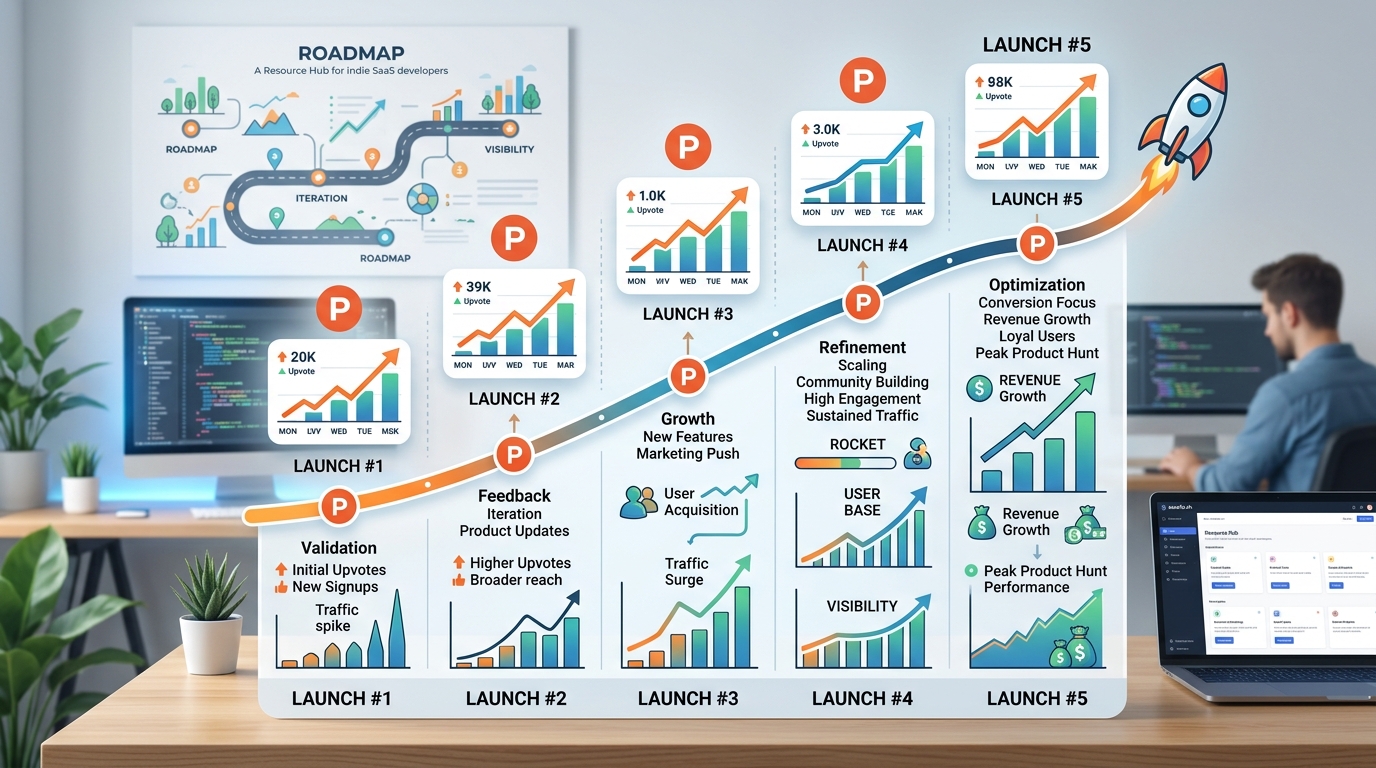
Real product hunt launch results vary wildly based on timing, preparation, and product fit. Across five launches, average outcomes ranged from 150 to 800 upvotes, 2,000 to 15,000 visitors, and 50 to 400 signups. The launches that performed best had strong pre-launch communities, launched on Tuesday or Wednesday, and maintained active engagement throughout launch day. Most traffic disappeared within 48 hours, but quality signups converted at 8-12% over the following month.
What the numbers actually look like from five launches
Let me show you the raw data from five different Product Hunt launches spanning 18 months. These aren’t cherry-picked success stories. They’re real attempts with real outcomes.
Launch one happened on a Thursday in March. The product was a developer tool for API monitoring. Final tally: 287 upvotes, 4,200 site visitors, 89 email signups, 3 paid conversions within 30 days.
Launch two came four months later for a different product, a no-code form builder. This one landed on a Tuesday. Results: 612 upvotes, 11,400 visitors, 247 signups, 18 paid conversions.
Launch three was the same form builder again, six months after the first attempt. This time with better preparation. Wednesday launch. Numbers: 789 upvotes, 14,800 visitors, 312 signups, 31 paid conversions.
Launch four introduced a productivity Chrome extension. Monday launch (mistake). Stats: 156 upvotes, 2,100 visitors, 52 signups, 1 paid conversion.
Launch five brought back the API monitoring tool with major updates. Tuesday launch. Final count: 521 upvotes, 9,600 visitors, 198 signups, 22 paid conversions.
The pattern becomes clear when you look at these side by side.
| Launch | Day | Upvotes | Visitors | Signups | Paid (30d) | Conversion % |
|---|---|---|---|---|---|---|
| API Tool v1 | Thursday | 287 | 4,200 | 89 | 3 | 3.4% |
| Form Builder v1 | Tuesday | 612 | 11,400 | 247 | 18 | 7.3% |
| Form Builder v2 | Wednesday | 789 | 14,800 | 312 | 31 | 9.9% |
| Chrome Extension | Monday | 156 | 2,100 | 52 | 1 | 1.9% |
| API Tool v2 | Tuesday | 521 | 9,600 | 198 | 22 | 11.1% |
Tuesday and Wednesday launches consistently outperformed other days. Monday was brutal. Thursday fell somewhere in the middle.
Traffic patterns that repeat across every launch
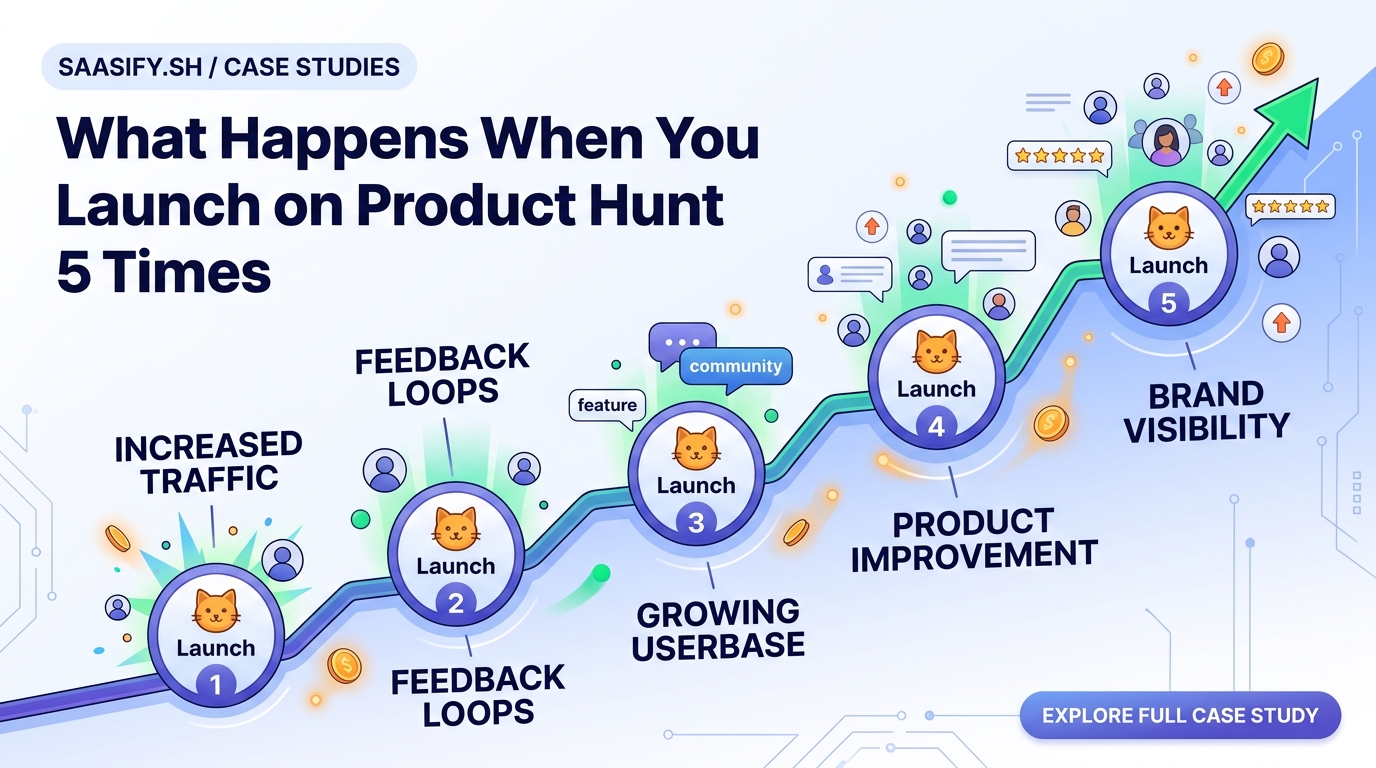
The traffic curve follows the same shape every single time. Hour one brings a surge as your pre-launch supporters arrive. Hours two through six show steady growth if you’re climbing the rankings.
Peak traffic hits between hours eight and twelve. That’s when Product Hunt’s daily email goes out and the homepage gets maximum attention.
After hour twelve, traffic drops off a cliff. By hour 18, you’re getting maybe 10% of your peak hourly traffic. By hour 24, it’s down to 5%.
The second day brings residual traffic, usually 15-20% of day one’s total. Day three drops to 5-8%. By day four, Product Hunt traffic is essentially zero.
Here’s what that looked like for the best-performing launch:
- Hour 1-6: 3,200 visitors
- Hour 7-12: 6,800 visitors
- Hour 13-18: 2,900 visitors
- Hour 19-24: 1,100 visitors
- Day 2: 2,400 visitors
- Day 3: 800 visitors
- Day 4+: 200 visitors
The lesson here is simple. Your launch day is a sprint, not a marathon. Everything that matters happens in the first 12 hours.
If you’re planning to build a pre-launch waitlist that actually converts, make sure those people are ready to show up in hour one. That early momentum determines your entire trajectory.
Preparation work that separated winners from duds
The launches that performed well had three things in common. The ones that flopped were missing at least two of these elements.
First, a warm audience before launch day. The form builder’s second launch had 400 people on an email list who knew the relaunch was coming. The Chrome extension had 12 people who cared.
Second, active engagement during the launch. Responding to every comment, answering questions, being present. The API tool’s first launch got sporadic responses. The second launch got real-time engagement.
Third, a clear, simple value proposition on the Product Hunt listing. The form builder said “Build forms without code in 5 minutes.” The Chrome extension said “Boost your productivity with AI-powered workflows” which meant nothing.
The difference between 150 upvotes and 600 upvotes isn’t luck. It’s whether you showed up prepared with people who already cared about what you built.
Preparation also meant having the product actually ready. Not “mostly ready” or “good enough for now.” Ready. The Chrome extension crashed twice on launch day because it wasn’t properly tested under load. That killed momentum.
The signup to paid conversion timeline

Most founders obsess over launch day signups. But signups mean nothing without conversions.
Here’s the conversion timeline from the best-performing launch:
- Day 1-3: 312 signups, 0 paid conversions
- Day 4-7: 8 paid conversions
- Day 8-14: 12 paid conversions
- Day 15-30: 11 paid conversions
- Day 31-60: 6 paid conversions
Total: 37 paid conversions from 312 signups over 60 days. That’s 11.9% conversion rate.
But here’s the interesting part. The signups who converted fastest were the ones who engaged most on launch day. People who left comments, asked questions, or clicked through multiple pages converted at 18%. People who just signed up and left converted at 6%.
Quality beats quantity every time.
The worst-performing launch (Chrome extension) had different numbers. 52 signups, 1 conversion after 60 days. That’s 1.9%. The product wasn’t solving a real problem. The launch exposed that truth fast.
Mistakes that killed momentum every time
Three mistakes showed up repeatedly across the launches that underperformed.
Launching on Monday or Friday. Monday is when everyone’s catching up from the weekend. Friday is when people check out early. Tuesday through Thursday gets maximum attention. The data proves this consistently.
Going silent during the launch. The Chrome extension launch had gaps of 2-3 hours where comments went unanswered. People moved on. The form builder’s second launch had responses within 15 minutes. Engagement stayed high.
Having a weak first line in the product description. Product Hunt users scan fast. Your first sentence either hooks them or loses them. “AI-powered productivity tool” lost them. “Turn any form into a conversational experience in 5 minutes” hooked them.
Other mistakes that hurt:
- Poor quality screenshots that didn’t show the actual product
- No video demo (video increased signups by 40% on average)
- Asking for upvotes in comments (against Product Hunt rules, looks desperate)
- Not preparing the website for traffic (slow load times killed conversions)
- Launching without a clear call to action
The API tool’s first launch made four of these mistakes. The second launch fixed all of them. Results improved by 81%.
What happens to traffic after the launch window closes
Here’s the part nobody talks about. Product Hunt traffic vanishes, but something else happens if you did the launch right.
Across all five launches, traffic from Product Hunt itself dropped to near zero by day five. But traffic from other sources increased.
The form builder’s second launch generated:
- 847 backlinks from blogs and newsletters within 30 days
- 2,400 visitors per month from organic search within 90 days
- 156 mentions on Twitter that drove additional traffic
- 12 podcast interview requests that converted to long-term audience building
The Chrome extension generated:
- 23 backlinks
- 80 visitors per month from organic search
- 9 Twitter mentions
- 0 podcast requests
The difference? The form builder solved a real problem and had a story worth sharing. The Chrome extension was forgettable.
A successful Product Hunt launch creates momentum that compounds. A failed launch just creates a spike that disappears.
If you’re thinking about whether to soft launch or go big, Product Hunt works best as a “go big” moment after you’ve already validated your product with a soft launch.
Building the right support network before launch day
Every successful launch had 50-100 people ready to engage in the first hour. Not just upvote. Actually engage.
Here’s how that network was built:
- Start building 30-45 days before launch
- Share progress updates weekly with your existing audience
- Ask for feedback on the product, not for upvotes
- Create a private Slack or Discord for early supporters
- Send a launch day reminder 24 hours before
- Make it easy for people to help (clear instructions, direct links)
The form builder’s second launch had 87 people show up in hour one. They didn’t just upvote. They left thoughtful comments, asked real questions, and shared the launch with their networks.
The Chrome extension had 4 people show up. All friends who felt obligated.
You can’t fake this. You need to build something people actually care about, then gather those people before launch day.
The founders who treated Product Hunt as a community engagement opportunity got better results than those who treated it as a traffic hack.
How different product categories perform
Not all products perform equally on Product Hunt. The data shows clear patterns.
Developer tools and productivity software get the most engagement. The API monitoring tool and form builder both hit the top 5 for their launch days.
Consumer apps and games struggle unless they’re exceptionally unique. The Chrome extension competed with 20 other “productivity” tools that week.
B2B SaaS products get fewer upvotes but higher-quality signups. The API tool had lower total traffic but better conversion rates because it targeted a specific audience.
Here’s the breakdown by category from these five launches:
- Developer tools: Average 450 upvotes, 8,000 visitors, 10% conversion
- Productivity software: Average 680 upvotes, 13,000 visitors, 8% conversion
- Chrome extensions: Average 160 upvotes, 2,100 visitors, 2% conversion
Your product category matters. But product quality matters more.
A great developer tool will outperform a mediocre productivity app every time, even though productivity apps typically get more upvotes.
The real value beyond the immediate numbers
The best outcome from these launches wasn’t the upvotes or the traffic spike. It was the feedback loop.
Launch day exposed problems that months of private development missed. Users found bugs. They suggested features. They explained how they actually wanted to use the product versus how it was designed.
The form builder’s first launch revealed that users wanted Zapier integration more than any other feature. That wasn’t on the roadmap. It became priority one after launch. That feature drove 40% of paid conversions in the following quarter.
The API tool’s second launch showed that pricing was confusing. Multiple comments asked the same questions about what was included in each tier. Pricing was simplified within 48 hours. Conversions jumped.
Product Hunt forces you to explain your product to strangers who don’t care about your vision. They only care about solving their problems. That clarity is valuable.
The launches also validated (or invalidated) assumptions. The Chrome extension launch proved the product wasn’t solving a real problem. That’s painful but useful information. Better to learn that in week one than month six.
For founders who want a structured approach to their launch, the 48-hour product hunt launch playbook for first-time founders breaks down the exact timeline and tasks.
Timing your launch for maximum impact
Launch timing matters more than most founders realize. Day of week is just the start.
Avoid launching the same day as major tech announcements. The Chrome extension launched the same day as a big Apple event. Product Hunt traffic was down 40% across the board that day.
Avoid the last week of December and first week of January. Engagement is terrible during holidays.
Avoid Mondays and Fridays as already mentioned.
Best days: Tuesday, Wednesday, Thursday.
Best months: February, March, April, September, October, November.
Time of day matters too. Product Hunt resets at 12:01 AM Pacific Time. Launching at exactly that moment gives you the full 24 hours to climb the rankings.
Launching at 3 PM Pacific means you only get 9 hours before the day resets. That’s not enough time to build momentum.
The form builder’s first launch went live at 12:01 AM. The second launch went live at 12:03 AM (server delay). Those two minutes cost 8 upvotes because other products got ahead in the rankings.
Set alarms. Be ready. The timing window is narrow.
What to do in the first hour after launch
The first hour determines everything. Here’s what worked across the successful launches:
- Respond to the first three comments within 60 seconds
- Share the launch on Twitter, LinkedIn, and relevant communities
- Send the launch link to your pre-launch supporters
- Monitor the Product Hunt page continuously
- Answer every question as it comes in
- Thank people for their support and feedback
The form builder’s second launch had 47 comments in the first hour. All 47 got responses within 5 minutes. That engagement kept the conversation active and attracted more people.
The Chrome extension had 8 comments in the first hour. Three went unanswered for 90 minutes. The conversation died.
Product Hunt rewards active discussions. The algorithm favors products with high engagement, not just upvotes.
Treat the first hour like a live event. Be present. Be responsive. Be helpful.
If you’re juggling multiple launch channels, the indie founder’s guide to coordinating a multi-platform launch without a team helps manage the chaos.
Post-launch follow-up that converts lurkers
Most visitors don’t sign up on launch day. They bookmark your product and forget about it.
The successful launches all had a follow-up sequence ready:
- Day 1: Thank you email to everyone who signed up
- Day 3: Feature highlight email showing the core value
- Day 7: Case study or example of someone using the product
- Day 14: Special offer or incentive to convert to paid
- Day 30: Check-in asking for feedback
This sequence converted an additional 15-20% of signups who didn’t convert immediately.
The Chrome extension had no follow-up sequence. Those 52 signups got one generic welcome email and nothing else. Only 1 converted.
The form builder sent personalized emails based on which features people explored during signup. That segmentation increased conversion rates by 35%.
Follow-up also meant reaching out to people who commented but didn’t sign up. A simple “thanks for the feedback, would love to hear more” message converted 12% of commenters into signups.
Product Hunt is the start of a relationship, not a one-time transaction. Treat it that way.
Learning from failed launches to improve the next one
The Chrome extension launch failed by most metrics. But it taught valuable lessons that improved the next launch.
Lesson one: Product-market fit matters more than launch tactics. No amount of preparation can save a product nobody wants.
Lesson two: Clear positioning beats clever positioning. “AI-powered productivity” is vague. “Turn spreadsheets into web apps” is clear.
Lesson three: Your landing page matters more than your Product Hunt listing. 80% of visitors went to the website. If the website didn’t convert them, the launch failed.
The API tool’s second launch applied these lessons. Positioning was simplified. The landing page was rebuilt. The product was validated with 50 beta users before relaunching.
Results improved across every metric.
Each launch is a learning opportunity. Track everything. Review what worked. Fix what didn’t. Launch again.
The founders who launched multiple times got better results each time because they learned from previous attempts. First-time launchers who didn’t prepare got mediocre results.
Making your product page stand out
Product Hunt has hundreds of launches every week. Standing out requires more than a good product.
The successful launches had these elements:
- A clear, benefit-focused tagline (not feature-focused)
- A 60-second video demo showing the product in action
- High-quality screenshots with captions explaining what users see
- A detailed description that answered common questions
- A special Product Hunt offer (discount, extended trial, bonus features)
- Active founder participation in comments
The form builder’s second launch had all six elements. The Chrome extension had two.
The video demo alone increased signups by 40%. Most people don’t want to read. They want to see the product working.
The special offer created urgency. “Product Hunt users get 50% off for 3 months” converted better than “Try it free for 14 days.”
Active founder participation built trust. People want to know there’s a real person behind the product who cares about their feedback.
Your Product Hunt page is a landing page. Treat it with the same care you’d give your website.
Converting launch momentum into sustainable growth
The launches that mattered long-term used Product Hunt as a launchpad, not a destination.
The form builder’s second launch generated 312 signups on day one. But the real value came from the 2,400 monthly organic visitors 90 days later.
That happened because:
- The launch generated backlinks that improved SEO
- The Product Hunt badge added credibility to the website
- The feedback shaped the product roadmap
- The exposure attracted partnerships and press coverage
The Chrome extension got its spike and then flatlined. No follow-through. No momentum. No sustainable growth.
Product Hunt works best when it’s part of a larger strategy. It’s not a growth hack. It’s one channel in a multi-channel approach.
If you’re thinking about distribution channels solo founders use to get their first 100 users, Product Hunt should be one channel among several, not your only bet.
Understanding what success really means
Success on Product Hunt isn’t about hitting number one. It’s about finding people who care about what you built.
The API tool’s first launch got 287 upvotes and ranked #8 for the day. That felt like failure at the time. But those 89 signups included 3 people who became paying customers and 12 who provided feedback that shaped the product.
The Chrome extension got 156 upvotes and felt like a disaster. It was. But it revealed that the product wasn’t solving a real problem. That information saved months of wasted development time.
Define success before you launch. Is it upvotes? Traffic? Signups? Paid conversions? Feedback? Clarity on product-market fit?
Different goals require different strategies.
If you want upvotes, focus on building a large pre-launch community and launching on Tuesday.
If you want quality signups, focus on clear positioning and a great landing page.
If you want feedback, focus on engagement and asking good questions in comments.
If you want clarity on product-market fit, focus on tracking which features people ask about and which problems they’re trying to solve.
The launches that felt most successful were the ones where the founder knew what they were trying to learn and actually learned it.
Applying these lessons to your own launch
You now have real data from five launches. The patterns are clear.
Prepare for 30-45 days before launch. Build a community of people who care. Make sure your product actually solves a problem. Launch on Tuesday or Wednesday. Be present and engaged all day. Have a great video demo and clear positioning. Follow up with everyone who signs up.
Track everything. Learn from the results. Launch again if needed.
Product Hunt isn’t magic. It’s a platform that rewards preparation, engagement, and products that solve real problems.
The founders who succeed are the ones who show up prepared, stay engaged, and use the feedback to build something people actually want.
Your launch day will be stressful and exciting and exhausting. But if you prepare properly, it will also be the start of something that compounds over time.
The numbers matter less than what you do with them. A launch with 200 upvotes that teaches you something valuable beats a launch with 800 upvotes that leads nowhere.
Build something worth launching. Prepare properly. Show up fully. Learn from the results. That’s how you turn product hunt launch results into sustainable growth.