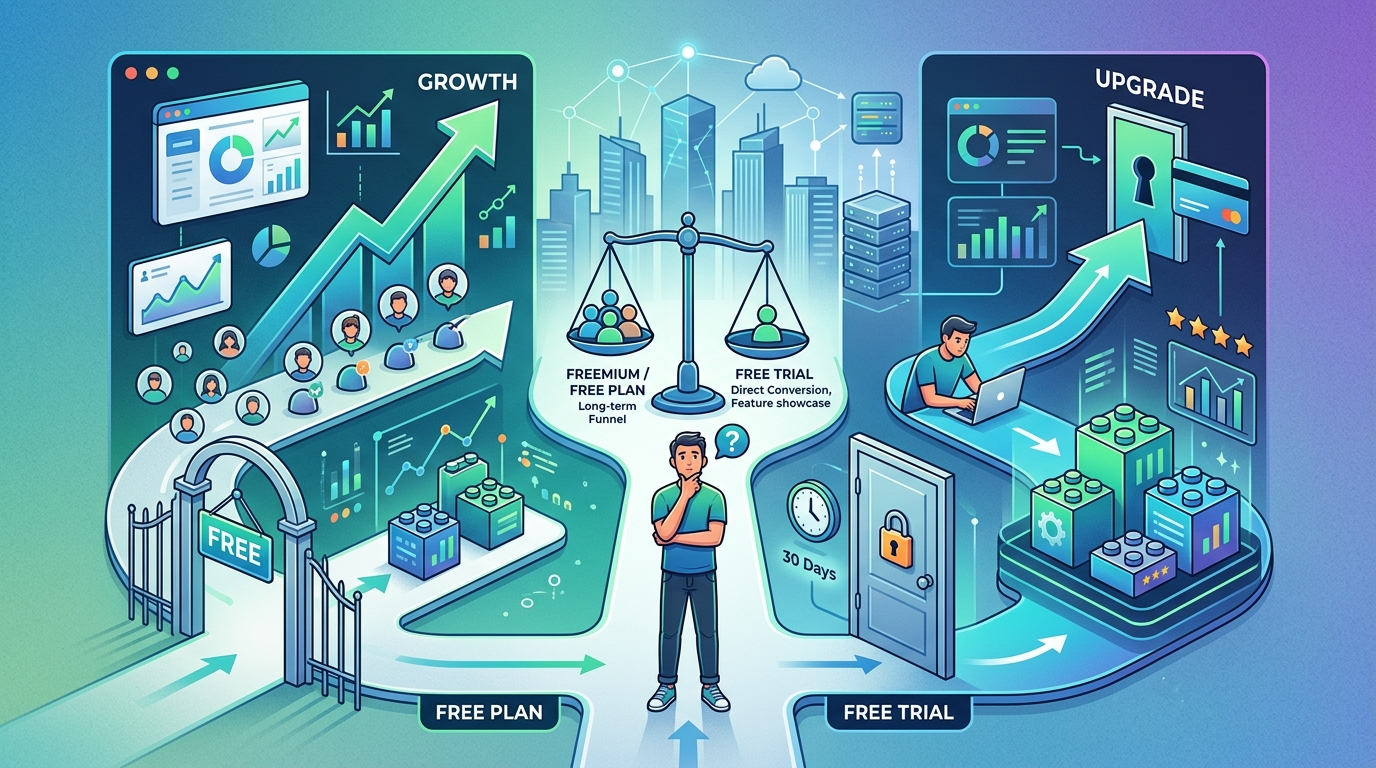
Choosing between a free trial and a free plan feels like picking between two equally uncertain paths. Both get users in the door. Both promise growth. But they create completely different economics, user behaviors, and long-term trajectories for your product.
The decision isn’t about copying what Slack or Dropbox did. It’s about matching your pricing model to your product’s activation patterns, your target customer’s buying behavior, and your ability to deliver value before asking for payment.
Free trials work best for products with fast time-to-value and clear ROI, converting 10-25% of users to paid within 14-30 days. Free plans excel when network effects or viral loops matter, trading immediate revenue for user acquisition and long-term expansion revenue. Your choice depends on activation speed, customer acquisition cost, support capacity, and whether your product gets more valuable with more users on the platform.
Understanding the fundamental difference
A free trial gives full access for a limited time. Users see everything, use premium features, and hit the limits only when the clock runs out.
A free plan restricts features or usage permanently. Users stay on the platform indefinitely but face walls that push them toward paid tiers.
The psychology differs completely. Trial users know they’re on borrowed time. They evaluate whether the product justifies the upcoming payment. Free plan users experience no urgency. They upgrade only when they hit a genuine limitation.
This creates different conversion mechanisms. Trials convert through demonstrated value before the deadline. Free plans convert through accumulated frustration or growing needs.
When free trials convert better
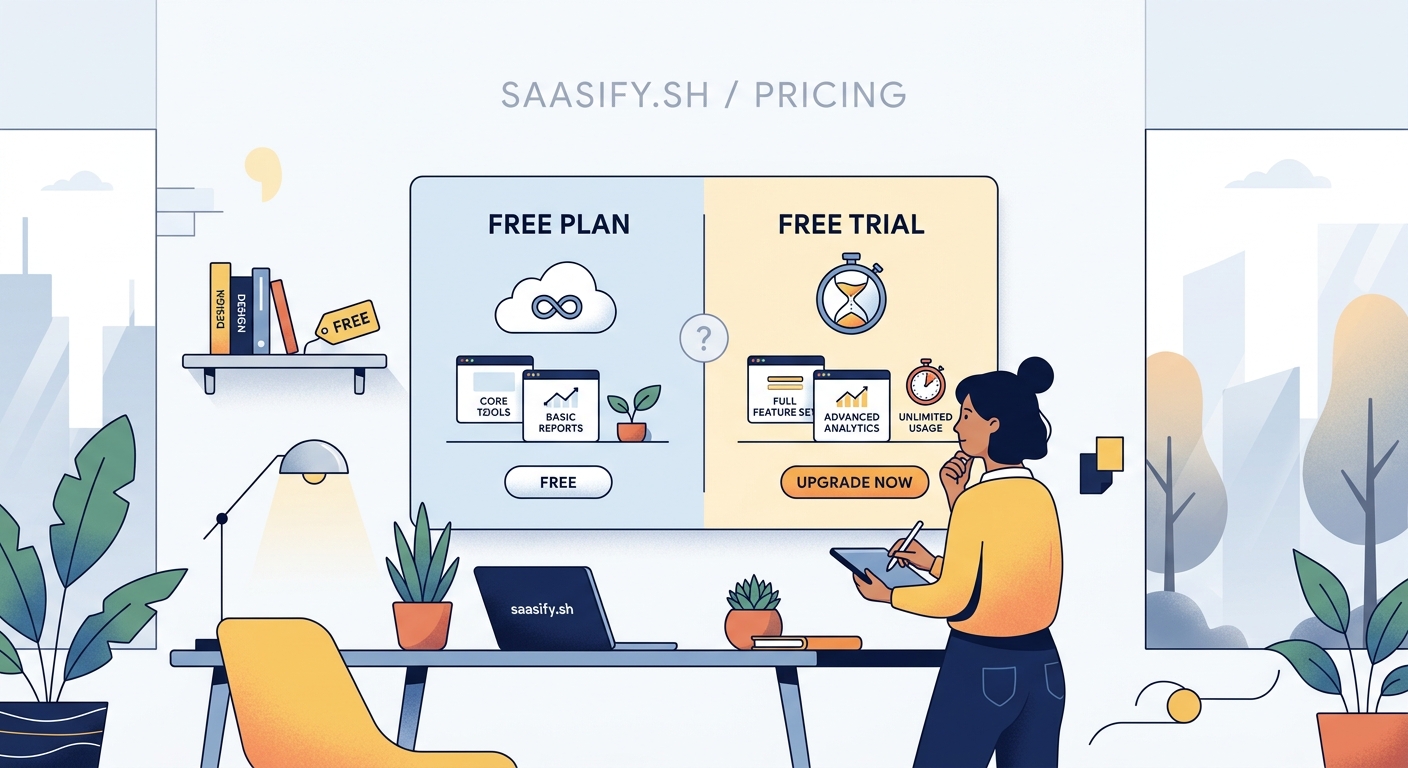
Free trials shine when your product delivers obvious value within days, not weeks. If a user can see measurable results in their first session, a trial creates the perfect pressure cooker for conversion.
Products with high touch onboarding work well with trials. You can guide users through setup, ensure they hit activation milestones, and create success before the trial expires.
Here’s when trials typically outperform free plans:
- Your product solves urgent, painful problems
- Time-to-value happens within 7 days
- The learning curve is manageable
- You can afford hands-on onboarding
- Your target customers have budget authority
- Monthly pricing exceeds $50
Analytics platforms, project management tools, and business intelligence software often use trials because value becomes obvious during evaluation. A marketing director testing an analytics tool either sees better campaign insights within a week or they don’t.
The trial deadline creates natural urgency. Users must decide before access disappears. This forces evaluation while the product is fresh in their minds.
When free plans drive more revenue
Free plans work when your product needs time to become habit-forming or when value compounds with usage. If it takes 30 days for users to build workflows around your tool, a 14-day trial ends before they’re hooked.
Products with network effects need free plans. Communication tools, collaboration platforms, and marketplaces get more valuable as more people join. Charging everyone upfront kills the network before it forms.
Free plans excel in these scenarios:
- Value increases with team size or user count
- Activation takes longer than 30 days
- Viral loops drive acquisition
- Support costs stay low at scale
- You’re optimizing for land-and-expand
- Usage naturally segments into free and paid tiers
Slack built a massive user base on free plans because team communication tools need the whole team using them. A trial would have created friction at exactly the wrong moment, when you’re trying to get colleagues to switch tools.
The free plan becomes your sales team. Users invite others, build dependencies, and eventually hit limits that make upgrading feel natural rather than forced.
The economics tell different stories
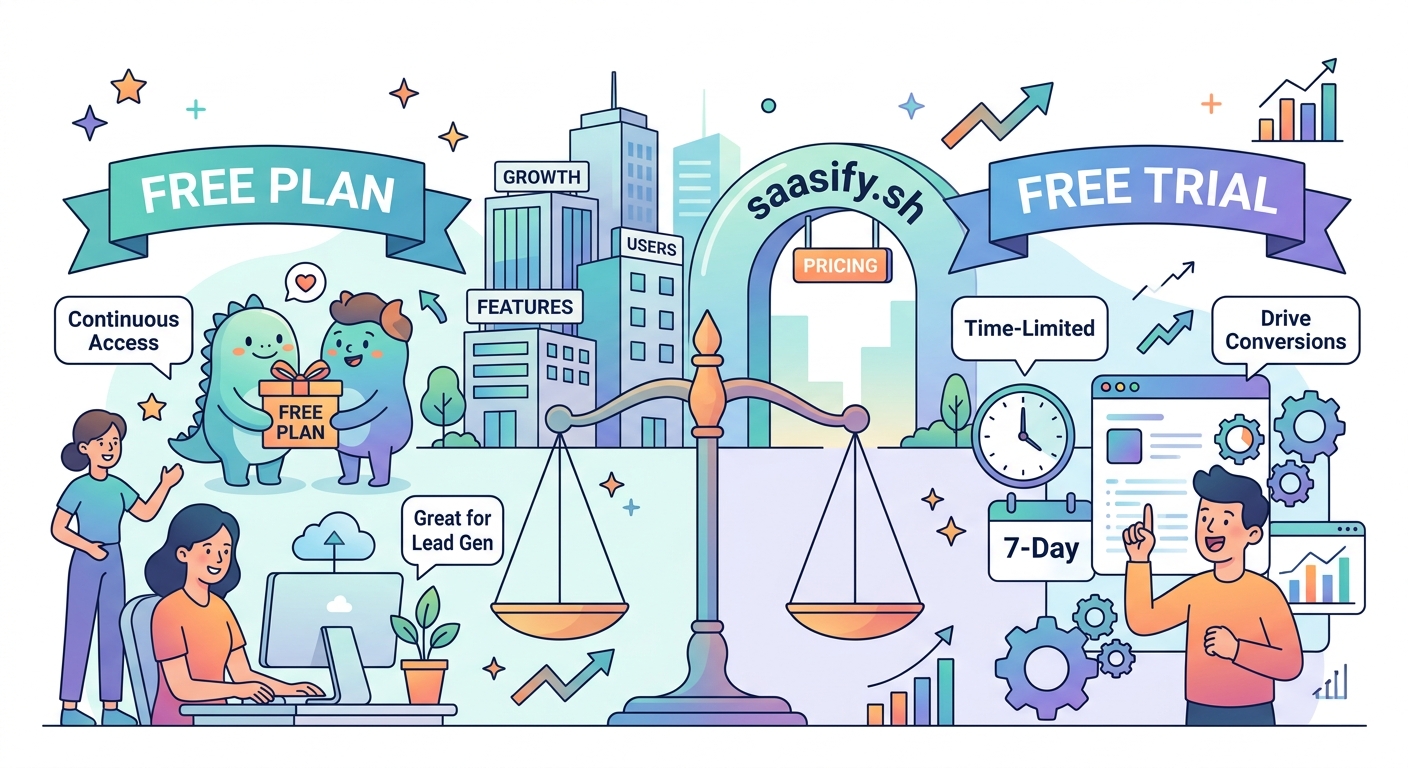
Let’s compare the unit economics side by side:
| Metric | Free Trial | Free Plan |
|---|---|---|
| Conversion Rate | 10-25% | 2-5% |
| Time to Convert | 14-30 days | 60-180 days |
| Support Cost per User | Higher (condensed timeline) | Lower (spread over time) |
| CAC Efficiency | Better (faster payback) | Worse (longer payback) |
| Expansion Revenue | Limited | Higher (seat-based growth) |
| Churn Risk | Higher (forced decision) | Lower (gradual commitment) |
Free trials create faster revenue but require more aggressive onboarding. You’re compressing the entire evaluation and activation process into weeks.
Free plans generate slower revenue but lower acquisition costs. Users market the product for you, and you avoid paying for leads who would never convert anyway.
Your pricing strategy needs to account for these different timelines. Trials demand higher lifetime value to justify the support investment. Free plans work with lower per-user revenue if you can scale user acquisition efficiently.
Building the right trial experience
If you choose trials, the experience needs surgical precision. Every day matters when you’re working against a countdown.
Start with the right trial length. Too short and users don’t activate. Too long and urgency disappears. Most B2B SaaS products land between 14 and 30 days.
Here’s how to structure an effective trial:
- Remove friction at signup (no credit card unless absolutely necessary)
- Trigger activation emails on days 1, 3, 7, and 12
- Set up automated check-ins based on usage milestones
- Offer a single extension for users showing engagement
- Create a clear upgrade path before expiration
The biggest trial mistake is treating it like a demo. Users need to do real work, solve real problems, and build real dependencies on your product.
Track activation metrics obsessively. What percentage of trial users complete your core workflow? Which features correlate with conversion? Where do users get stuck?
You can improve trial conversion rates without changing your product by fixing onboarding, improving email sequences, and removing friction from the upgrade process.
Designing a free plan that converts
Free plans need careful feature gating. Give away too much and nobody upgrades. Gate too aggressively and users leave before experiencing value.
The best free plans create natural upgrade triggers rather than arbitrary limits. Users hit walls when their usage genuinely outgrows the free tier, not when they hit some artificial cap.
Common gating strategies include:
- Usage limits (projects, contacts, storage)
- Feature restrictions (advanced analytics, integrations)
- User/seat limits (solo vs team plans)
- Time-based limits (data retention, history access)
- Support tiers (community vs priority support)
The free tier should deliver complete value for a specific use case. A solo freelancer should feel like they got a complete product, even if it’s missing features that only matter to agencies.
Your upgrade prompts need to feel helpful, not naggy. Show them when users hit limits, not randomly during their workflow. Make the value of upgrading obvious in the context of what they’re trying to accomplish.
Free plan users often take longer to convert, but they churn less once they do. They’ve already built habits and workflows around your product.
Support costs change the math
Free users need support. The question is how much you can afford to provide.
Free trials concentrate support costs into a short window. You’re essentially providing full customer success to people who might never pay. But the timeline is finite.
Free plans spread support costs across a larger user base over longer periods. Individual interactions cost less, but the total volume scales with your free user count.
Calculate your support capacity honestly:
- How many support tickets can you handle per week?
- What’s your current ratio of free to paid users?
- What percentage of free users contact support?
- How does support load correlate with conversion?
If you’re a solo founder, free trials might be more manageable. You invest heavily in 100 trial users this month, but next month is a fresh batch.
Free plans create ongoing support obligations. Your free user base grows continuously, and support load grows with it. You’ll need better tools and systems to scale.
The best pricing model is the one you can afford to support at scale. A free plan that drowns you in support tickets destroys more value than it creates.
Testing your way to the right model
You don’t have to commit forever. Many successful SaaS companies have switched between models or run both simultaneously.
Start with your best hypothesis based on your product characteristics. Then test ruthlessly.
If you start with trials, track these metrics:
- Trial signup to activation rate
- Activation to paid conversion rate
- Time to first value
- Feature usage during trial
- Trial extension requests
- Reasons for not converting
If you start with free plans, monitor:
- Free to paid conversion rate
- Time to upgrade
- Feature adoption on free tier
- Viral coefficient
- Support tickets per free user
- Expansion revenue from converted users
Run pricing experiments to test different trial lengths, feature gates, or hybrid models. Change one variable at a time and measure impact over at least 60 days.
Some products benefit from both. Offer a 14-day trial of premium features, then downgrade to a free plan instead of cutting off access completely. You get trial urgency plus free plan retention.
Common mistakes that kill conversions
The free trial mistake most founders make is requiring a credit card upfront. You’ll see higher conversion rates from trial users, but signups drop 30-60%. The math rarely works out unless your product is already well-known.
For free plans, the biggest error is making the free tier too generous. If 90% of your users never need to upgrade, you’re running a charity, not a business.
Other conversion killers include:
- Asking for payment before users experience value
- Creating upgrade friction (complicated checkout, unclear pricing)
- Failing to communicate value during the trial or free period
- Setting limits that feel arbitrary rather than natural
- Ignoring users until they’re about to churn
- Making the free tier feel like a second-class experience
Your free offering, whether trial or plan, should feel like a complete product within its scope. Users should never feel punished for being free. They should feel grateful for what they get and excited about what’s possible with paid tiers.
Matching your model to your market
B2B products with long sales cycles often need free plans. Buyers want to test with their team, get stakeholder buy-in, and prove ROI before committing budget.
B2C products with immediate value often convert better with trials. A consumer who sees results in the first session will pay to keep access.
Your customer acquisition cost matters too. If you’re spending $200 to acquire a trial user, you need high conversion rates to break even. Free plans work better when organic or viral growth keeps CAC low.
Consider your go-to-market strategy too. Product-led growth favors free plans. Sales-led growth pairs well with trials that create urgency for sales conversations.
If you’re building a vertical SaaS for a specific industry, trials often work better because you can provide hands-on onboarding that demonstrates deep domain expertise.
Making the decision for your product
Stop looking at what competitors do. Their economics, team size, and growth stage differ from yours.
Instead, answer these questions:
- Can users experience meaningful value in 14 days?
- Does your product get more valuable with more users?
- Can you afford to support unlimited free users?
- Do you have the resources for intensive trial onboarding?
- Will users need time to build habits before seeing value?
- Does your pricing model support land-and-expand growth?
If you answered yes to questions 1, 4, and 6, lean toward free trials.
If you answered yes to questions 2, 3, and 5, lean toward free plans.
If answers are mixed, consider a hybrid approach or test both models with different user segments.
The right choice depends less on your product category and more on your specific activation patterns, support capacity, and growth model.
Revenue impact over 12 months
Let’s model both approaches for a hypothetical SaaS product with $50 monthly pricing.
Free trial scenario:
– Month 1: 100 signups, 20 conversions, $1,000 MRR
– Month 6: 600 signups, 120 conversions, $6,000 MRR
– Month 12: 1,200 signups, 240 conversions, $12,000 MRR
Free plan scenario:
– Month 1: 300 signups, 6 conversions, $300 MRR
– Month 6: 2,400 signups, 72 conversions, $3,600 MRR
– Month 12: 5,000 signups, 200 conversions, $10,000 MRR
Trials generate faster early revenue. Free plans build a larger user base that converts over time and creates expansion opportunities.
The trial model hits profitability faster if CAC is similar. The free plan model scales better if viral growth keeps acquisition costs low.
Neither model is universally better. The right choice depends on your unit economics, growth channels, and cash flow needs.
Why some products need both
Hybrid models let you capture different user segments. Offer trials for users who want full access immediately and free plans for users who need time to evaluate.
Canva does this well. They offer a 30-day trial of Pro features and a permanent free plan with limited functionality. Users self-select based on their needs and buying timeline.
The hybrid approach adds complexity. You’re managing two conversion funnels, two onboarding experiences, and two sets of upgrade triggers.
Only add this complexity if data shows you’re losing conversions by forcing users into a single path. Start simple, then add sophistication as you learn what different user segments need.
Finding what works for your SaaS
The free trial versus free plan debate has no universal answer. Your product’s activation speed, target market, support capacity, and growth model all factor into the right choice.
Start with the model that matches your product’s natural usage patterns. If users see value in days, try trials. If value compounds over weeks, test free plans.
Measure everything. Track conversion rates, time to upgrade, support costs, and expansion revenue. Let data guide your decisions, not competitor analysis or conventional wisdom.
Remember that you can change models as you learn. Many successful SaaS companies switched approaches after seeing what actually drove conversions versus what they assumed would work.
The best monetization strategy is the one that converts your specific users with your specific product at your specific price point. Build, measure, learn, and iterate until you find it.