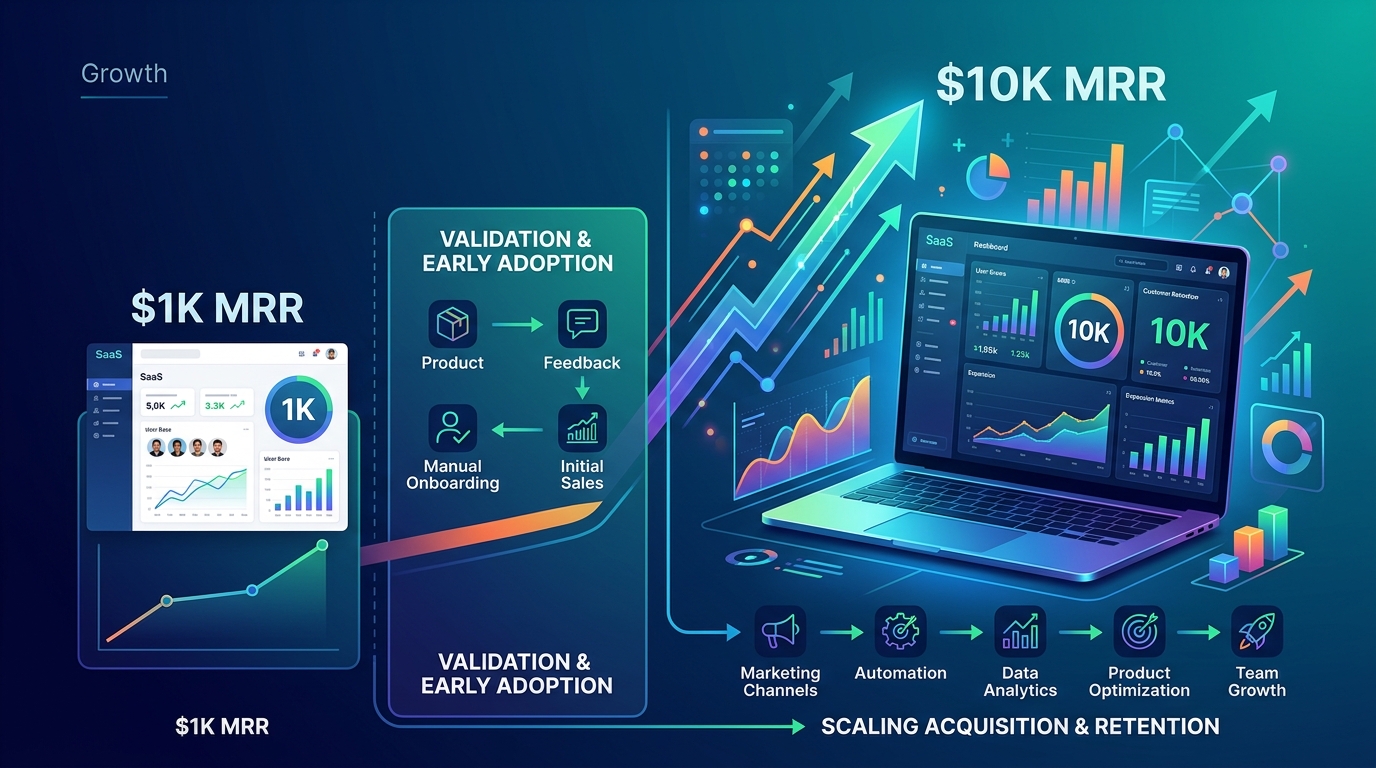
You’ve hit $1K MRR. Congratulations. That’s real money from real customers who trust your product enough to pay for it. But getting to $10K feels like a completely different game. You’re right. It is.
Scaling from $1K to $10K MRR requires fundamental shifts in how you spend your time, price your product, and acquire customers. The tactics that got you to initial traction won’t carry you to sustainable growth. This guide shows you exactly what changes, what stays the same, and how to prioritize the transitions that matter most for solo founders and small teams.
The mindset shift nobody talks about
At $1K MRR, you’re still validating. You can talk to every customer. You can change pricing on a whim. You can rebuild features based on one person’s feedback.
At $10K MRR, you’re operating a business. Different rules apply.
The biggest mistake founders make is trying to scale the same behaviors that got them to $1K. Those scrappy, do-everything-yourself tactics worked because you had nothing to lose. Now you have customers depending on you. Revenue to protect. A reputation forming in your market.
Your time becomes the constraint, not your ideas.
This means saying no more often than yes. It means building systems instead of fighting fires. It means choosing one growth channel and going deep instead of trying everything at once.
Where your time actually needs to go
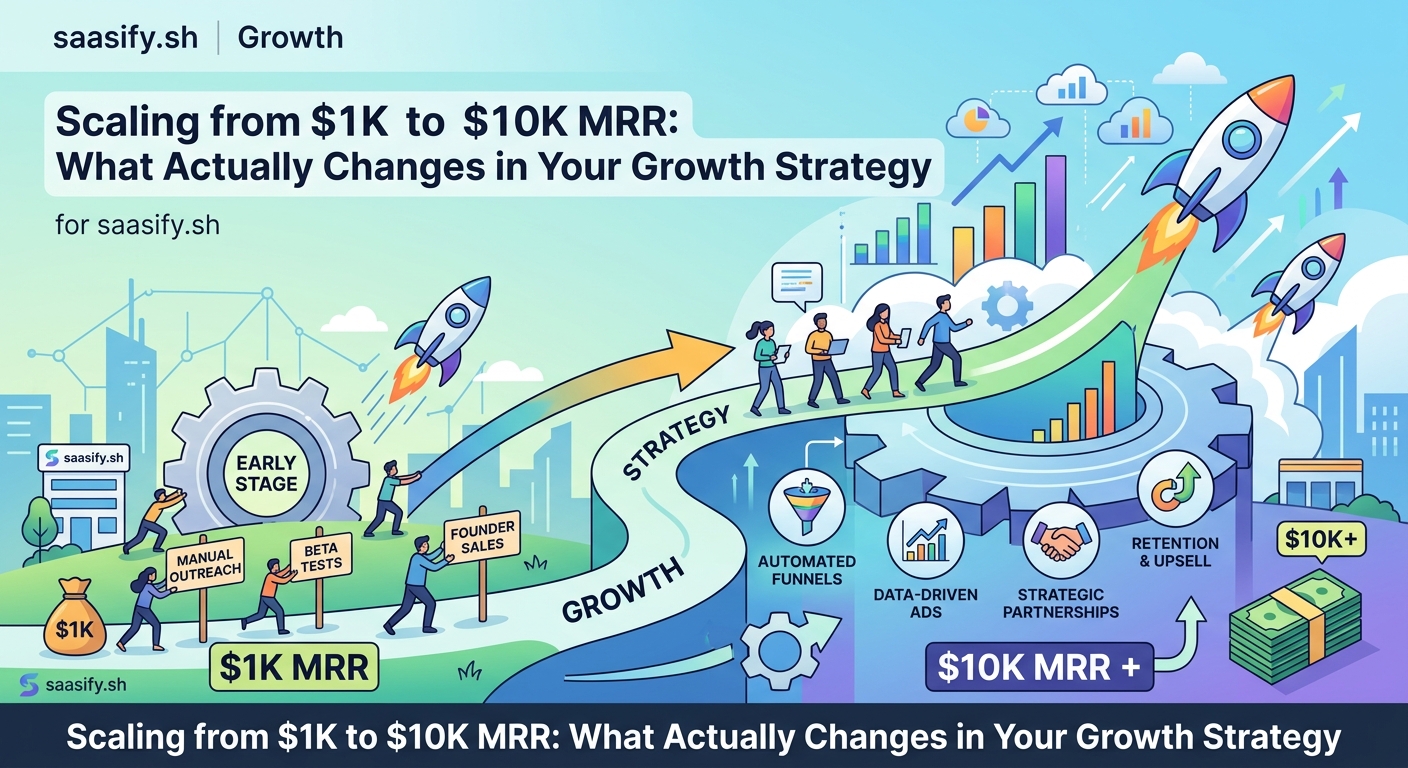
Here’s how your time allocation should shift:
| Activity | At $1K MRR | At $10K MRR |
|---|---|---|
| Building new features | 60% | 30% |
| Customer conversations | 20% | 15% |
| Marketing and growth | 10% | 40% |
| Operations and systems | 10% | 15% |
Notice marketing jumps from 10% to 40%. This feels wrong to most developers. You want to build. But growth doesn’t happen by accident at this stage.
The features that got you to $1K are probably good enough. What you need now is more people seeing them.
Building features users actually want matters, but only after you’ve nailed distribution. A mediocre product with great distribution beats a great product nobody knows about.
Your pricing strategy needs to mature
At $1K MRR, you probably have one of these pricing models:
- A single tier at $29/month
- Pay what you want
- Lifetime deals to get early adopters
- Grandfathered rates for everyone
None of these will get you to $10K.
You need real pricing tiers that segment customers by value. Not by features, by outcomes.
Here’s the framework:
- Starter tier – Gets people in the door ($19-$39/month)
- Professional tier – Where most revenue comes from ($79-$149/month)
- Business tier – Captures high-value customers ($249-$499/month)
Your professional tier should be where 60% of new customers land. If everyone picks your cheapest plan, you’re leaving money on the table.
If everyone picks your most expensive plan, you’re not charging enough at the top.
The math is simple. To get from $1K to $10K MRR:
- Option A: 100 customers at $100/month
- Option B: 200 customers at $50/month
- Option C: 50 customers at $200/month
Option A is usually the sweet spot. Fewer customers to support. Higher perceived value. Room to grow both up and down.
Understanding pricing psychology helps you structure tiers that actually convert instead of confusing people.
The growth channel mistake that costs months
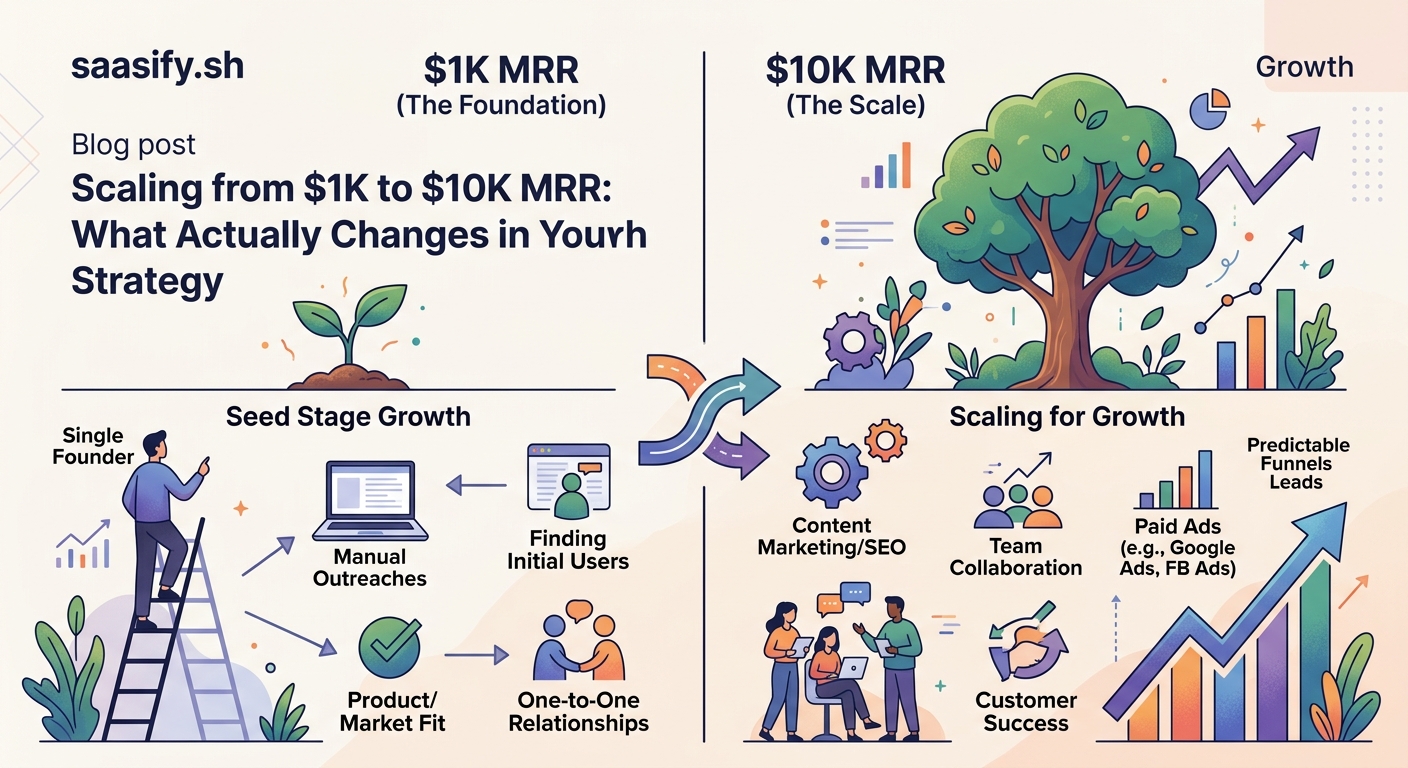
At $1K MRR, you probably got customers from:
- Product Hunt
- Hacker News
- Friends and early supporters
These are launch channels. They give you a spike. Then they fade.
To scale from 1K to 10K MRR, you need a repeatable channel. Something you can invest time or money into and get predictable results.
Pick one:
- Content marketing – Write 2-3 articles per week targeting buyer keywords
- SEO – Build backlinks and rank for search terms your customers use
- Paid ads – Facebook, Google, or LinkedIn depending on your audience
- Partnerships – Integration partners who refer customers
- Cold outreach – Email or LinkedIn for B2B products
Notice I said pick one. Not try all of them. Not dabble in each.
Going deep on one channel beats spreading yourself thin across five. You want to own a channel, not just participate in it.
Most solo founders should start with content or SEO. Why? Because they compound. An article you write today can bring customers for years.
Paid ads stop working the moment you stop paying.
Low-cost marketing channels work best when you’re still bootstrapping and can’t afford big ad budgets.
Customer acquisition economics change completely
At $1K MRR, you probably didn’t track these numbers:
- Customer Acquisition Cost (CAC)
- Lifetime Value (LTV)
- Payback period
- Churn rate
At $10K MRR, these numbers determine whether you survive.
Here’s what healthy looks like:
- LTV should be at least 3x your CAC
- Payback period should be under 12 months
- Monthly churn should be under 5%
If you’re spending $100 to acquire a customer who pays $50/month and churns after 3 months, you’re losing money on every sale.
Better to spend $200 to acquire a customer who pays $100/month and stays for 24 months.
This is why pricing matters so much. Higher prices mean higher LTV. Higher LTV means you can afford more expensive acquisition channels.
“We were stuck at $3K MRR for six months because we were afraid to raise prices. When we finally went from $29 to $79 for our main tier, we lost two customers but tripled our revenue in 90 days. The higher price attracted better customers who stuck around longer.” – Indie founder who scaled to $15K MRR
Knowing when to increase prices can be the single decision that unlocks your next growth phase.
The retention problem you can’t ignore anymore
At $1K MRR with 20 customers, losing one customer is annoying. You can replace them.
At $10K MRR with 100 customers, if you’re churning 10% monthly, you need to add 10 new customers just to stay flat. That’s exhausting.
Retention becomes more important than acquisition.
Here’s how to fix it:
- Onboarding that actually works – First 7 days determine if they stay or churn
- Regular check-ins – Monthly emails asking what’s working and what’s not
- Feature usage tracking – Know which features predict retention
- Proactive support – Reach out before they have problems
- Community building – Customers who connect with other customers stay longer
The best retention strategy? Make sure they’re actually getting value.
If someone signs up and never uses your product, they’ll churn. If they use it daily and it saves them time or makes them money, they’ll stay for years.
Track activation metrics. What actions do your best customers take in their first week? Make sure every new customer takes those actions.
Focusing on retention versus acquisition determines whether you’re building a leaky bucket or a sustainable business.
Systems and automation become mandatory
At $1K MRR, you can manually:
- Send welcome emails
- Process refunds
- Answer support tickets
- Generate invoices
- Track metrics in a spreadsheet
At $10K MRR, manual processes will destroy you.
You need systems for:
- Email sequences – Welcome, onboarding, re-engagement, winback
- Support – Help desk software with canned responses
- Analytics – Automated dashboards that update daily
- Billing – Automated dunning for failed payments
- Marketing – Scheduled content, automated social posts
This doesn’t mean buying expensive tools. It means setting up workflows that run without you.
Use Zapier or Make to connect your tools. Build simple scripts that automate repetitive tasks. Create templates for common responses.
Every hour you spend building systems saves you ten hours later.
Automation tools that save time let you focus on growth instead of maintenance.
The feature roadmap trap
At $1K MRR, customers ask for features. You build them. They’re happy. You get testimonials.
This stops working at scale.
If you build every feature request, you end up with a bloated product that’s hard to use and impossible to maintain.
Instead, look for patterns:
- Are 10 different customers asking for variations of the same thing?
- Does this feature move you closer to your ideal customer profile?
- Will this feature increase retention or just delay churn?
- Can you charge extra for this as an add-on?
Say no to most requests. Build only features that:
- Solve problems for your target market, not edge cases
- Increase the core value proposition
- Create defensibility or network effects
- Enable you to charge more or reduce churn
Everything else goes in the “maybe later” pile.
Your product at $10K MRR should be more focused than it was at $1K, not more complex.
When to start thinking about paid acquisition
Most founders ask this too early. Here’s the real answer:
Start spending on paid acquisition when:
- Your organic channels are maxed out
- You have positive unit economics (LTV > 3x CAC)
- You’ve optimized your conversion funnel
- You have cash reserves to test for 3 months
If you’re still figuring out messaging, don’t run ads. You’ll burn money learning what you could learn for free through content and conversations.
But once you know:
- Who your ideal customer is
- What problem you solve for them
- What messaging converts
- What your customer is worth
Then paid acquisition becomes a growth lever you can pull.
Start small. $500/month on Facebook or Google ads. Track everything. Optimize. Scale what works. Kill what doesn’t.
Knowing when to invest in paid acquisition prevents you from wasting money before you’re ready.
The metrics dashboard that actually matters
Stop tracking vanity metrics. At $10K MRR, you need a dashboard with:
| Metric | Why It Matters | Target |
|---|---|---|
| MRR | Total recurring revenue | Growing 20%+ monthly |
| New MRR | Revenue from new customers | Covers churn + grows total |
| Churn MRR | Revenue lost to cancellations | Under 5% monthly |
| Trial to paid | Conversion rate | Above 15% |
| CAC | Cost to acquire customer | Under 1/3 of LTV |
Update this weekly. Share it with advisors or mastermind groups. Use it to make decisions.
If new MRR is growing but total MRR is flat, you have a churn problem. If trial to paid is low, you have an onboarding or pricing problem. If CAC is too high, you need better targeting or cheaper channels.
The numbers tell you what to fix.
Building a revenue dashboard gives you the visibility to make smart growth decisions.
What stays the same (and what you should never change)
Not everything needs to change as you scale from 1K to 10K MRR.
Keep doing:
- Talking to customers – Just more strategically, not with everyone
- Shipping regularly – Weekly or bi-weekly releases maintain momentum
- Building in public – Transparency builds trust and attracts customers
- Staying lean – Don’t hire until pain is unbearable
- Focusing on value – Revenue comes from solving real problems
The core of what made you successful at $1K still applies. You’re just doing it at a different scale with better systems.
Whether to build in public remains a personal choice, but the transparency often accelerates trust and growth.
Common bottlenecks that stall growth
Most founders get stuck between $3K and $5K MRR. Here’s why:
- Trying to do everything yourself – You need to delegate or automate
- Not picking a primary growth channel – Spreading too thin
- Underpricing – Can’t afford to acquire customers profitably
- Poor onboarding – New customers churn before seeing value
- Weak positioning – Nobody knows who you’re for or why you’re different
- Feature bloat – Trying to be everything to everyone
Pick your biggest bottleneck. Fix it. Then move to the next one.
Understanding common growth bottlenecks helps you diagnose what’s actually holding you back.
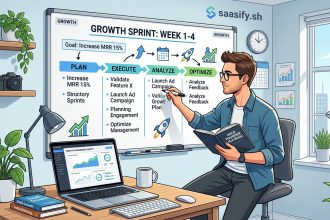
The 90-day sprint that changes everything
Here’s a practical plan to go from $1K to $10K MRR:
Month 1: Foundation
1. Implement proper pricing tiers
2. Set up analytics and tracking
3. Build automated email sequences
4. Choose your primary growth channel
5. Create a content calendar or ad plan
Month 2: Execution
1. Publish content or launch ads consistently
2. Run pricing experiments with new customers
3. Improve onboarding based on usage data
4. Build referral program or partnership pipeline
5. Set up automated retention campaigns
Month 3: Optimization
1. Double down on what’s working
2. Kill what’s not moving the needle
3. Raise prices for new customers
4. Expand successful growth channel
5. Build systems to reduce your daily involvement
This isn’t a guarantee. But it’s a framework that’s worked for hundreds of indie founders.
The key is focus. Pick one thing per week that will move revenue. Do it well. Measure results. Adjust.
Running effective growth sprints helps you maintain momentum without burning out.
Making the transition stick
Scaling from $1K to $10K MRR isn’t just about tactics. It’s about becoming a different kind of founder.
You move from builder to operator. From generalist to specialist. From reactive to strategic.
The good news? You’ve already proven people will pay for what you built. Now you’re just getting it in front of more of them.
Stay focused on the fundamentals. Pick your channel. Fix your pricing. Optimize retention. Build systems. The revenue follows.
Most founders who hit $1K MRR never make it to $10K because they keep doing what worked at the beginning. Don’t be that founder. Evolve your strategy as your business grows. The tactics that got you here won’t get you there, but the lessons you learned along the way absolutely will.