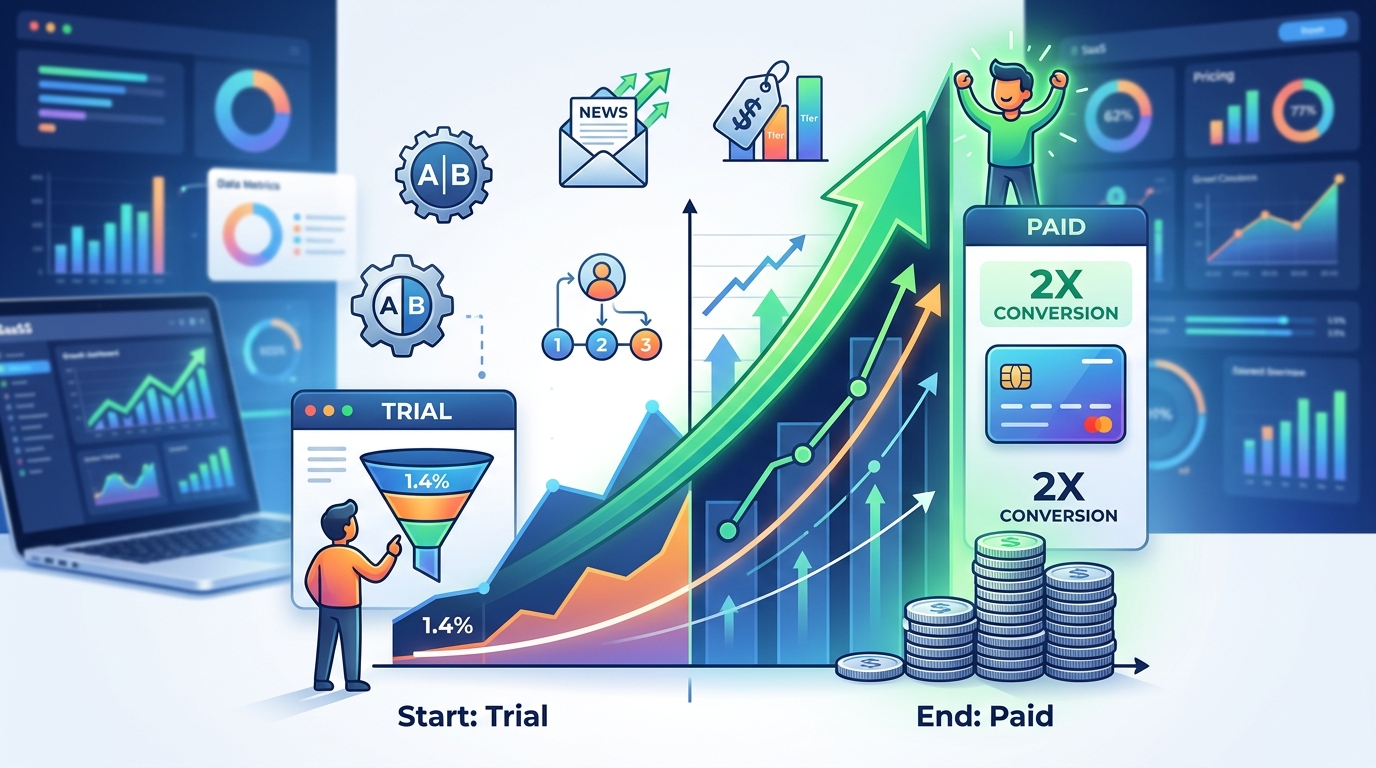
You’ve built a product people want to try. They sign up, poke around, maybe even use a feature or two. Then they vanish. Your trial conversion rate sits stubbornly at 8%, and engineering says they need six months to ship the features you think will fix it.
Here’s the thing: you don’t need to wait for product development to turn this around.
Most SaaS teams assume low trial conversion means a feature gap. But the real problem usually lives in the space between signup and value. The onboarding flow. The email sequence. The pricing page. The friction points you can fix this week without touching a line of production code.
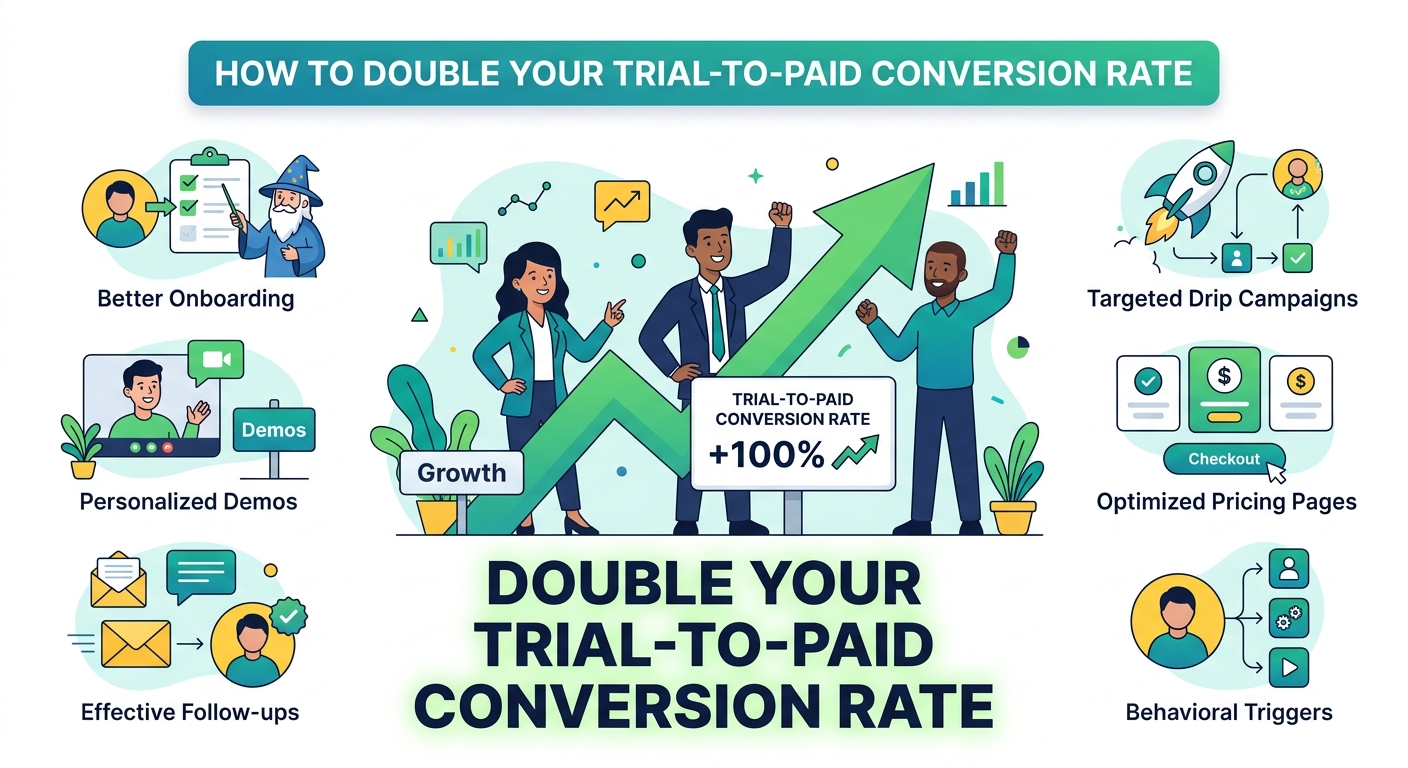
You can increase trial to paid conversion rate by optimizing onboarding, reducing friction, personalizing user journeys, and making pricing transparent. These tactics require no product changes and can be implemented in days, not months. Focus on getting users to their first win faster, removing barriers to upgrade, and communicating value at every touchpoint throughout the trial period.
Understanding what actually drives trial conversion
Before you start changing things, you need to know what moves the needle.
Trial conversion isn’t a single metric. It’s the outcome of dozens of micro-decisions your users make. Do they understand what your product does? Can they set it up without help? Do they hit a meaningful milestone before the trial ends?
The best converting trials share three characteristics. They get users to value fast. They remove friction from the upgrade path. They communicate urgency without feeling pushy.
Most teams focus on the wrong levers. They add features, extend trial periods, or discount aggressively. These might help, but they’re treating symptoms instead of causes.
The real opportunity sits in your existing user journey. Between signup and payment, there are probably five to ten places where users get stuck, confused, or distracted. Fix those, and your conversion rate climbs.
Calculate your baseline before changing anything
You can’t improve what you don’t measure.
Start by calculating your current trial to paid conversion rate. Take the number of users who converted to paid in the last 30 days. Divide by the number who started trials 30 days ago (accounting for your trial length).
That’s your baseline. Write it down.
Now calculate two more numbers. Time to first value: how long does it take the average user to complete a meaningful action? And activation rate: what percentage of trial users actually reach that milestone?
These three metrics tell you where to focus. If your activation rate is low, fix onboarding. If time to first value is long, reduce setup friction. If activation is high but conversion is low, your pricing or upgrade flow needs work.
Track these weekly. Small improvements compound faster than you think.
The seven day action plan to boost conversions
Here’s how to increase trial to paid conversion rate in one week. No product team required.
- Map your current onboarding flow from signup to first win
- Identify the three biggest friction points where users drop off
- Rewrite your trial emails to focus on outcomes, not features
- Add a pricing page link to your main navigation
- Set up a simple in-app message for users approaching trial end
- Create a one-click upgrade path from your dashboard
- Test a 3-day pre-expiration email with a specific use case
Each of these takes a few hours, not weeks. You can ship all seven in five business days.
The impact won’t be uniform. One or two changes will drive most of your lift. But you won’t know which ones until you try.
Onboarding fixes that work in any vertical
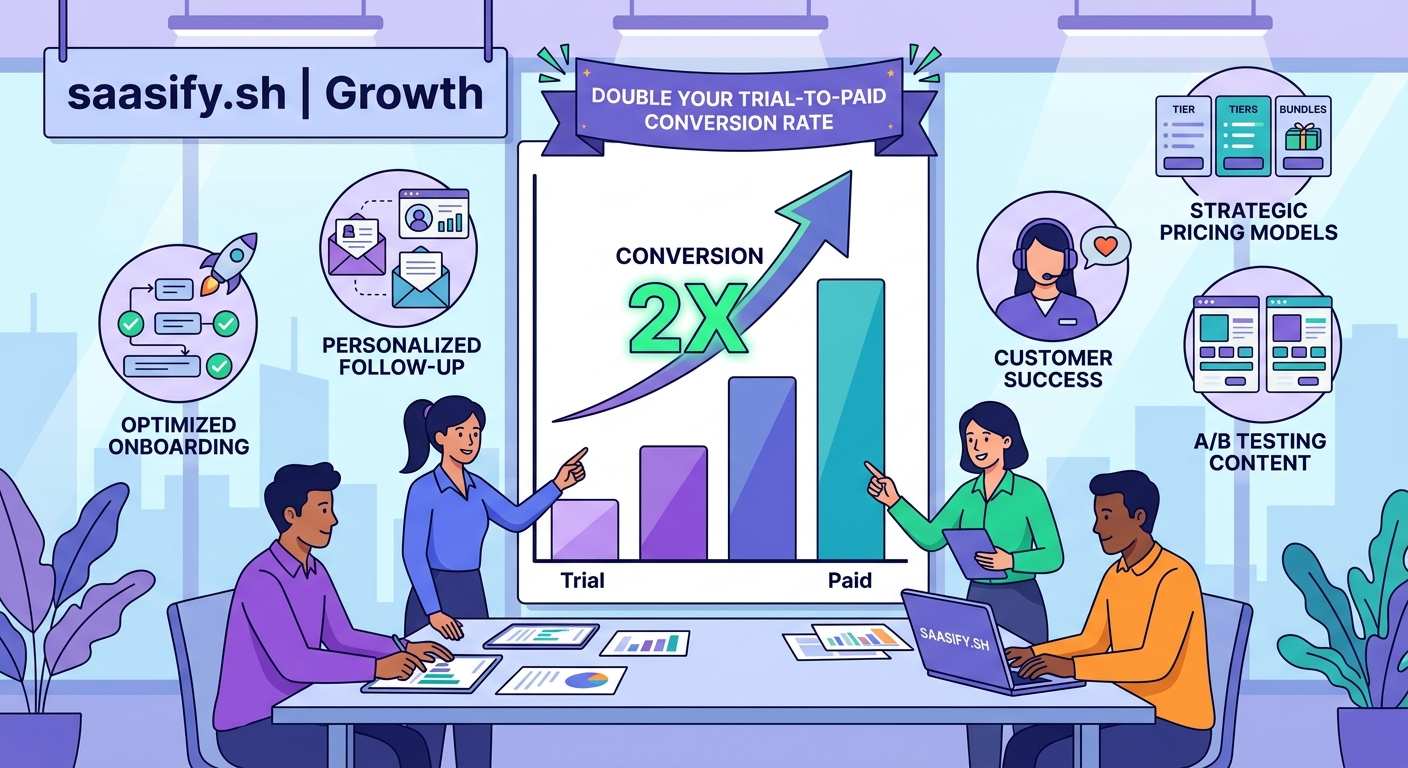
Your onboarding flow probably has too many steps.
Count how many actions a user must complete between signup and their first meaningful result. If it’s more than three, you’re losing people.
Here’s what to cut:
- Profile completion forms that ask for information you don’t need yet
- Feature tours that explain things users haven’t tried to do
- Email verification steps that could happen in the background
- Integrations that aren’t required for core functionality
Replace these with a single, focused path to value. If you’re a project management tool, create a sample project automatically. If you’re an analytics platform, show demo data immediately.
The goal is to get users to say “oh, that’s useful” in under two minutes. Everything else can wait until after they’ve experienced value.
One SaaS founder I know cut their onboarding from seven steps to two. Their activation rate jumped from 34% to 61% in a week. They didn’t add features. They just removed obstacles.
Email sequences that actually convert trialists
Your trial emails probably talk too much about your product.
Users don’t care about your features. They care about their problems. Your email sequence should map to their journey, not your feature list.
Here’s a better structure:
Day 1: Welcome email with one specific action to take right now
Day 3: Case study showing how someone like them solved a specific problem
Day 5: Educational content about the outcome they want (not your product)
Day 7: Reminder of trial timeline with clear next steps
Day 12: Pre-expiration email with upgrade incentive
Day 14: Final day email with urgency and social proof
Notice what’s missing? Feature announcements. Update logs. Generic tips.
Each email should have one goal and one call to action. Make it about them, not you.
The day 12 email is your secret weapon. Users who engage with it convert at 3x the rate of those who don’t. Test different subject lines, offers, and formats until you find what resonates.
Pricing transparency beats clever hiding
If users have to hunt for your pricing, they won’t upgrade.
Put pricing in your main navigation. Link to it from your dashboard. Mention it in your trial emails. Make it impossible to miss.
This feels counterintuitive. Won’t showing prices scare people away?
No. The opposite happens. Transparency builds trust. Users who view your pricing page during their trial convert at higher rates than those who don’t.
Your pricing page should answer three questions in ten seconds:
- What does each plan include?
- How much does it cost?
- What happens when I upgrade?
Skip the comparison tables with 47 features. Show three plans maximum. Use plain language. Make the differences obvious.
If your pricing is complicated, that’s a separate problem. But hiding complexity doesn’t make it go away. It just delays the objection until checkout, where it kills conversions.
Consider making how to price your SaaS product when you have zero customers part of your strategy from day one.
Reducing friction at the upgrade moment
Most trial users who want to upgrade will bounce if the process takes more than 60 seconds.
Time your own upgrade flow right now. From clicking “upgrade” to seeing a success message, how long does it take?
If it’s more than a minute, you’re bleeding revenue.
Common friction points:
- Requiring users to re-enter information you already have
- Forcing them to choose annual when they want monthly
- Making them create a new password for billing
- Asking for company details that don’t affect pricing
- Hiding the “skip” option on optional fields
The best upgrade flows feel like one click. Stripe Checkout, Paddle, and similar tools make this easy. If you’re building custom, study how Notion, Linear, and Figma handle it.
Here’s a simple test: can a user upgrade on mobile in under 45 seconds? If not, you’re losing 30% of potential conversions right there.
Using data to personalize the trial experience
Not all trial users are the same. Stop treating them that way.
Segment users based on behavior, not demographics. Someone who logs in daily needs different messaging than someone who signed up and disappeared.
Create three segments:
Active explorers: Logged in 3+ times, tried multiple features
Focused users: Logged in 2-3 times, used one core feature repeatedly
Ghosts: Signed up but barely engaged
Each segment needs a different approach. Active explorers respond to advanced tips and case studies. Focused users need help expanding their use case. Ghosts need a reset email that acknowledges their absence and offers a fresh start.
You can set this up in any email tool with basic automation. Intercom, Customer.io, and even Mailchimp support behavioral triggers.
The payoff is real. Personalized trial experiences convert 40% better than one-size-fits-all approaches.
What the data says about trial length
Should you offer 7, 14, or 30-day trials?
It depends on your complexity and sales cycle. But here’s what the numbers show across hundreds of SaaS products:
| Trial Length | Avg Conversion Rate | Best For |
|---|---|---|
| 7 days | 18-25% | Simple tools, clear value prop, low learning curve |
| 14 days | 12-18% | Most B2B SaaS, moderate complexity, individual buyers |
| 30 days | 8-15% | Complex products, team purchases, long sales cycles |
Shorter isn’t always better. If your product takes a week to set up, a 7-day trial just frustrates people.
But longer trials don’t automatically improve conversion either. They just delay the decision. Users who will convert usually do so in the first week, regardless of trial length.
The sweet spot for most SaaS products is 14 days. It’s long enough to experience value but short enough to create urgency.
One exception: usage-based trials often outperform time-based ones. Instead of “14 days free,” try “100 credits free.” Users focus on value instead of calendar days.
Common mistakes that tank conversion rates
Let’s talk about what not to do.
Requiring a credit card at signup sounds like a good filter. In practice, it cuts your trial signups by 60% and only improves conversion by 10%. The math doesn’t work unless you’re desperate to reduce support load.
Extending trials for users who ask rarely helps. They’re delaying a decision, not gathering more information. Better to offer a discount or a call with your team.
Hiding your product behind a demo request form kills self-serve conversion. If you’re worried about competitors, build better features. Don’t punish legitimate users.
Sending daily emails during the trial annoys more than it converts. Three to five emails over two weeks is plenty.
Here’s a table of mistakes and fixes:
| Mistake | Why It Hurts | Better Approach |
|---|---|---|
| Generic welcome email | Doesn’t guide users to value | Personalized first action based on use case |
| No upgrade CTA in product | Users forget to convert | Persistent but unobtrusive upgrade prompt |
| Confusing pricing tiers | Decision paralysis | Clear differentiation, recommended plan |
| Trial expires without warning | Users feel ambushed | 3-day and 1-day reminder emails |
| Long signup forms | Abandonment before trial starts | Email and password only, collect details later |
Most teams make two or three of these mistakes. Fix them and your conversion rate improves immediately.
Testing your way to better results
You can’t optimize what you don’t test.
Start with your biggest drop-off point. If 40% of signups never complete onboarding, test a simpler first step. If users view pricing but don’t upgrade, test different plan structures.
Run one test at a time. Changing five things simultaneously means you won’t know what worked.
Good tests to start with:
- Subject lines on your day 7 trial email
- Number of steps in your onboarding flow
- Placement of upgrade CTA in your dashboard
- Wording on your pricing page headline
- Length of your trial period
Track results for at least 100 conversions per variation. Smaller sample sizes give you noise, not signal.
The best growth teams test relentlessly. Not because they love experimentation, but because small wins compound. A 2% improvement every month becomes 27% over a year.
If you’re building in public or validating ideas, how to build a pre-launch waitlist that actually converts can help you start with better qualified leads.
Support tactics that boost conversions
Live chat during trials converts better than you think.
Users who interact with support during their trial convert at 2-3x the rate of those who don’t. Not because support convinces them, but because engaged users are more likely to reach out and more likely to convert.
This doesn’t mean you need 24/7 coverage. A simple chatbot that escalates to email works fine. The key is making help visible and easy to access.
Proactive support works even better. If a user gets stuck on the same page for three minutes, trigger an automatic “need help?” message. If they haven’t logged in for three days, send a personal email asking if they’re blocked.
One founder increased conversions by 23% just by sending a personal video to every trial user on day 2. Five minutes of Loom per signup. It doesn’t scale forever, but it works brilliantly up to 50 trials per week.
“We stopped trying to automate everything and started treating trial users like VIP customers. Our conversion rate doubled in six weeks. The secret was making people feel seen, not selling them harder.” – Sarah Chen, founder of a project management SaaS
Building urgency without being pushy
Urgency drives decisions. But fake urgency destroys trust.
Don’t use countdown timers that reset. Don’t claim limited spots when there aren’t any. Don’t offer a “one-time” discount every week.
Real urgency comes from trial expiration. Use it honestly.
Your day 12 email should acknowledge the approaching deadline and offer a clear reason to upgrade now. A discount works, but so does early access to a new feature, priority support, or extended data history.
Frame it as a benefit, not a threat. “Upgrade before Friday to lock in this pricing” beats “Your trial expires in 2 days.”
The best urgency tactic? Show users what they’ll lose. If they’ve created projects, built reports, or added team members, remind them that this work goes away unless they upgrade. Loss aversion is powerful.
Measuring what matters beyond conversion rate
Trial to paid conversion is important, but it’s not the only metric.
Track these too:
- Activation rate (users who reach first value)
- Time to activation (how long it takes)
- Feature adoption during trial (which features predict conversion)
- Upgrade attempt rate (users who start checkout but don’t complete)
- Day 30 retention (users who stick after converting)
These metrics tell you where to focus. Low activation? Fix onboarding. High activation but low conversion? Check pricing or upgrade flow. High conversion but low retention? You might be attracting the wrong users.
Building a revenue dashboard that actually drives growth decisions helps you spot patterns faster.
The goal isn’t to track everything. It’s to track the right things so you can make better decisions.
Why small improvements compound faster than big bets
You don’t need to double your conversion rate overnight.
A 10% improvement every month gets you to 3x in a year. Small, consistent wins beat waiting for the perfect solution.
Most founders waste months planning the ideal onboarding flow. Meanwhile, they could have tested ten small changes and found three that work.
Start with the easiest fixes. Rewrite one email. Add a pricing link. Simplify your signup form. Ship it today. Measure the impact next week.
The teams that win at growth aren’t smarter. They’re faster. They test more, ship more, and learn more.
If you’re still in the early stages, how to build a SaaS MVP in 30 days without burning out can help you launch faster and start learning from real users.
Your trial conversion playbook starts now
You have everything you need to increase trial to paid conversion rate this month.
Pick three tactics from this guide. The ones that feel most relevant to your biggest drop-off points. Implement them this week. Measure the results in 30 days.
You’ll probably see a 15-30% lift from your first round of changes. That’s not luck. That’s what happens when you remove friction, communicate value clearly, and make it easy for people to give you money.
The best part? These improvements stack. Every friction point you remove makes the next change more effective. Every email you optimize teaches you more about your users.
Your trial conversion rate isn’t fixed. It’s a reflection of how well you guide users from curiosity to commitment. And that’s something you can improve starting today.